Enūma Eliš (The Babylonian Epic of Creation) · Companion Guide
埃努玛·埃利什
巴比伦祭司把城邦霸权写进天地开辟之前的那首泥板长诗
The Opening
Before heaven and earth were split apart, water was everything. Salt and fresh, mixed together, nameless. Then the two bodies of water collided on their own, and the first gods rose up out of that murky broth, one layer at a time. This isn't a metaphor. It's the opening lines of the Enuma Elish.
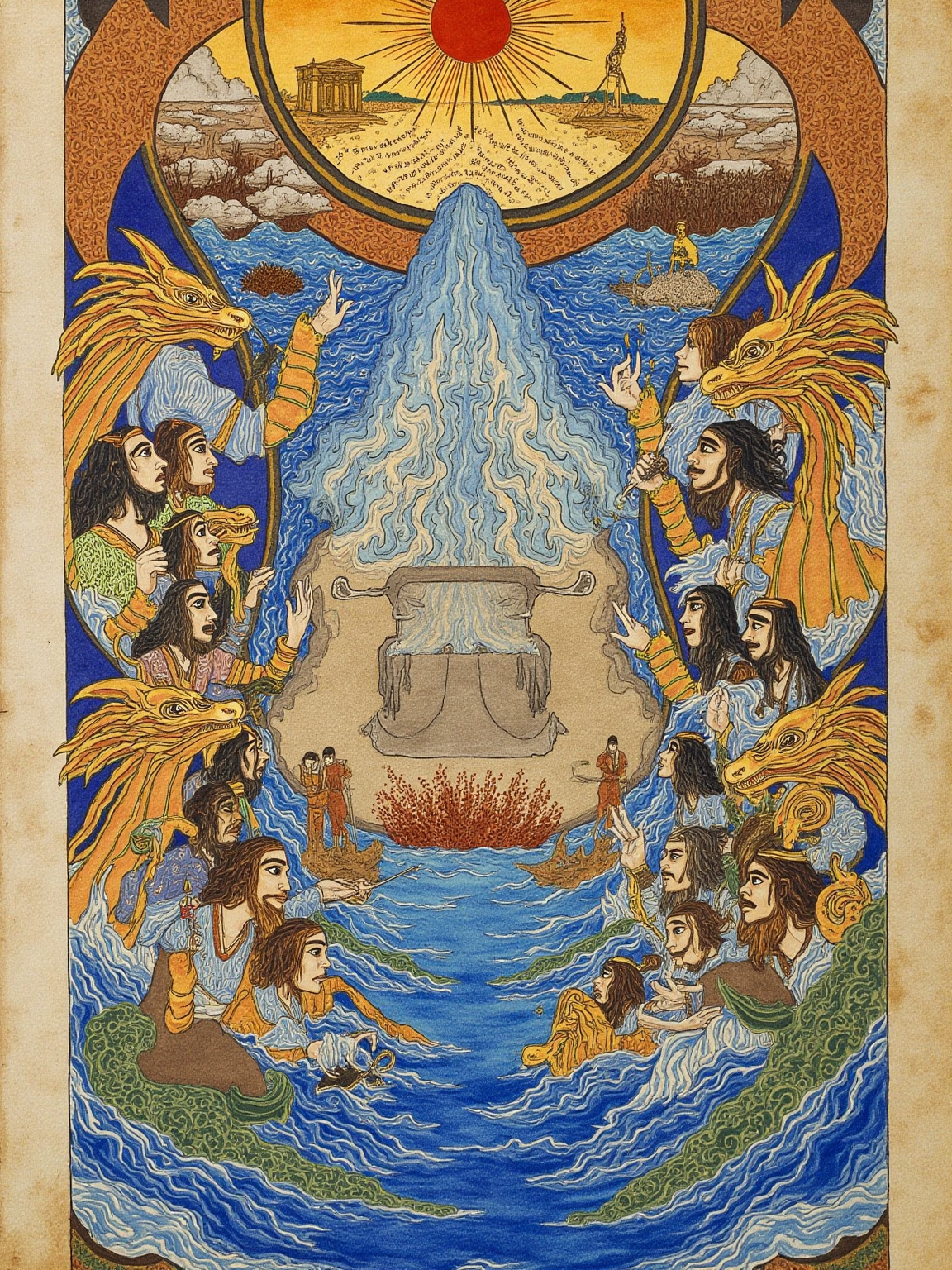
When on high the heaven had not been named, firm ground below had not been called by name.
天上未曾有名,脚下未曾有称,唯咸水与淡水相混,万物尚未成形。
金句 · 第1块泥板 · 序诗开篇
What Kind of Book This Is
It has no author. The earliest copies date to around the 12th century BCE, and the roots may go back to the 18th century BCE or earlier. The most complete text scholars have today comes from the library of Ashurbanipal, seventh century BCE, a set of clay tablets. The whole poem runs to about a thousand lines, carved across seven tablets, a little over a hundred lines to a tablet, in Akkadian cuneiform. Why has it lasted? Because it is one of the earliest written epics to tell the story of how the world began, start to finish. Anyone who reads Genesis eventually runs into it: the two texts overlap too much in structure to ignore, and scholars of ancient Near Eastern myth treat it as a standard reference text. It stands alongside Gilgamesh as one of the two great landmarks Mesopotamia left behind.
The Gods on Stage, and Where They Come From
The hero is Marduk, patron god of the city of Babylon. His father is Ea, chief of the gods of wisdom and water; his mother is Damkina. The day Marduk was born he was given four toys to play with: the four winds. The villain is Tiamat, the primordial salt-water goddess, mother of chaos. Her mate is Apsu, the primordial god of fresh water, called the first father of the gods. Before Marduk was even born, Ea had already put Apsu to sleep forever with a spell and turned his body into the foundation of the gods' palace. Two minor players matter too. Kingu is Tiamat's lieutenant and new husband. Mummu is Apsu's counselor, the one who backed the failed plot to kill the younger gods. The family tree here is simple: the old generation wants to wipe out the young, the young kill their father first, and then they carve up the mother goddess to build heaven and earth out of her body. City politics hides inside this domestic drama. The Babylonians didn't write it to explain the cosmos; they wrote it to put their own patron god at the head of the table.
One: Generational Succession in the Waters of Chaos
In the beginning there was only water. Salty Tiamat and fresh Apsu mixed together, and the first gods, Lahmu and Lahamu, Anshar and Kishar, Anu, rose out of the water one after another. This is the first tablet of the poem, order building up layer by layer from nothing. The younger gods made too much noise, and Apsu couldn't sleep. He talked it over with Mummu and decided to strike first, to get rid of these rowdy sons before they caused more trouble. It's a familiar pattern in old myths: the father can't stand the noise, so the children kill him first.
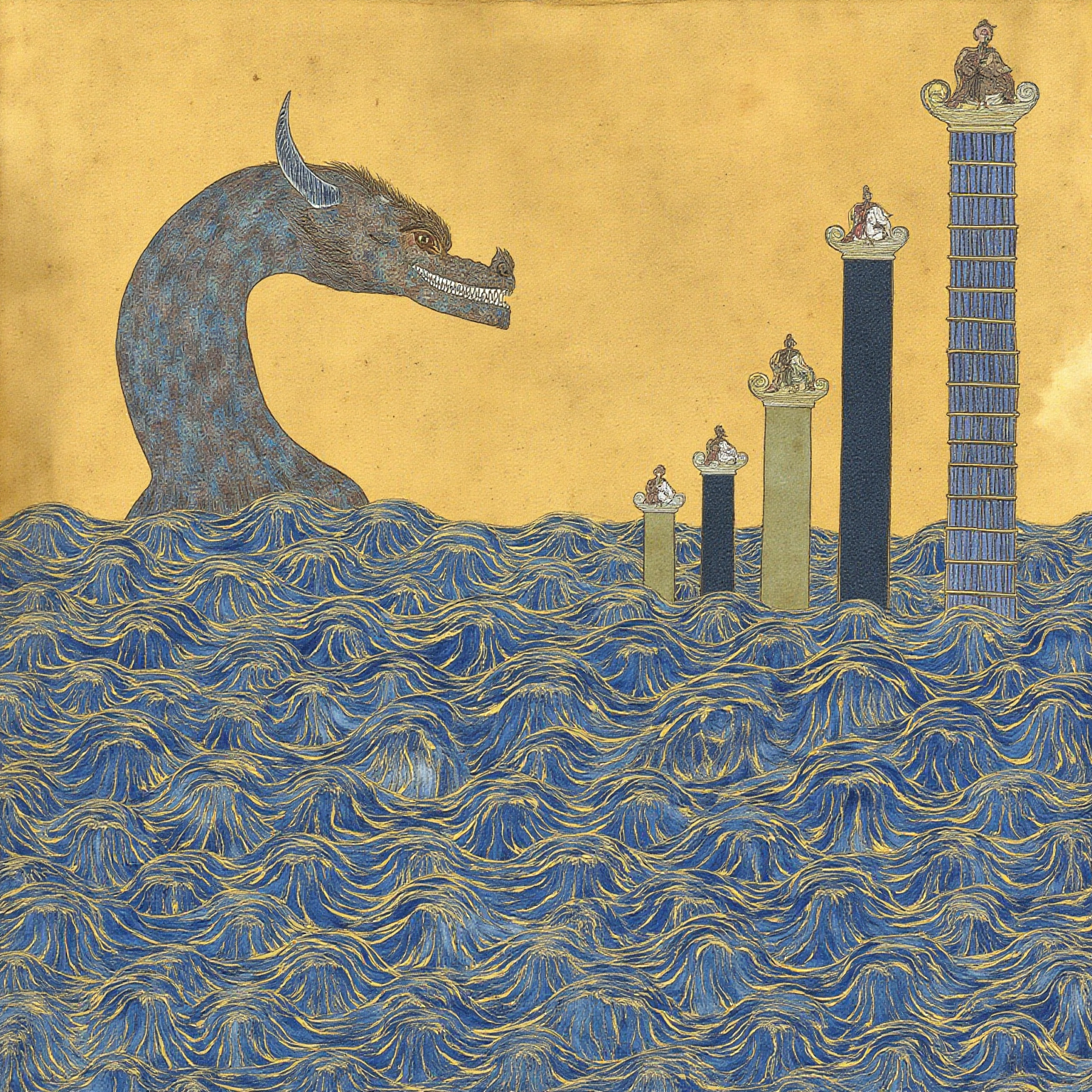
Lahmu and Lahamu were called into being; ages passed, then Anshar and Kishar were created.
拉赫穆、拉哈穆被召而出;时光推移,安沙尔与基沙尔亦自水中诞生。
金句 · 第1块泥板 · 诸神从水升
Two: Patricide Builds a Home for the Gods, and Marduk Is Born
Ea moved first. He chanted a spell to put Apsu to sleep, then killed him while he lay there defenseless. Where would the gods live now? The answer was simple: in their father's body. Apsu's corpse was rebuilt into the gods' palace, an old mythic pattern that keeps turning up, the world made from a dead god's remains. Marduk was born around this time. From the moment of his birth he was given the four winds as toys. This was no ordinary child. His eyes, his mouth, every gesture carried some sign that he was marked for something large.
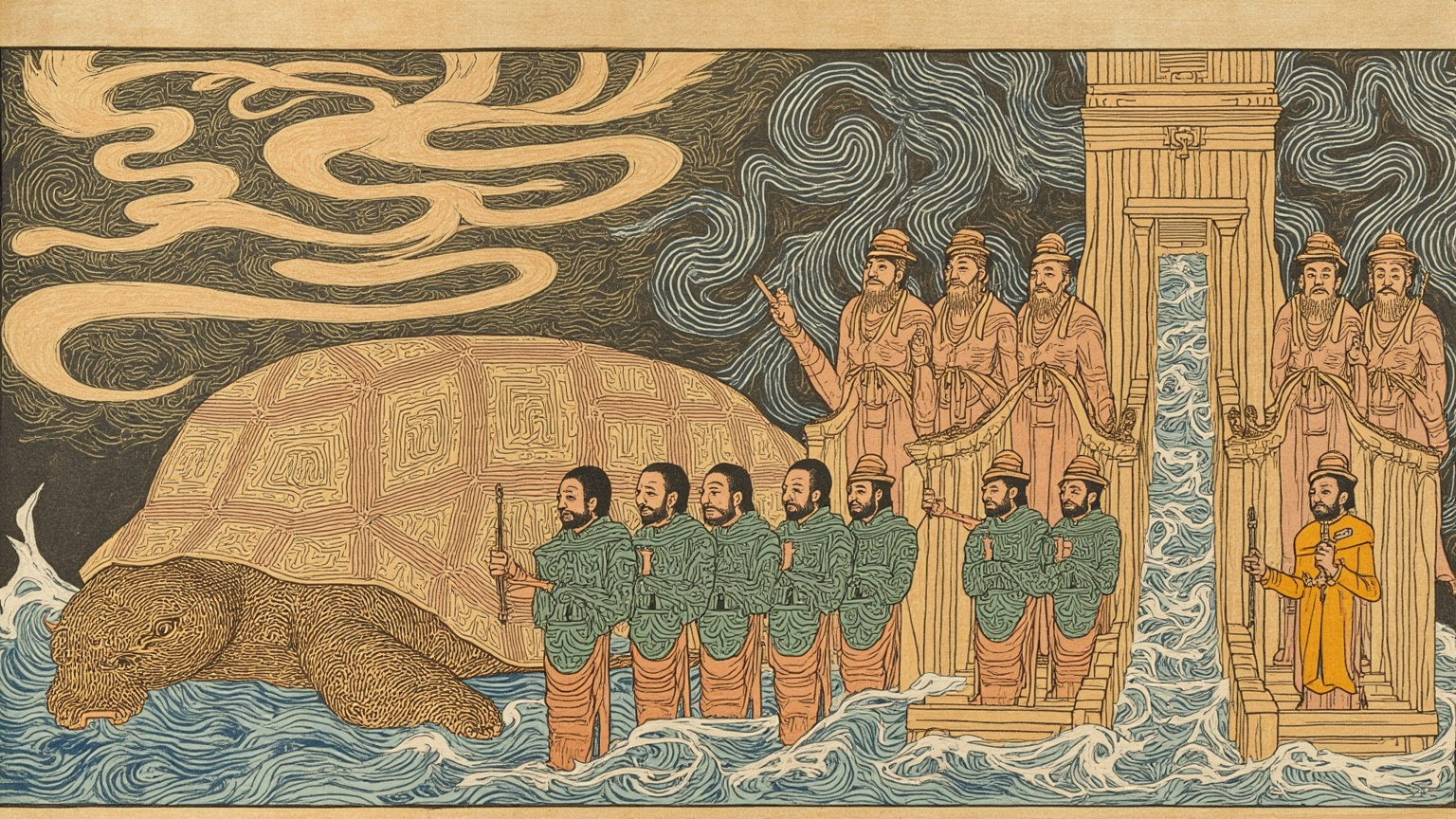
He recited the spell, and with his pure incantation put Apsu to sleep; upon him Ea rested, and his stilled voice he set at rest.
他诵其咒,以洁净之言令阿卜苏沉沉入睡;埃安居于其上,使其喧嚣归于死寂。
金句 · 第1块泥板 · 埃阿以咒杀父
Three: Tiamat's Revenge
With her husband killed by her own son, Tiamat wanted revenge. The primordial salt-water goddess bred eleven monsters: serpents, giant centipedes, lions, scorpion-men, giant fish, all of them venom-mouthed things. She took a new husband too, Kingu, and around his neck she hung the Tablet of Destinies, the mark of supreme rule. The gods panicked. None of the old generation would step up, and none of Marduk's own generation dared take the fight either. In the end they all turned to the child who had been born clutching the four winds as toys.
Four: The Gods Nominate a Champion, and Strike a Bargain
The gods were willing to back Marduk as their champion, but they set a condition: he had to prove himself worthy of the role in front of the whole assembly first. Words, signs and wonders, one test after another, until his supreme authority was established beyond doubt. This is really a political statement the priests of Babylon wrote for their own city: the transfer of power among the gods goes through a legitimate process. A chief god does not crown himself. The assembly elects him.
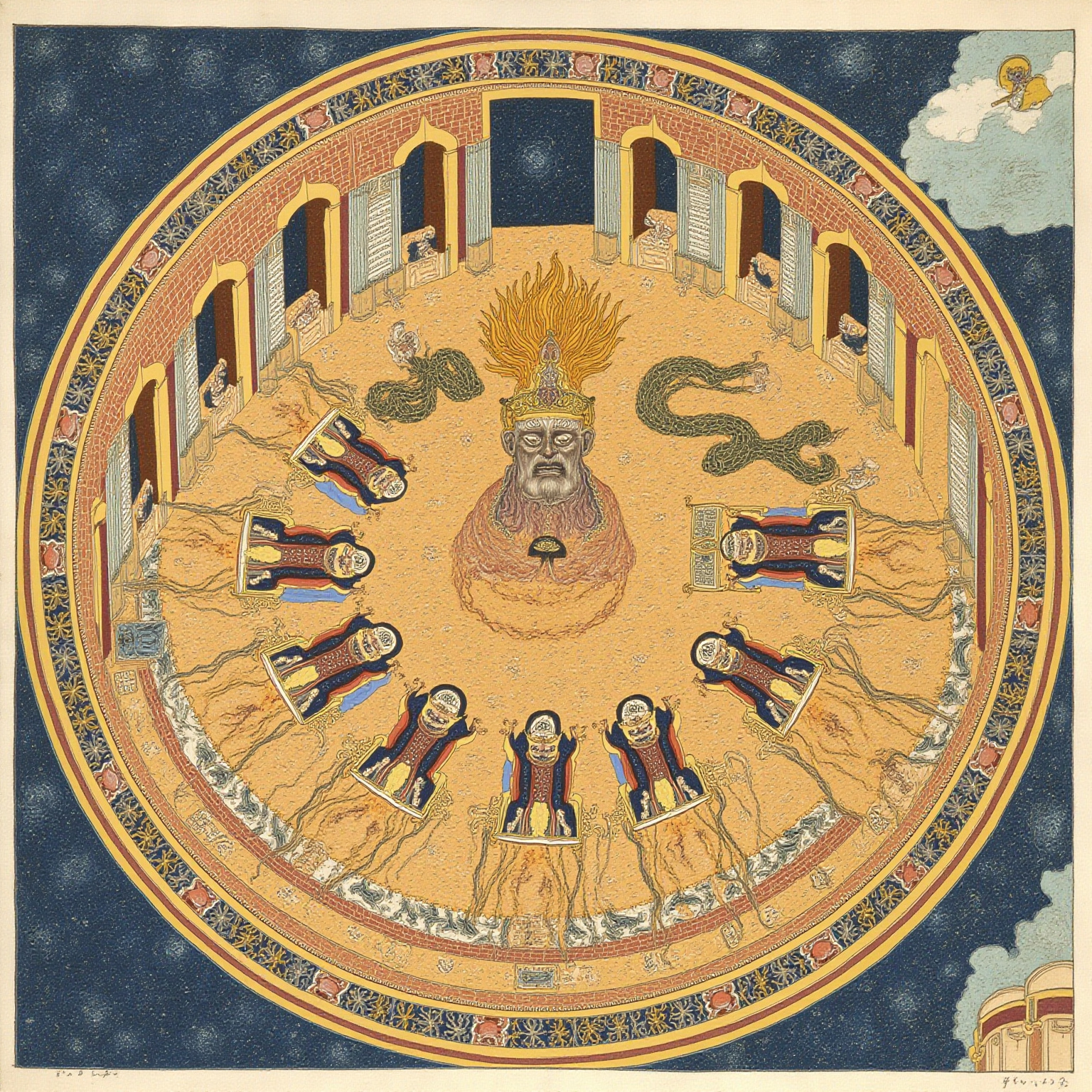
Let him be sovereign over the great gods! They shall proclaim his fifty names; let them walk in his ways.
愿他作众神之王!愿众神齐声宣其五十名号,愿万神皆遵其道而行。
金句 · 第2块泥板 · 众神推举马尔杜克
Five: The Battle of the Four Winds and the Storm-Chariot
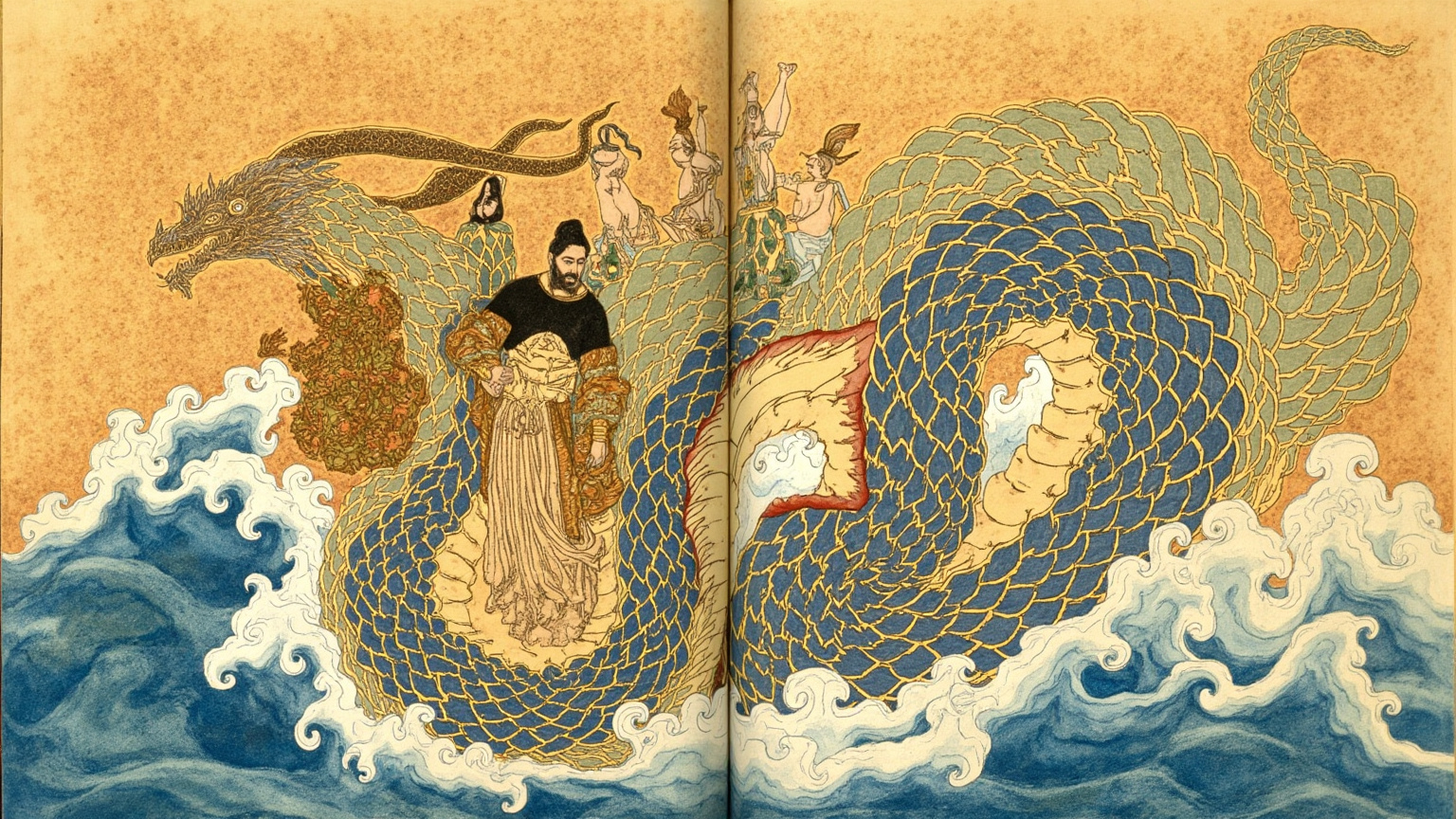
Marduk went to meet her. He spread a net, drew a bow, and mounted a storm-chariot drawn by the four winds: the winds were his weapon, his chariot, and his net all at once. The text doesn't linger on how he beat Tiamat; it states the outcome and moves on. In one line: she lost. Then her body was split in two, one half stretched out to make the sky, the other laid down to make the earth. The stars, the seasons, the dwelling places of the gods were all set in order after that. It's the cleanest single cut in the whole poem.
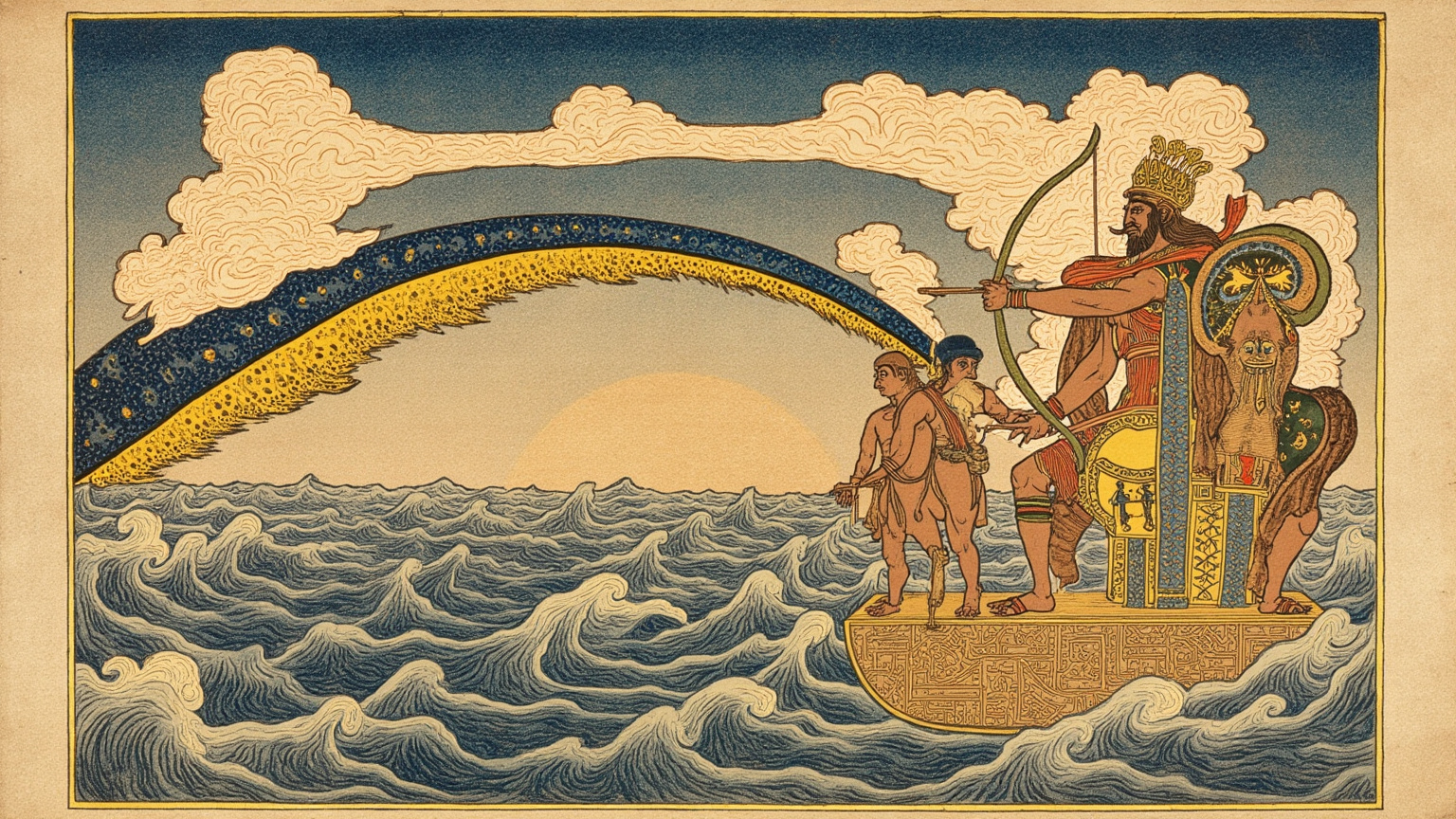
He split her like a shellfish into two halves; one half he set in place and made the sky.
他以贝裂之法将其剖为两半:一半高高举起,化作穹苍;另一半铺陈于下,以为大地。
金句 · 第4块泥板 · 剖分提亚马特
Six: Man Made from Blood
With the war over, Marduk stripped Kingu, the newly minted supreme ruler, down to a convict sentenced to hard labor. The gods, for their part, no longer wanted to farm their own fields, haul their own water, do their own chores. So Marduk mixed Kingu's blood with clay and shaped it into man. Don't think about this one too long, or it turns cold. In this epic, the definition of a human being is labor built to serve the gods. That is the whole point of being human here. It's the sharpest dividing line between this text and the Hebrew Book of Genesis on what a person is: two accounts that grew out of the same tablet-writing world, and gave humanity two completely different origins.
Seven: The Fifty Names and the Ziggurat of Babylon
With the war won and order established, the gods threw Marduk a victory celebration. They built him a temple in Babylon, called Esagila, and beside it raised a ziggurat, a temple-tower stacked level by level straight toward the sky. Then the gods gave him the Fifty Names. Each of the fifty was a title of praise, and each title was another confirmation of power: head of all the gods, lord of heaven and earth, master of destinies. The city politics behind this could not be more obvious. What gave Babylon the right to lead the alliance of Mesopotamian city-states? Its god already led the gods.
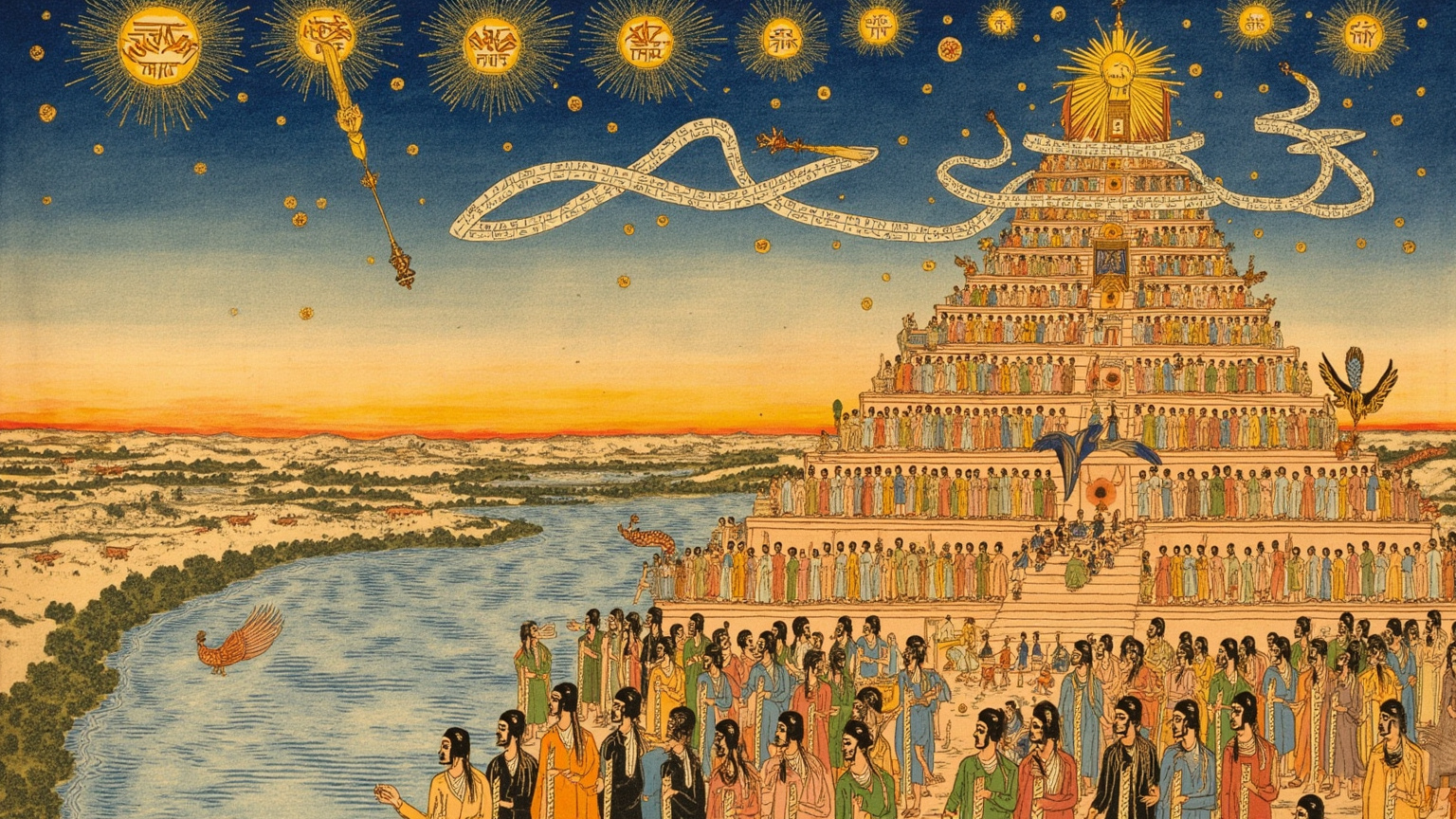
Let me bring to birth the first man, that man may bear the yoke that the gods might have rest.
容我以血造出初人,使人负轭而劳,使众神得以安歇于其圣居。
金句 · 第6块泥板 · 以血造人
What It's Really About
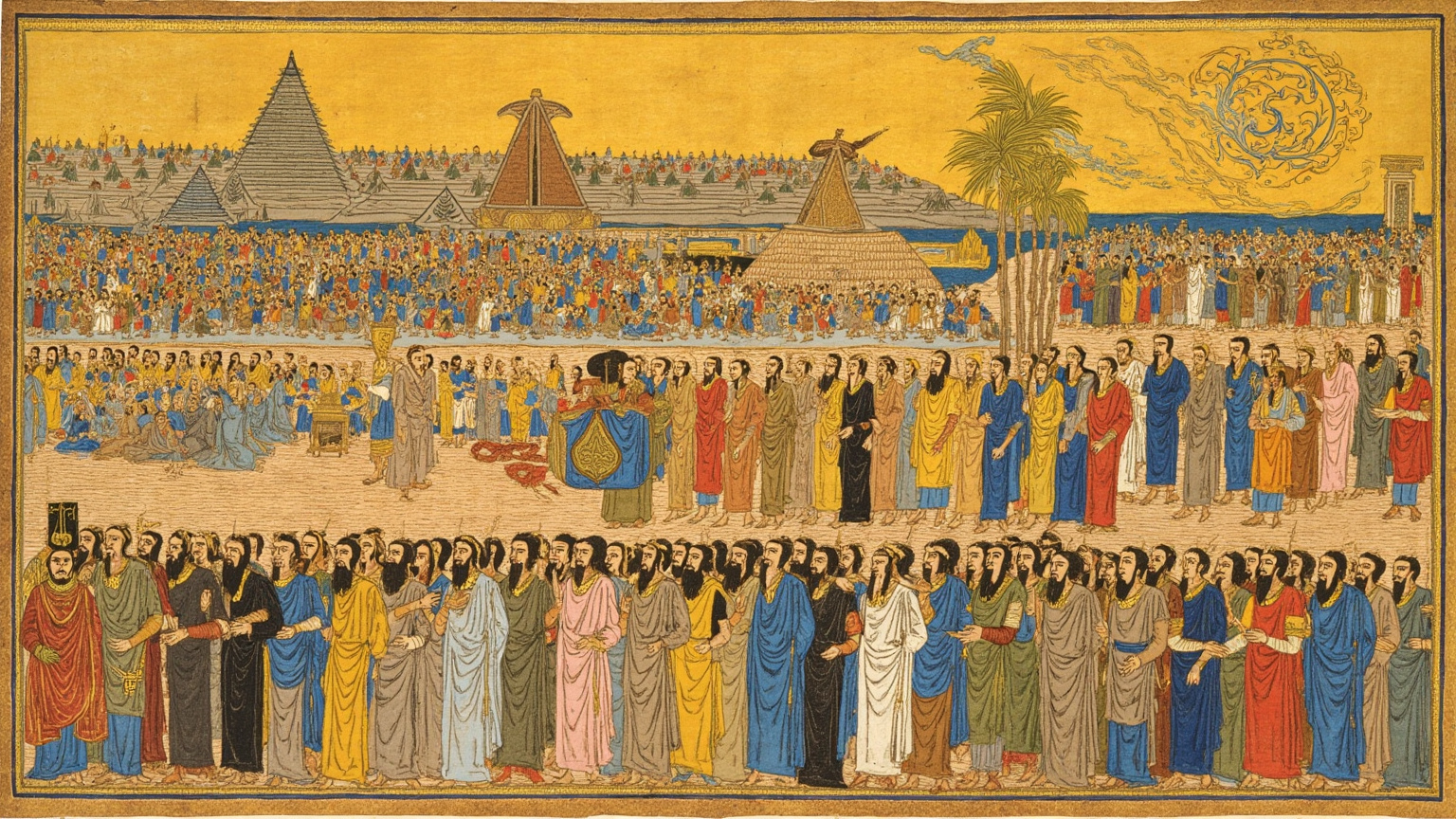
On the surface it tells the story of cosmic origins: how chaos becomes order, how salt water and fresh water split apart into sky and earth. Underneath, it's about city politics: how Babylon lifted its own patron god to the top of the pantheon. The real function of the epic isn't to answer where the world came from. It's to answer why Babylon gets to rule Mesopotamia. Every year before the spring floods, the Babylonians held a New Year festival called Akitu. The king went to the temple of Esagila and, in front of everyone, took Marduk's hand: the grip was the god re-stamping the king's authority, the old order torn down and a new one built out of chaos again. Once a year, the cosmos and the crown were both renewed together. Later the Assyrians took this same text and simply swapped in Ashur, their own patron god, in place of Marduk, and kept reciting it. That in itself proves something: at bottom this epic was a piece of city-state propaganda, and whoever held it could rewrite it.
Why It's Held in Such Regard
First, it's one of the earliest written creation epics, telling the origin of the world start to finish with a complete structure. Second, it functions as a standard reference text: any discussion of how Genesis relates to other ancient Near Eastern creation myths — Ugaritic, Norse, Greek — tends to circle back to the Enuma Elish. Third, and this is the point most often overlooked, it welds myth and city politics together so tightly that it's an unavoidable sample for anyone studying the relationship between ancient religion and kingship. The first time I read the line where Tiamat is split in two, one half becoming sky and the other earth, I sat with it for a long while. People thousands of years ago genuinely thought this through: how did the universe begin? The answer they landed on was that a god cut it open with one stroke.
What makes this epic remarkable isn't the creation myth it tells, but how successfully the priests of Babylon wrote 'our god rules over every god' into the story before the universe even existed.
Worth Reading the Original, Even If You Know the Plot
A gloss gives you the skeleton. The original gives you the texture. What this poem can't be replaced by is the carved, hammered-out rhythm of cuneiform cut into clay, the way its repeated parallels and refrains stack order up layer by layer. The standoff between Marduk and Tiamat before the fight, the gravity of hearing all fifty names read out one by one, the moment in the Akitu ritual when kingship gets stamped by the god: none of that reaches you unless you open the tablet yourself. A gloss tells you what happened. The original shows you how it happened. You only get the second one by reading it.
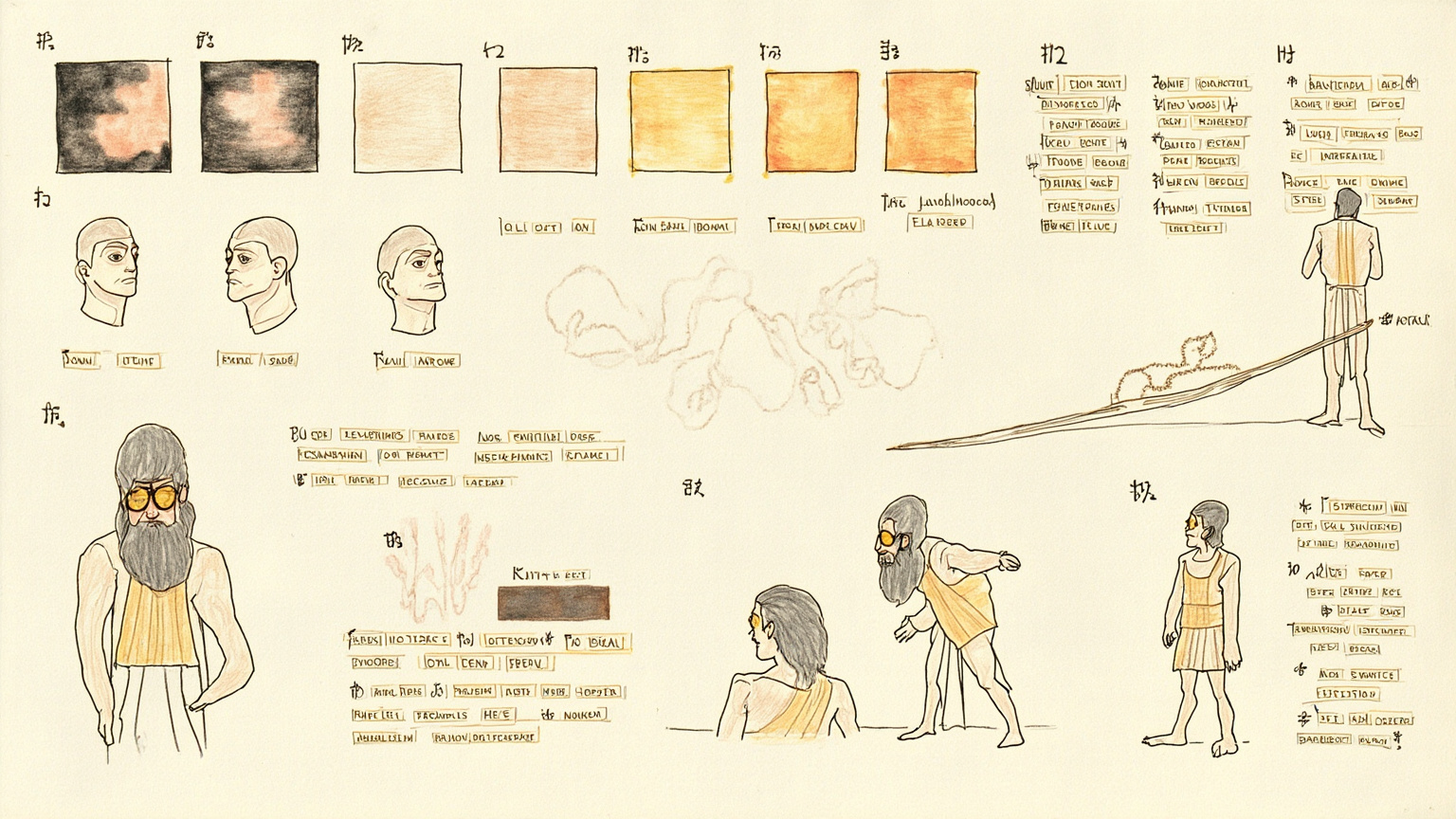
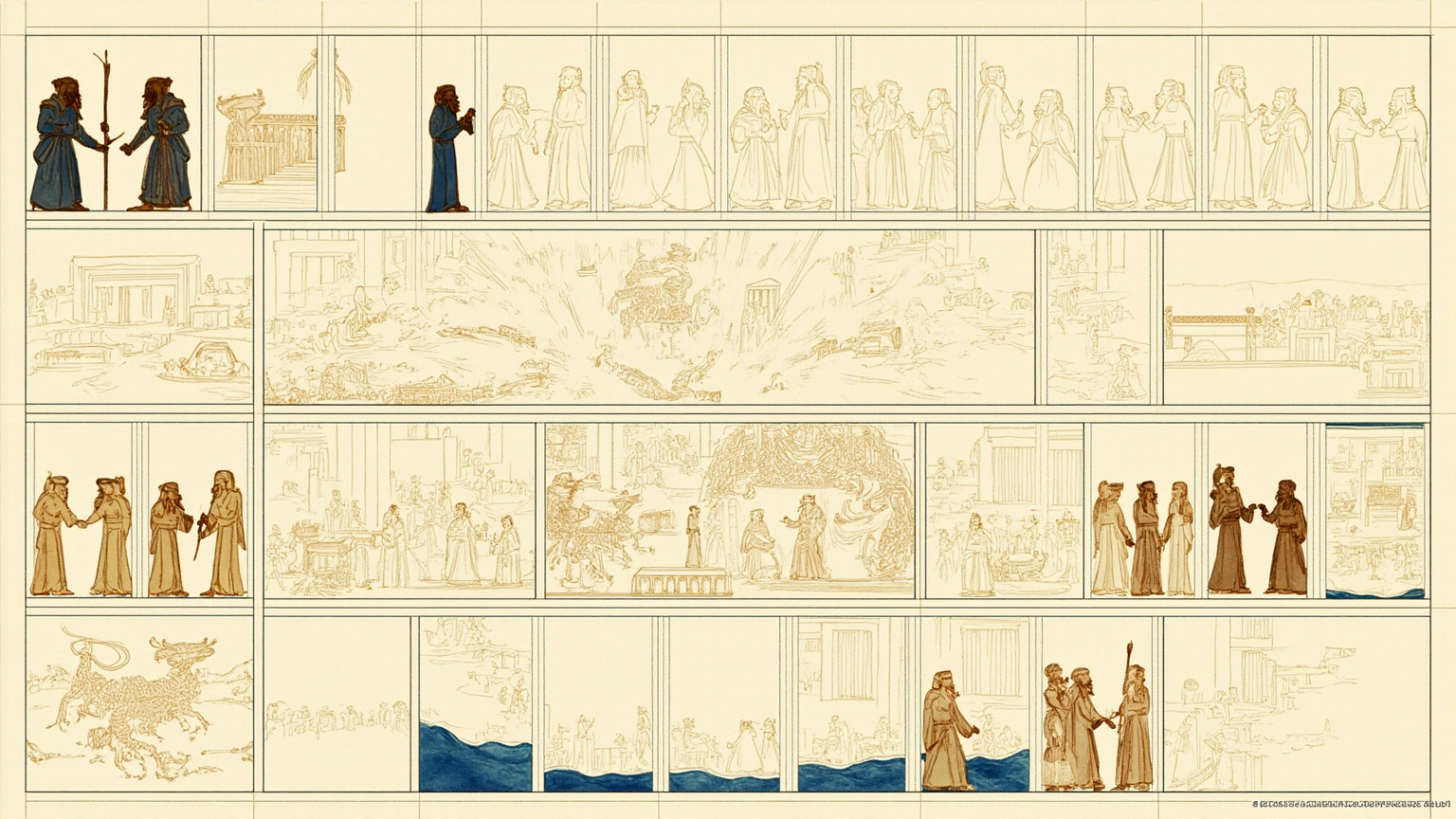
Art Direction4 plates
Before the guide was written, this book got a visual foundation — every illustration you just read grew out of it.