

Ghost Stories of an Antiquary · Companion Guide
古董家的鬼故事
学者从旧书商柜台上接过一份中世纪手稿,烛泪凝在黄铜台座;翻开它的那一夜,北海的风便对着他书房那扇窗吹个不停。
Opening: The Trouble a Manuscript Page Turns Up
A brass candlestick sits on the old bookseller's counter, wax running down its stem and hardening there. The bookseller, all smiles, slides a medieval manuscript into the light, vellum painted with a few small figures, the colors still that rouge-red and indigo laid down centuries ago. He tucks the manuscript into a pasteboard box for the antiquary, then shuts the lid, tapping the corner with one finger, like knocking on a door that ought to stay shut. The antiquary pays and carries the box home under his arm. London fog bleeds the streetlamps' yellow into orange the whole way, and he never notices that the painted figure in the corner of the page seems to have tilted toward him.
What Kind of Book This Is
M. R. James was a medieval manuscript scholar at Cambridge, born in the middle of the nineteenth century and dead by the first half of the twentieth. Ghost stories were his Christmas sideline, something to entertain his colleagues with; his real work was cataloguing old manuscripts, running a college, sitting as a fellow of King's. And yet that sideline made him the founding father of the English ghost story as we know it. The eight tales he told colleagues on Christmas Eve became this book, Ghost Stories of an Antiquary, first published in London in 1904. The BBC has adapted his stories for Christmas Eve broadcast since the 1970s, on and off for half a century now; Stephen King and Neil Gaiman both hold him up as the founder of the genre.
Characters and World
There are no heroes here. The recurring figure is a college antiquary, usually somewhere past thirty, wearing brass-rimmed spectacles, fluent in Latin, comfortable with old manuscripts, writing letters in a stiff, correct hand; he simply sets down what happened. He is dragged into it by a beaming secondhand bookseller, a parish priest who won't finish his sentences, an innkeeper who swallows an old story halfway through telling it, a stationmaster at some small country halt who hands him an old ticket and says nothing more. The real protagonist never shows its face: something that should have been left undisturbed, a carved wooden figure, a bronze censer, an engraved mirror frame, or nothing more than a small figure with a twisted neck at the edge of a manuscript page. James never lets you see it clearly. You get an outline, a sound of breathing, or a face in a windowpane's reflection that isn't your own.
The setting is late-Victorian to early-Edwardian England: the library at King's College, Cambridge, and its manuscript room stacked with vellum rolls; an old church in some unnamed town, a ruined abbey, the cold green light stained glass throws across the floor, a country inn's creaking wooden staircase, a mahogany cabinet in some county council office. Everything is lit by gas and candle; travel is by train and coach; a ferry crossing is made on an old barge with its paint peeling. Nothing here runs on electricity, guns, or telephones — this is the kind of story told by candlelight, around a fire, on a winter night, to a room full of people.
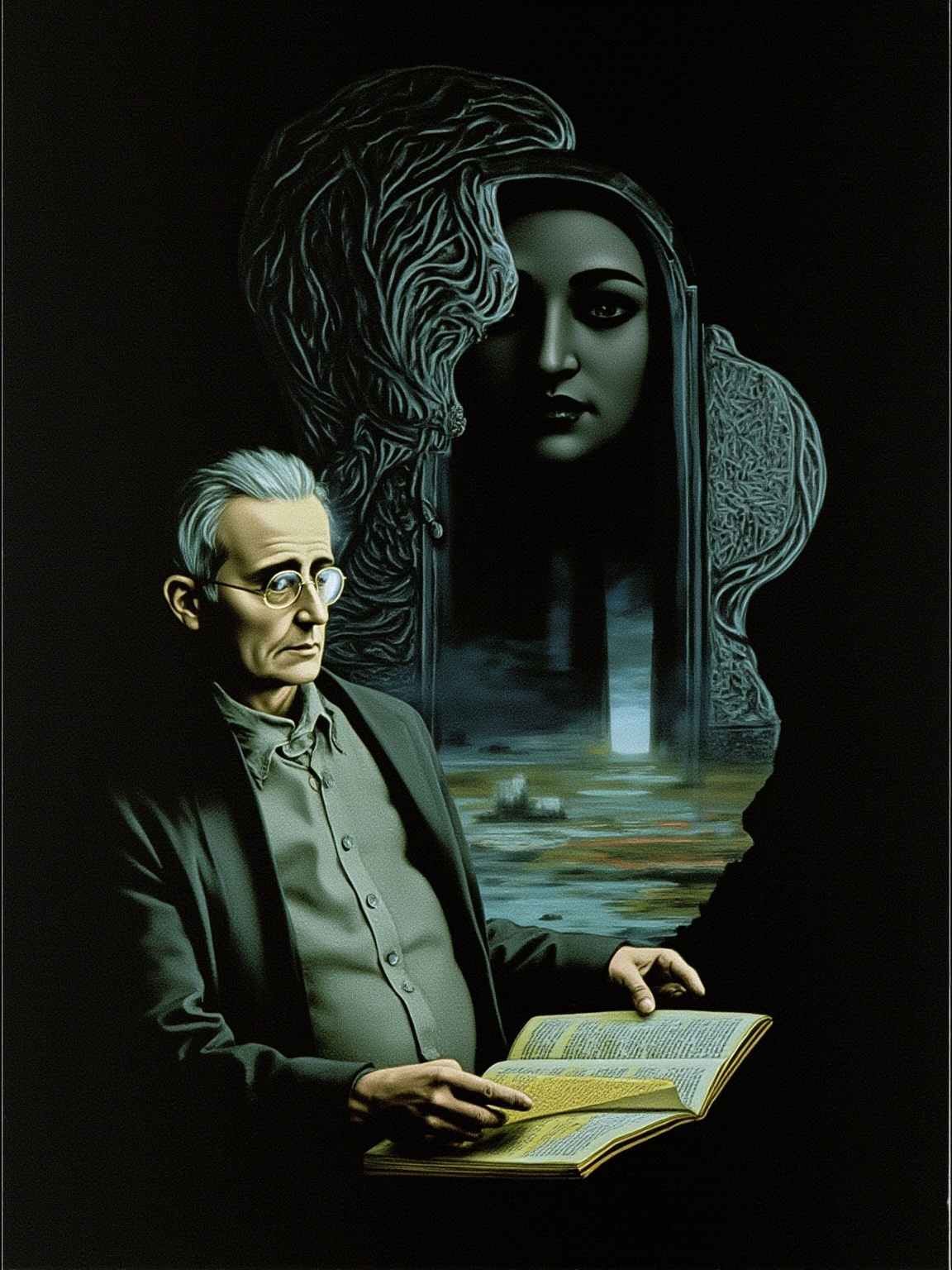
The narrator is careful to say that he himself is not a believer, but he sets down what he saw, and what he heard, and what he did.
我必须把自己所见的、所闻的、所做的都一一记下,虽然我相信世上本无鬼魂这回事——可那一夜,窗玻璃上确实映出过一张我认不出的脸。
金句 · 序言与第一夜 · 学者自陈
The Plot Line: One Skeleton for Eight Stories
James's eight stories share one skeleton, which means it can be laid out once and for all. First, the antiquary comes into possession, on business or by chance, of something he should not have touched: a rubbing taken from a church's brass memorial, a carved mirror frame, a bronze censer, an old wooden box full of shells and fossils. The thing looks harmless on the surface, even beautiful. He brings it home, spreads it out on his desk, and looks at it more closely than he means to. His fingers trace the lettering hammered into the brass; his cuff brushes an old lead seal, which in candlelight looks like a closed eye.
Night starts to come apart at the seams. In the reflection of a hallway window he catches a face that isn't his, the bridge of the nose flatter than his own, the corners of the mouth higher; he turns, and there is nothing there. He hears breathing at the foot of his own bed, drawn in and held, as if waiting for him to speak first; the bed curtains hang perfectly still, but the strip of shadow beneath them has gone an inch deeper than it was when he fell asleep. Passing the choir stalls, he notices that the carved eyes on a grotesque behind him seem to move as he bends to pick up a dropped glove. He is not going mad, and he knows his eyes are not lying to him: the thing has recognized him.
There was a face looking in at me through the lower pane of the window, and I saw it as plainly as I have ever seen a face in my life.
那扇窗的下半格里,正有一张脸朝里望着我——我平生从没见过比这更清楚的脸。
金句 · 夜半窗前 · 玻璃反光中的面孔
He starts asking around. He knocks on the old parish priest's door, and the priest, brow knotted, stammers that the thing used to be on display too, in a niche to the left of the parish altar, and then it wasn't; why, he can't quite say, and he only urges the antiquary to decide for himself whether to touch it. On his way out he leaves a rusted key on the threshold, and something like a draft seems to move through the keyhole. He asks the innkeeper, who grunts, digs a mildewed guest register out from under the counter, and shuts it again halfway through the story. Everything comes out in leaks; no one will tell it straight through, as if everyone here knows, and no one is willing to let the whole breath out.
He wants to back out, wants to destroy the thing; it is too late now. The whole setting starts to slip out of true: the gas flame jumps on its own in a still room, cold blue one moment, sickly yellow the next; candles go out one after another, as if someone were timing it; the North Sea wind spends the whole winter blowing against his seaward window, as if carrying a message for something. A child's drawing turns up on the corner of the dinner table, a figure on it with a twisted neck wearing the antiquary's own old coat, the angle of the neck matching, exactly, the pattern on the thing on his desk. The little carved wooden figure on the windowsill has turned halfway round at some point; the face that used to look away from him now looks at him.

The wind blew from the north all winter, and set against the very window of the room where the thing lay.
那一整个冬天,风都从北面来,正对着屋里搁着那东西的那扇窗。
金句 · 北海的冬天 · 不曾停歇的风向
The climax is never a direct confrontation. James never brings the thing out into the open; the horror lives entirely in that invisible collusion — the face reflected in a windowpane, a door by the fireplace left unlatched, a pair of eyes in a child's drawing that go deeper than anything a child could draw, pencil notes the antiquary once left in the margin of an old notebook, retraced at some point by another hand into letterforms he doesn't recognize as his own. What the reader hears is not a scream. It is the faint hiss of a gas lamp in a windless room, the sharp click of a bolt dropping shut at the far end of a hallway, the outline in the mirror stepping half a pace back into the dark just as the antiquary turns around.
The ending is usually a sealing-back-up. The dollhouse crouching in the attic corner gets burned whole, the fire scorching a half-ring into the window glass. The rubbing of the church's brass memorial gets wrapped tight in sacking and sunk in the churchyard's stone well, and by the next morning the well water carries a sweetish, rank smell. The carved mirror frame gets turned face-down on the desk and covered with a square of black velvet; but the old book pinning down the corner of that velvet seems, somehow, to have one more manuscript page in it than before. On the dunes along the coast, a set of footprints belonging to no one anyone can name still runs from the sea up to his doorstep and stops there, buried and uncovered again by the snow all winter, and never quite smoothed away.

We carried it down to the well in the churchyard, and dropped it in, and the water rose and closed over it, and we wished it may rest where it cannot be found.
我们把它抬到教堂墓地的井边,沉了下去;井水漫上来合拢,只愿它从此长眠,再没人去寻。
金句 · 封回井底 · 黄铜板沉入石井
Theme: Old Objects, Curiosity, and Winter's Restraint
What this book is really about is the danger inherent in old things themselves. Medieval manuscripts, church plate, carved wooden figures: anything old and beautiful might have some will lodged inside it that shouldn't be disturbed. Knowledge, in these stories, doesn't set anyone free. It hands you the key that lets trouble in. Whoever takes the book down off the shelf has delivered himself to whatever is waiting on the other side of it. The ordinary work of scholarship — copying, cross-checking sources, comparing editions, reciting a line of Latin — gets quietly swapped, under James's hand, for something closer to a summoning. This is a warning letter addressed to scholars, but really it's addressed to anyone with too much curiosity. By the time curiosity catches, the old thing has already started watching you.
It still works on readers today because James is so restrained about what he shows. He never gives you a face, never gives you blood, never uses a jump scare: the fear runs entirely on small wrongnesses in the setting — a wind blowing from the wrong direction, a lamp flame the wrong color, one extra figure in a mirror, an outline at the end of a hallway that's half a step closer than it should be. This kind of fear rewards rereading; every pass through it, you hear a different breath in that gray-green blank space he leaves you. What stays with the reader is a small, specific sound: footsteps somewhere down the hall, heard just after the book is closed and just before the light goes out.

Why Read the Stories Themselves
What you've just read is a map. The winter itself is in the stories. All eight are complete in themselves, each with its own small trap, its own ritual of sealing the thing back up: one by brass, one by fire, one by a mirror, a different closing for every tale. But after each sealing, there's still a set of footprints on the coast that shouldn't be there, still a page missing from the old box, still a door by the fireplace standing half open. That last chill is something no retelling can hand you.
Art Direction4 plates
Before the guide was written, this book got a visual foundation — every illustration you just read grew out of it.


