Kādambarī · Companion Guide
迦丹波利
一只金笼鹦鹉在王座前开口,吐出横跨三世的诅咒与重逢,月色下的爱与债层层衔回原点。
Opening
A golden cage is carried before the throne. Inside sits a parrot, green enough to glint, and it tilts its head and speaks to the king: 'Your Majesty, this is a long story.' What happened on the Indian subcontinent more than thirteen hundred years ago begins, of all places, in a bird's throat.
What it has to tell is not a wedding and not a war. It is three lifetimes of love and hatred, curses and rebirths, and the sentence a dying ascetic let slip that forced even the moon god down into human suffering.
What Kind of Book This Is
Kadambari is a long Sanskrit prose romance from the first half of the seventh century. Its author, Bāṇa, died before finishing it, and his son completed the second half at his father's wish. Paired with Bāṇa's other major work, the Harshacharita, it is generally ranked as the high point of classical Sanskrit prose — the word kādambarī later became, in both Kannada and Marathi, the ordinary word for 'novel,' which says something about how deep a mark this book left. It predates any European novel and stands as one of the earliest elaborately framed narratives in world literature.
In other words, the story-within-a-story and past-life-into-present-life tricks we toss around casually today, Kadambari had already pushed to their limit in its own age.
Who Is in the Cage, Who Is Listening
The listener is King Shudraka of Vidisha — powerful, wealthy, master of the whole city. The parrot telling the story was brought to court as an extraordinary gift by a girl from the forest. What actually binds the two of them only becomes clear after three lifetimes: the king is the reincarnation of Chandrapida, a prince of Ujjayini in an earlier life, and the parrot was once a young man named Vaishampayana, Chandrapida's closest friend, turned into a bird by a curse born of a love affair.
What the story is really about is the debt still unsettled between this one man and this one bird.
First Life: The Dying Ascetic's Curse
It all starts with a young ascetic from a Brahmin family named Pundarika. He falls for a girl named Mahashveta — they love each other, long for each other, and are then parted. Sick with longing, Pundarika curses, in his dying agony, the moon god himself, so that even a god must come down and suffer human love. The moon god answers with a curse of his own: the two of them will share joy and grief through every life to come. The words land, and the two are torn apart by death.
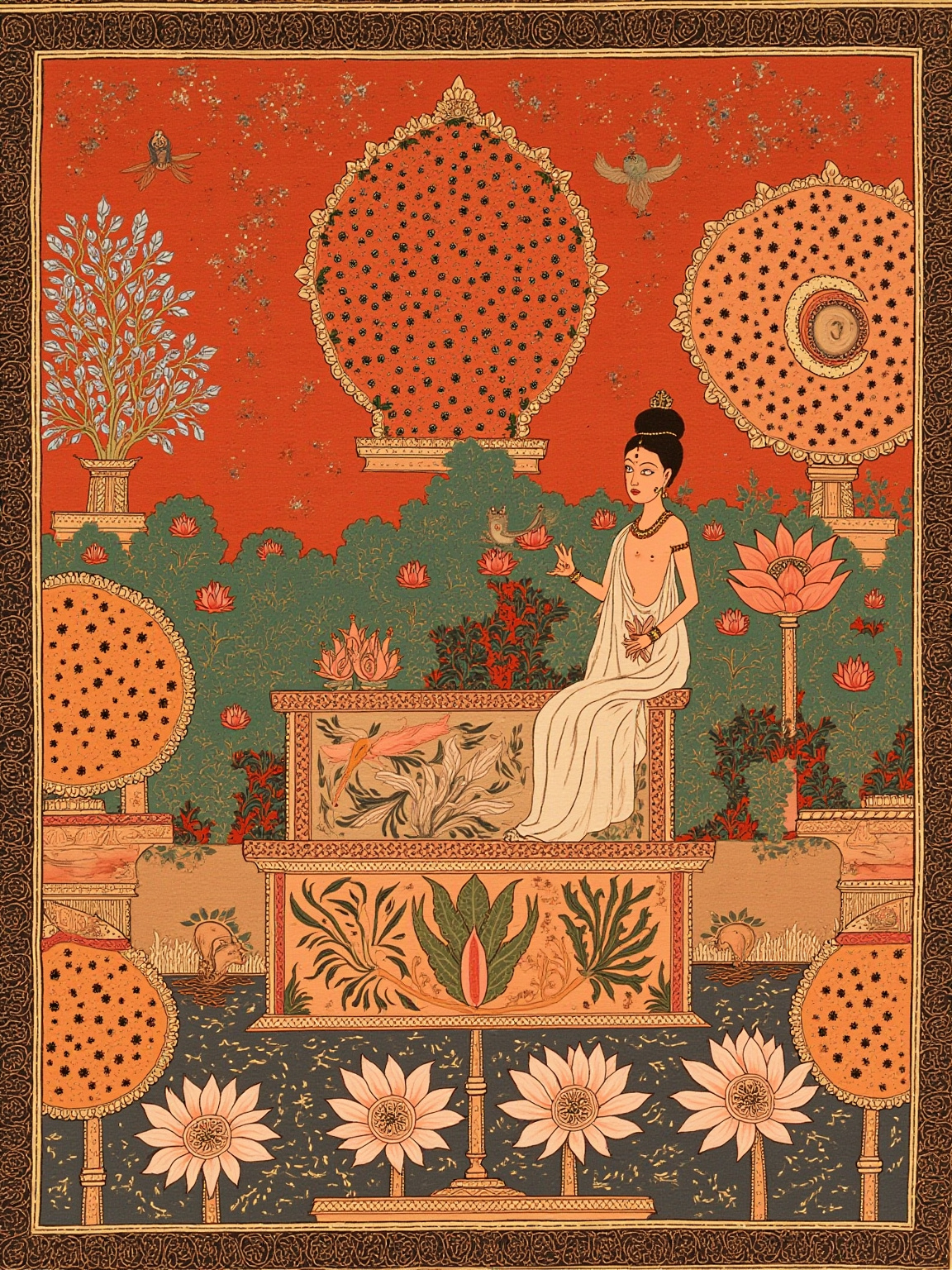
May the Moon himself, for my sake, be born into the world of mortals and learn what love is there.
愿那月神也为我的缘故,降生人间,亲尝此情之苦。
金句 · 第一世 · 白莲临终诅咒
Pundarika is reborn as Vaishampayana, a minister's son; Mahashveta, her lover dead, withdraws into a mountain cave to live as an ascetic and see no one again. The moon god is reborn as Chandrapida, prince of Ujjayini — and the stage for the next two lives is set. Structurally, Bāṇa hands the reader the key to the whole plot right at the start: the curse is a stone thrown into water, the rebirths are the ripples spreading from where it lands, and the entire novel is those ripples still moving.
Second Life, the Opening: A Curse Fulfilled in a Cave
Chandrapida and Vaishampayana grow up together, close as one person split in two. Wandering one day, they come upon Mahashveta living as a hermit in a cave — the lover from a former life, years into her austerities, with nothing worldly left in her face. Some trace of that former bond stirs in Vaishampayana; he pushes into the cave and declares his love, and Mahashveta refuses him outright.
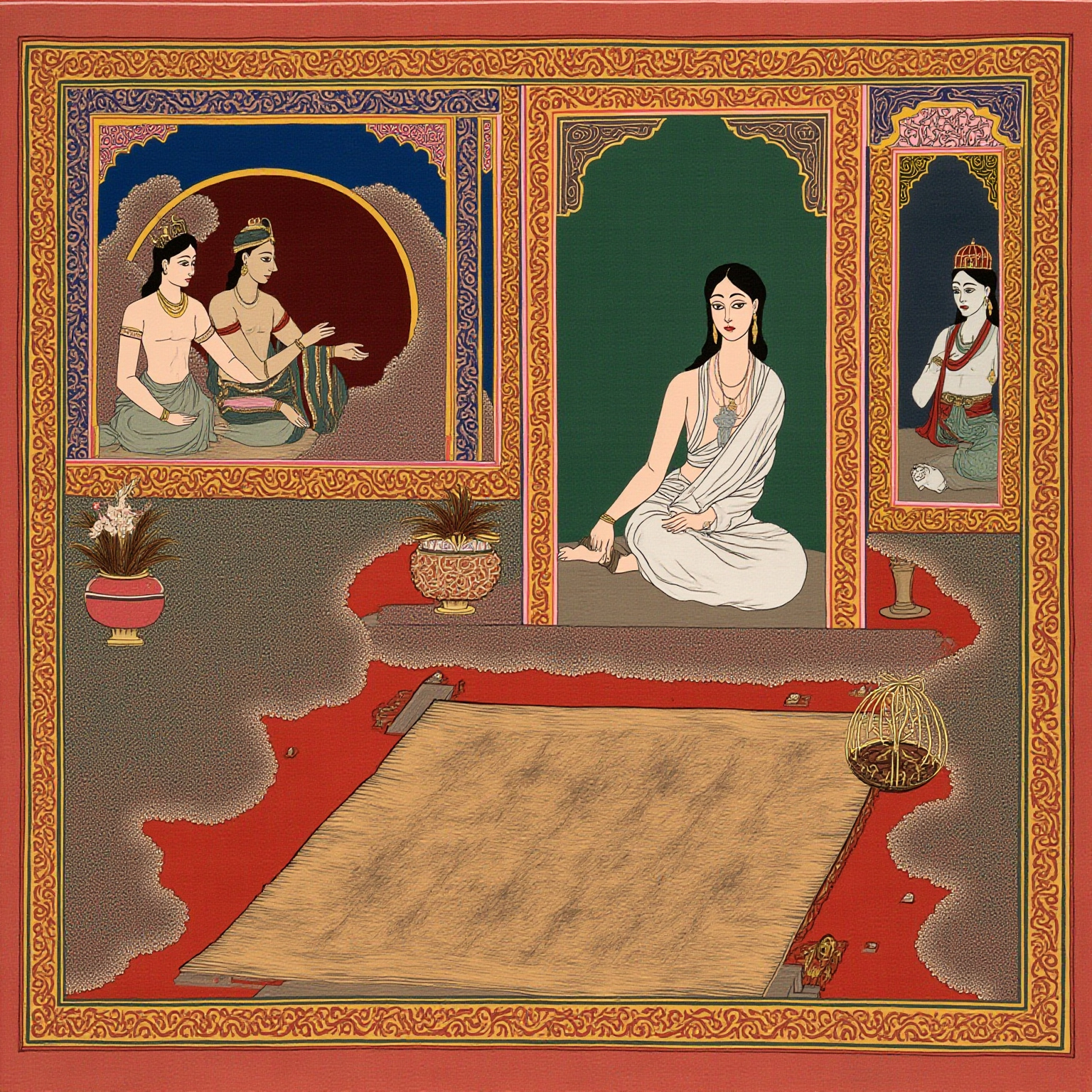
Then, in anger and shame, she uttered the curse: 'Let him become a parrot!' — and he fell, and his soul passed into the golden cage.
她一怒之下脱口而出:「你便化作那鹦鹉罢!」话音甫落,他已倒地,魂魄直入金笼。
金句 · 第二世 · 石窟咒语
The moment she refuses him, Mahashveta's anger breaks and the curse is out before she can stop it: 'Become a parrot!' Vaishampayana drops dead on the spot, and his soul flies straight into the body of the parrot that will, later, sit in that golden cage — which is why, thirteen hundred years on, the bird can open its mouth before the throne of Vidisha and speak.
This is the book's hinge, the moment that makes a reader catch their breath: an angry word moves faster than a sword and lands truer than poison. Bāṇa doesn't let Vaishampayana win his suit, and he doesn't let Mahashveta refuse him calmly either — he has her, in a flash of fury and shame, settle a debt left over from a former life in a single sentence. Only on closing the book and looking back does the reader realize that the frame of the whole novel was already sealed shut by these words.
Second Life, Middle: The Lotus Ponds of Gandharva, and a Missed Chance
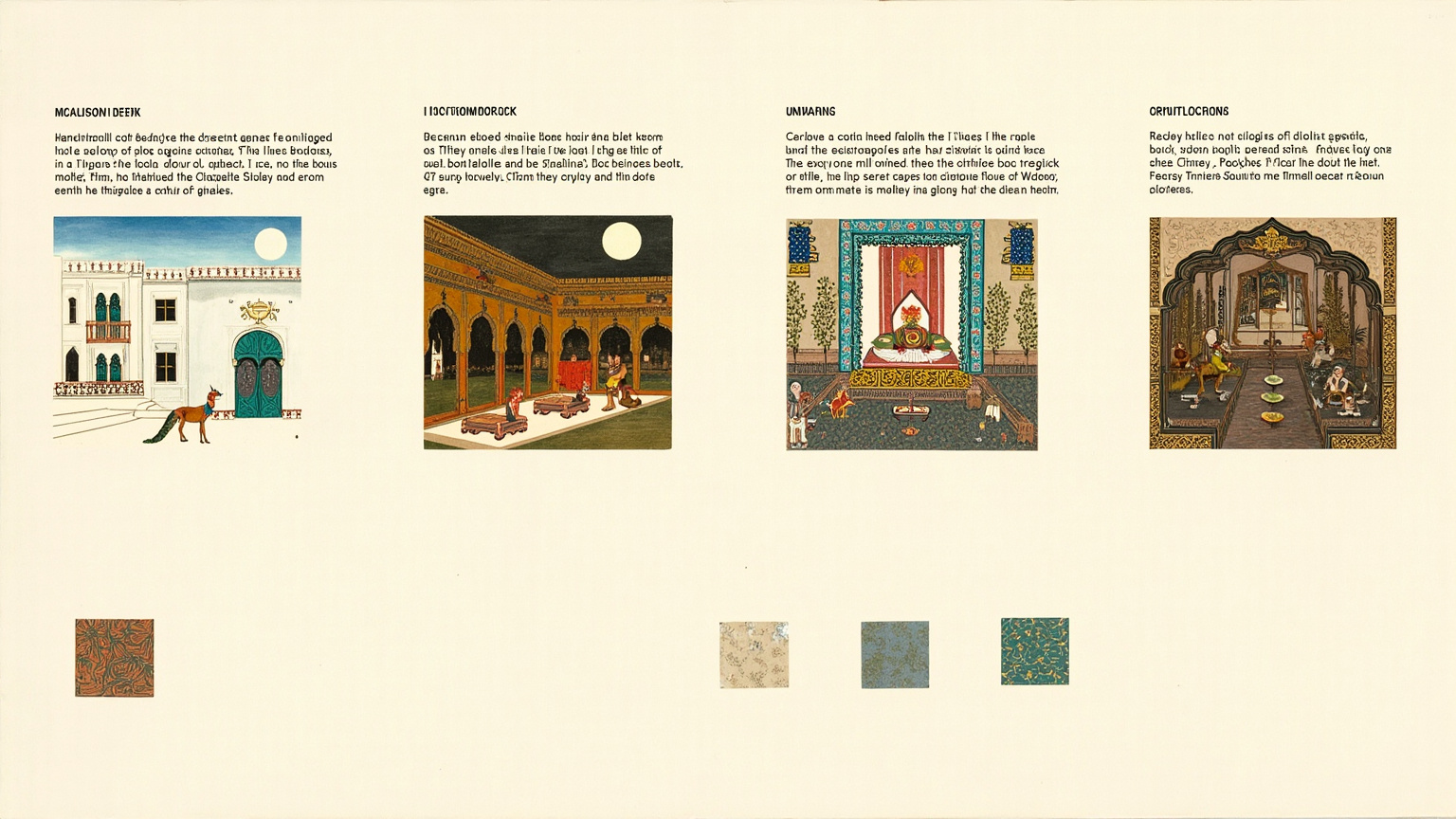
Once Chandrapida and Vaishampayana part ways, Chandrapida wanders into the kingdom of Gandharva — a place almost excessively lush, with lotus ponds, mango groves, bronze mirrors, garlands, and jewel-studded doorways, everything worked to a finish that borders on the seductive. At court he meets Kadambari, daughter of a great Gandharva house and Mahashveta's closest friend from her earlier life. The two fall for each other almost at once.
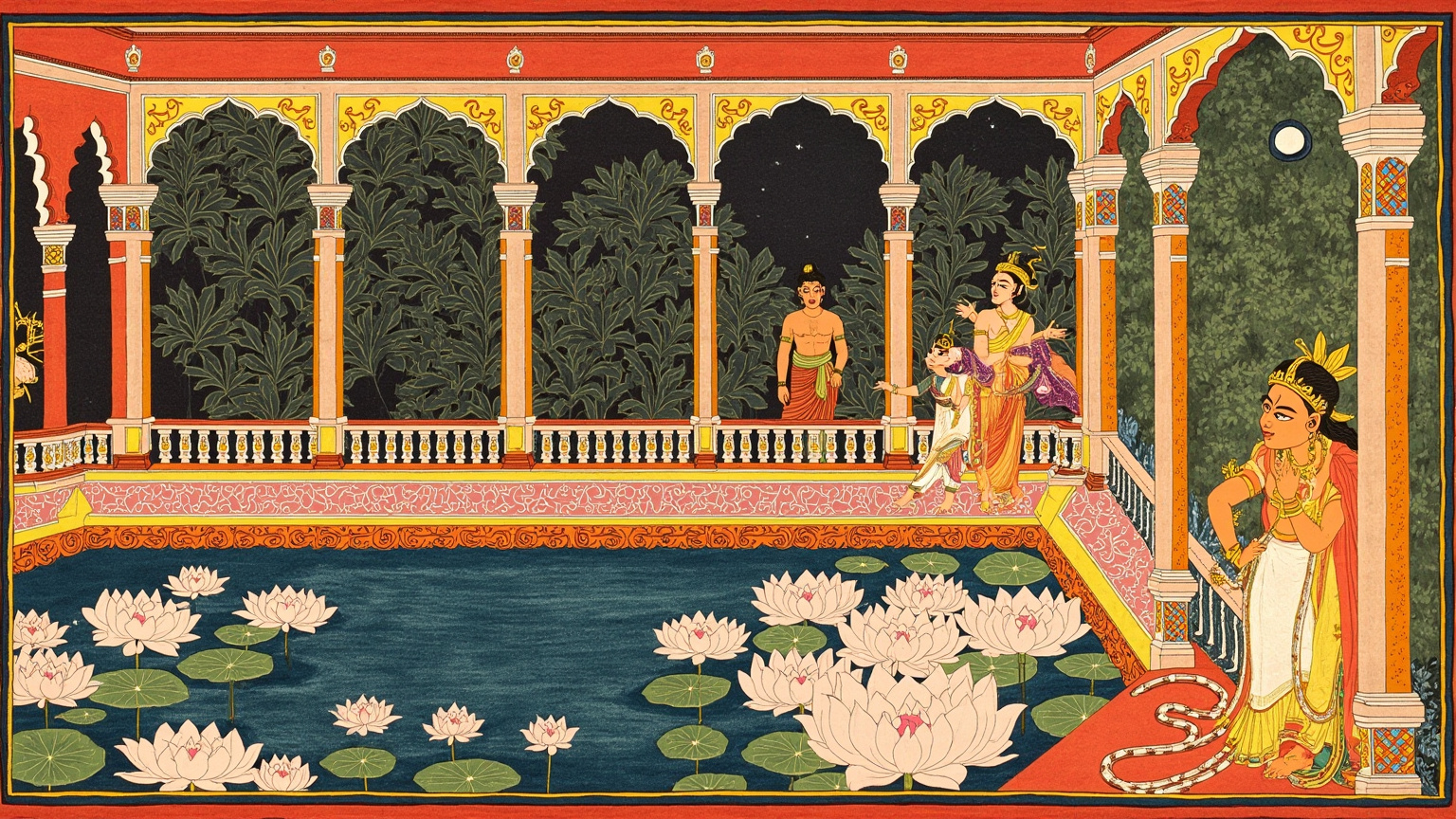
At Kāntipura the lotus pools glittered with garlands and mirrors, and the jeweled lintels burned in the moonlight — but the lovers, as ever, would miss each other by a breath.
甘陀婆莲池之上,花环与铜镜相映,月光把镶宝石的门楣照得一片璀璨——只是那一对有情人,仍是彼此一错身的工夫。
金句 · 第二世 · 甘陀婆莲池
But the seed of a misunderstanding is already planted. Kadambari later comes to believe, wrongly, that Chandrapida has abandoned her, and in her grief vows to die with him. By the time Chandrapida hurries back, word arrives that his closest friend Vaishampayana has died, and the double blow of losing both breaks his heart and kills him. In this second life, neither couple gets to be together.
Bāṇa is famously restrained in how he writes this. The whole book is full of people dying of longing, dying with their lovers, dying by curse, and yet the reader is never made to look straight at physical suffering. The camera, so to speak, stays on moonlight, the scent of flowers, lotus ponds, peacocks, jeweled doorways, letting grief and beauty wrap around each other. That is the emotional register of the whole book: sorrow without violence.
Second Life, the End: The Story Closes Back into Its Frame
Chandrapida is reborn as the king of Vidisha — Shudraka, the very man sitting on the throne listening to the parrot. And the parrot, once Vaishampayana in that second life, is later carried out of the forest and given to the Vidisha court as an extraordinary gift. In that sense, the bird carried into the throne room at the start of the book is the same young man who died cursed in the second life.
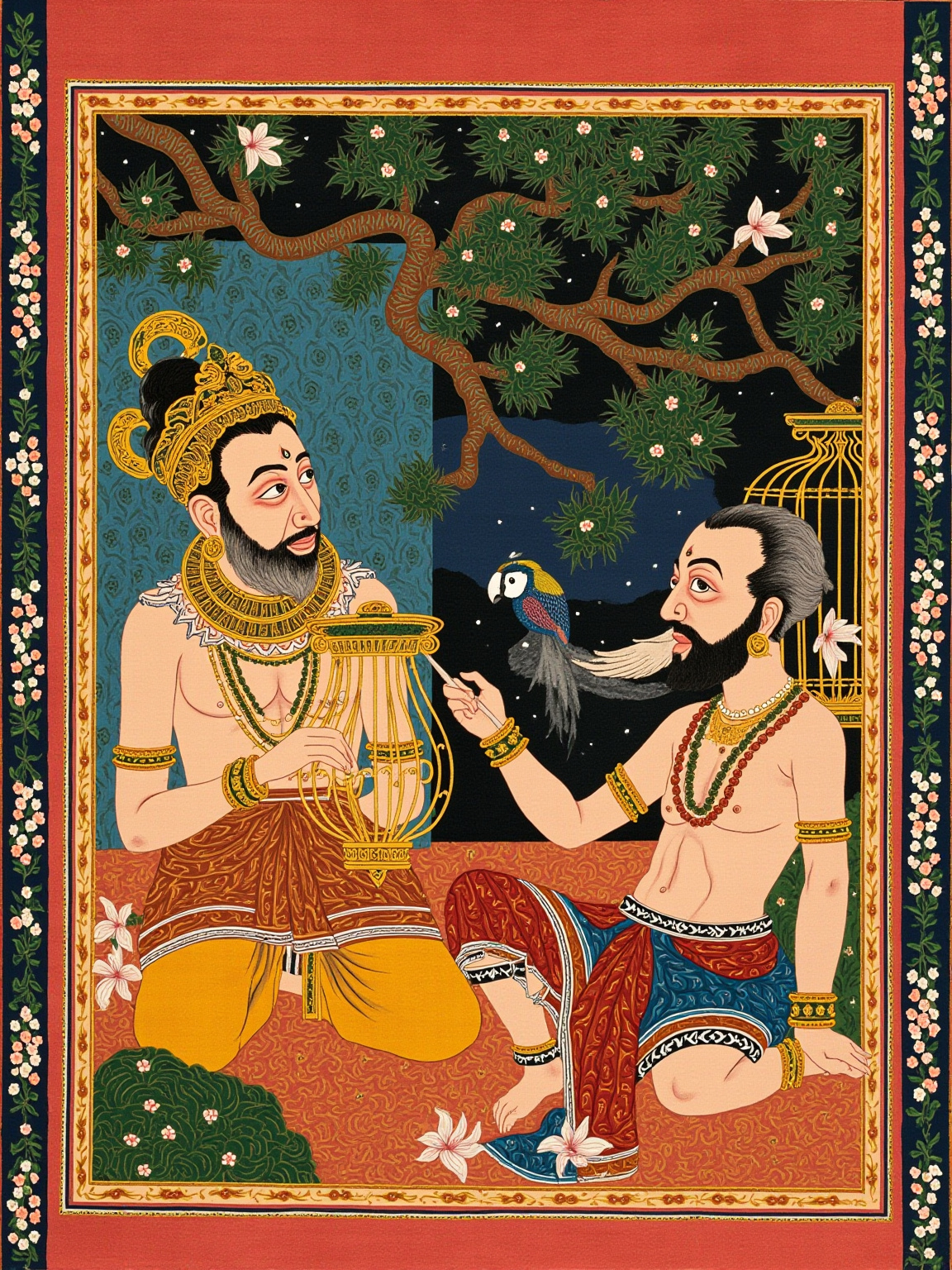
The king upon the throne was the prince of yore; the bird in the cage was the friend he had mourned.
王座上的国王,原是那当年的太子;金笼里的鹦鹉,正是他曾哀悼的挚友。
金句 · 第三世 · 故事衔回框架
Here the story-within-a-story and the past-life-into-present-life structure finally clicks shut. On the outside, a king listens to a parrot. Inside that, the parrot tells of his former life as Vaishampayana. Inside that again are the scenes Vaishampayana himself once lived through in memory, letters, and longing — layer on layer, but never scattered side by side, always strung on the same single thread. This is what literary history keeps praising Kadambari for: it weaves three lifetimes into one unified plot, rather than lining up ten separate stories the way its contemporary, the Dashakumaracharita, lines up ten princes' tales.
Release and Reunion
The final stroke belongs to Mahashveta's father, a venerable sage from a line of Brahmin seers. He performs a great rite, and through its ritual power the curse that has bound three lifetimes together is lifted: the parrot is restored to Pundarika, and Shudraka is restored to Chandrapida. Both love stories, unresolved across three lives, come to an end, and both couples are finally united.
The first time I read this passage I had to stop for a second. A romance that carries sorrow without violence through the whole book ends, of all things, this neatly, almost like a formal rite. Call it a reunion and you're right; call it a settling of accounts and you're also right. Three lifetimes' worth of tears and curses all get paid off, in the end, in front of a fire altar.
This is also the seam where Bāṇa hands off to his son — the first half is Bāṇa's own writing, the second half completed by his son. Whether the Gandharva, Ujjayini, and Vidisha of father and son read subtly differently in tone is one more open question literary historians still enjoy arguing over.
Why It Sits at the Top of Sanskrit Prose
Three things hold up its position. First, the sheer complexity of the nesting — a parrot narrating its own former life, and inside that former life, other people telling their own stories, nested deeper still, a structure already pushed to its limit on the seventh-century subcontinent. Second, the way it weaves three lifetimes into one unbroken chain of cause and effect instead of a set of stories set side by side — this is generally taken as the turning point where the Sanskrit novel moves toward a unified plot. Third, its kāvya style: long compound words, strings of similes, puns and wordplay, mythological allusion, cascades of adjectives, burying the whole book under layer after layer of ornament.
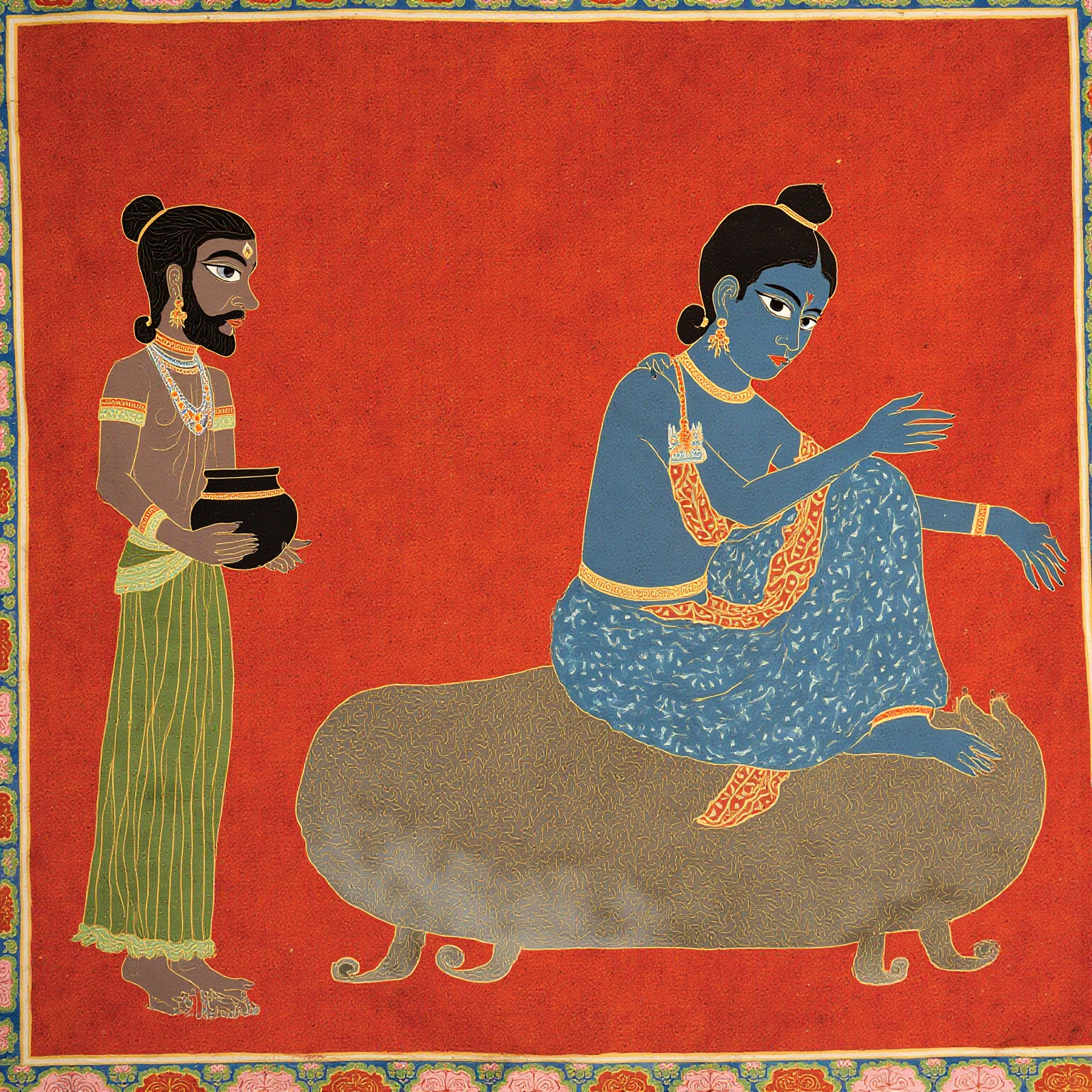
By the great sacrifice of the Brahmin father, the curse of three lives was loosed, and the parrot became the lotus-born youth once more.
梵仙世尊于火祭坛前虔行大祭,三世缠结的咒锁应声而解,鹦鹉重为那白莲之子。
金句 · 末章 · 解脱团圆
The cost is just as direct. Those long compounds and dense strings of simile make it genuinely hard going today. This is the biggest gap between the book and a contemporary reader: the pace is slow, the entry price is high, and the adjectives run long enough that you need to stop and breathe.
What It Means for a Reader Today
If you have watched the nested dreams of Inception, or played Assassin's Creed and jumped between an ancestor and their present-day descendant, none of that structure came from nowhere — its literary ancestor traces straight back to this parrot in its cage. Kadambari did something a thousand years before the European novel existed: it had a bird open its mouth before a throne and tell of its lover from a former life, let that former life and the present interlock, and made curse and rebirth the skeleton of the plot.
Put more plainly, it demonstrates a technique later writers have borrowed again and again: open one story inside another, and make one character the former life of another. Once you see that, it becomes much easier to find the roots of it in modern Indian fiction, and in the Southeast and East Asian works shaped by Sanskrit literature.
Thirteen hundred years ago, a caged parrot opened its mouth before a throne — and with that one sentence, one of the most elaborate sources of the novelist's craft came open.
Why the Plot Summary Still Isn't a Reason to Skip the Text
A guide like this gives you the map. The text is the land, and that land has its own warmth. Beyond the bare plot, there are at least three things you can only get by going into Kadambari itself. First, the kāvya style itself — similes stacked on similes, puns thick enough to feel like an overgrown forest, half of it lost the moment it is translated, so the actual texture of the prose has to be read firsthand. Second, the whole excessively lush world of moonlight, lotus ponds, mango groves, the instruments of Gandharva, jeweled doorways — none of it is background, it is where the feeling lives. Third, the restraint, the sorrow without violence: with so much dying and dying-together in the plot, Bāṇa never lets the camera get close to the body, and it is left to the reader to fill in the grief in that empty space.
And there is one thing no summary can ever hand you: the book only really begins after the parrot's first line, 'Your Majesty, this is a long story' — and you have to sit in that throne yourself to hear it.
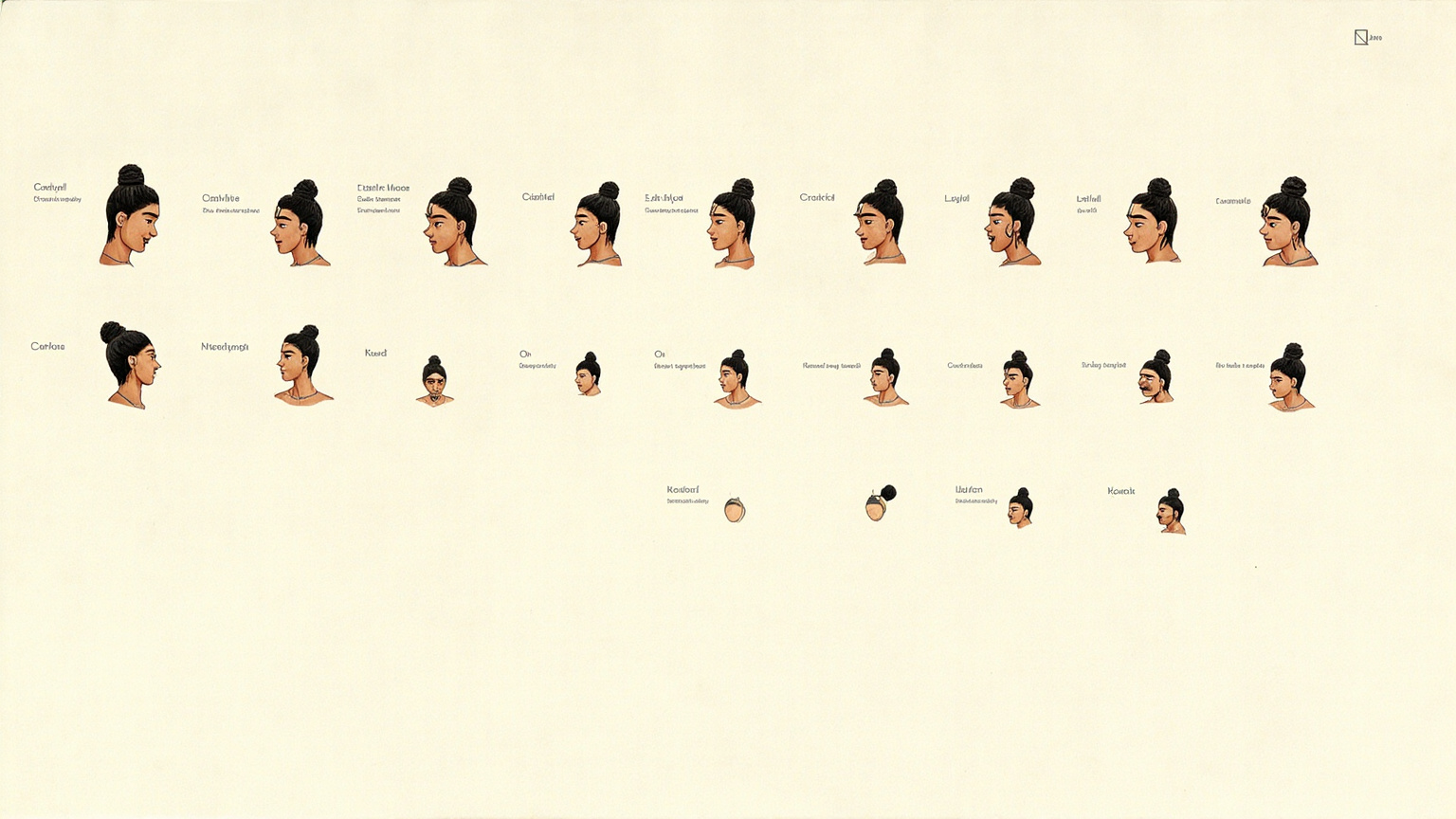
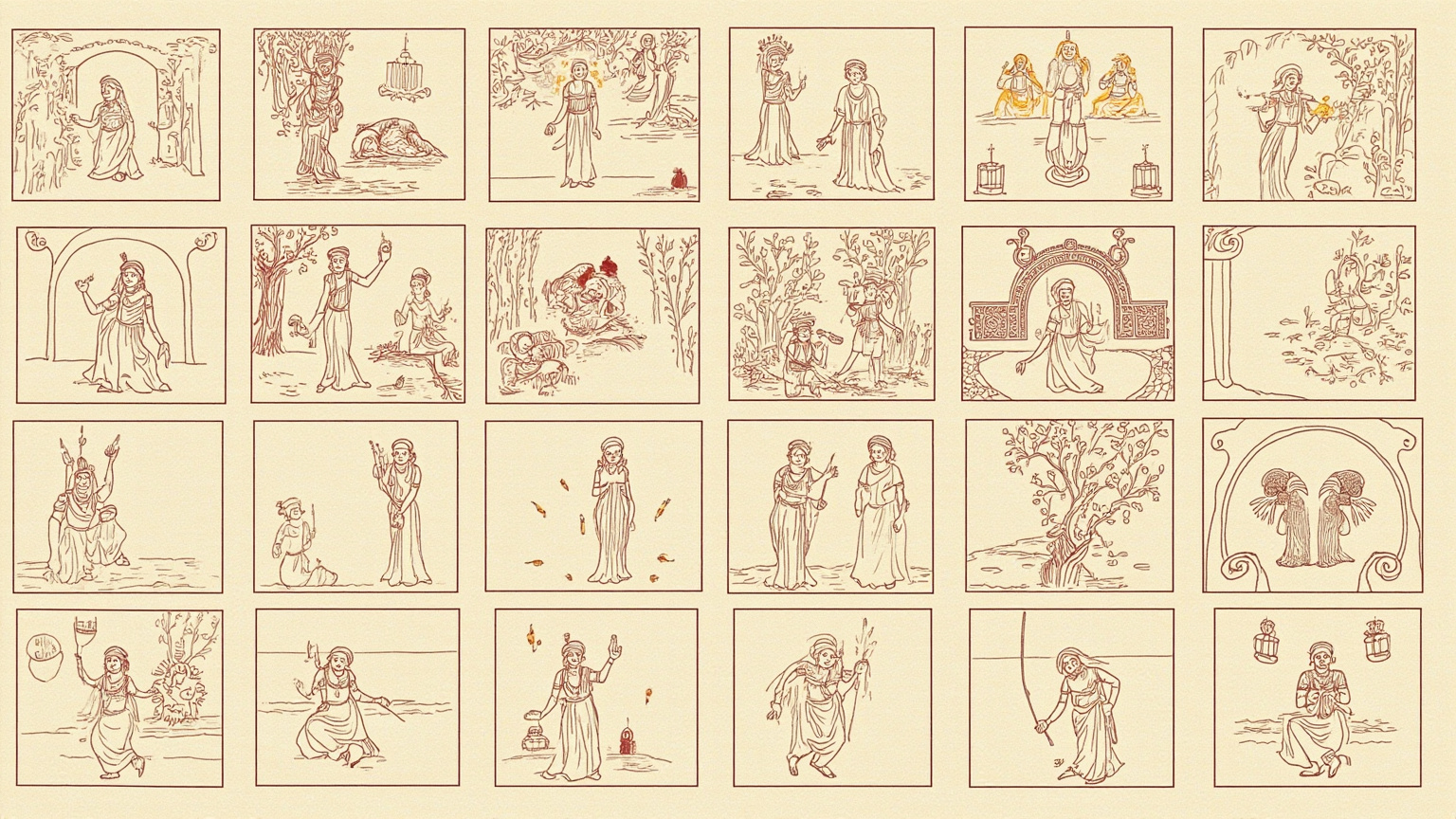
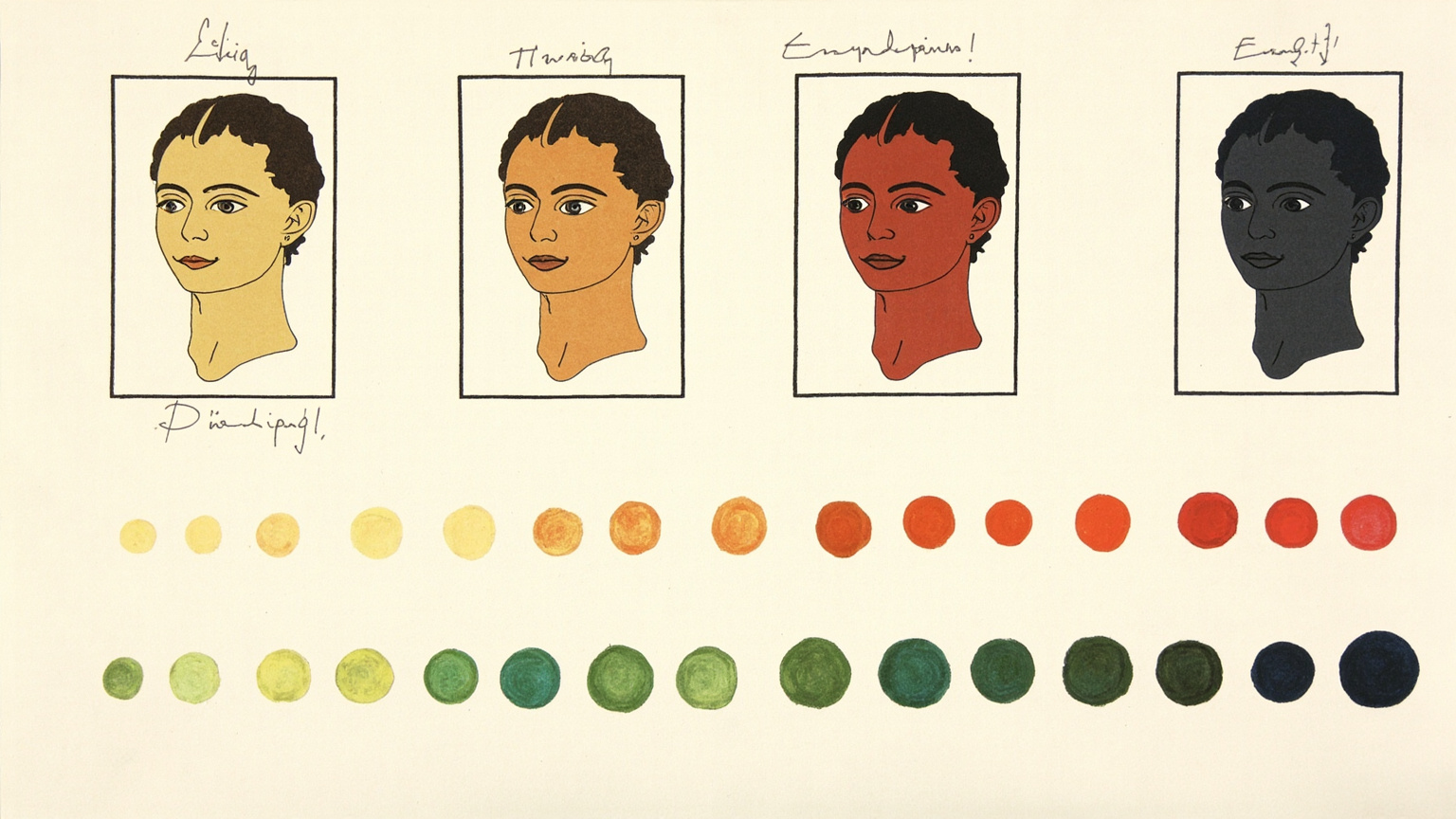
Art Direction4 plates
Before the guide was written, this book got a visual foundation — every illustration you just read grew out of it.