Kojiki (Records of Ancient Matters) · Companion Guide
古事记
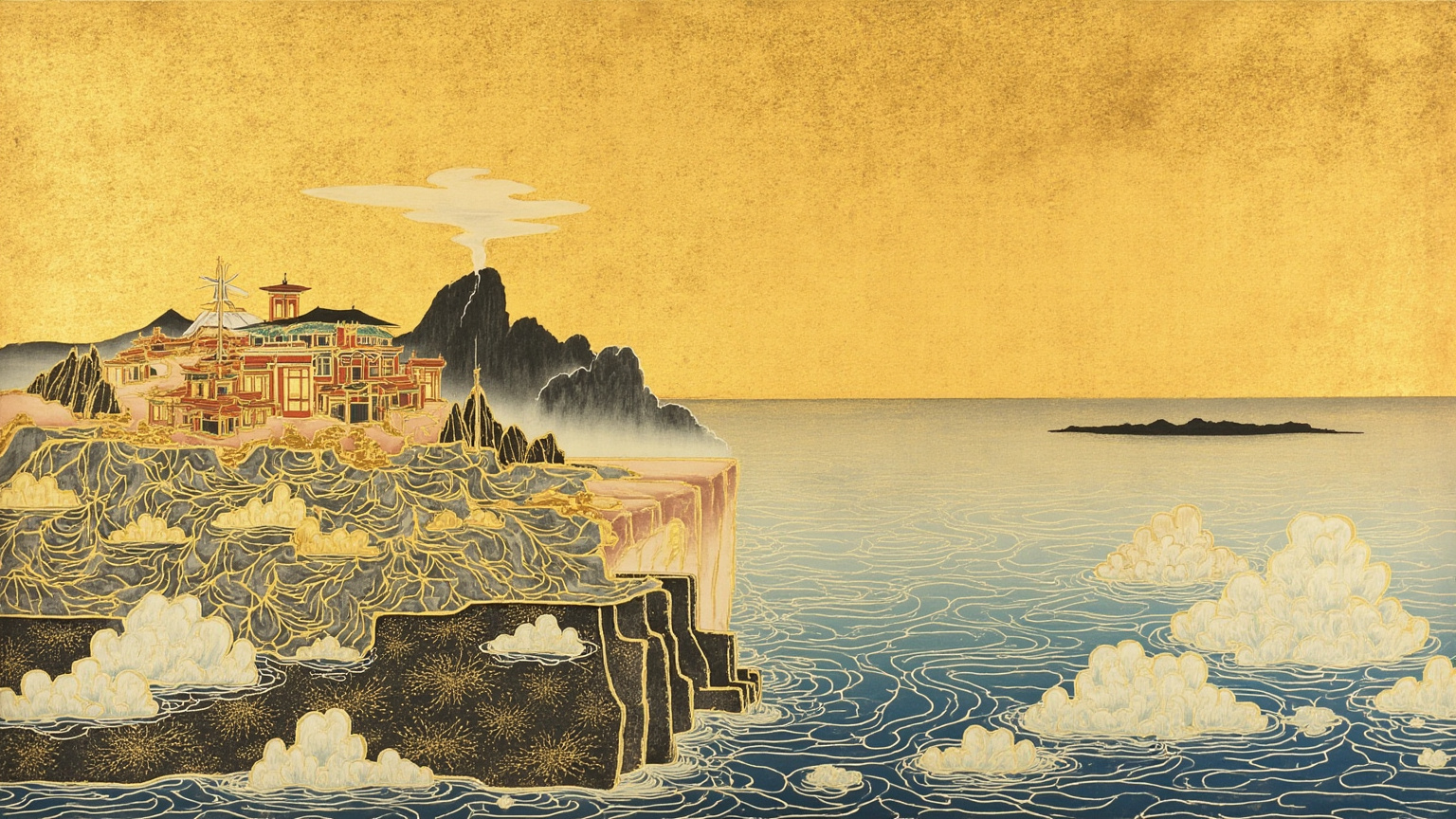
一根矛搅出一座岛,一段婚生出一个国,从此死与生被同一根柱子绑在一起。
A Spear, a Drop of Salt, an Island
A spear dips down and stirs a sea still raw and unformed. That is the first frame of Japanese mythology. A drop of brine falls from its tip and thickens on the water into an island of something like congealed fat: Onogoro. Heaven and earth have not yet pulled apart, and already the land has a shape. This is not a metaphor. It is an action, an image, the beat where the story actually begins.
The hand that stirred the sea was not human. It belonged to two of the last gods sent down from Takamagahara, the Plain of High Heaven: Izanagi and Izanami. Brother and sister, they descended to the island that had just taken shape, raised a heavenly pillar, built an eight-fathom hall beside it, and began circling the pillar to marry. Told plainly, it is one sentence. But that single turn around a pillar is the entire origin of the Japanese islands, the sea, the wind, the trees, the fire.
What This Book Records, and How
The Kojiki is Japan's oldest surviving written text, compiled in the early eighth century by the Nara-court chronicler O no Yasumaro at the order of Empress Genmei, in a mix of archaic Japanese and adapted Chinese script. The myths themselves had circulated by mouth for who knows how many generations before he ever set pen to paper. Yasumaro was less an author than a scribe: he pinned down, line by line, what Hieda no Are, who had memorized the whole cycle, recited aloud. That act of pinning down is the source text behind every torii gate, every shrine, every yokai story Japan has told since.
The book is short, but it packs three layers of time into one volume: the Age of the Gods, the age of human emperors starting with the first sovereign, and finally, at its close, Empress Suiko and Prince Shotoku. In other words, it is a creation epic, the opening chapter of an imperial genealogy, and the template Shinto narrative would run on for the next thousand years. Understand this book and the path becomes clear for everything after it: the Nihon Shoki, waka poetry, the monogatari tradition, Shinto ritual itself.
Two Founding Gods, a Marriage Around a Pillar
Izanagi and Izanami are brother and sister, and also husband and wife. That pairing shows up across ancient creation myths, in Norse and Egyptian stories alike, and it does not need to be judged by the family ethics of the present day. The two walked around the heavenly pillar toward each other. Izanami spoke first: what a fine young man. Izanagi answered: what a fine young woman. On that call and response, the Japanese islands came into being one after another, and the gods of sea, wind, tree, and fire were born in turn.
Trouble came with the birth of the fire god. Izanami was burned giving birth to him, and she died. Her death is the first true turn in the whole Kojiki. The joy of creation snaps in half right here: everything before is birth, everything after is death. Izanami went down to Yomi and stayed there; Izanagi was left alone in the world of light. This is the origin point for the cycle of defilement, purification, and rebirth that runs through every Japanese narrative that comes after.
I will each day slay a thousand of thy people; do thou, each day, set up a thousand and five hundred hearths.
吾当每日诛杀汝国千人,汝当每日建起一千五百之灶以祭吾。
金句 · 黄泉别 · 伊邪那美立誓
Yomotsu Hirasaka, and the Boulder That Sealed It
Izanagi could not let her go. He followed her into Yomi to bring her back. Izanami agreed to return, on the condition that he wait outside and not look at her. He could not wait. He lit a torch and looked anyway. His wife had become a rotting corpse crawling with maggots, thunder gods writhing across her body. He turned and ran.
What follows is one of the most harrowing chases in the myth. Ashamed and furious, Izanami sent the hags of Yomi and the eight thunder gods after him. Izanagi ran, throwing his hairpin behind him, then peaches, then grapes, each object becoming the model for a ward against evil in later Japanese folk practice. At last he heaved a boulder that a thousand men could not move across Yomotsu Hirasaka, sealing the two worlds apart for good. Standing on his side of the rock, he told his dead wife: I will kill a thousand of your people every day. She answered: then I will bear fifteen hundred. From that moment, life and death have defined each other. This scene should stay in silhouette. No rotting detail belongs on the page; a dark outline, underworld light, and shadowed ripples are enough.
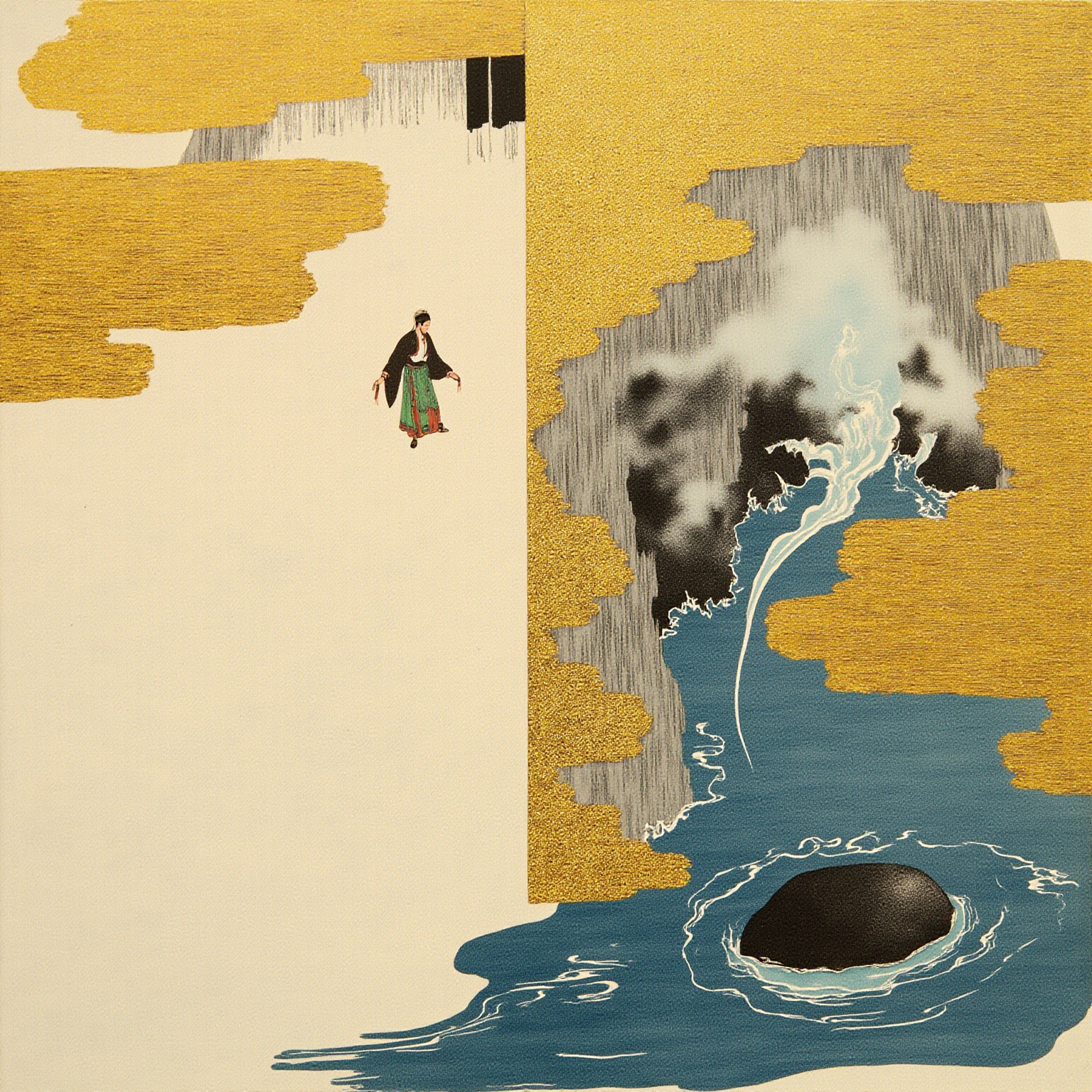
Then, at last, he fled. Even the thunder-gods and the ugly hags of Yomi could not hold him. With the thousand-draft stone he rolled between the worlds, and the road of Yomi was sealed.
伊邪那岐乃惊而奔逃,黄泉丑女与八雷神追之不及;遂取千引石塞于黄泉比良坂,隔绝生死之径。
金句 · 黄泉别 · 千引石堵坂
One Dip in the Sea, Three Noble Children
Izanagi ran back from Yomi still carrying its filth, and he plunged into the sea to wash it off. That single act became the origin of misogi, the Shinto rite of purification: water can rinse away the stain death leaves behind. Every piece of clothing he shed turned into a god. He washed his left eye, then his right, then his nose, and from those three washings came Amaterasu, goddess of the sun; Tsukuyomi, god of the moon; and Susanoo, god of storms. Life and death had made a full circuit through Izanagi's body, and in the sea they crystallized again into three points of light.
Amaterasu and Tsukuyomi divided day and night between them, but Susanoo, god of storms, would not stop wailing, and his tantrums eventually drove Amaterasu to shut herself inside the heavenly rock cave. The world went dark at once. Sun, moon, and storm together form the backbone of the Takamagahara pantheon that follows, and the most unruly of the three is the one who drives the rest of the book.
The Door of the Heavenly Rock Cave, and How the Light Got Out
Susanoo's banishment from Takamagahara comes later. First there is what happened after Amaterasu shut herself inside the rock cave. With the sun gone, nothing grew, and both the world of the gods and the world of men sat in darkness. The gods, eight million of them, gathered on the dry bed of the Heavenly River and worked out a plan: Ame-no-Uzume, ancestor of all the performing arts, would dance in front of the cave. She overturned an empty tub, draped herself in leaves, stamped the tub like a drum, and danced a dance both solemn and strange.
At the wildest point of the dance, Amaterasu, unable to hold back her curiosity, cracked the door open. The gods outside had already set their trap: Ame-no-Tajikarao stood ready at the side of the cave to pull the door wide, the long-crowing roosters began to call, and the Yata Mirror and the curved jewel Yasakani no Magatama hung waiting at the entrance. The instant light spilled through the gap, all of Takamagahara went bright again, and Amaterasu returned to the heavens. The image that matters here is light moving in and out, not the cave mouth itself. The crack in the door is the only light source; the gods should rise around it like a crowd gathering out of mist.
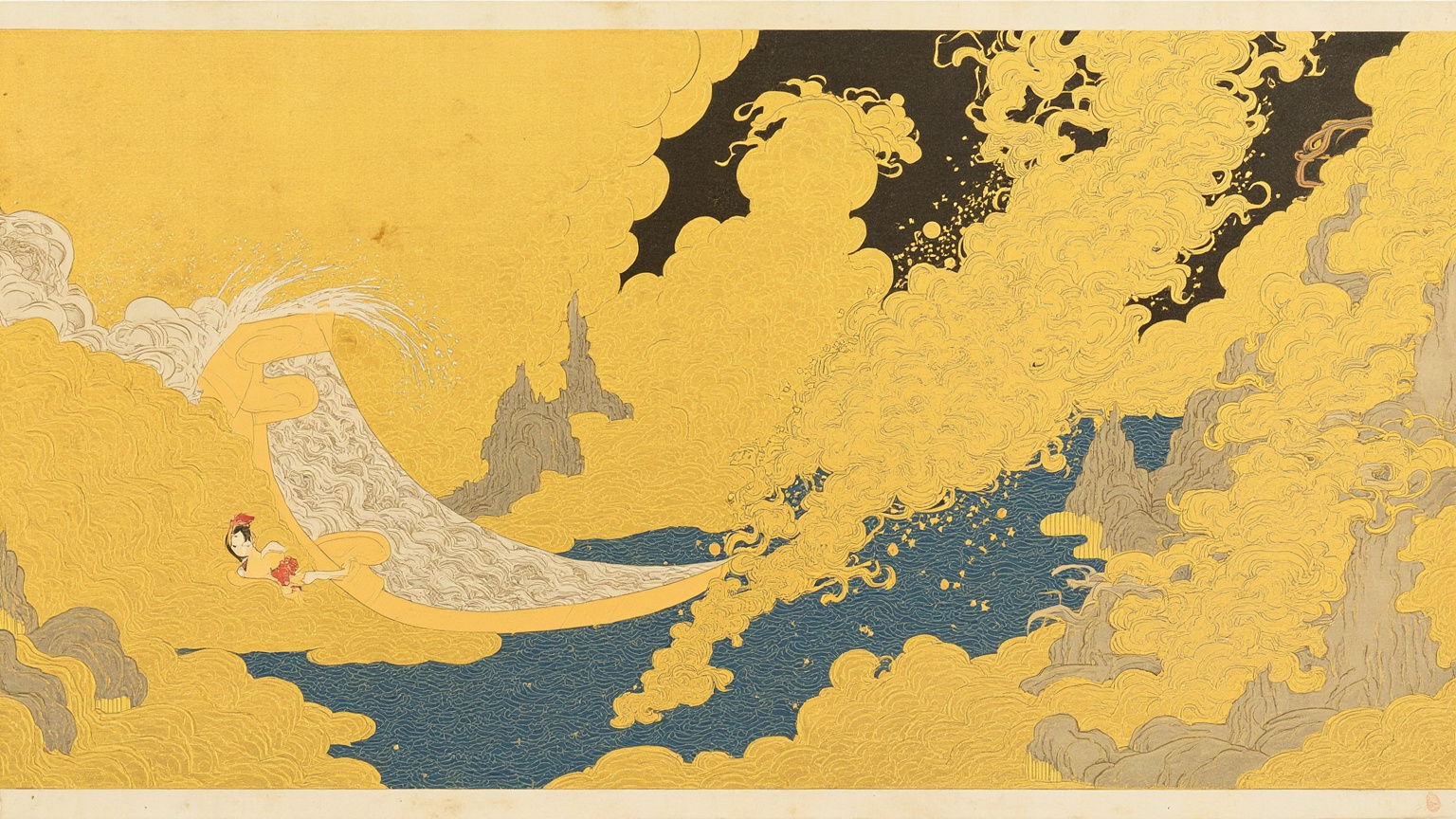
Then Ama-no-Uzume, fastening a mirror and a many-beaded string, stood before the Rock-Cave and overturned a bucket; the eight hundred myriads of gods laughed together with one voice.
天宇受卖乃立于天岩户之前,倒覆空桶,八百万神同声而笑。
金句 · 岩户再出 · 天宇受卖起舞
A Sword Hidden in the Tail of the Eight-Forked Serpent
Susanoo, cast out of heaven, landed in Izumo. There he came across Yamata no Orochi, an eight-headed, eight-tailed monster so vast it spanned eight valleys and eight peaks, and every year it demanded a young boy and girl to devour. Susanoo had the villagers set out eight vats of strong sake and hid himself behind them. The serpent came to drink, drank itself senseless, and all eight heads and tails fell into a heavy sleep. Susanoo drew his blade and cut his way through it, and in the last of its tails he found a sword: Ame-no-Murakumo-no-Tsurugi.
That sword was later renamed Kusanagi, and it is one of the sources of the three sacred treasures of the Japanese imperial line. One detail worth noting: Kusanagi does not breathe fire. Its name comes from an image of clustering clouds rising like the gleam of a blade, so the sword should stay a sword and the clouds should stay clouds; no flame belongs at its tip. Susanoo offered the sword to Amaterasu and stayed behind in Izumo as the god who watched over that land. Order here is not restored by grinding an enemy down with force. It is restored by sending the enemy's most precious thing back up to heaven, and that pattern of reconciliation becomes a key strand in the Shinto spirit that follows.
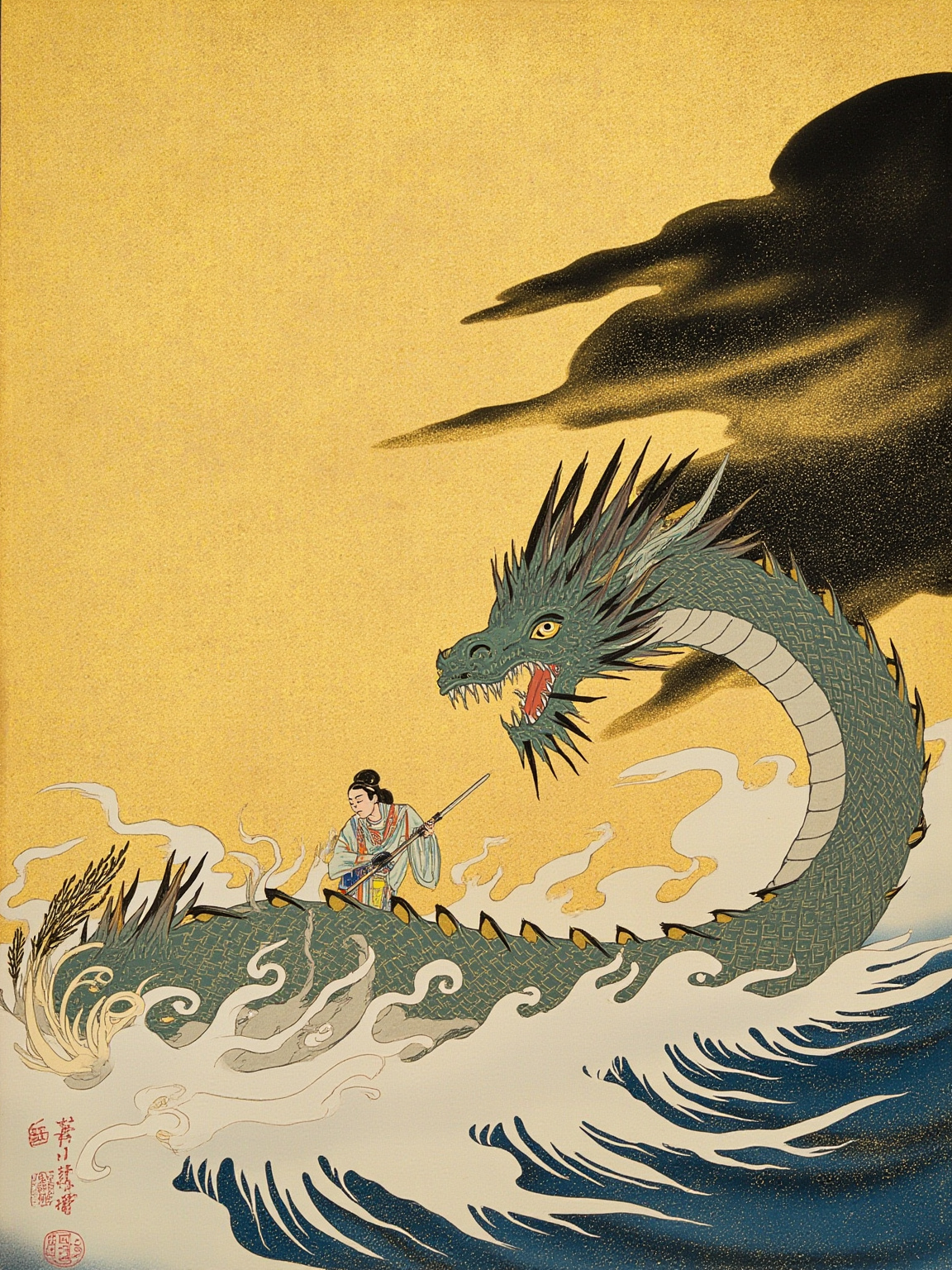
He slew the eight-headed serpent, and in its long tail he found a great sword. This sword he named Ama-no-Murakumo-no-Tsurugi, and offered it to the Sun Goddess.
素戋呜乃斩大蛇,于其尾中得一大剑,名曰天叢雲剣,献于天照大御神。
金句 · 八岐退治 · 天叢雲剣献上
The Heavenly Grandson Descends on Takachiho, and Izumo Cedes Its Land
Amaterasu handed the sword Susanoo had offered her to her grandson Ninigi and sent him down to rule the earth. Ninigi descended onto Mount Takachiho in Hyuga, Kyushu, carrying the Yata Mirror, the Yasakani no Magatama, and Ame-no-Murakumo-no-Tsurugi, the three items later known as the imperial regalia. This descent of the heavenly grandson is the formal starting point where divine rule hands off to human emperors. After Emperor Jimmu's eastern conquest, the Kojiki records the deeds of successive emperors one after another, down to Empress Suiko and Prince Shotoku at the book's close, the two figures who happen to be the ones who fixed the title tenno, emperor, in place.
But the land itself was governed at the time by Okuninushi of Izumo. Takamagahara first sent Ame-no-Hohi down to scout, then sent the war god Takemikazuchi, along with a second warrior god, down to Izumo to put the question directly to Okuninushi's son, Kotoshironushi: would he yield the Central Land of Reed Plains, or not? Standing among the branches of a tree, Kotoshironushi gave an answer that mattered enormously: this land was wild once, he said, and I have already put it in order on Amaterasu's behalf, so let it be given. Okuninushi himself agreed to cede the land soon after and withdrew into the Land of Roots. Sovereignty over the earth passed to Amaterasu's line from that point on, the world of the gods and the world of men shaking hands over the same ground.
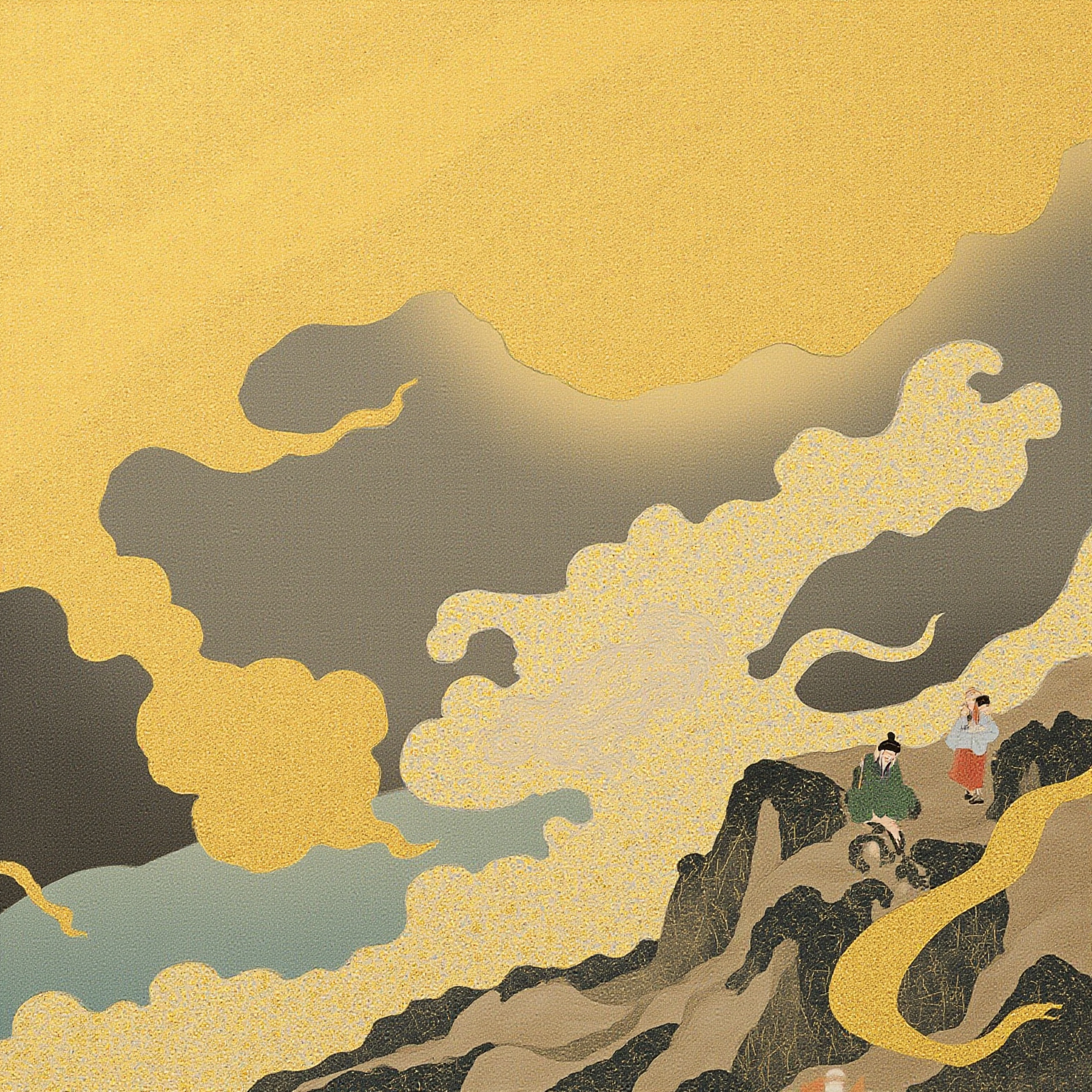
This Land of Reed-Plains, though it be a wild and uncouth land, has been, by the leaving of my child, made a land that is brought to peace. I will, in obedience, withdraw.
苇原中国者,本是荒国,然已因吾子之治而定矣。谨奉命退让。
金句 · 出云让国 · 事代主神应答
The Spear in the Sea, Worth an Afternoon
The core of this book is not which story reads best. It is an old account of where the land came from, how imperial rule became legitimate, and how death is to be faced. Japan as a nation exists, in this telling, because two founding gods walked in circles around a pillar. Its origin is not war, not treaty, but birth, marriage, one drop of salt falling from the tip of a heavenly spear. So the next time you stand before a plain shrine in Kyoto or Nara, thatched roof, wooden posts, bare earth underfoot, this whole set of images is what it is quietly holding.
Japan was not built. It was stirred into being, circled into being, born into being. That is the oldest theme the Kojiki hands down to everyone who comes after.
As a piece of narrative construction, the Kojiki pulls off something remarkable: myth and history sit in the same book without fighting each other. The age of the gods stays the age of the gods, the human emperors stay the human emperors, and the two are welded together by the descent of the heavenly grandson and the ceding of Izumo. It is the earliest attempt in East Asia to fold myth into a historical record. The West has the Edda, India has the Mahabharata, Persia has the Avesta, but none of them carry quite the same texture as this one. Its prose moves like an incantation: the god said, the land said, the word said, and once a name is spoken aloud it becomes real. That tradition of kotodama, word-spirit, later seeps into waka poetry, Noh theater, the tea ceremony, and swordsmanship, turning up almost everywhere.
Its reputation does not rest on age alone. A large part of it comes from how the book treats order: not as something won by force, but by coaxing out, negotiating, ceding. The gods do not break down the door of the rock cave; they lure Amaterasu into opening it herself. The heavenly grandson does not slaughter the gods of Izumo; the land is simply handed over. Amaterasu does not strike Susanoo down; she banishes him and later accepts a sword from him instead. That theme of non-violent reconciliation becomes the template for the Shinto spirit that follows, and it is the part readers keep coming back to turn over in their minds.
You Already Know the Plot. Why Read the Original Anyway?
Because a companion guide gives you the map, and the original text is the land itself. You already know what Izanagi finds in Yomi and how he flees, but you have not felt the almost breathing tension of that passage in the original. You know Ame-no-Uzume dances on an overturned tub, but you have not heard the incantatory solemnity of that language, where a name spoken aloud freezes the whole scene into place. You know Susanoo pulls a sword from the serpent's tail, but you have not felt the sheer momentum of that entire slaying, line by line. These things only live in the words themselves. A summary cannot carry them across.
There is another reason. The original is far shorter than a modern novel, and reading it through does not take long, yet every rereading turns up a different layer. Myth studies, comparative religion, the history of Japanese literature, the history of Shinto ritual: this thin book yields a different thread depending on which direction you pull from. So even if you already know the plot, that afternoon with the original text is still worth spending.
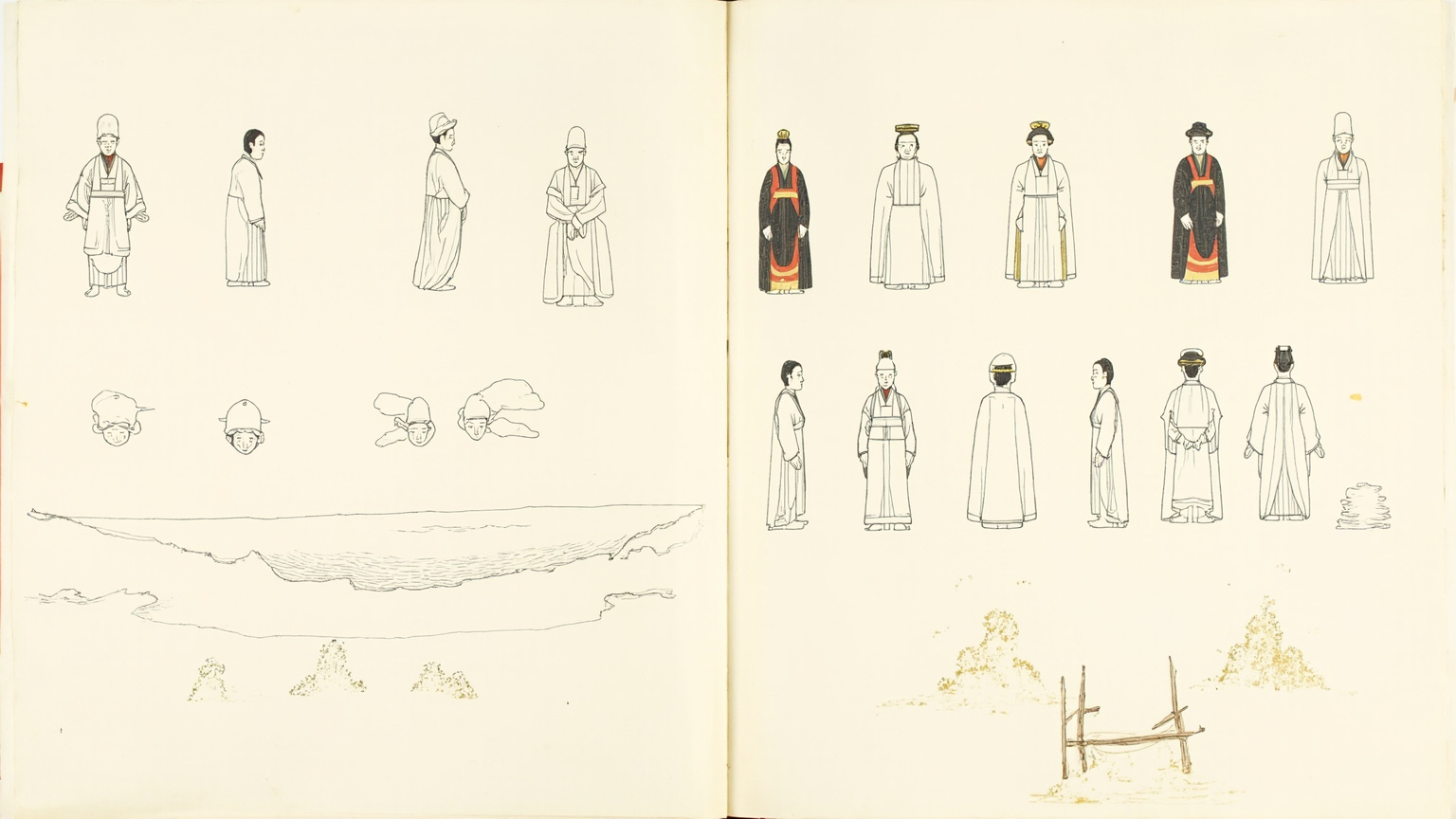
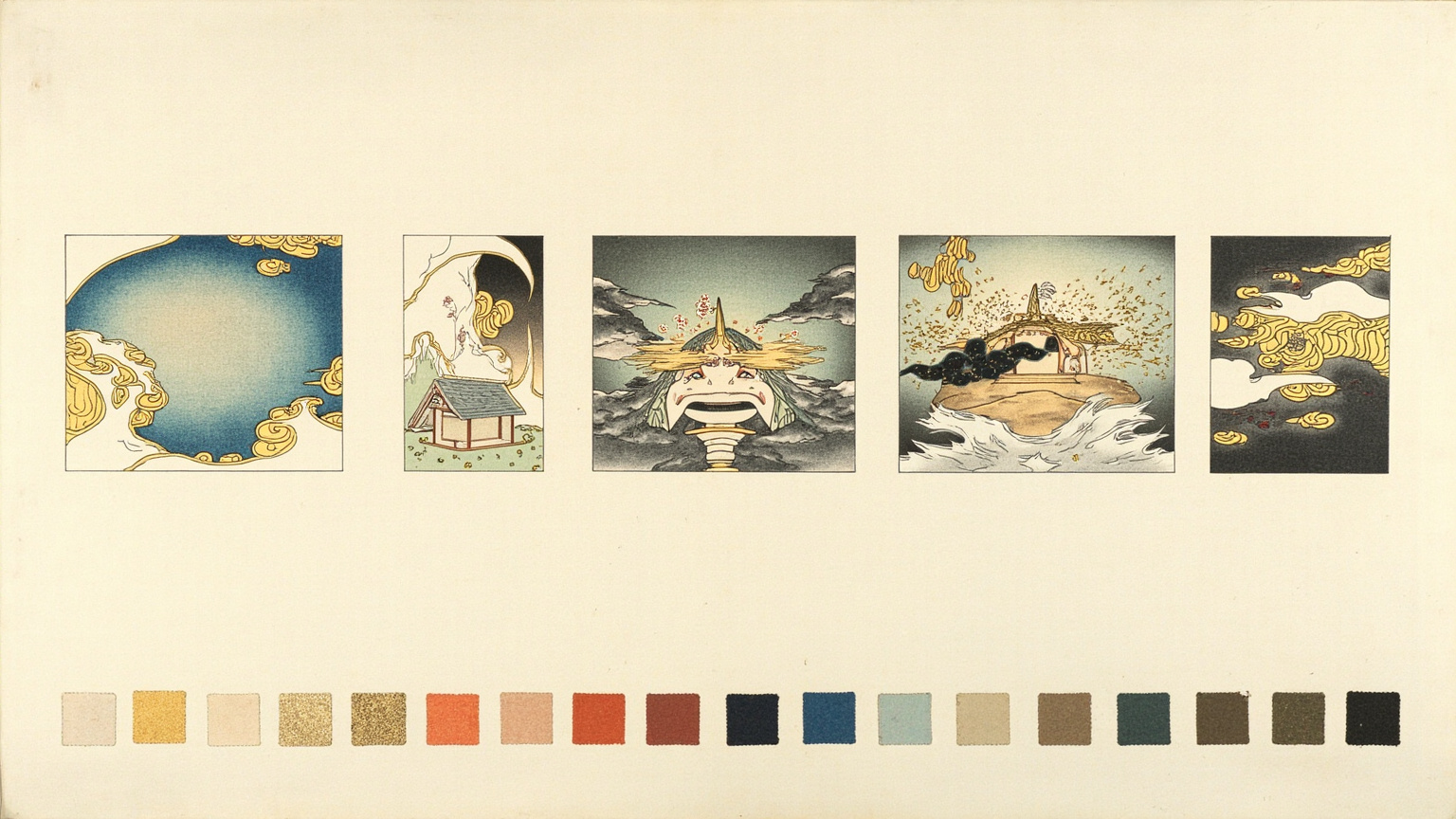
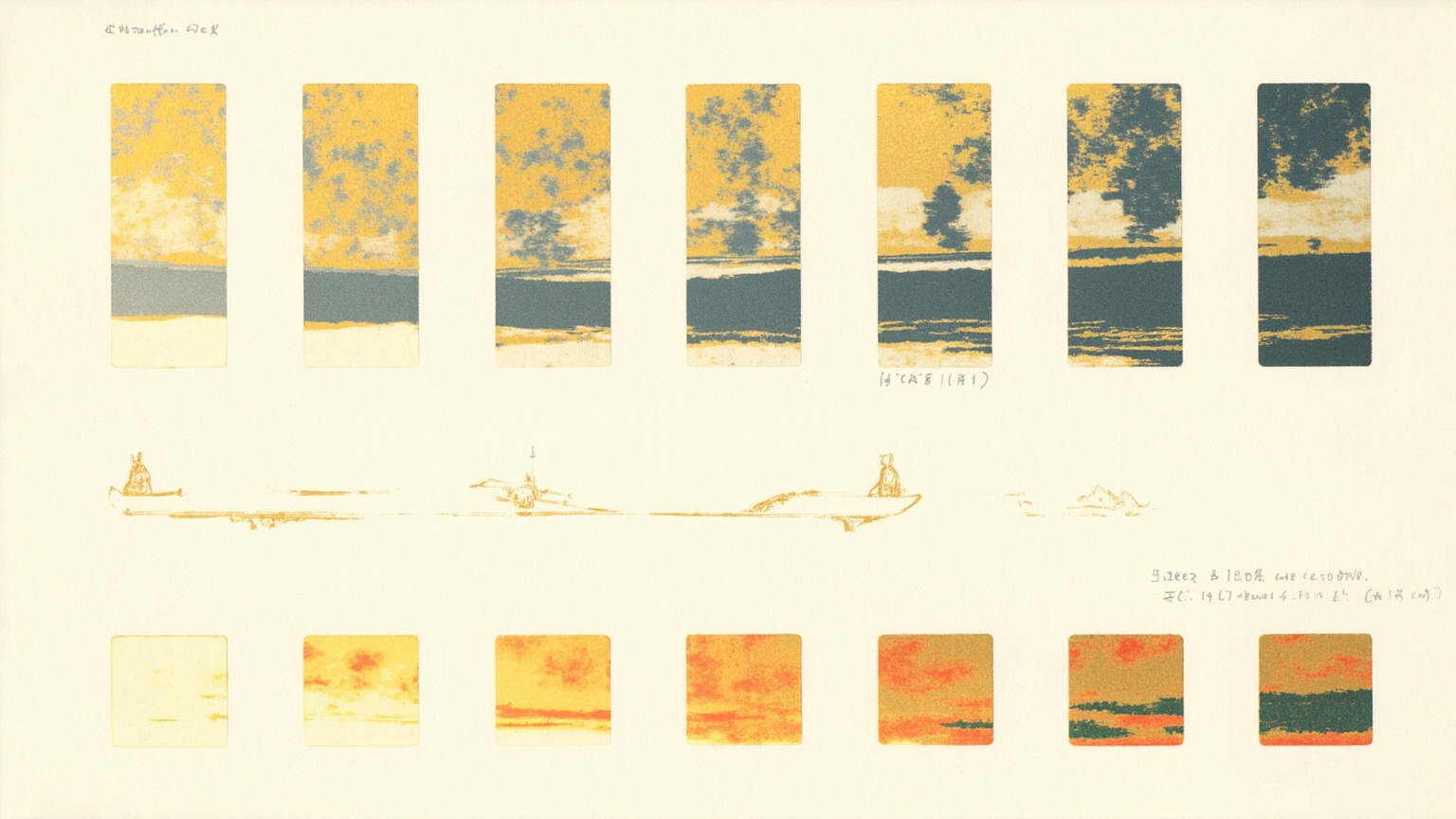
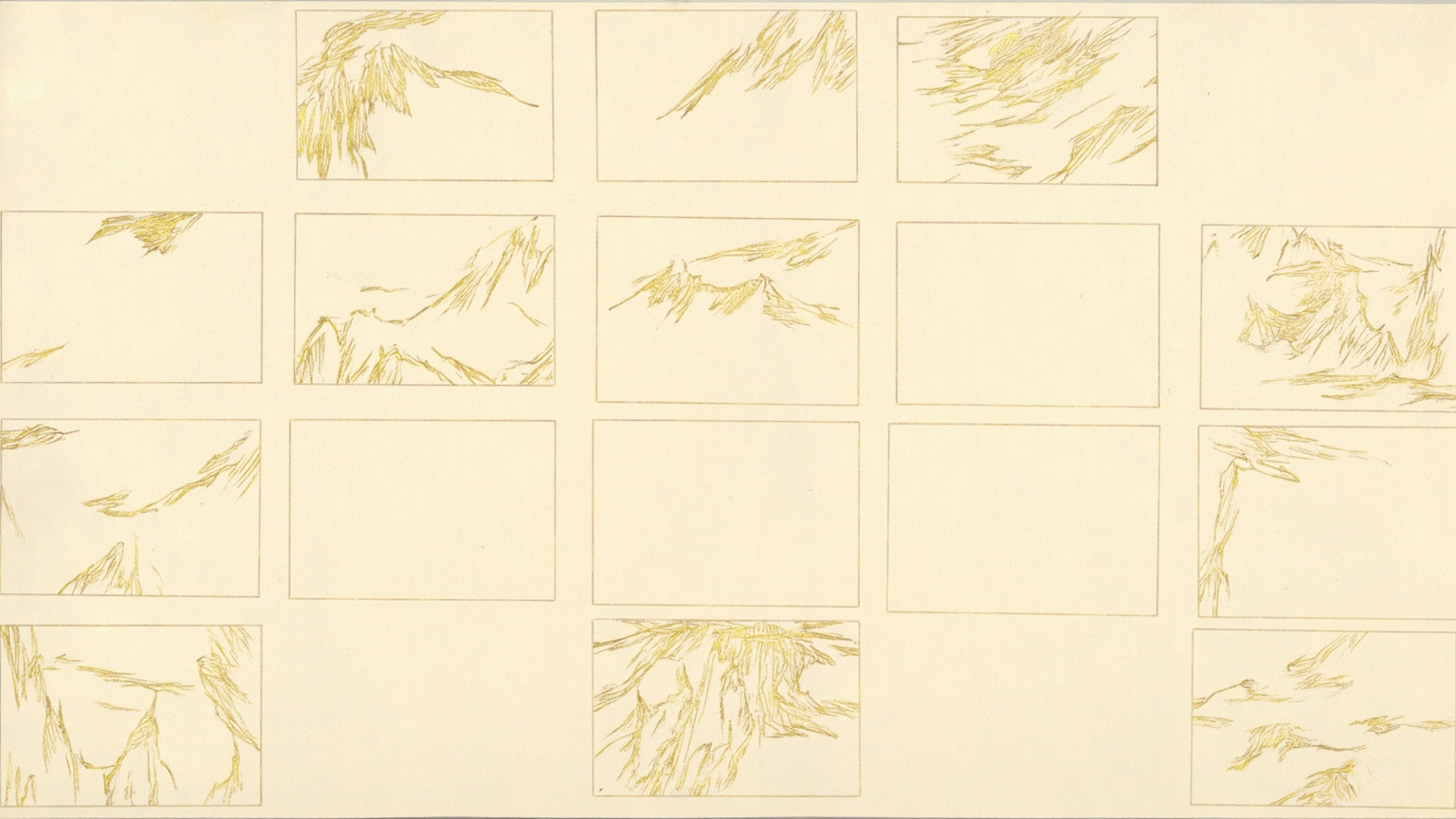
Art Direction4 plates
Before the guide was written, this book got a visual foundation — every illustration you just read grew out of it.