The Love Suicides at Sonezaki (Sonezaki Shinjū) · Companion Guide
曾根崎心中
元禄十六年堂岛的雨夜里,一个守信的伙计被人当众剥去清白,檐下灯笼一灭,露水便把两个人的脚印带进了曾根崎的松林。
Opening scene: no umbrella, and the two of them are already walking into the woods
A paper lantern glows behind the lattice window, and the noren curtain lifts in the wind and falls again. In the crawl space under the floor, Tokubei, a twenty-five-year-old soy sauce apprentice, curls beneath a woman's silk skirts, his toe pressed to the throat of Ohatsu, a twenty-one-year-old courtesan — the signal the two of them agreed on. He still carries the scabs from a beating he took hours earlier. Three days later, in the early hours of the seventh day of the fourth month, Genroku 16, he will walk hand in hand with Ohatsu across the bridge at Sonezaki and into the forest beneath the entwined pine. This is Chikamatsu Monzaemon's The Love Suicides at Sonezaki.
On the day it happens, a light rain is falling over Osaka.
What this play is, and why it's still read three hundred years on
Chikamatsu Monzaemon wrote it in 1703. Before this he had been writing historical hero plays for Osaka's bunraku (ningyo joruri) troupes — emperors and generals, gifted scholars and beautiful women, for an audience of the wealthiest samurai and merchants in the house. This play is different: a soy sauce apprentice, a courtesan from Dojima Shinchi, a beating dealt out by a mob at a street-corner shrine. A small catastrophe, and an ordinary one. It reached the stage in June of that year, and afterward people in Osaka really did start dying in copycat love suicides, until the shogunate banned the entire genre of shinjumono outright. A play's greatness sometimes gets stamped onto it after the fact, by the real shockwave it sets off — this is one of those.
Later generations call him the Shakespeare of Japan, and not really because of this one play — he wrote well over a hundred in his lifetime — but this is the play that laid the first brick under that title. With it he wrenched Japanese theater away from emperors and generals and toward ordinary people in the street. After this, writing the present moment, the neighbor down the block, the poor fool next door, became a legitimate path for Japanese drama. The genre later got its own name: sewamono, domestic drama.
Four people and one forest
Tokubei, twenty-five, an orphan, has made himself a place at his uncle's soy sauce shop, the Hiranoya, through honesty and hard work — the kind of clerk an owner grooms to take over the business. Until he refuses to marry his aunt's niece, and refuses to give up the woman he actually loves. His uncle disowns him on the spot: pay back the cost of your clothes within seven days, and leave Osaka. He is thrown into the street with nothing.
Ohatsu, twenty-one, a courtesan at the Tenmaya in Dojima Shinchi — bound by contract, not a woman of respectable family. She has no say over her own life. And yet the part Chikamatsu writes for her is the cleanest, most honest one in the whole play.
Kuheiji, Tokubei's friend of many years, an oil merchant, reliable enough that Tokubei trusted him with money he could not afford to lose — until he wasn't. A trick built out of a lost-seal report and a forged loan document turns the tables: Tokubei ends up holding a stamped two-kanme loan note, and somehow he is the one who looks like a blackmailer.
Most of the play is pinned to one stretch of Osaka around Dojima: the Hiranoya soy sauce shop on Uchihonmachi-dori, the approach and stone lanterns of Ikutama Shrine, the lattice windows of the Tenmaya teahouse in Dojima Shinchi — and finally a stretch of road through the night, over a bridge and its reflection in the water, ending under the entwined pine of the Sonezaki Tsuyu Tenjin forest, a pine and a palm grown as one trunk, an image Japanese theater has staged again and again.
On the shrine approach: a reunion after time apart, and the whole story comes out
On the morning of the seventh, Tokubei is out collecting payments and passes Ikutama Shrine, where he runs into Ohatsu on the approach. She is upset that he never wrote. He unloads the whole story at once: refusing the marriage, being disowned, going back to the country to claw back the two kanme his stepmother had taken as betrothal money, then lending that same money to Kuheiji when he needed it. Every step he took was the right one, and every step got him kicked further down.
Chikamatsu keeps this scene restrained. The two of them do not fall into each other's arms weeping — they lay the facts out one by one, so the audience understands exactly how this bruised young man got ground down by the city until there was nowhere left to stand. I stopped short the first time I read this too: he never does anything wrong, and every single thing he does pushes him closer to death.
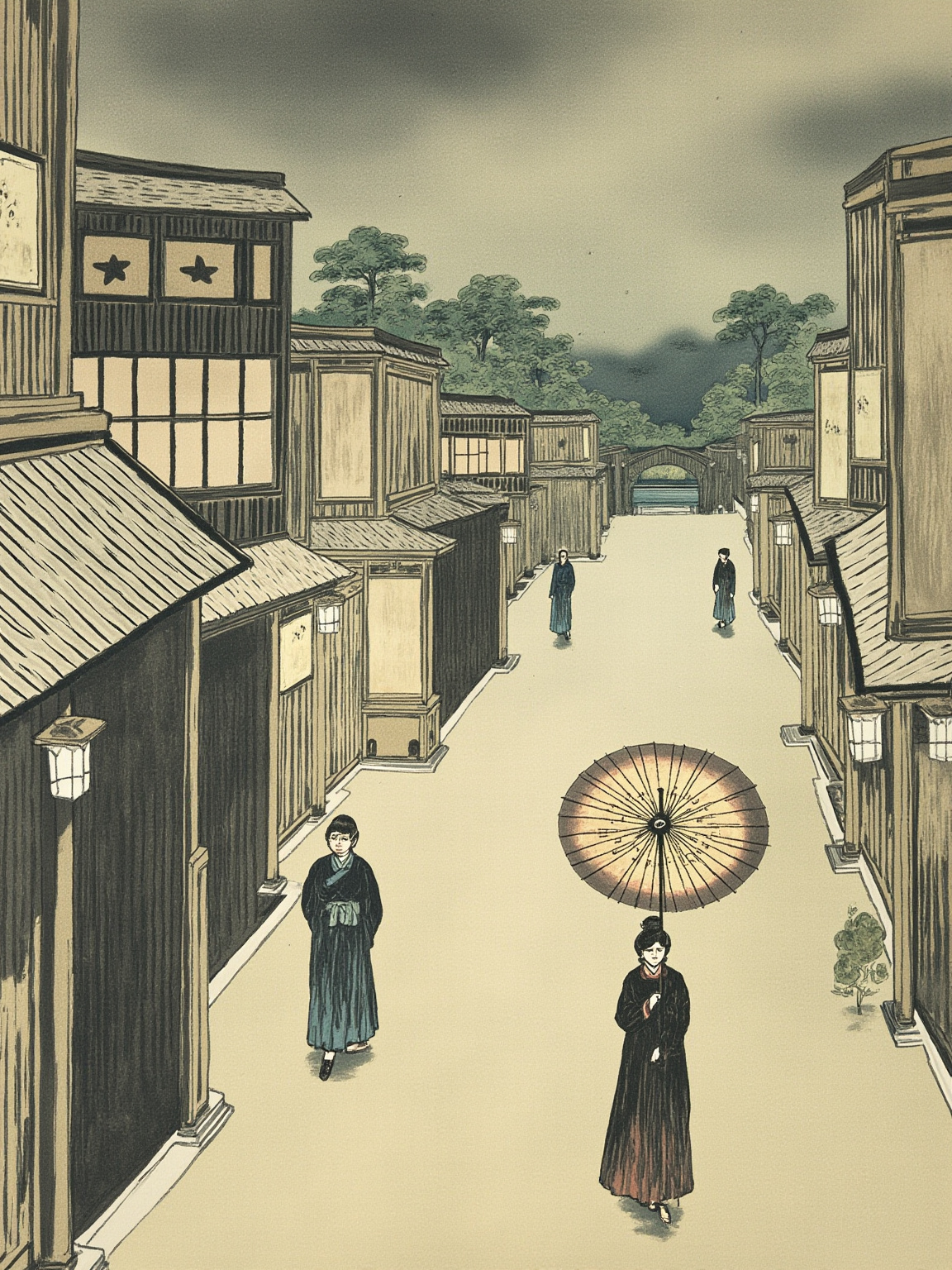
Each step he took was right, and each step he took left him no place left to stand.
每一步都没走错,可每一步都把他逼到再无立锥之地。
金句 · 神社参道一段
Kuheiji turns on him in public: the trap of the seal
While the two of them are talking, Kuheiji's crowd shows up at the shrine. He turns on Tokubei in front of everyone: he had already reported his personal seal lost to the authorities, he says, which means the seal on the loan document is already invalid — so it is Tokubei who is the one trying to extort money with a worthless piece of paper. He turns the accusation around. Tokubei pulls out the stamped loan note to clear his name, and Kuheiji's men pile on and beat him against the stone lanterns.
The move is cleverer than it looks. Kuheiji is not just beating up a man, he is destroying the one thing Tokubei has built his standing on in the neighborhood: his name. In the merchant society of Genroku-era Osaka, a name was your business — lose it, and you might as well walk the streets naked. Tokubei never gets his money back, and his reputation is smashed in public before that. Nothing he does after this can undo it.
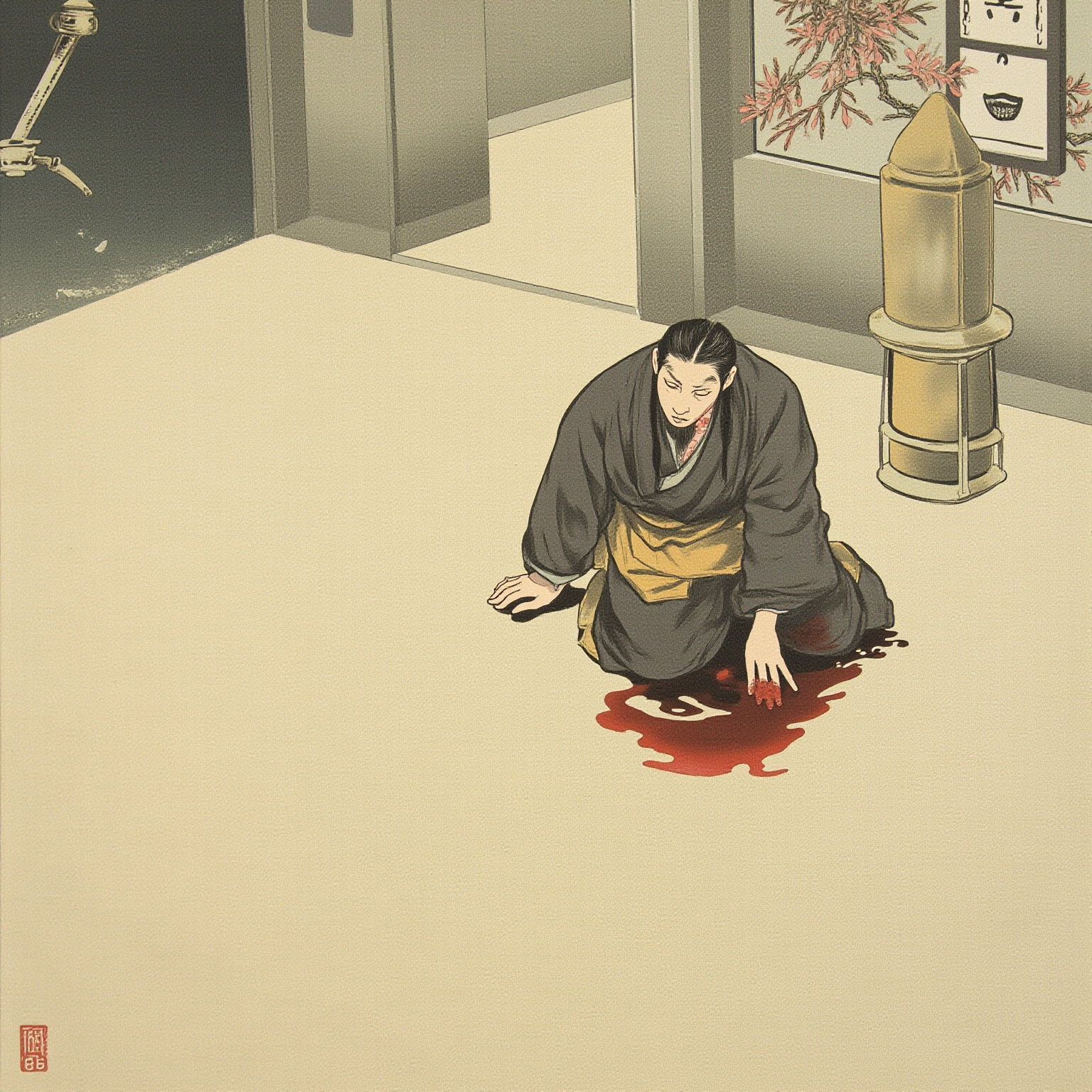
He did not strike down Tokubei alone — he struck down the very name by which Tokubei stood among his neighbors.
九平次打的不止是德兵卫,是他赖以在街坊上立足的那一块名。
金句 · 神社翻脸一段
Under the floor at the Tenmaya: a pact sealed by a toe against a throat
Tokubei drags himself, injured, back to the Tenmaya, and Ohatsu hides him in the space under the floor, beneath her own skirts — a board in the teahouse floor lifts just enough for a person to slip under, and the hem covers the gap. Kuheiji walks in right behind him, sits down as a paying customer, and spends the evening bragging about his new money and telling everyone that Tokubei is a con man, with no idea that the con man he is talking about is hiding under the very skirts at his feet.
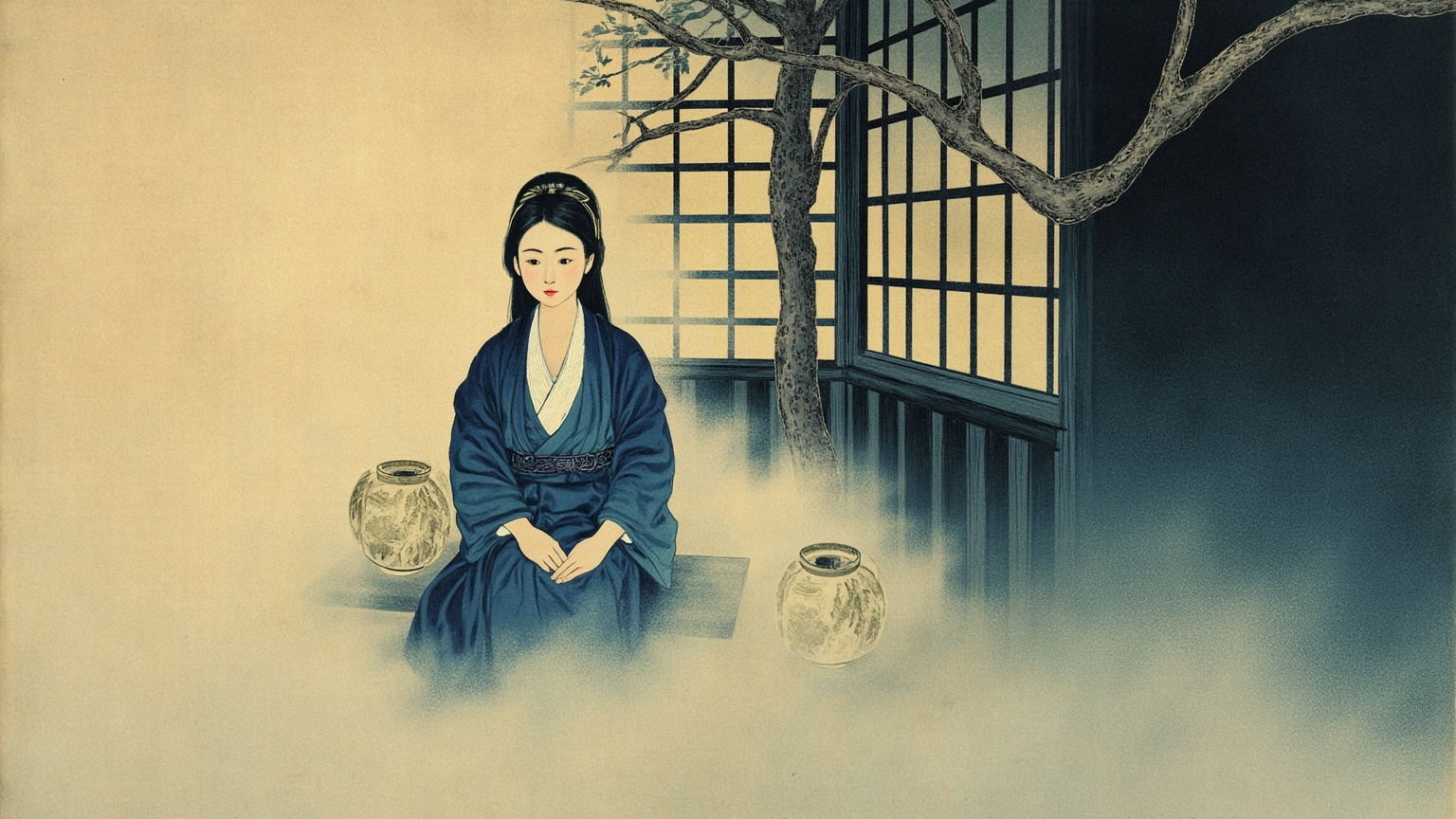
Two lovers, no sound — a toe touches a throat, and their whole future is decided.
两人不言不语,一缕脚趾抵上喉头,此后的生死便一齐定下了。
金句 · 地板间密约一段
Down in that gap he cannot make a sound, so the two of them work out a code: a toe against the other's throat. One says tonight, with a touch. The other touches back: yes. That is how the whole plan gets settled — wait until the night watchman falls asleep, slip out the back door. It is the quietest scene in the play, and Chikamatsu writes a bloody conspiracy as two people talking through the tip of a toe, with a layer of silk between them.
Michiyuki: through the dark, toward the forest
The back door opens onto the night air. The two of them cross the bridges of Dojima hand in hand, a scattering of lantern light reflected on the water below. This passage is called the michiyuki, the journey, and it is one of the most accomplished passages of sound and language in the history of Japanese theater. Chikamatsu lays the night road out inch by inch in alternating lines of seven and five syllables: dew on the grass blades, the sky whitening by degrees, the outline of the entwined pine emerging slowly out of the mist. The joruri chanter carries the words across the stage one at a time, and the whole theater sits inside that half-light before dawn.
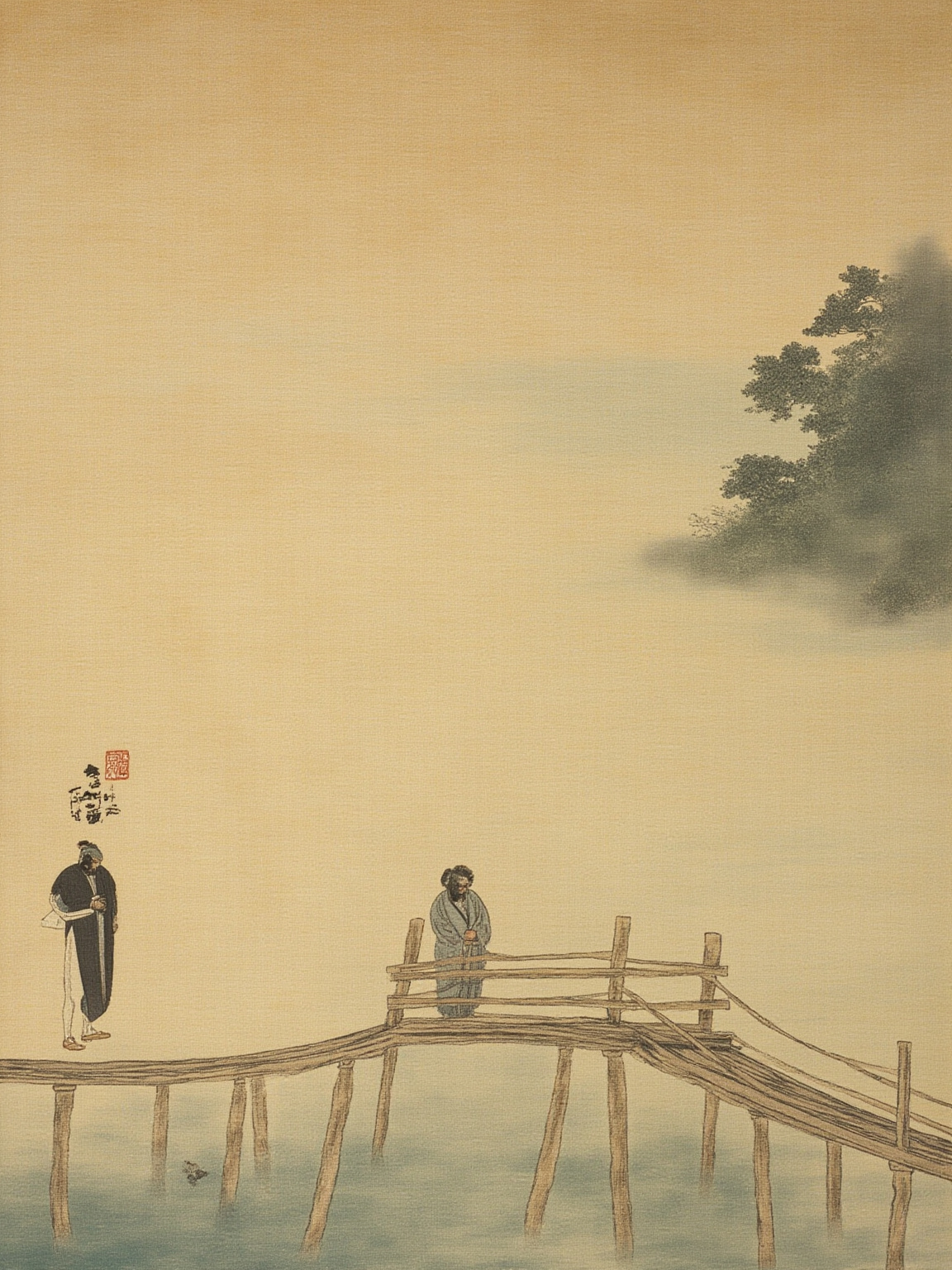
The dew is so heavy that it soaks the sleeves before a single word is spoken.
露水这般重,两个人还未开口说话,袖上已是湿的。
金句 · 道行一段
I have to be honest about this — the beauty of this passage only opens up if you sit in a theater and hear the chanter draw out every syllable with that catch in the voice. No amount of description can give you the rhythm, the way the breath holds and releases.
Under the entwined pine: an ending in a single line
Chikamatsu does not write the razor, does not write the short sword, does not write the two bodies bound together, does not write the dying itself, does not write blood or the corpses. One line — the two of them meet their end together in the Sonezaki forest — and that is the whole ending. Tokubei and Ohatsu are lovers, not husband and wife. Ohatsu is a courtesan still under contract, not a woman of respectable family. Chikamatsu is clear about this, and merciless about it: he puts two people with no way back left in society into one final morning, and then refuses to write out their last moment for them. That is the blank space, left for the chanter's voice in the theater, and for the breath the audience holds in the dark.
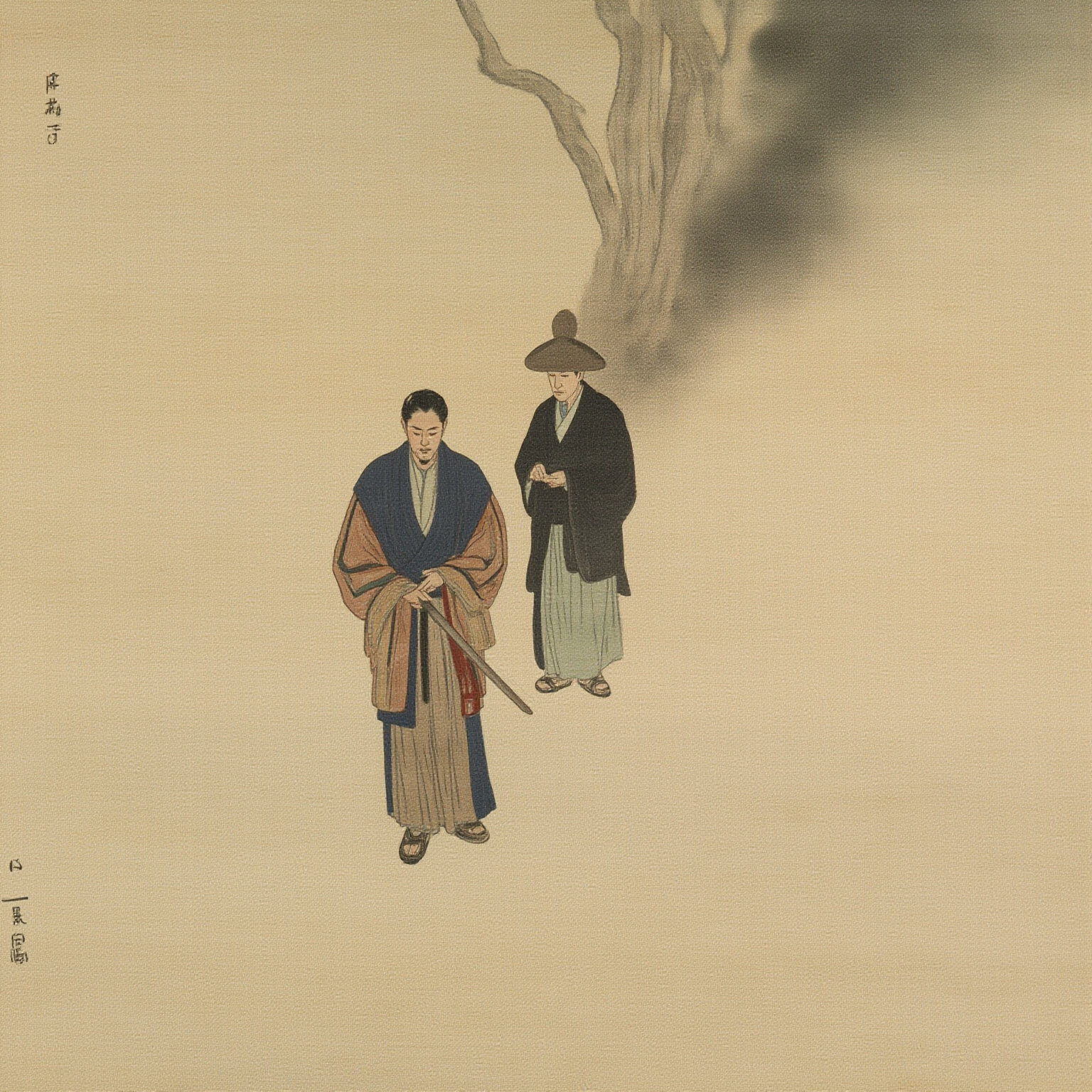
The two set out together for the Sonezaki forest, and there is no more told of them.
二人相携赴曾根崎林中,此后再无别话。
金句 · 连理松下一段
After the premiere: a play that set a city on fire
After the play premiered in June 1703, people in Osaka really did start dying in imitation. Love suicides spiked, and the shogunate issued a ban: no more shinjumono, full stop. A play's real social shockwave ended up stamping it as great, and in the history of early modern Japanese literature, that kind of grip between a play and the society watching it is exceedingly rare.
The truly ruthless stroke in this play sits inside the sound of dew along the road to the forest, where the audience hears two fingertips touch and a death get decided.
Why you should go read the text
A guide like this one gives you the map. The text is the actual ground, and that is especially true here. The long road of the michiyuki, the chanter's drawn-out rhythm, the half-light under the entwined pine, the toe-code passed between two people through a floorboard — none of that survives being summarized. You have to sit in a theater for it, or at least open the script and read it line by line. If you want to see how giri and real feeling get carved into the bone of an ordinary person, read it yourself.
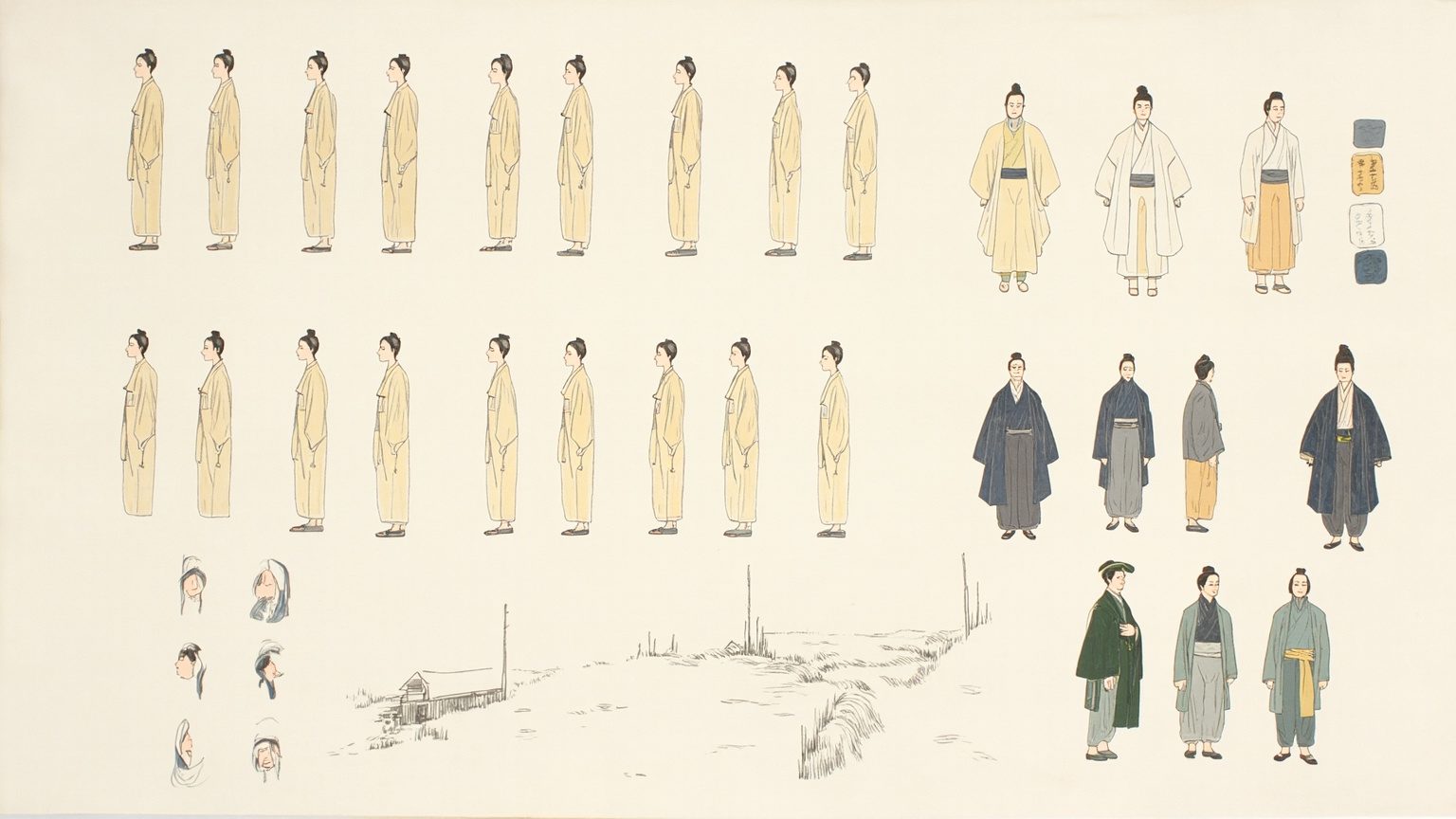
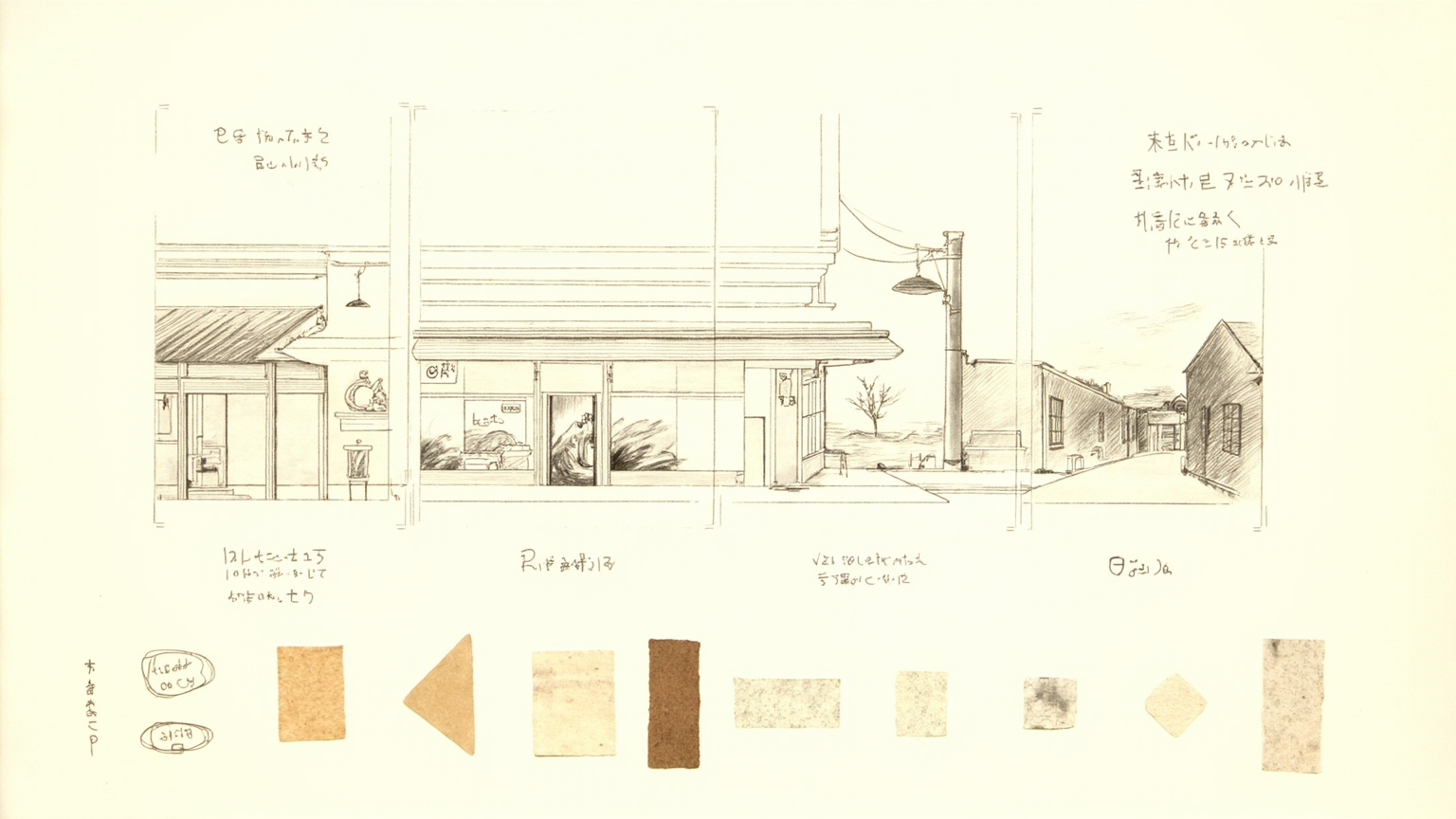
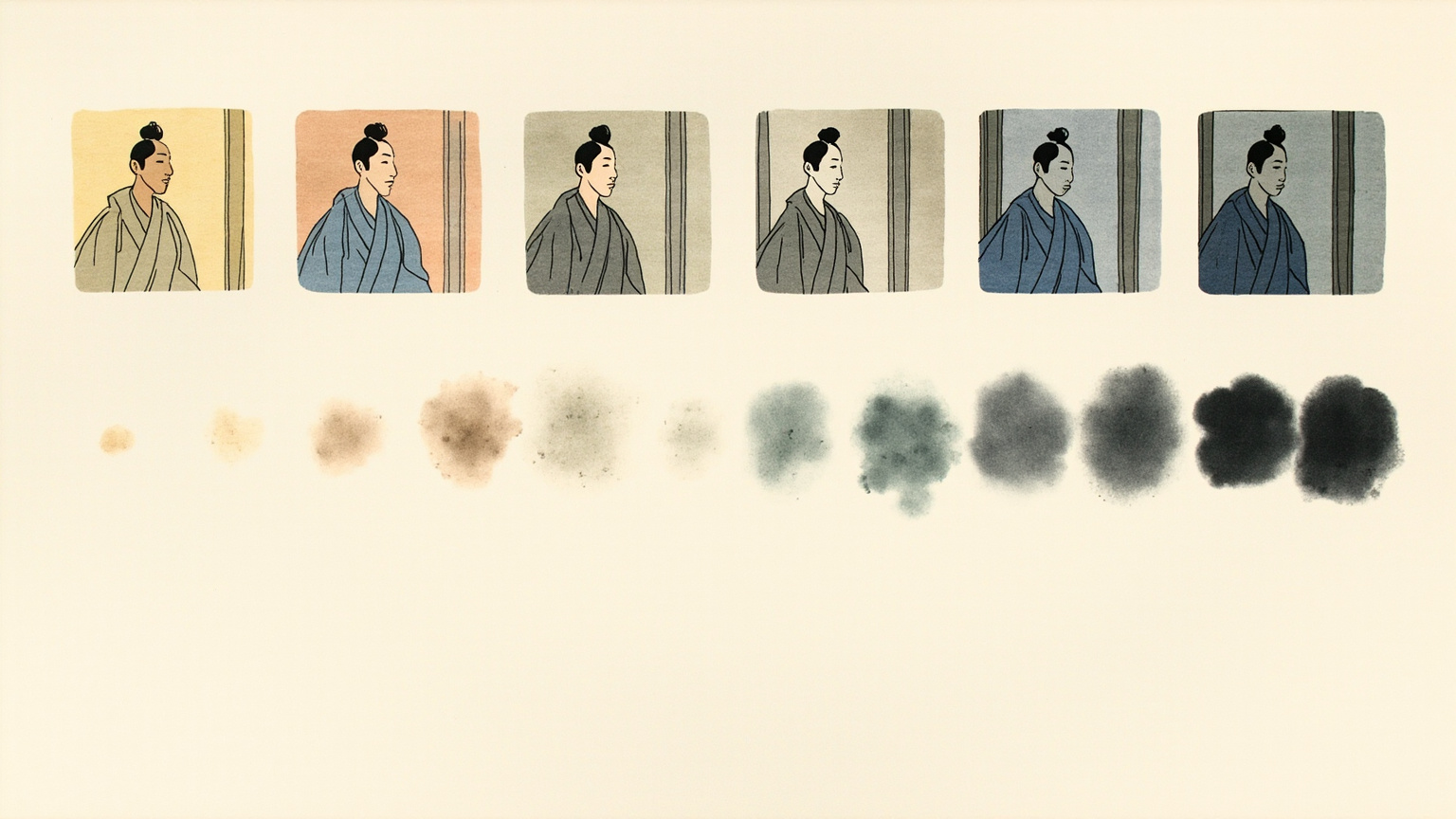
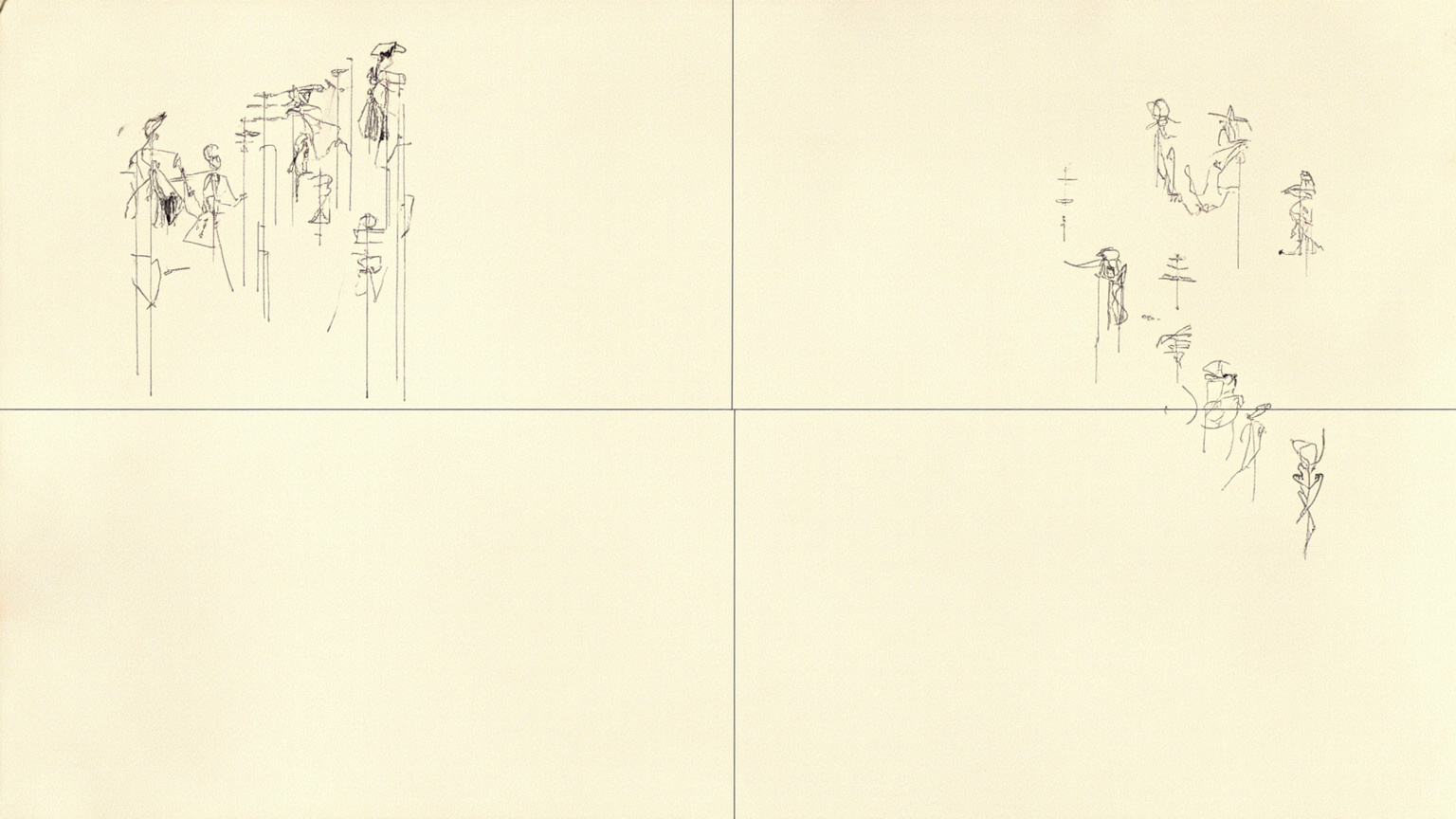
Art Direction4 plates
Before the guide was written, this book got a visual foundation — every illustration you just read grew out of it.