Mujong / The Heartless (무정) · Companion Guide
无情
三个朝鲜青年,一段三角旧情,一座被殖民的旧京城在脚下塌成新的去处——谁先动身,谁就被留下来
Opening
A steam train sits at the platform of the Seoul station — Kyŏngsŏng, under its colonial name — steam rolling off it, and a young woman boards alone, a leather case in her hand. She doesn't look back at the platform. Behind her, Kyŏngsŏng holds her old life; ahead, no one is waiting. Her name is Pak Yŏngch'ae. A man has just left her behind, and a flood has just swept over her a second time. The home she can't go back to is a trade, and the home she can go back to isn't really a home either. The train pulls out. This is the closing scene of the first modern novel in Korean literature.
What This Book Is
Mujŏng was written by Yi Kwang-su, pen name Ch'unwŏn, in 1917, and began running that summer as a serial in the Maeil Sinbo. It's widely recognized as the first modern novel written in Korean, and the zero point for everything that followed in modern Korean fiction. Before it, Korean-language fiction was still learning to walk. After it, a tile-roofed hanok and a mission school, a kisaeng house and the University of Chicago, could all fit inside the same book.
You can't get through a Korean-language textbook without running into it, and the reasons split two ways. Half is form: the vernacular syntax, the first-person interior voice, the borrowed foreign words — all of it got demonstrated here first. Half is subject matter: serialized in a colonial-era newspaper, it blew a love triangle among young Koreans up into a confrontation between old Korea and new, between modernity and colonial rule.
Three People, Two Old Threads
The male lead, Yi Hyŏngsik, is twenty-five or twenty-six, an English teacher at a mission school in Seoul — clever, easily embarrassed, and quick to duck whenever a decision comes due. Two women are pulling him in opposite directions. One is Kim Sŏnhyŏng, from a wealthy Christian family in Seoul, just graduated from a Western-style school and planning to study in America — clean and untouched as a freshly printed textbook. The other is Pak Yŏngch'ae, already mentioned above: raised in the Confucian manner, gifted at music, who fell into kisaeng life once her family's fortunes collapsed. Her world is old words, old songs, pawned clothes. The two women stand on either side of him, one holding the new faith and the new language, the other the old upbringing and a history of being wronged. Hyŏngsik knows exactly how much weight this carries — he just keeps putting off every choice — and so all three of them get pulled into the larger tearing apart of colonial Korea.
The first time I read this far, I stopped short: a man of twenty-five or twenty-six with a young woman standing on each side of him, and he chooses neither A nor B — he just makes the whole street wait through his indecision along with him. We've seen this particular hesitation so many times since, in Korean fiction that came after. Its ancestor is probably sitting right on this page.
The Triangle Tears Open an Old Nation
The story opens in the hallway of a mission school in Seoul. Hyŏngsik teaches English; across from him sits Sŏnhyŏng, fresh out of a modern school, already able to recite English poetry, already knowing where America is. On the other side of town, down a lane of mud walls, is Yŏngch'ae — her family, too, was once respectable, and she was the most musically gifted of its daughters, before she fell into kisaeng life. She still thinks of Hyŏngsik as the boy next door from her childhood. Hyŏngsik goes back and forth between them, and the longer he does, the softer his resolve gets. What Sŏnhyŏng stands for — the new — has a way out: faith, schooling, a passage abroad. What Yŏngch'ae stands for — the old — is a world already pawned off: sold as a girl, nearly assaulted on the road, later a near-drowning in the river she threw herself into. The book gives each of these three turns only its outcome, never the scene itself. Hyŏngsik's feelings for her can't get past that door, and yet he can't wipe out the old world just by standing next to Sŏnhyŏng either.
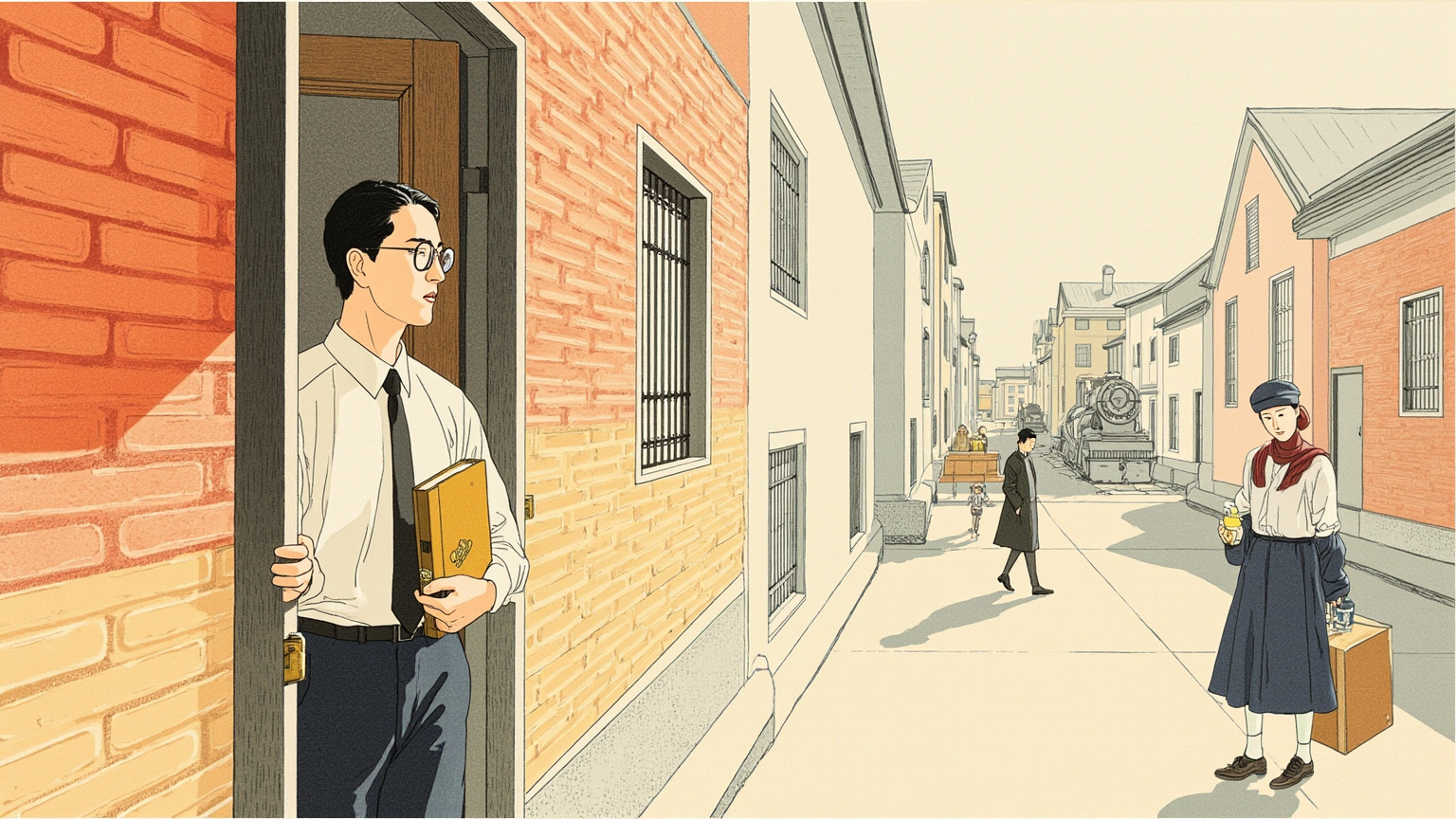
From one side sat Sin-hyang, who had just been graduated from the new school, able already to recite English verses and to point out on the map where America lay.
一侧坐着善行,刚从新式学堂里出来,已经能背得出英文诗,也已经知道美国是在地图上的哪一处。
金句 · 第三章 · 走廊与三角
This particular tear is what made the 1917 newspaper serial detonate the way it did. The triangle here refuses to stay a triangle: it swells into the question of how Korea itself should go on living. Hold onto the old ethics, and you're holding onto exactly the part of it neither Sŏnhyŏng nor Hyŏngsik wants to keep. Run toward the new schools, and you're leaving a debt behind — the debt of Yŏngch'ae, left standing where she was.
The Same Ship, Separate Minds
Sŏnhyŏng and Hyŏngsik move first, bound for Tokyo to study. This is a real shipping route from the 1910s: all three leave Korea on the same vessel, running Busan–Nagasaki–Yokohama, its third-class holds packed with young Korean students. Sŏnhyŏng and Hyŏngsik got engaged before setting out, and going to Japan is meant as the step that leaves the old ethics behind on the dock. Yŏngch'ae boards the same ship, but the story doesn't turn her into a convenient tagalong or a chance fellow passenger — it brings her old life onto the ship with her: the look in her eyes, the old feeling still running between her and Hyŏngsik, how out of place she is in a Western-style cabin. Three people crammed onto one ship, and none of them can pretend not to see the others. When the ship reaches a port partway, Yŏngch'ae disembarks alone and stays behind on the Nagasaki-Yokohama coast. Sŏnhyŏng and Hyŏngsik don't look back; they sail on toward Tokyo.
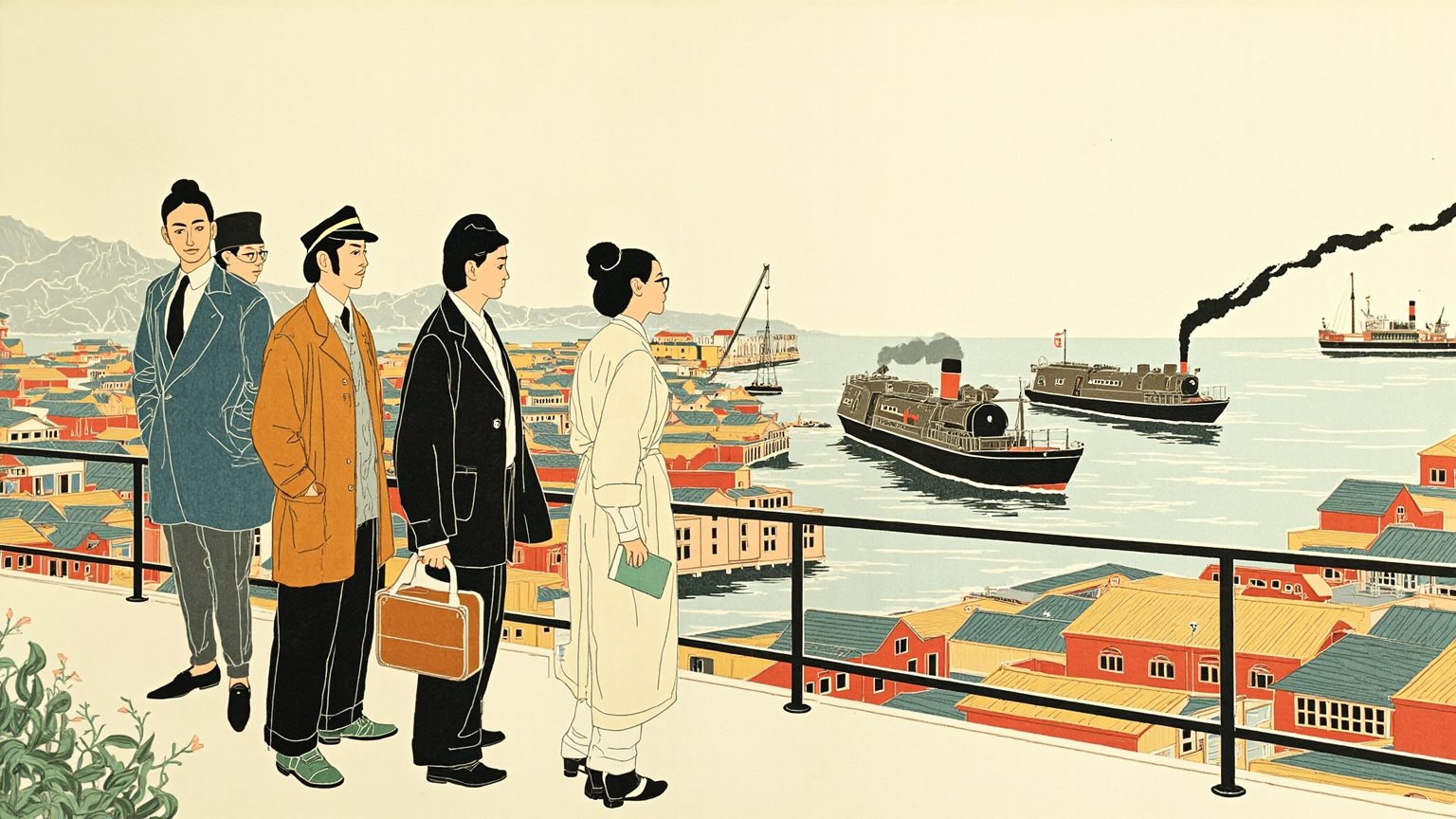
We three Koreans were leaving old ethics behind on the same boat, as though the very crossing of the sea could launder us clean of the past.
我们三个朝鲜人,把旧伦理一起留在了那条船上,仿佛只要渡过这片海,就能把旧的我们洗得干净。
金句 · 第七章 · 同船去东京
Their parting doesn't go far, though. There's a small move here that a lot of readers skip past: Yŏngch'ae never makes it to Tokyo. She stays in Seoul, and the reason is written so thin the book turns the page on it in a few words — but that one stroke redirects the whole force of the novel.
The Flood at Samnangjin
What comes next is an unexpected turn. Yŏngch'ae doesn't go to Tokyo, and she doesn't settle back into the kisaeng house either — she ends up in the flood zone around Samnangjin, right in the middle of a major flood. The book stays restrained about it: mud water, makeshift shelters, relief workers dead on their feet, and her with her sleeves rolled up, ladling out food bowl by bowl. A novel that had been running on personal feeling suddenly plants a woman barefoot in the mud.
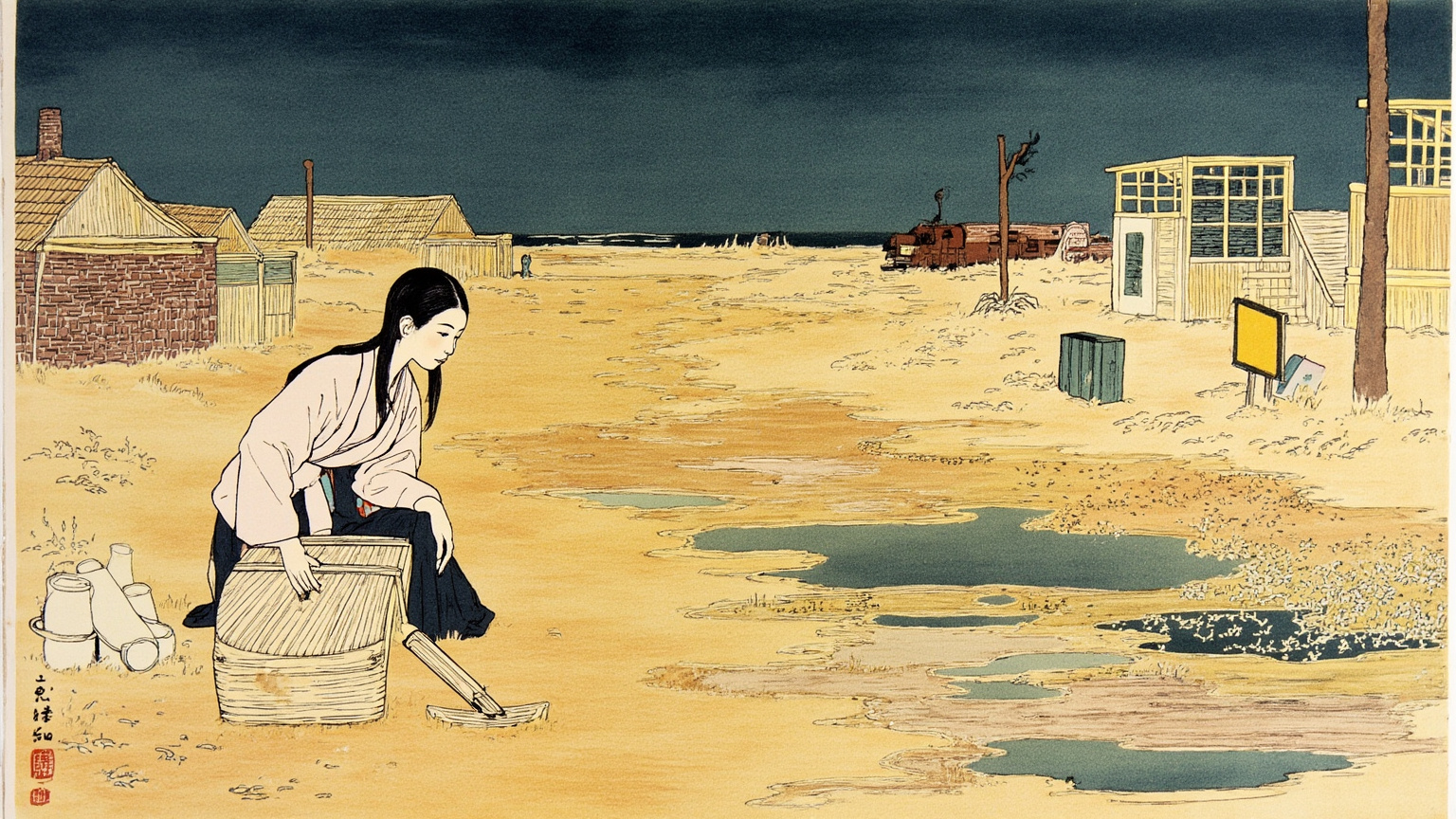
She had been crushed by the old world once; now, in another flood entirely, she learned at last what her own hands could still do.
她已经被旧世界碾过一回,这一回她陷进的是另一场洪水,可她在那泥水里,慢慢知道自己这双手还做得了什么。
金句 · 第十一章 · 三浪津的水
This is the hinge of the whole book. From here on, the main thread isn't just three people loving each other back and forth — it's someone who'd been ground down by the old ethics discovering, in a different kind of flood, what her own hands and feet can still do. The same novel starts leaning, from this page on, toward national awakening.
On to Chicago
In Tokyo, Sŏnhyŏng and Hyŏngsik don't stop moving. They set out again, this time across the Pacific, headed for the University of Chicago. A serial novel from 1917 had already drawn the map of new learning, in young Korean eyes, all the way to North America. At the time this was a startling distance to go — Tokyo wasn't the endpoint; if you were going to chase this new knowledge, you went to its farthest outpost.
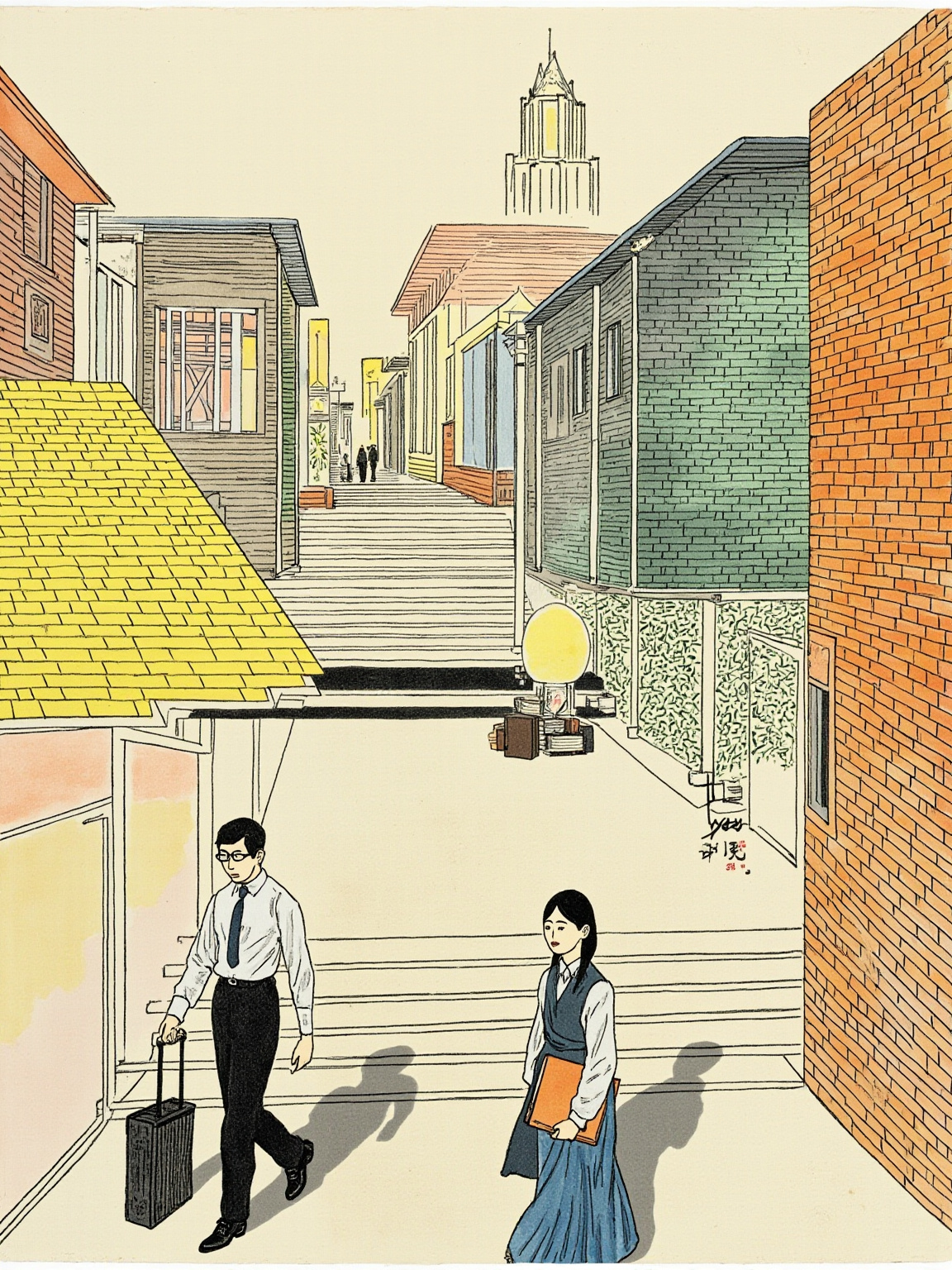
They were already picturing, in a Korean eye of 1917, the new learning set down on the very steps of Chicago.
一九一七年的朝鲜人,已经把这门新学问,安放在了芝加哥的石阶上。
金句 · 第十五章 · 太平洋那一头
To put both leads in a Chicago classroom at that point in history is the author telling his readers something specific: for young Koreans, wanting the new reached past a change of government, all the way into a different kind of mind. Inch by inch, this book closes the distance between the two worlds down to almost nothing.
She Boards That Train
The ending returns to that same train from the opening. Yŏngch'ae never goes to Tokyo, never goes to Chicago — in the end she rides the train alone, back to the kisaeng house in Seoul. The book doesn't say whether she cries, doesn't say who she hates. It just walks her back to that window and shuts the door. She's the one left behind, not because no one loved her, but because the old world she carries is too heavy, and the ship to the new one couldn't carry it for her.
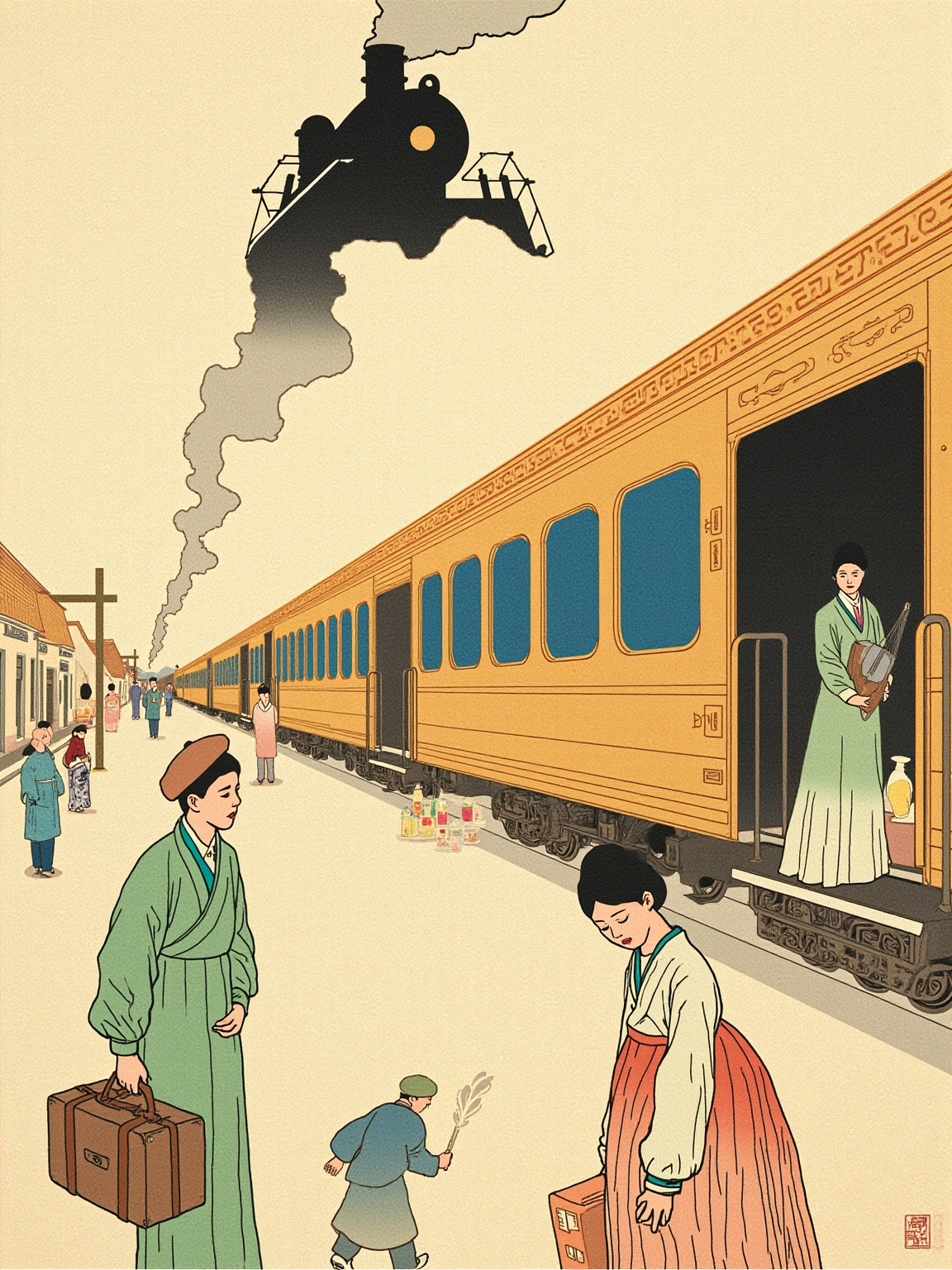
The age turns, and stops for no one; a heart, it turns out, may be the most unfeeling thing of all.
时代的轮子不替谁停,原来最无情的,是这一颗心。
金句 · 尾声 · 归车
Three young people step off the same ship into three different lives: Sŏnhyŏng and Hyŏngsik head overseas toward new learning, and Yŏngch'ae stays behind in colonized Korea — the new life and the old one split apart for good, right there. This is what the word Mujŏng actually names: the heartlessness of a wheel of history that stops for no one.
Why It's the Origin Before the Origin
These three types take their seats for the first time in this 1917 serial, and everything that follows is some variation on them. Other books had touched similar material before; what's original here is that the characters themselves were minted on this page. The modern schoolgirl, the once-gifted woman fallen into disgrace by the old rules, the man caught wavering between old and new — nearly all of Korean literature that came after keeps rewriting these three people.
The same holds for form. This is the first book to tell a love triangle in modern sentences ordinary Koreans could read without stumbling, the first to hold first-person interiority, English words mixed with Chinese characters, and cuts between city and countryside all steady on a single narrative line. Every modern Korean novel we read today has a copy of Mujŏng pressed underneath it.
The Author's Ledger
The author, Yi Kwang-su, pen name Ch'unwŏn, went on to walk a path later generations find hard to talk about plainly. From 1939 on he worked in service of Japanese colonial rule, and his name sits on the list of pro-Japanese collaborationist writers. A 1917 work that carried the new nation's imagination and the choices its author made afterward are two separate ledgers, and neither cancels out the other.
So reading Mujŏng can't mean treating it as some spotless model to worship. Reading it means holding both facts at once: that it drew the first line of life for modern Korean literature, and that its author later ran up a separate debt to this land. Only holding both of those together is actually understanding the position this book stands in.
A foundational book has always owed us one discipline: keeping where its author stands separate from where its work stands.
Knowing the Story Isn't the Same as Reading It
The plot is told now, but anyone who has never opened the actual text of Mujŏng is missing the texture of language that is over a century old — the awkwardness of old-style, well-bred sentences colliding with new-style schoolroom syntax, an awkwardness that fits exactly the half-formed state of a 1910s Korean mind. Every one of Hyŏngsik's hesitating internal monologues, the single motion of Yŏngch'ae bending down in a rain-soaked shelter — that physical sense can only grow out of the original text, and no summary can stand in for it.
Then there's the geography — a Seoul where tile-roofed hanok sit beside red-brick school buildings, ferries crossing the Han River, makeshift shelters in the mud at Samnangjin, the whistle of a ship at Yokohama or Nagasaki harbor in the 1910s, stone steps in a Chicago a hundred years gone. A novel drew the world of young Koreans out that far; to really stand on that ground, to walk it out behind those three pairs of feet, you still have to open the book yourself.
Art Direction4 plates
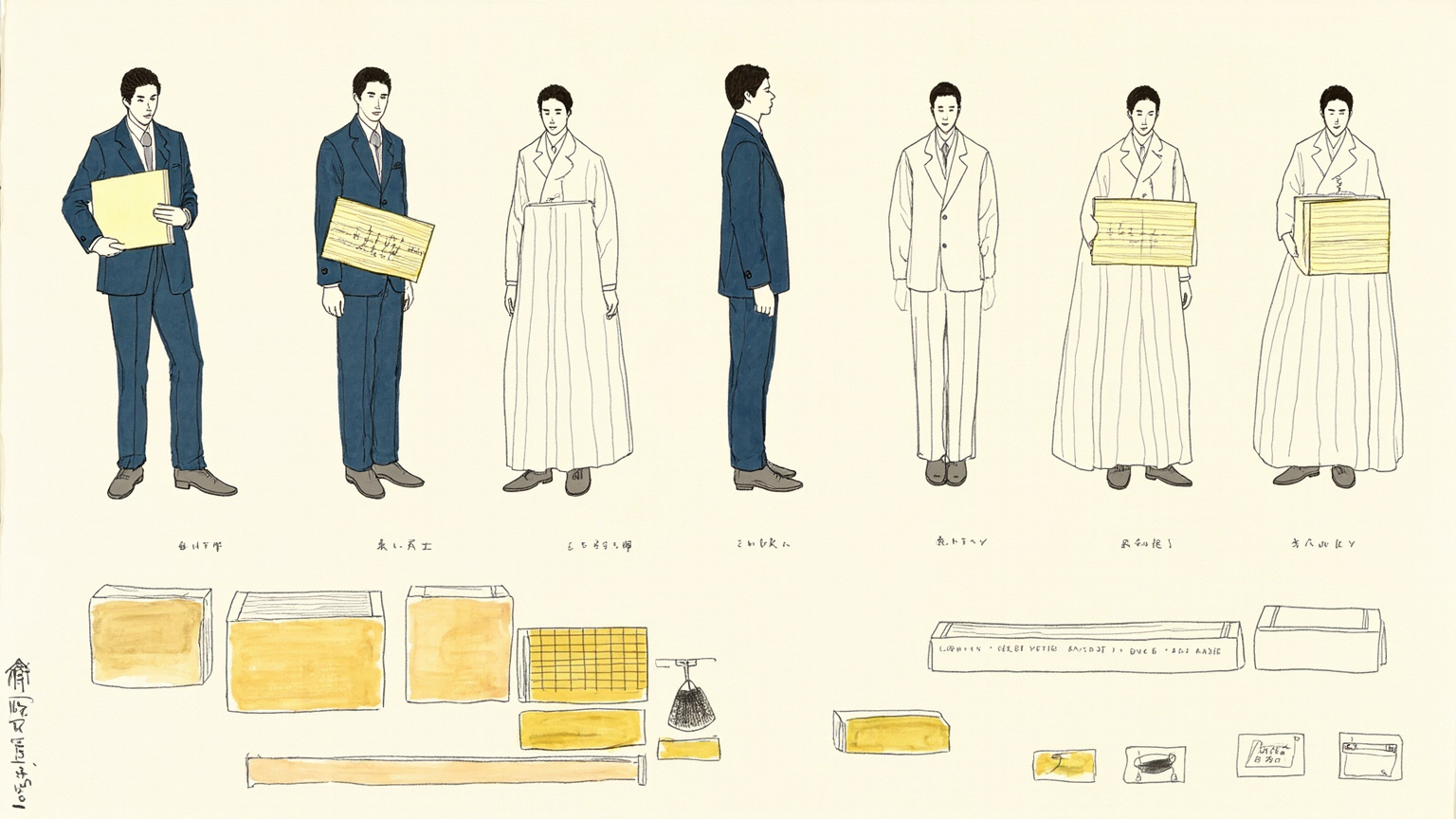
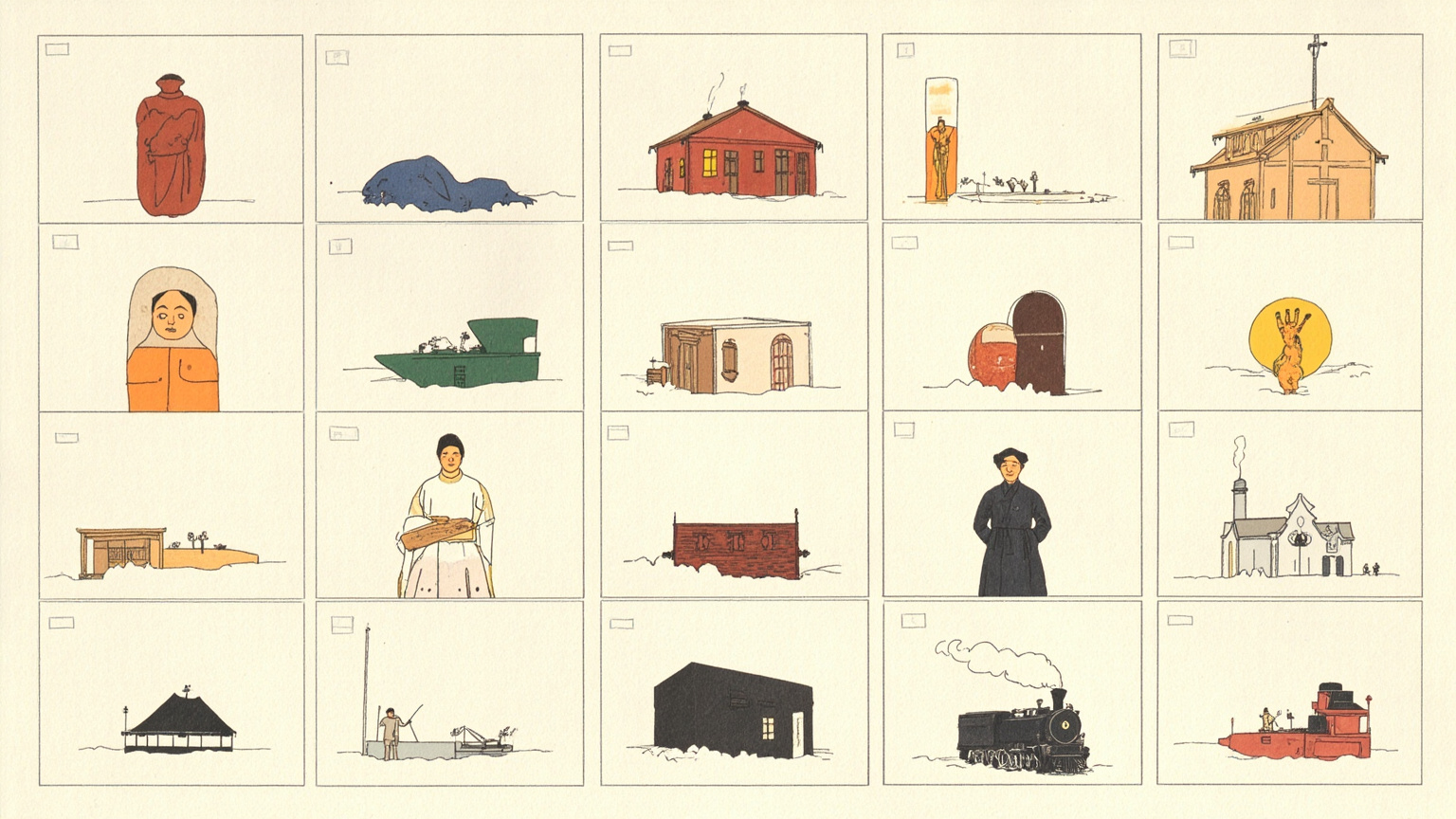
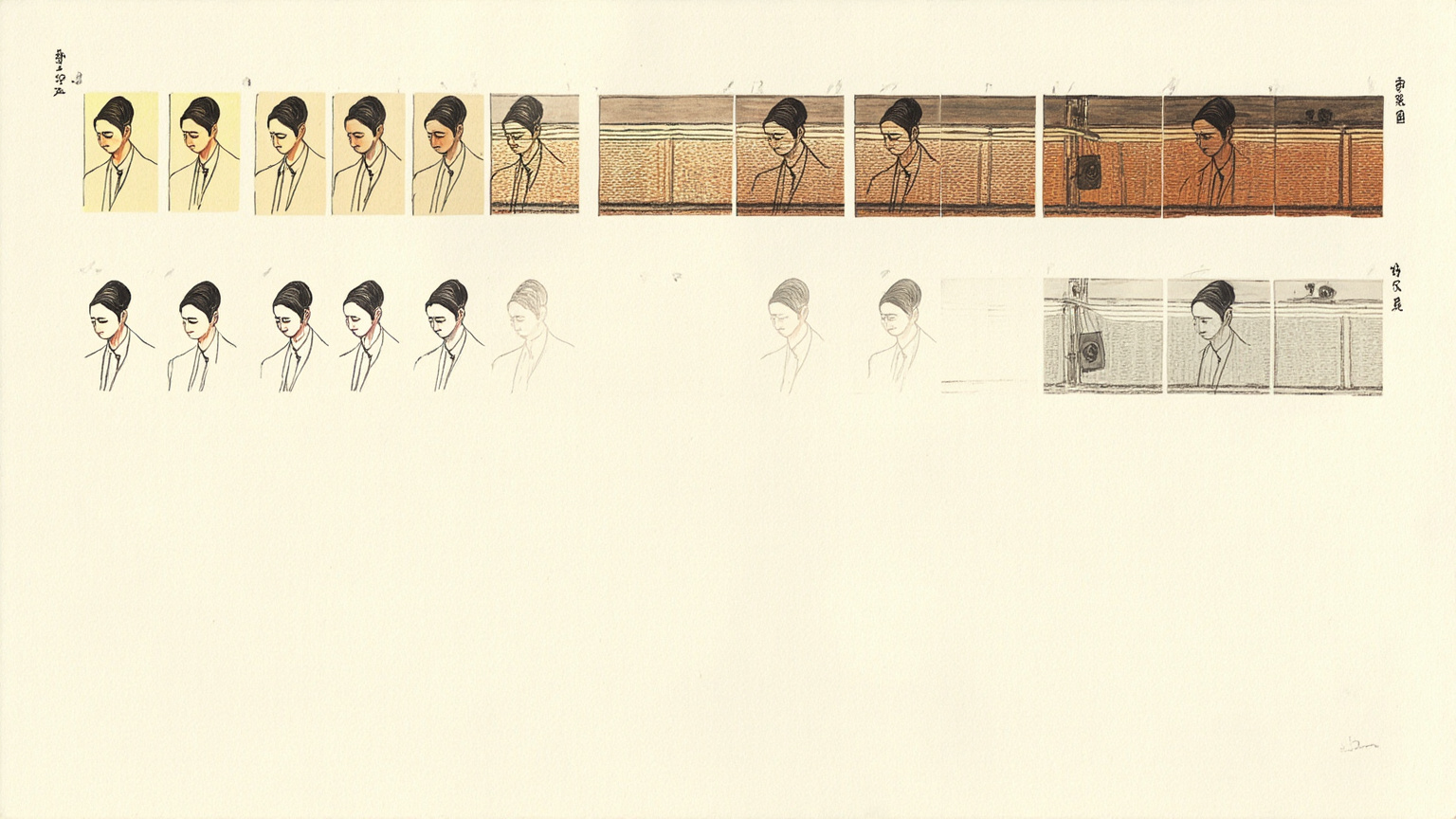
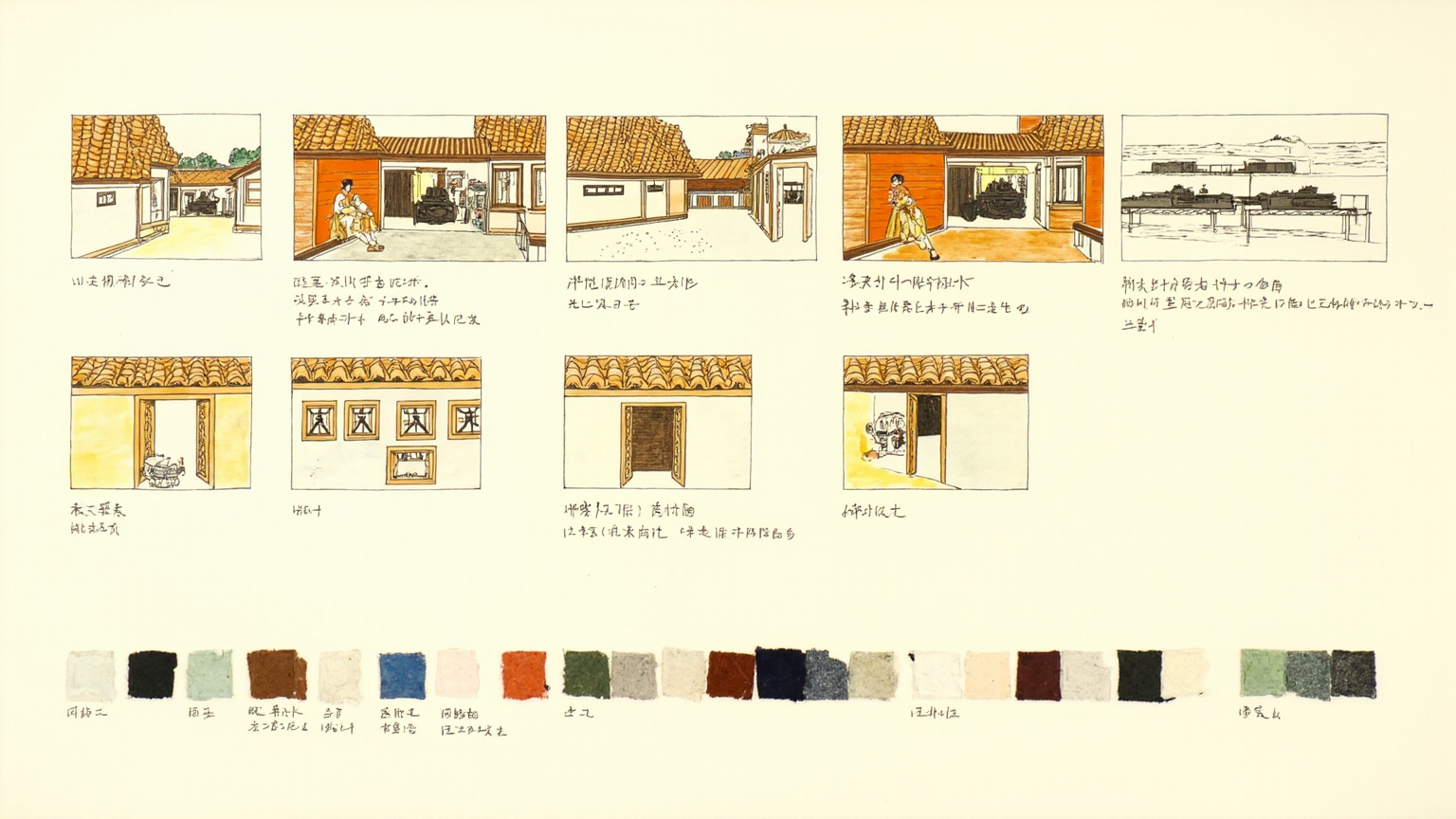
Before the guide was written, this book got a visual foundation — every illustration you just read grew out of it.