Pirkei Avot (Pirke Aboth / The Ethics of the Fathers) · Companion Guide
犹太先贤箴言录
圣殿已成焦土,一卷口耳相传的格言,如何撑住一个没有祭坛的民族走过两千年。
Opening: A Hand, Half a Denarius
A hand reaches out from beneath a ragged cloak, takes the half denarius, and disappears into the dusk-lit alley. This is Hillel. Legend has it that his day labor earned him only half a copper coin, and he spent the other half of the day on the academy's stone bench, ear pressed to the teacher's mouth. A man too poor to afford shoes went on to become the founding sage of the academy at Yavneh, and left behind a line the West has quoted for two thousand years: If I am not for myself, who will be for me? If I am only for myself, what am I? If not now, when? This book begins with him — or rather, with the longer chain that runs back before him.
Read it as a Jewish Analects and you are already most of the way there. It is a collection of sayings in the same mode: a teacher speaks, disciples respond, now and then they argue, and the master's lines get passed down the line. But it was born into a more brutal age than the Analects — not amid the chariot ruts of the Warring States, but on scorched earth.
What Kind of Book This Is
It was compiled around the turn of the second and third centuries by Rabbi Judah ha-Nasi in Roman Judaea, as one tractate of the Mishnah — the written compilation of Jewish oral law. The Mishnah's six orders handle the concrete legal detail of daily Jewish life; this tractate, Avot, is its ethical preface. It says nothing about which offering to bring or how to wash — only what kind of person a human being should become. The standard English translation dates to the late nineteenth century, by Charles Taylor, and anyone who has ever sat through a Bar Mitzvah speech has probably quoted a line from it without knowing where it came from.
Its place in Judaism resembles the Analects' place in Confucian tradition: read aloud at home on Sabbath eve, recited at a child's coming of age, quoted at weddings by brides and grooms who reach for a line without thinking twice. For two thousand years it has stayed with the Jewish people through the loss of the Temple, through exile and dispersion, through every night of massacre and assimilation. It never disappeared, because it never depended on that Temple in the first place.
The People and Their World: An Age Without an Altar
This unfolds in an age that looked like it had lost everything and had in fact gained everything. In the year 70, the Romans burned the Second Temple in Jerusalem — the one place where Jews had offered sacrifice for a thousand years, where priests had slaughtered cattle, thrown blood, and burned incense. After that, the priests were out of work and the incense went cold, but Judaism did not die. A circle of rabbis, sitting under the olive trees of Galilee and on the stone benches of Yavneh, announced something outlandish: from now on, studying the law was itself the sacrifice; reciting the Torah was itself the work of the altar.
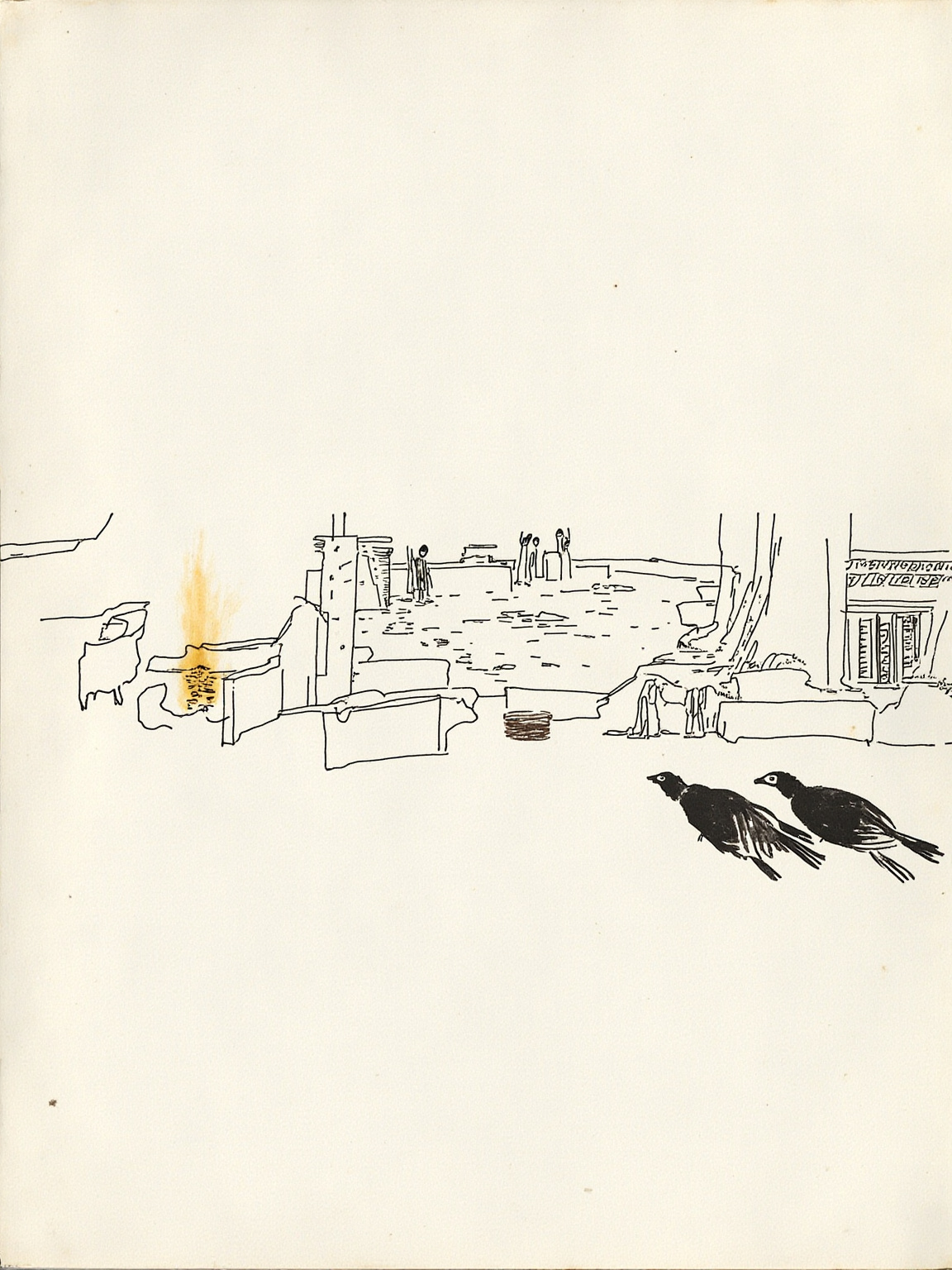
Moses received Torah from Sinai and transmitted it to Joshua, Joshua to the Elders, and the Elders to the Prophets, and the Prophets to the Men of the Great Assembly.
摩西在西奈领受妥拉,传于约书亚;约书亚传于长老;长老传于先知;先知传于大议会的人。
金句 · 第一章 · 传承之链 (Shalshelet HaKabbalah)
So the figures who step forward are no longer priests but teachers. Hillel and Shammai stand together as the two founding sages of the Yavneh academy — not master and disciple, but the founders of two rival schools, one preaching leniency and accommodation, the other strictness and urgency, and for three generations their disciples argued across every page of the Mishnah. After them comes Rabban Yochanan ben Zakkai, the old fox who is said to have played dead and had his students smuggle him out of besieged Jerusalem in a coffin, just to get an audience with the Roman general Vespasian. Then Rabbi Akiva, an illiterate laborer until forty and the greatest sage in Yavneh after it. Then Rabbi Judah ha-Nasi himself, the man who gathered all of it into a book. It is a group portrait with no king in it — a portrait of teachers.
The Chain of Transmission: From Sinai to Yavneh
The book opens with a bare-bones list: Moses received the Torah at Sinai and handed it to Joshua, Joshua to the Elders, the Elders to the Prophets, the Prophets to the Great Assembly, the Great Assembly to the Pairs, the Zugot, the Pairs to Hillel and Shammai, and finally down to the rabbis of Yavneh. One line after another, like a relay baton — Moses handed it to Joshua, Joshua handed it to the Elders — no argument, no miracle, just an unbroken chain. This is the foundation on which the whole book's authority rests: the Jewish oral law was not composed by any one man, it was passed hand to hand from the revelation at Sinai. I stopped short reading it. It turns out the God of the Jews comes down through the ear.
As a piece of writing, this is a roll call. No story, only names — but the act of naming is itself the story. When a people has lost every physical thing it owned, Temple, land, priesthood, the one thing left to hold onto is a name. To remember the teacher's name is to remember that the Torah was never broken.
Hillel's Half Denarius, and Shammai's Short Temper
Hillel's story has become something close to folklore among Jews. He heard there was an academy in Jerusalem he wanted to sit in on, but he was too poor to pay the entrance fee. The legend says he climbed onto the roof and pressed himself to the skylight to listen in, and in a snowstorm he froze there and nearly died. It was Shammai — yes, that same hot-tempered Shammai — who saw snow drifting down into the room on the Sabbath and shouted for everyone to clear the house, there was a dead man on the roof. Hillel was pulled down and revived, Shammai took him on as a student, and the two later stood as equals at the head of the academy.
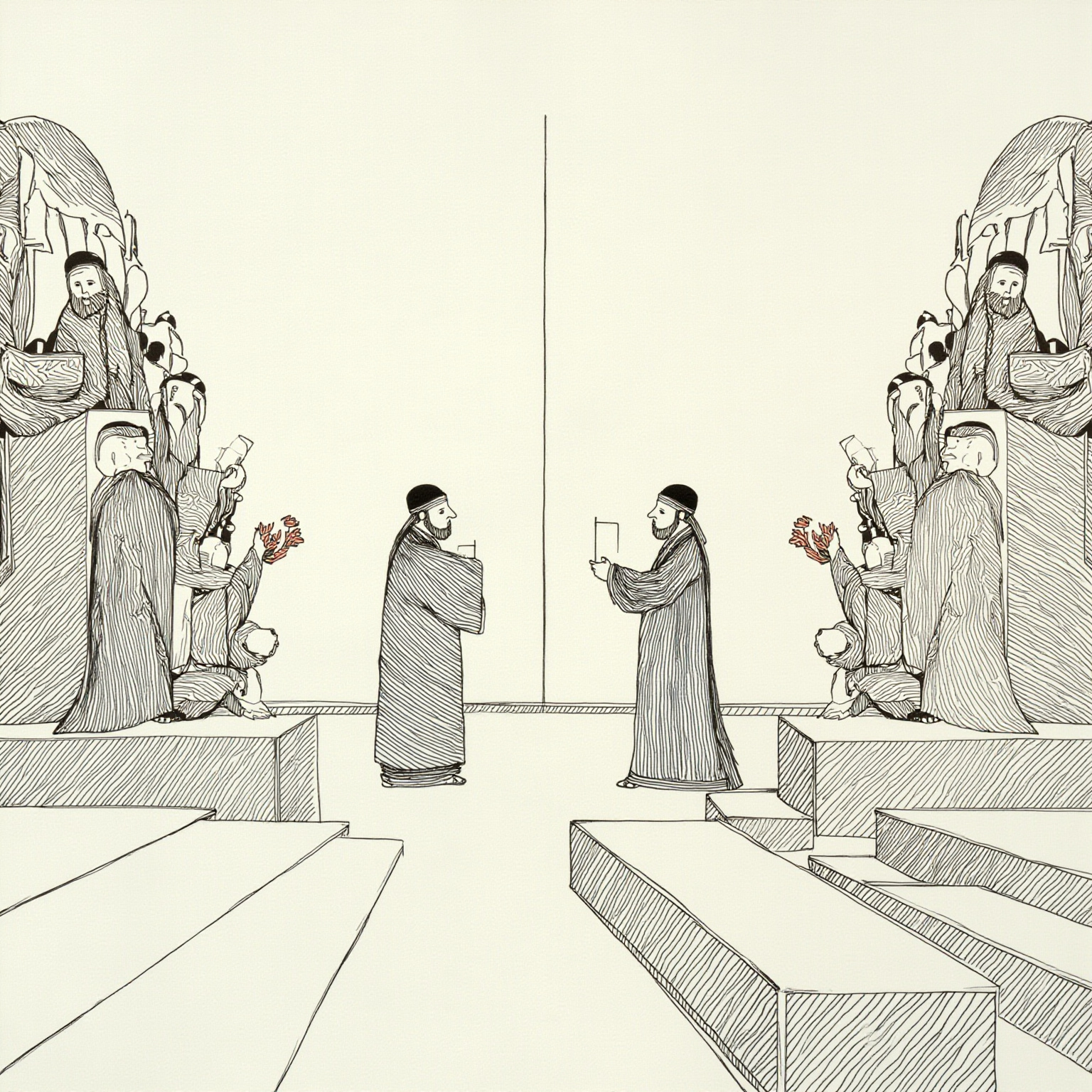
Go and acquire for yourself a friend; and let your mind's judgment be a guide to your own actions.
去为自己择一位同伴;让你的判断,成为自己脚步的尺度。
金句 · 第一章 · 希勒的告诫
Hillel's followers grew into the House of Hillel, Shammai's into the House of Shammai. Turn a few pages of the Mishnah and you run into another line like it: on such and such a matter, the House of Shammai says X, the House of Hillel says Y, and the law follows this one or that one. This is Judaism's strangest form of politics, settled not by force but by argument. Three generations of arguing, a verdict finally reached, written into the book, still being read aloud centuries later.
Hillel's own lines get quoted again and again: Go and study Torah even in a place you despise, for its master remains its master — meaning it does not matter whether you like the place, or what temper the teacher has; the Torah itself outweighs your comfort. Whoever exalts himself will be brought low, and whoever humbles himself will be exalted — eight words that Christianity has borrowed and repeated for a thousand years, tracing back, in fact, to right here.
Dusk at Yavneh: When the Altar Became a Lecture Hall
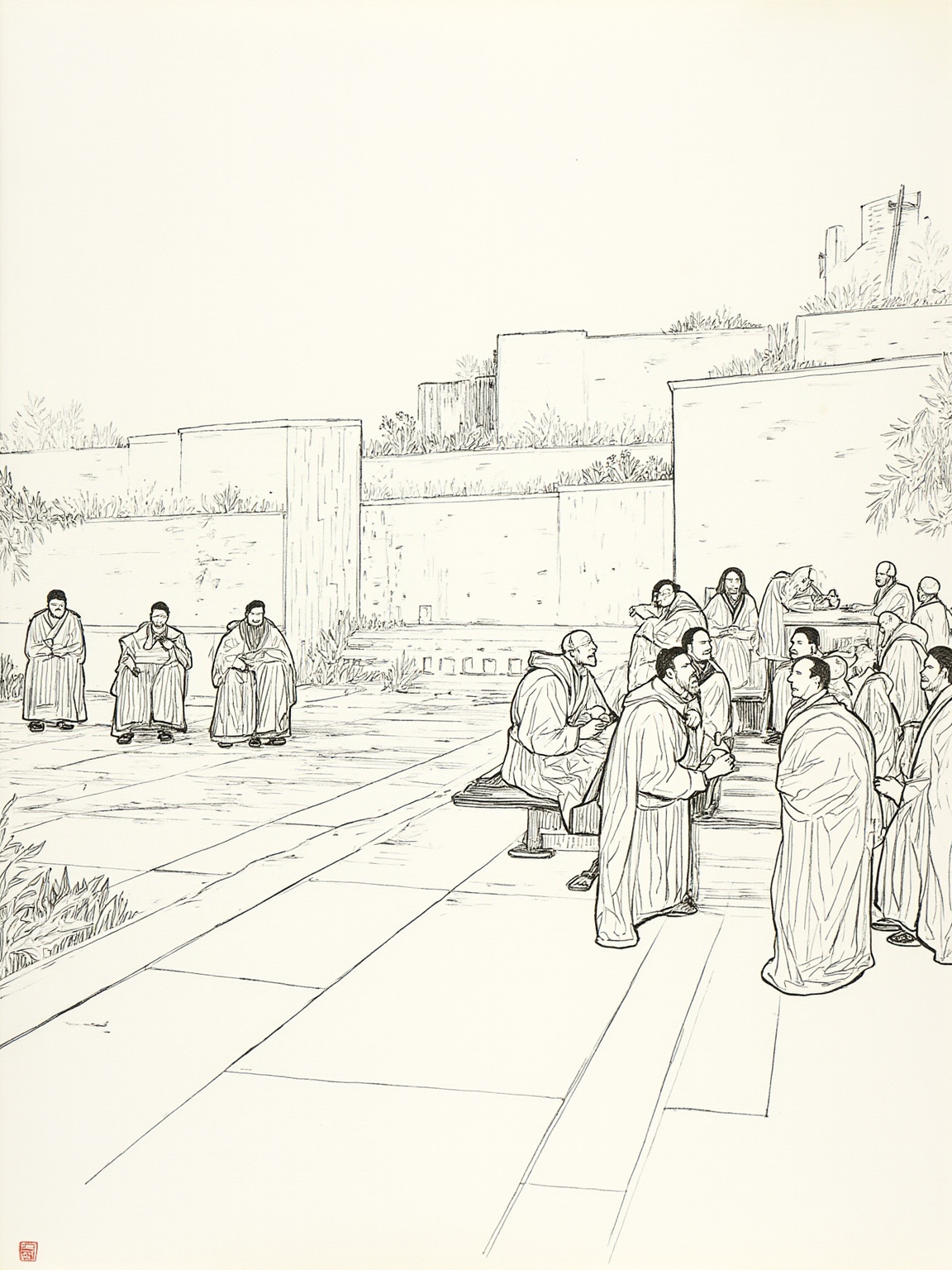
After the fire of the year 70, Rabban Yochanan ben Zakkai — the one who is said to have played dead and had his students carry him out of besieged Jerusalem to reach the Roman general Vespasian — secured permission to found the academy at Yavneh. A new center grew up out of the ruins: under the olive trees at dusk, students sitting in a circle, a rabbi speaking. This is the true stage of the Mishnah's ethical tractate. No more blood of cattle and sheep, no more smoke from the incense, only argument, recitation, and a courtyard of stone benches ringed with students.
This generation of rabbis did something more fundamental still: they translated the merit of the Temple into the merit of Torah. The line, roughly, is this: without the Temple, the world stands on three things, the study of Torah, worship, and acts of loving kindness. Sacrifice could go; these three could not. This is the hinge on which Judaism turned from a religion of sacrifice into a religion of study. As writing, the book never once mourns the destruction of the Temple. It turns the page on the old world and sets the new one standing in a single line, with a bluntness that stops you cold.
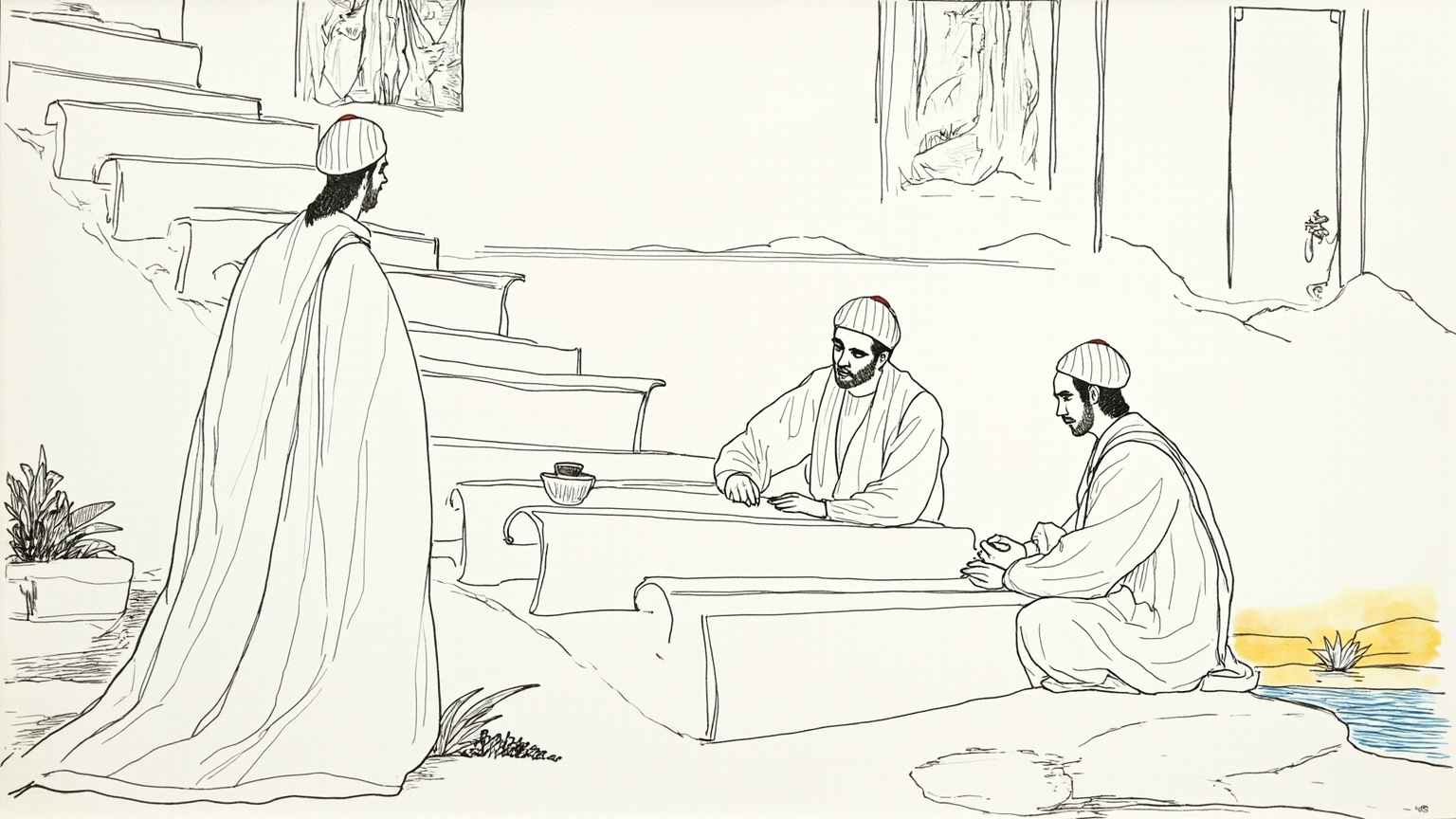
If the Temple is destroyed, the world stands on these three: on Torah, on worship, and on deeds of loving-kindness.
若无圣殿,世界仍立于此三事之上:研习妥拉、敬拜、与仁爱之行。
金句 · 第一章 · 亚夫内的三大支柱 (Shlosha Devarim)
Akiva: The Man Who Began at Forty
Legend has it he began as an illiterate laborer, and even the woman who chose him for a husband, it is said, did so because she saw in a vision what reward waited for him. Shame over his own ignorance drove him, at forty, to start learning his letters. Thirty years later he was the greatest sage in Yavneh, with tens of thousands of disciples. Asked once whether a certain commandment of the law still had to be observed, his answer was: study the law without pause, and speak of it as though you knew nothing of it, for even on the day you know nothing, you will still be rewarded.
This is the least intuitive move in the whole book: the more a person learns, the more he knows he does not know; the deeper he goes, the more he has to admit that even a day of knowing nothing earns its reward. It is a teaching about learning, and it is a teaching about humility. Real learning is not stuffing everything into your head, but understanding what your head cannot hold. Akiva's end came at Roman hands, flayed alive after the Bar Kokhba revolt, and he died reciting the Shema, Hear, O Israel, his voice giving out on the last word. This man who did not begin until forty became the very image of Jewish lifelong learning. He spent a whole life proving one thing: it is never too late to start.
Four Who Entered the Orchard: Seeking Wisdom Beyond What a Man Should
The strangest passage in the whole book runs only a few lines, and it sits there like a black star: four men, Akiva, Ben Azzai, Ben Zoma, and Elisha ben Abuyah, entered Pardes together. Pardes means, literally, an orchard; in rabbinic exegesis it names the fourfold mystery of interpretation, the literal, the allegorical, the allusive, the secret. The four went in, and this is how they came out. Akiva entered and left in peace. Ben Azzai looked, and died. Ben Zoma looked, and lost his mind. Elisha ben Abuyah cut down the shoots, and from that day was an apostate, known ever after as Acher, the Other.
This is the harshest warning Jewish tradition delivers against reaching for wisdom past what a person can bear. The line itself is short: to seek knowledge beyond your measure brings ruin on yourself. But its force lives in the four fates: one dead, one mad, one an apostate, and only Akiva, the man who began at forty and stayed humble to the end, walked back out. As writing, this does the hardest thing with the fewest words. It never explains what Pardes is, never explains why entering it goes wrong. It only lists four names and four fates, and lets the reader do the shaking.
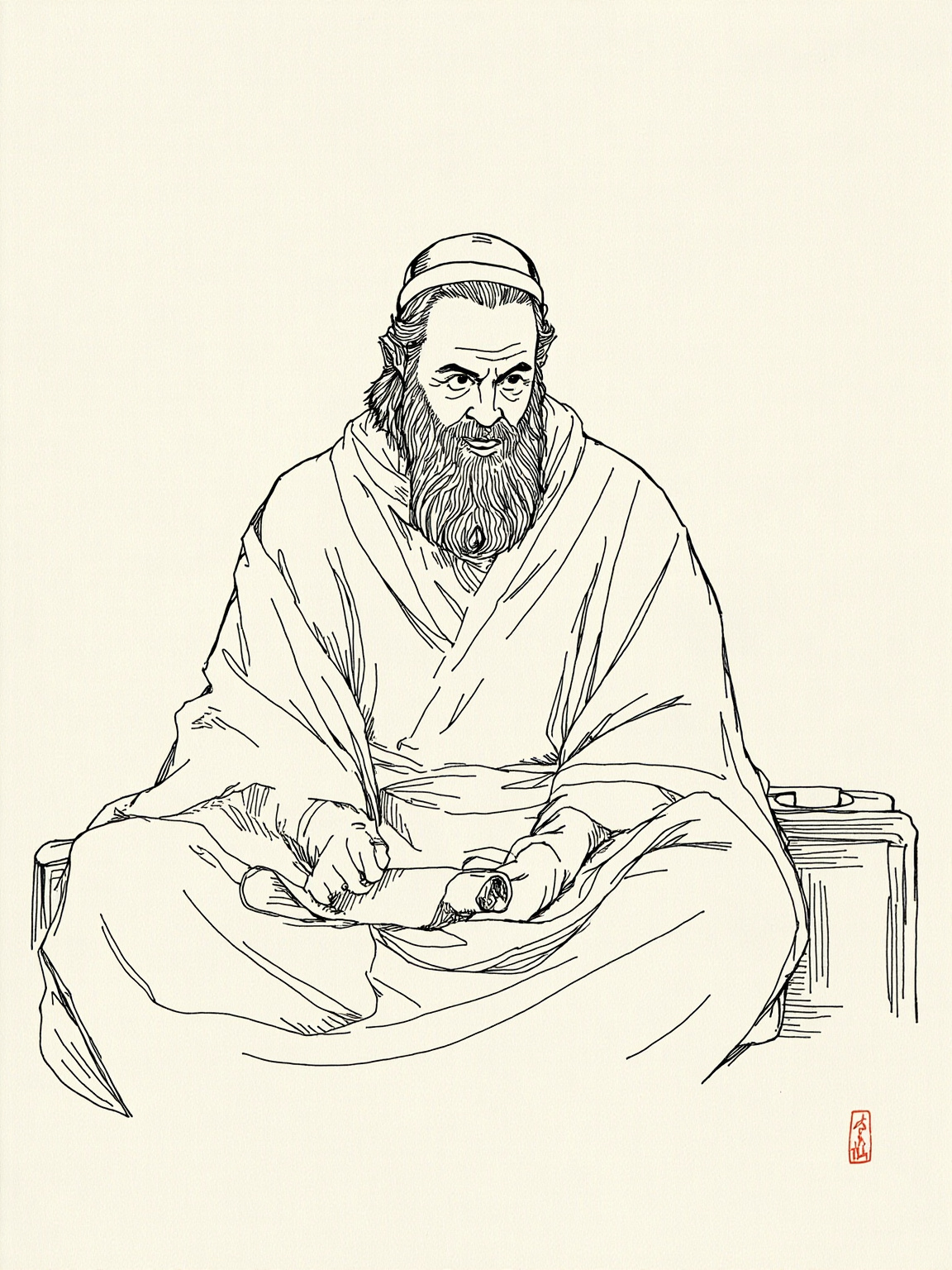
He who gazes upon four things — it would have been better for him not to have come into the world.
那窥见四事之人,倒不如不来这世上一遭。
金句 · 第四章 · 四入 Pardes
Elisha ben Abuyah is said to have lamented afterward: now that I have lost the tender shoot that was pure, how can I go on raising shoots for a child who is unclean? Meaning: should he still teach the young students newly come to the law? The question drives Jewish tradition's idea of a teacher's responsibility to its limit. Once a teacher himself has fallen into doubt, does he still have the standing to lead students? The book gives him no answer. The answer sits with the reader.
The Last Sages: Sayings for Everyday Life
The book's second half turns into a collection of sayings from its last sages: the compiler Rabbi Judah ha-Nasi, Rabbi Meir, one of Akiva's four great disciples, and dozens of other rabbis, each leaving behind a line or two. Here is a sample, in Rabbi Meir's voice: whoever labors without studying the law, his labor comes to nothing. Rabbi Hanina ben Dosa says: whoever acts for the sake of the soul, I will stand with him. Rabbi Hanina ben Gamliel says: there are three kinds of labor in the world, the work of the mind, the work of the tongue, the work of the hand, and blessed is the one who honors all three.
The whole book closes on two lines. One is Jewish realism at its plainest: everything is in the hands of Heaven, except the fear of Heaven. You till the field, you marry, you go into business, and the outcome belongs to Heaven, but your own reverence for it has to be yours alone. The other is a prayer: may His will be done, may His will be accomplished in heaven and on earth. Between the two sits the whole ethical weight of Judaism: do everything within your power, accept what you cannot control, but never skip the step of reverence.
What It Is Really Saying
It says three things, stacked one on top of the other. The most practical layer: a person should study the law, do good, stay close to the community, keep an open door for guests, and judge without favor, call it the ethics of character. The harder layer: when a civilization loses its physical center, its Temple, what keeps it alive? Transmission, names, teachers. This very tractate is the answer. The deepest layer: wisdom has a boundary, and reaching past it drives people mad, kills them, turns them into apostates, which is why Hillel keeps folding the word reverence back into his sayings.
He used to say: Whoever does these three things, he inherits the world to come: judgment, truth, and peace.
他曾说:凡行此三事者,将得入来世——公正、诚实、与和平。
金句 · 第一章 · 伦理之柱
The reason to read it today is just as practical. Two thousand years on, our own generation is losing things too: steady work, the church or temple down the street, a community you can actually see. The response those rabbis worked out, turn what you lost into something to study, turn the altar into a lecture hall, turn the physical into what passes from mouth to ear, still works. What makes this book great is not the polish of its sayings, but that it shows a civilization how to translate itself: how a new world grows out of the rubble once the old one has fallen.
Two thousand years ago, the rabbis already showed us this: a civilization survives not on buildings, but on names passed from one ear to the next.
Why the Original Text Still Rewards You, Even After You Know How It Goes
I told you the story of Akiva starting at forty, but the original carries another layer I could not hand you: the word ehad, one, the last word of the Shema, meaning the Lord is One, that stopped in his throat when the Romans executed him. That physical sensation of a word cut off mid-breath does not survive retelling. I told you the four fates in the orchard, but in the original, Pardes is also a code for the four levels of interpretation, Peshat, Remez, Derash, Sod, and how each level maps onto one of the four postures toward seeking wisdom. That density is exactly what gets lost when someone else tells it to you.
More important than any of that is the rhythm. The original is six short chapters of sayings, each holding a few dozen lines, each line meant to stand alone and be sat with alone, a book you turn a page of every week, not one you read straight through in a sitting. Hillel said, if not now, when. The way that best honors this book is to open it every morning, read one line, close it, and let that line turn over in your head for the rest of the day. That is how Jewish families have read it for two thousand years.
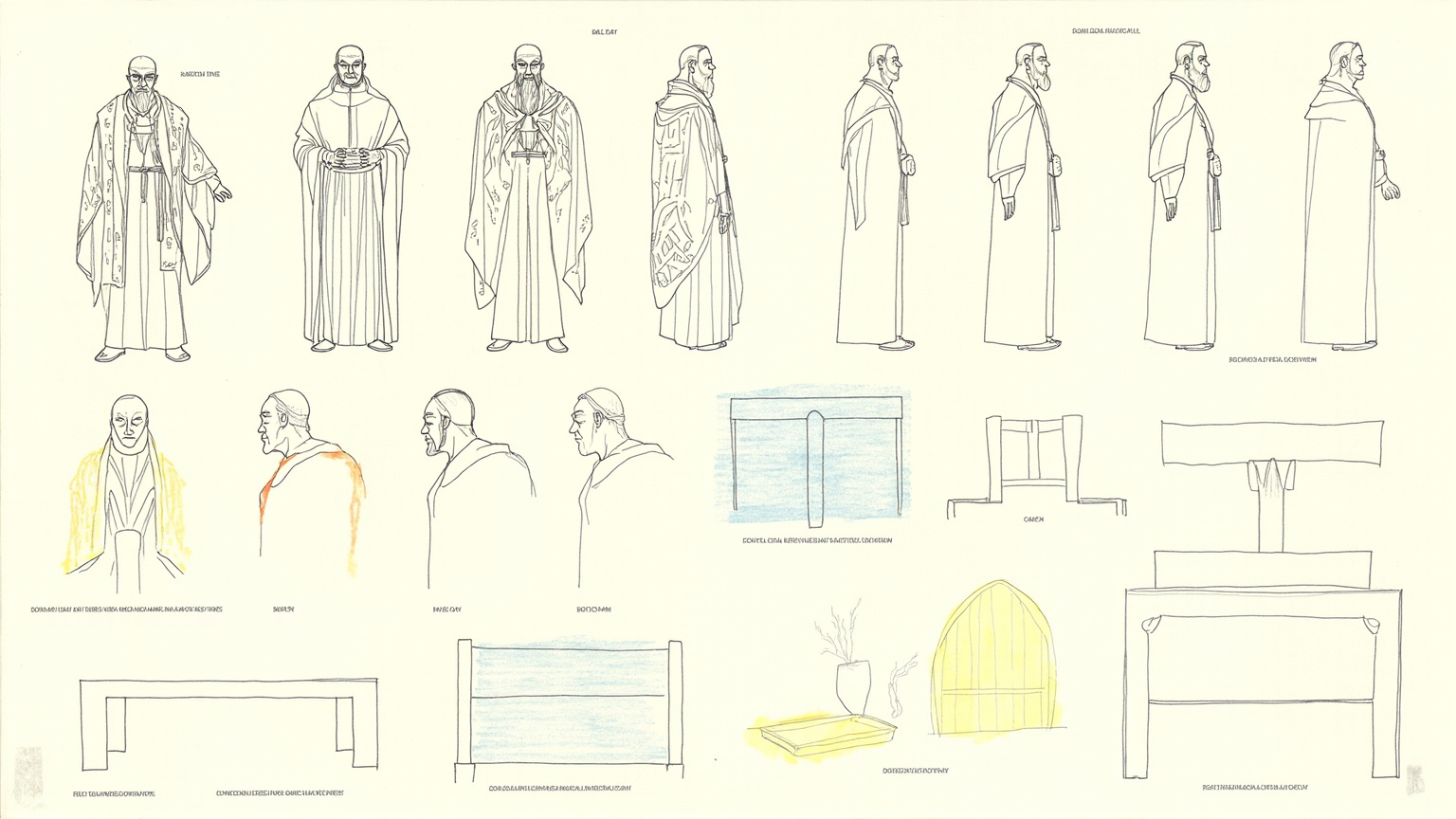
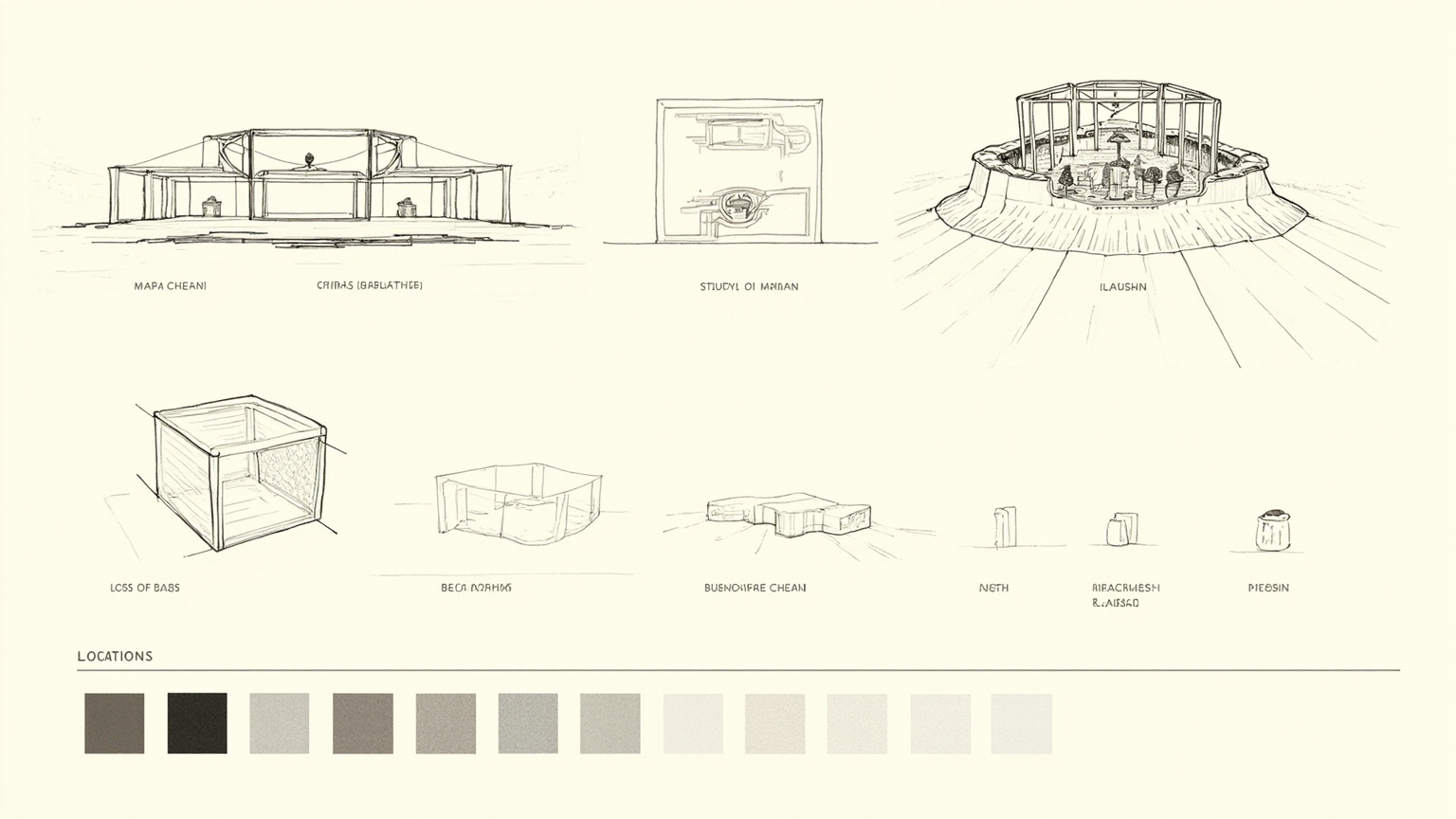
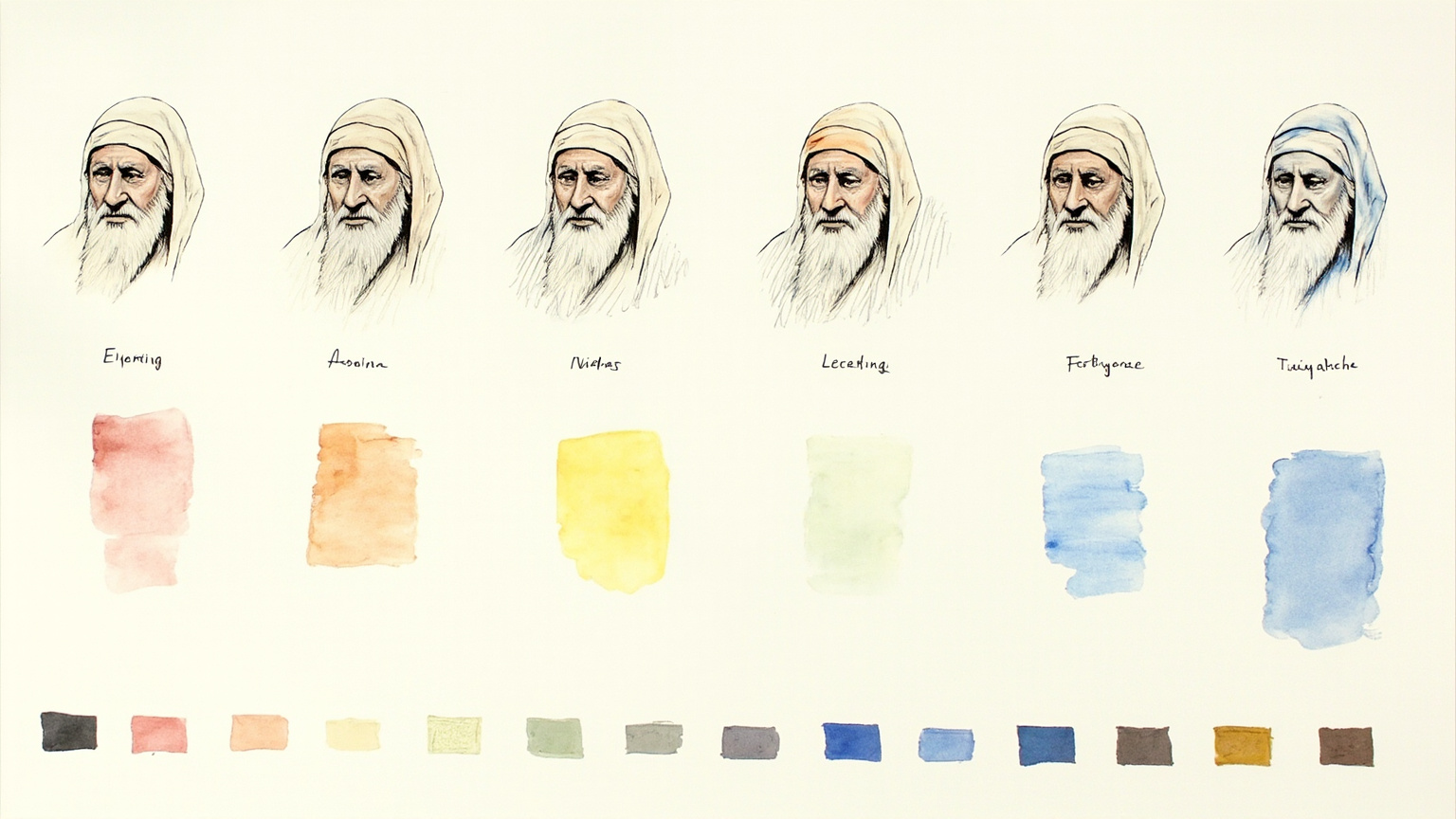
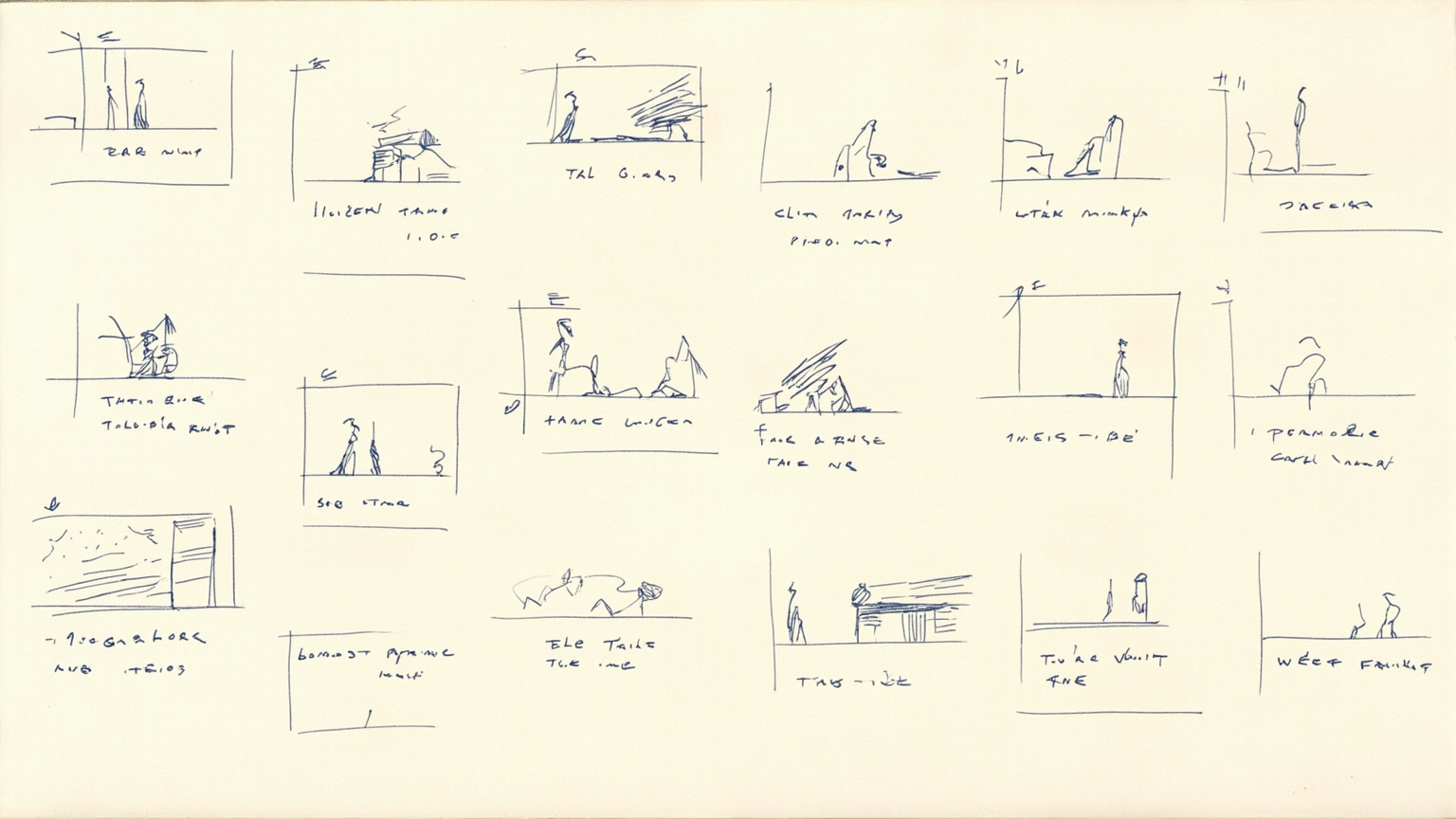
Art Direction4 plates
Before the guide was written, this book got a visual foundation — every illustration you just read grew out of it.