Prometheus Bound (Προμηθεὺς Δεσμώτης) · Companion Guide
被缚的普罗米修斯
铁楔穿胸,钉进山岩。盗火者不肯低头,悬崖便替他开口——把两千五百年的不妥协,一声一声说给天地听。
Opening
An iron wedge, driven through the chest, into the rock. A pair of hands fastens the chains link by link into Prometheus's chest, until he hangs spread-eagled against a cliff face in the Caucasus. Wind comes in off the Black Sea; below him the chasm has no visible bottom. Somewhere in the distance, the shadow of an eagle circles the mountainside. The scene arrives with no backstory — only pain, and a man who refuses to cry out.
What kind of book this is
Prometheus Bound is a late work by Aeschylus, the eldest of the three great Greek tragedians, written in the early fourth century BC, decades before Socrates would be handed the poison cup on the streets of Athens. It was originally the second play of a trilogy, preceded by Prometheus the Fire-Bringer and followed by Prometheus Unbound, but those two survive only in fragments. This is the one play that made it through whole, and it happens to be the one that became the prototype for every rebel in Western culture since. Say the name Prometheus today and the images arrive on cue: chains, cliff face, an eagle at the liver, a mouth that won't open. All of it comes from this play. Milton's Satan, Byron's long poem, the creature in Mary Shelley's Frankenstein — all of them descend from this Titan nailed to a mountain.
Characters and world
Prometheus is not a man but a Titan, an elder of the divine generation that ruled before Zeus. His crime was stealing fire from Olympus and giving it to humankind, handing mortals technology, writing, and a way to survive. Zeus sentenced him to death, but killing him wasn't satisfying enough, so he had him nailed to a cliff in the Caucasus instead, with an eagle sent to eat his liver every day, the wound healing overnight so the bird could start again. The whole play takes place in a vacuum between heaven and earth: Olympus somewhere above the clouds, the underworld somewhere below the abyss, the human world an unreachable shore. Prometheus hangs in between, out of everyone's reach, beyond anyone's help. A few visitors make it to him anyway.
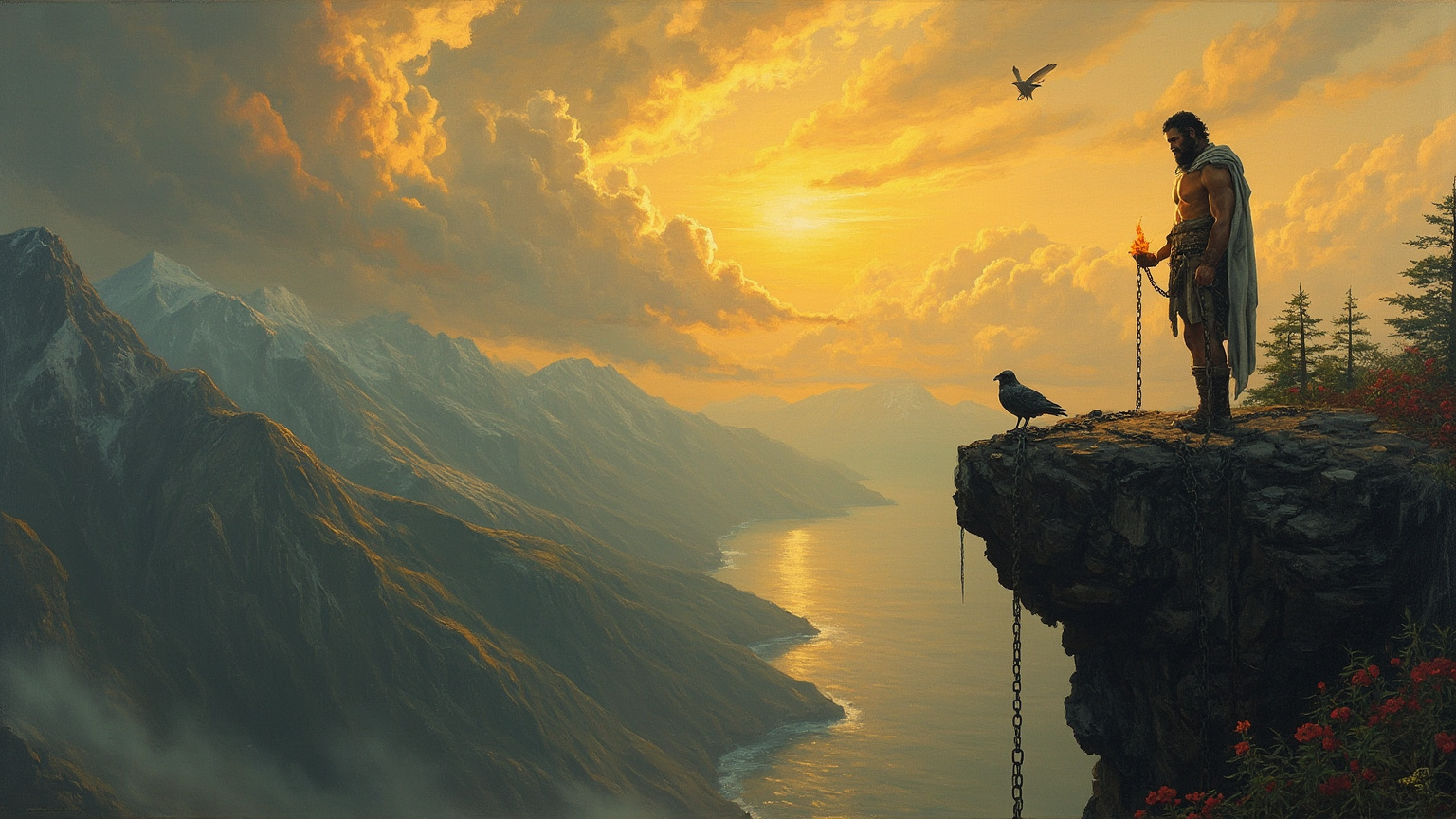
I gave mortals fire, and for that gift I am nailed to this rock, where neither pity nor release shall ever reach me.
我曾把火种交给凡人,如今就为这一份赠礼,被钉在这崖石上——既无怜悯,也无解脱。
金句 · 开场 · 普罗米修斯自陈其罪
The Oceanids arrive by cloud-chariot over the sea, a chorus of young women who turn out to be the only ones in the play on Prometheus's side — pitying him, urging him to stop provoking Zeus, unable to bring themselves to leave. Hermes, the messenger god, shows up near the end under orders to force the secret out of him, and gets nowhere against a flat "go back where you came from." And one visitor travels further than any of them: Io, whose story runs as the play's other current underneath.
How the plot moves
The play opens with no recap of what came before. Might and Violence march Prometheus to the cliff and order Hephaestus, the smith god, to do the nailing himself. Hephaestus pities the Titan in his custody, sighing as he works and cursing his father for being so hard-hearted, but his hands never once stop driving the wedge. It is one of the most unbearable moments on the Greek stage: pity and obedience fighting inside a single body.
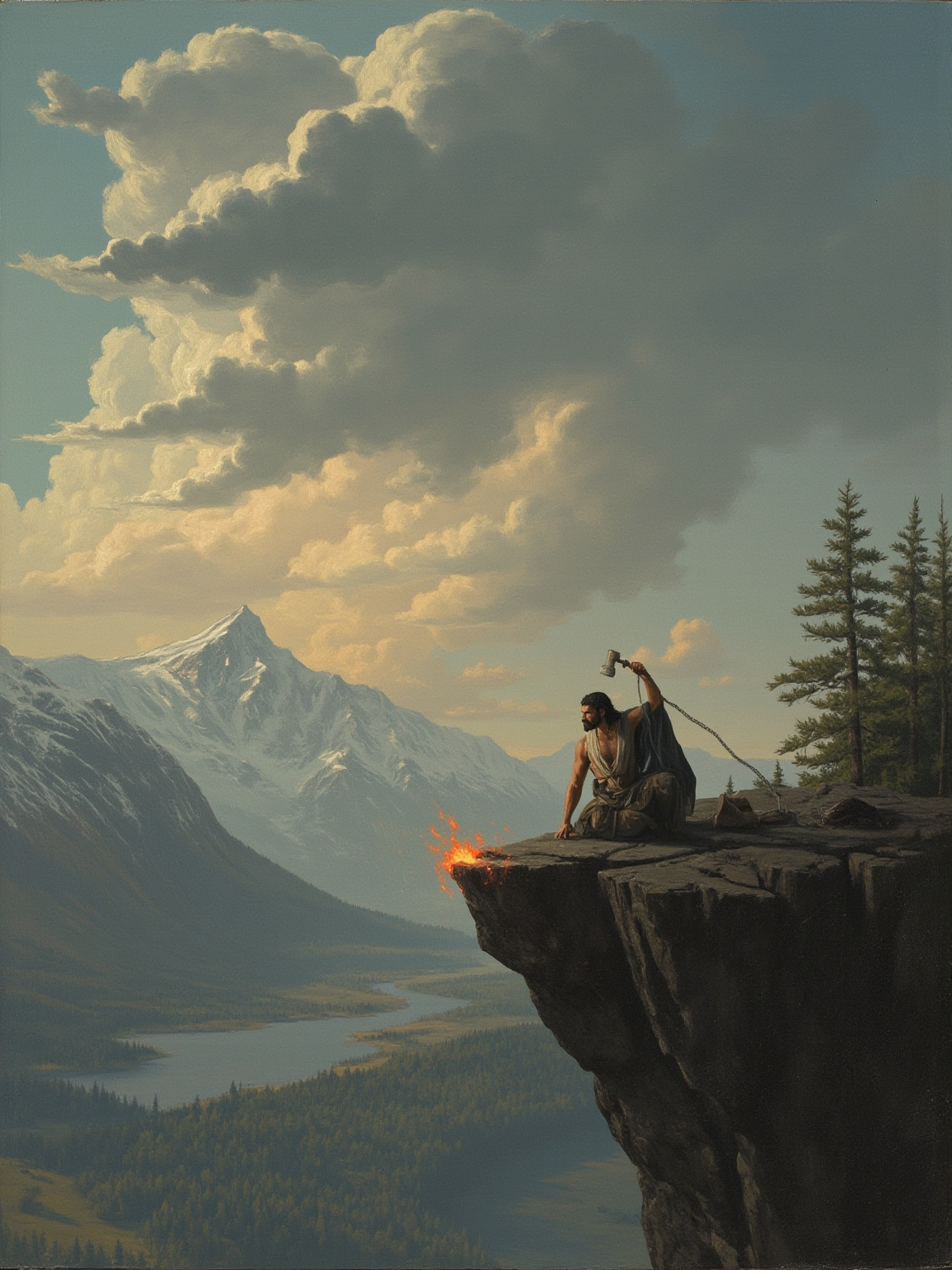
Your craft is not your conscience — strike, and let the iron do what Zeus has commanded.
手艺不是良心——动手吧,让这铁去完成宙斯的命令。
金句 · 开场 · 赫菲斯托斯受命行刑
The nailing finished, the others leave, the cliff empties out. Prometheus speaks for the first time, alone. He doesn't say it hurts. He says what he did, why he did it, and that he doesn't regret it. This is the moment the Oceanids descend by cloud-chariot and settle onto a low rock partway up the cliff — the chorus's entrance. The line the whole play turns on is buried in that opening speech: "I would rather be chained to this rock than serve as the errand-boy of Zeus." The rebel's manifesto, written out in full twenty-five hundred years ago.
Then Prometheus runs the Oceanids through an inventory of everything he gave humankind. Number, so people could keep accounts. Writing, so memory had somewhere to live. The taming of horses and the building of chariots, so the road stopped being just dirt underfoot. Seafaring, so people could leave the shore. Ore under the ground, remedies for disease. He lists them one by one, like a roll call. This is the actual reason he is nailed to this rock, not for doing evil, but for doing one specific thing: handing the gods' technology over to people.
Partway through, the old river god Oceanus turns up leaning on a staff carved with a winged horse, come to talk Prometheus down: bow to Zeus, it costs you nothing. Prometheus answers with cold contempt — this is a Titan who has spent his whole existence bending the knee, kneeling to whoever happens to be running Olympus at the time. A man practiced at kneeling, come to counsel a man who won't kneel at all: that is the contrast the scene is built on. Oceanus doesn't stay long; the play sends him off within a few lines. What follows is the longest scene in the play: the entrance of Io.
Io was a priestess of Hera whom Zeus took a liking to. Hera turned her into a white heifer out of fury, set the hundred-eyed Argus to guard her, and after Argus was killed, sent a gadfly to chase her instead, biting her the whole way. That is how she arrives at the Caucasus, stung all the way from Argos, two small white horns just showing through her forehead, still human enough to have a human shape, feet still on the ground. Prometheus recognizes her and pities her. Drawing on his gift of foresight, he lays out her wandering route stage by stage: from the Caucasus to the Black Sea, on through Asia Minor, and finally to the Nile in Egypt, where she will become human again. Two beings suffering for Zeus's power recognize each other across a cliff face.
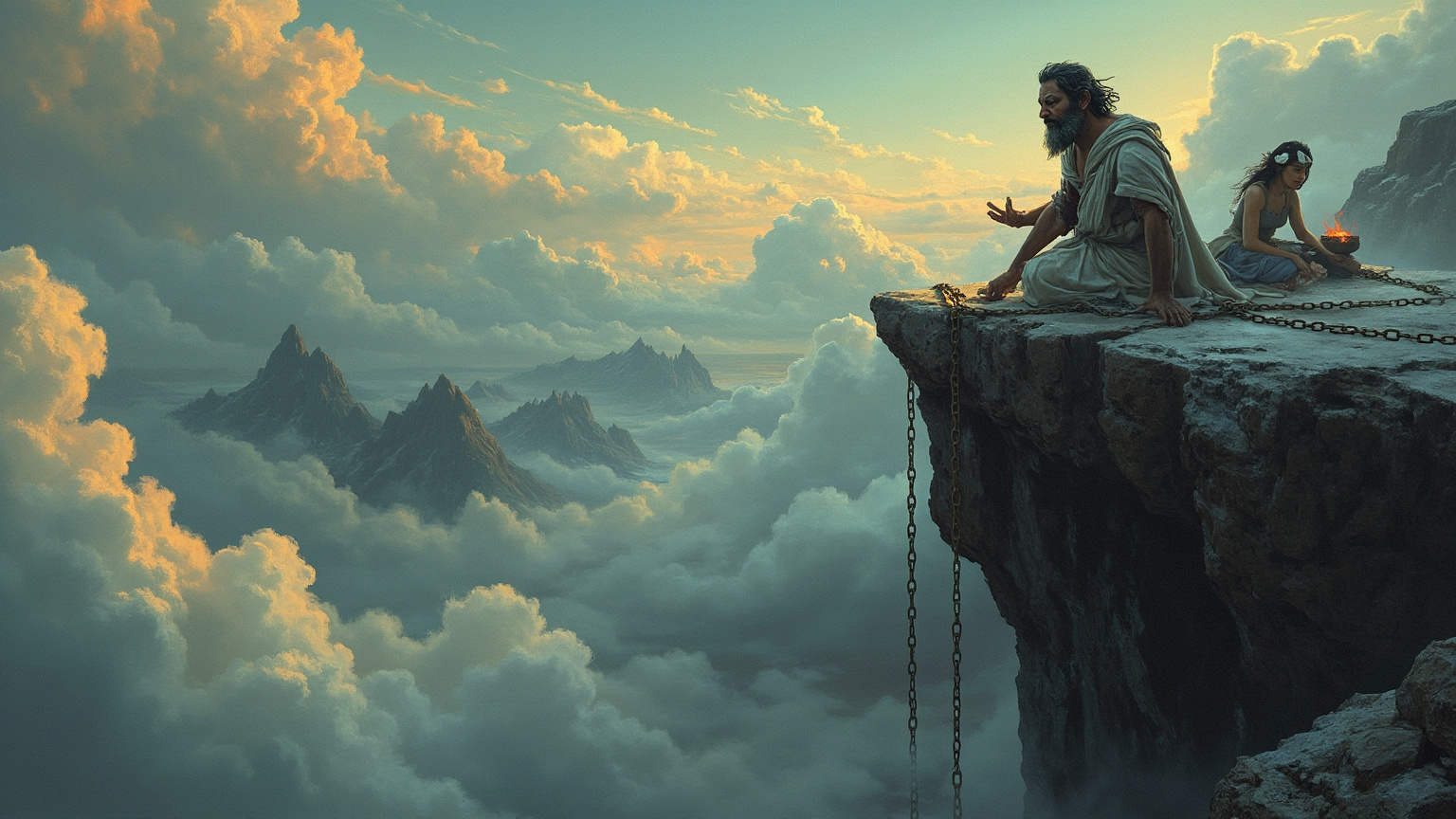
I hear the gadfly sting her, the heifer driven from land to land — her wanderings are the prophecy of my own.
我听见牛虻在蜇她,那头母牛被一国一国地赶走——她流浪的足迹,正是我日后命运的预言。
金句 · 中段 · 普罗米修斯为伊俄预言
Io leaves, and the play enters its final stretch. Prometheus's mother, the earth goddess Themis, speaking through an old prophet, adds one line: this trial was never lawful. Before the thought is even finished, Hermes comes down from Olympus. He has come to force a confession. Zeus knows Prometheus is holding a secret — that a marriage yet to come will bring trouble down on Zeus himself, and only Prometheus can say which one. Hermes tries threats, then bribes, to pry it loose. Prometheus answers with a single line, go back to your Zeus, I have nothing to tell you, and that is where the play breaks apart for good.
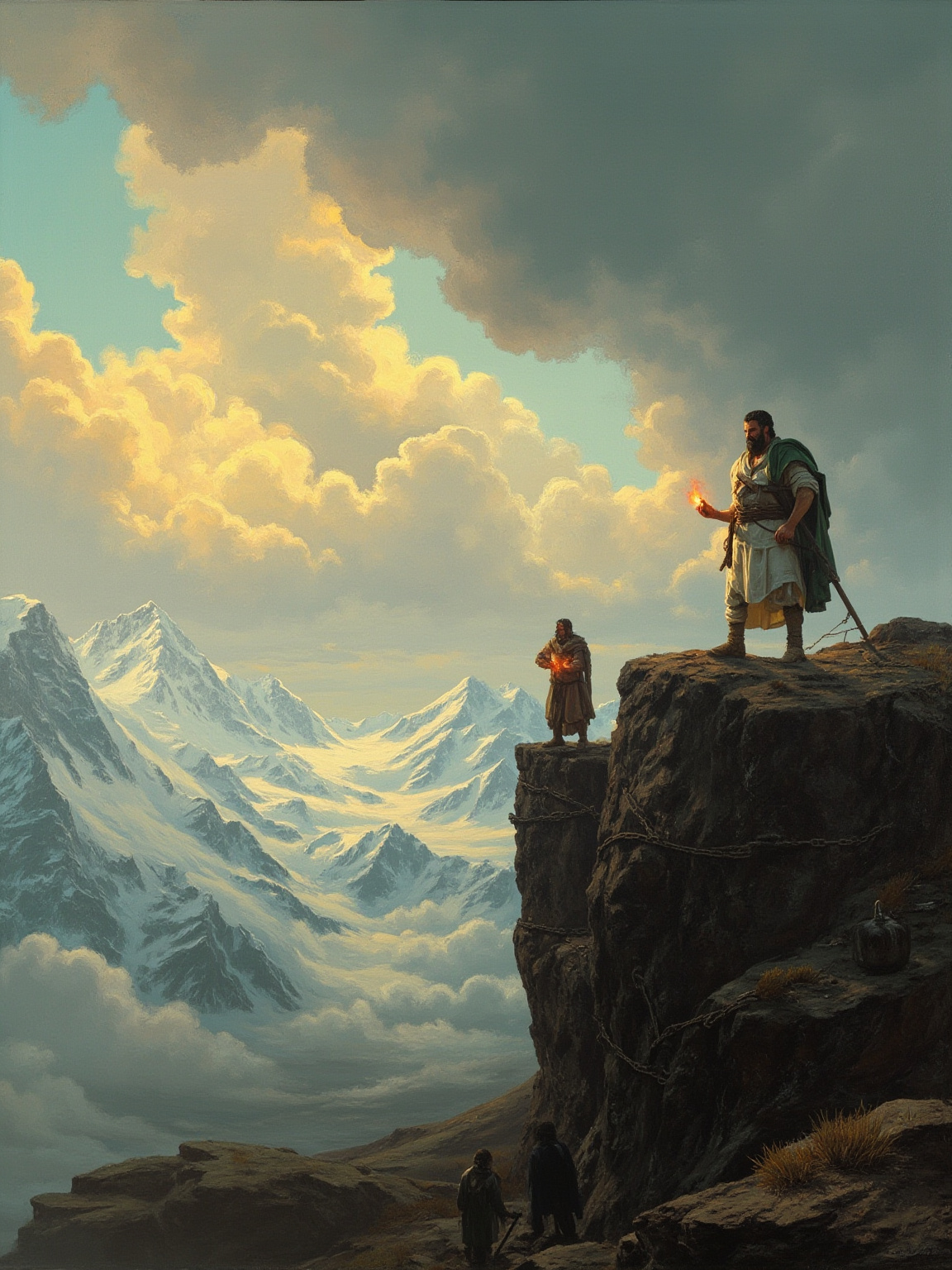
No — let him hurl his blazing bolts, let the sky crack open above me; I shall not tell him what he asks to know.
不——让他掷他的雷霆吧,让天穹在我头顶裂开;他要问的事,我半个字也不会说。
金句 · 末段 · 普罗米修斯拒绝赫尔墨斯
Thunder splits down from the sky. The mountain breaks apart. The ground cracks open. Prometheus goes down into the bottomless dark, cliff and all. The Oceanids' chorus doesn't leave; they go under with him. That is how the play ends: not release, but a deeper hell. Not victory, but being pulled down.
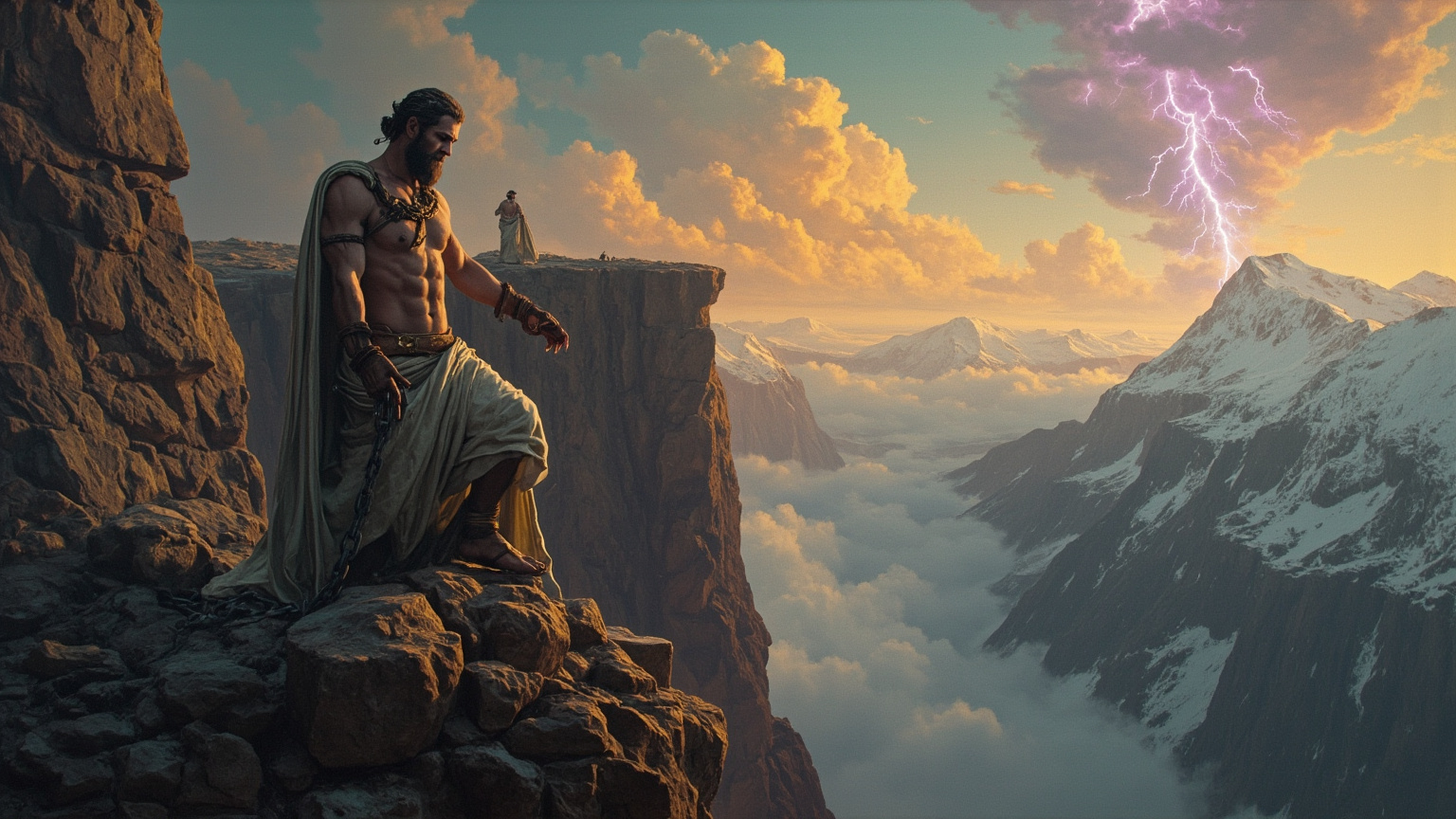
The earth groans, the deep thunder rolls — the peak is torn away, and I go down into the pit with my chains upon me.
大地在呻吟,闷雷滚过深渊——峰顶被撕开,我披着锁链一同坠下。
金句 · 终段 · 山崩地裂,坠入深渊
But the play's last line leaves the audience with a hook: Prometheus still holds the secret of Zeus's future, the one thing that hasn't been taken from him, his only leverage for whatever comeback or bargain might still be possible. The man disappears; the suspense doesn't.
Themes and craft
On the surface, Prometheus Bound is myth. Underneath, it's politics. Aeschylus wrote it only a few decades after Athens had climbed out of tyranny, while democracy was still finding its footing. Through Prometheus's mouth he keeps asking the same question: is Zeus's law actually lawful? What gives a god-king perched above everyone the right to punish an elder god for saving lives? The play never accuses Zeus outright, but every scene says the same thing in different words: power's legitimacy can be questioned. That is why every revolutionary era since has reached for this play and read it again.
A second current runs underneath, one most readers miss: Io. A girl turned into a cow and hunted across the world for the crime of catching a god's eye, and not one line in the play is spoken in her own defense — Prometheus has to speak her suffering for her, step by step. A god's love, for a woman, turns out to be a catastrophe. Read alongside the main plot, the tragedy stops belonging only to the rebel and becomes the tragedy of everyone power runs over. Craft-wise, the play's real strength isn't in the dialogue but in its stage images. Almost every scene freezes into something that could stand alone as a painting: the Caucasus cliff face, iron through bone, the eagle's silhouette circling, the Oceanids' cloud-chariot, Io stumbling in with two small white horns. Aeschylus works in pictures. In his hands, drama hasn't fully separated from epic; it is still, in large part, something seen.
The punishment is the price of what he did; the refusal to bow is the price of who he is — this play settled that account twenty-five hundred years ago.
Why read the play itself
This guide gives you the map. The play itself is the ground. What no summary can replace is the play's physical presence: the tremor in Hephaestus's hands as he drives the wedge, the chorus of Oceanids arriving in waves, the sound of Io's breath as she staggers onstage. Read it as a script, out loud if you can. You'll find it isn't something you understand so much as something you hear, see, and get pinned to your chair by.
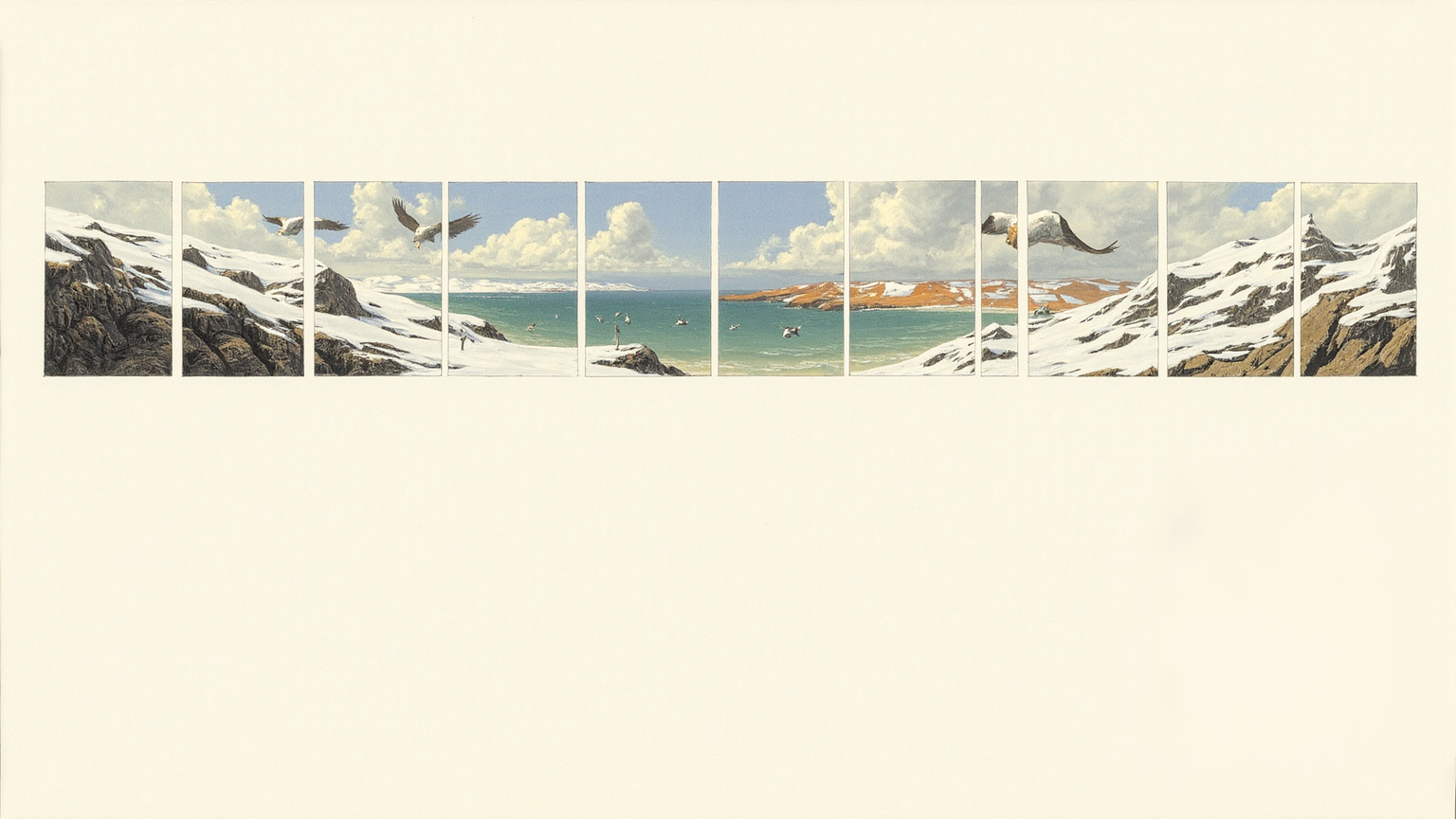
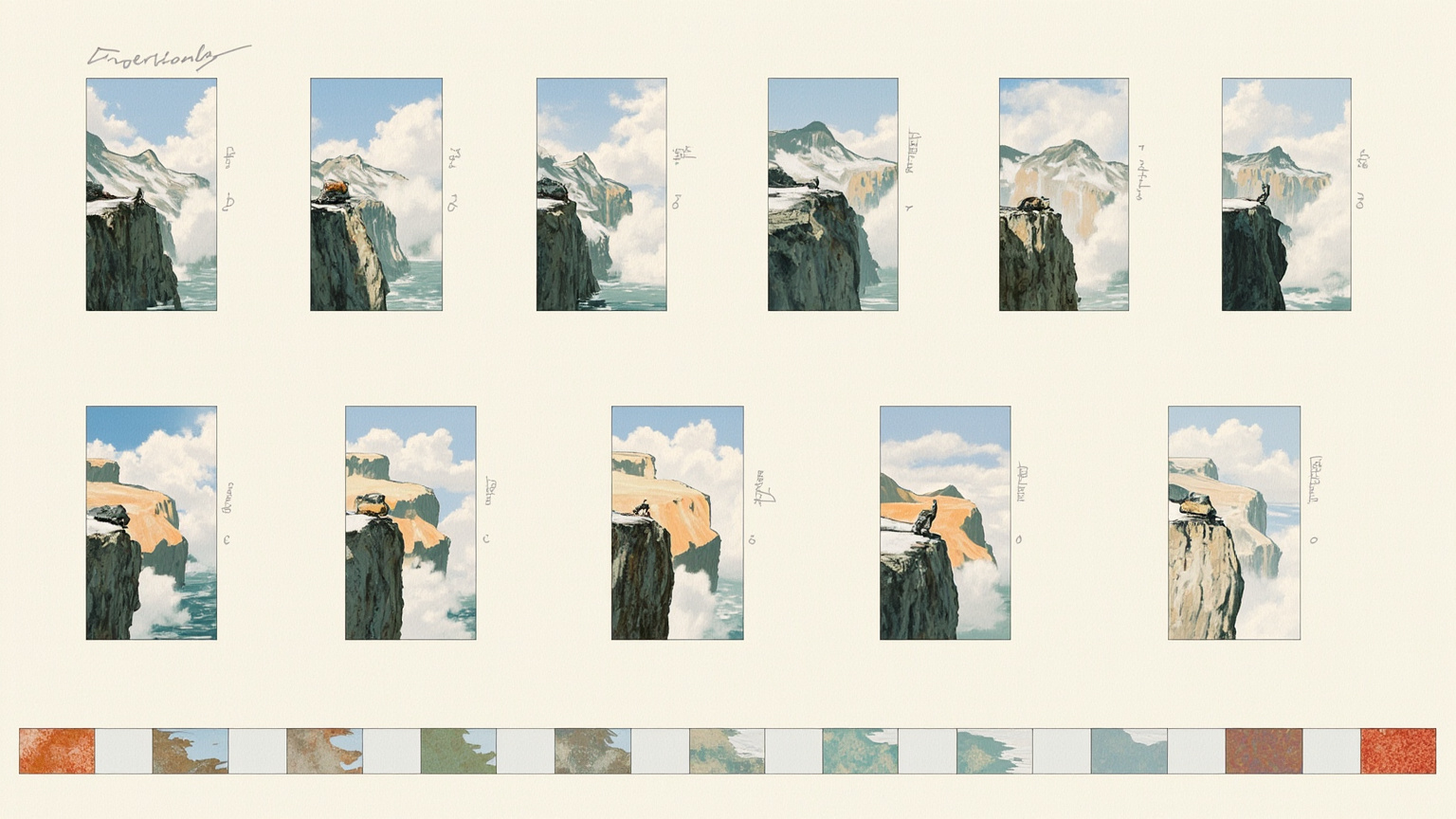
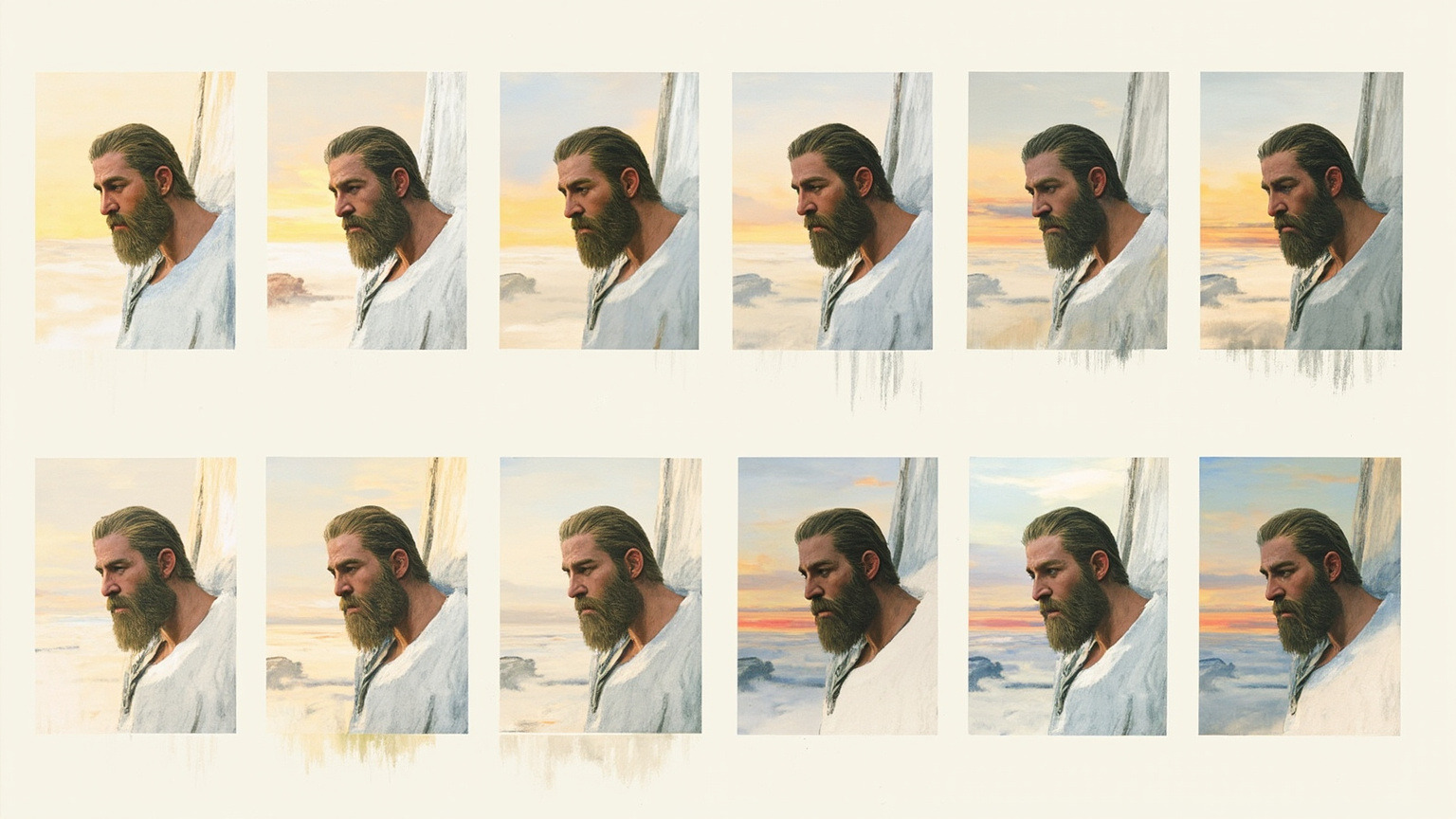
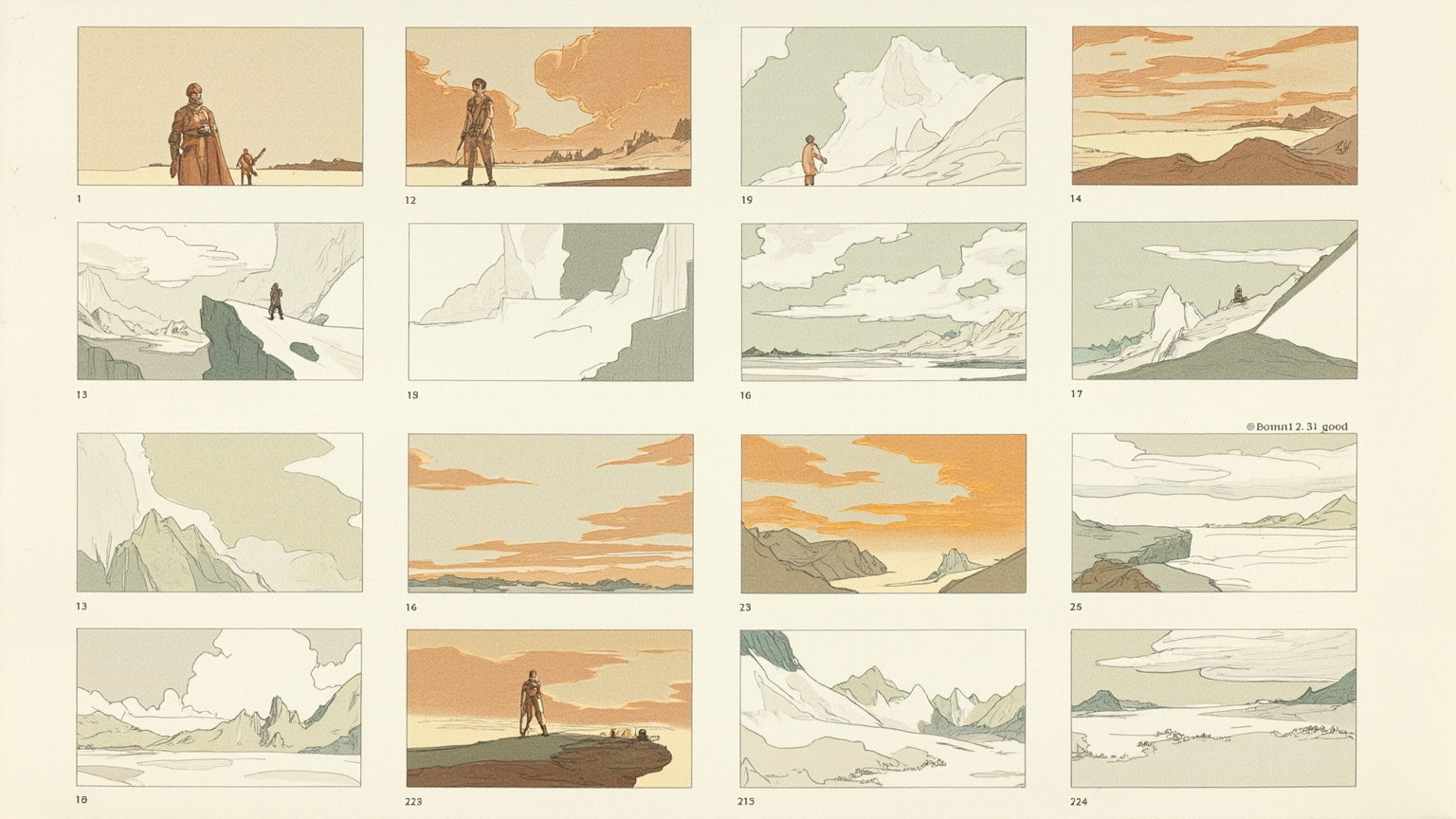
Art Direction4 plates
Before the guide was written, this book got a visual foundation — every illustration you just read grew out of it.