Sir Gawain and the Green Knight · Companion Guide
高文爵士与绿骑士
一位胸前绣着五角星的年轻骑士,为一句契约踏上仲冬荒原——完美是铠甲,也是囚衣。
So What Kind of Book Is This
A giant strides into Camelot's hall, green from head to foot, a branch of holly in one hand and a massive axe in the other. The firelight only makes the green brighter — beard, skin, horse, harness, not one patch spared. That entrance opens an anonymous long poem from medieval England. Nobody knows who wrote it; scholars simply gave him a name, the Pearl Poet, and grouped this work with a handful of shorter poems by the same hand into what's now called the Pearl manuscript. The poem runs to roughly twenty-five hundred lines in an alliterative meter, in the medieval dialect of England's northwest — each long line driven forward by alliteration and stress, like a stone rolling down stone steps. It belongs to the sprawling medieval tradition of Arthurian romance. The more famous entry in that tradition is Malory's Le Morte d'Arthur, a prose history of the whole order of knighthood. Gawain runs the opposite way: short, cold-toned, strange to look at, close to the purest fantasy core the Arthurian material ever produced. Given a giant who is green down to the last inch of him, that's not much of an exaggeration.
Who's on Stage, and What They Want
The hero is Gawain, King Arthur's own nephew, the youngest and most celebrated knight of the Round Table. The poem crowns him with a title: model of the five-fold code, a pentangle stitched on his chest standing for piety, courtesy, chastity, friendship, and valor, all held at once. He's the kind of knight whose presence alone tells you Arthur's court still has its honor intact. The one who sets the wager in motion is the Green Knight, and nobody knows who he is. He calls himself a stranger out of the wilderness, lord of the Green Chapel, and claims he's someone worth reckoning with — but no one can place where he comes from. The hand actually moving the pieces belongs to Morgan le Fay, Arthur's half-sister and the oldest sorceress in the whole Arthurian legend. In the poem she appears as the old woman, seated in a corner of Hautdesert, barely stirring from her chair the whole time.
How the Plot Moves
The instant the Green Knight strides through the door, Arthur's face goes white — then he throws his head back and laughs, and reaches for the axe himself. He genuinely means to take the challenge on. A few of the older knights around the Round Table trade glances. Not one of them speaks up. Gawain stands. He says one line: let this task fall to me. Short, clean, cutting through the hall's silence like a blade. He takes the axe, raises it with both hands, and brings it down. The Green Knight's head rolls across the hall floor, blood scattering everywhere. Then, a moment later, the headless green body bends down, picks its own head up, and swings back onto its horse. Held aloft in his hand, the head's lips move. It grins at Gawain and repeats itself: this same day, next year, at the Green Chapel. With that, Gawain has signed himself away.
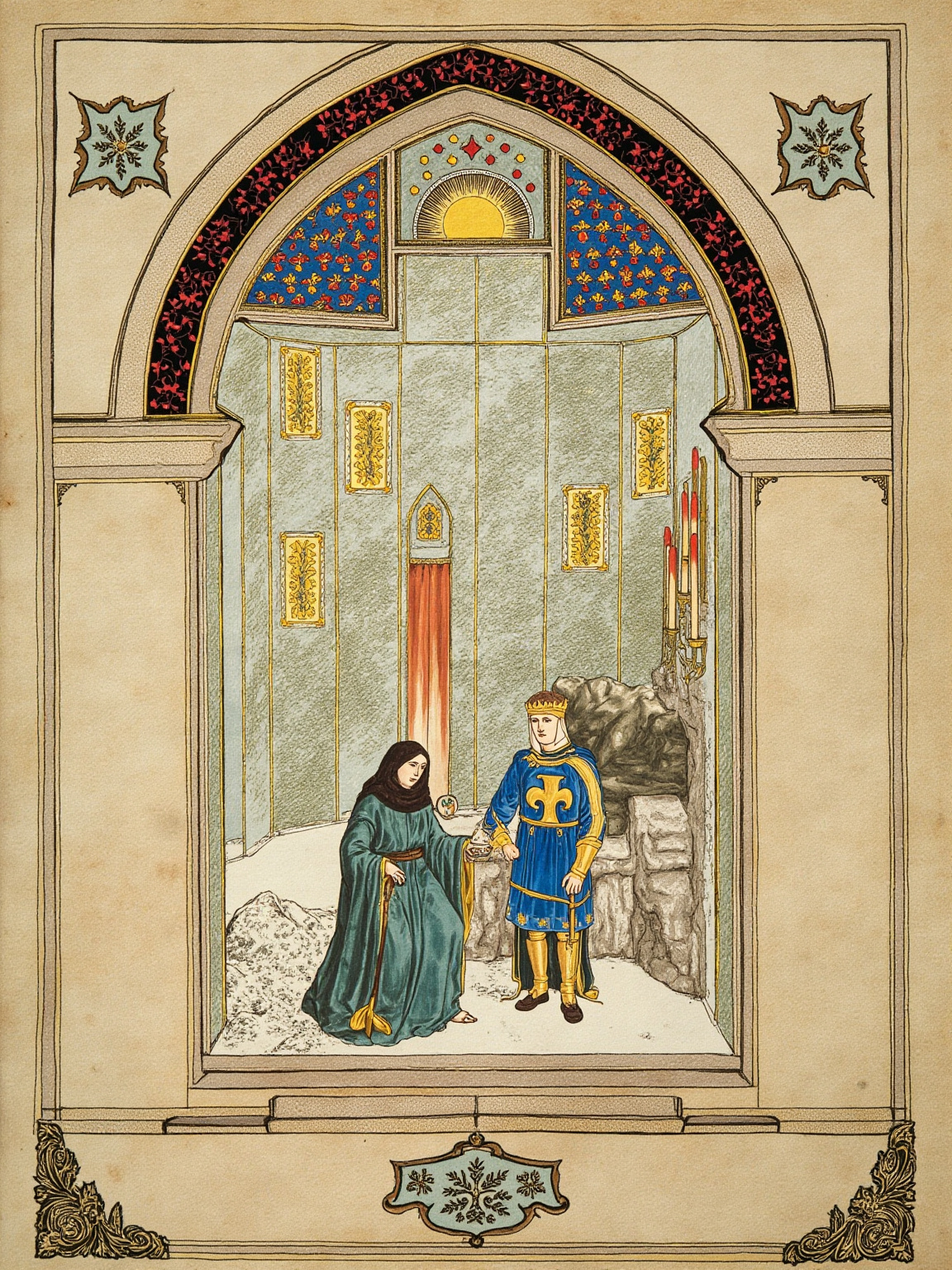
And the Green Knight came riding, all green as the grass, with a great green beard, and he bore a great axe in his hand.
绿骑士纵马而入,周身绿如春草,大鬚垂胸,手执一柄巨斧。
金句 · 第1章 · 卡美洛盛宴
From New Year to Christmas: a year's grace. Gawain has to ride out alone and find a place called the Green Chapel. Nobody knows where it is — it's not on any map in Camelot, and none of the court's chroniclers have heard of it. He leaves Camelot by himself, riding into the wastes of England's north. By late October the snow has reduced the world to three colors: gray sky, white ground, black woods. He fords frozen streams, skirts ridges choked with brambles, passes wild boar and wolves in the fog. The only living souls he meets along the way are farmers and monks, and none of them can tell him where the Green Chapel is. He prays to the Virgin, begs the wilderness itself for help, and only on the eve of St. John's Day — the day after Christmas — does he finally spot a castle's lights in the distance.
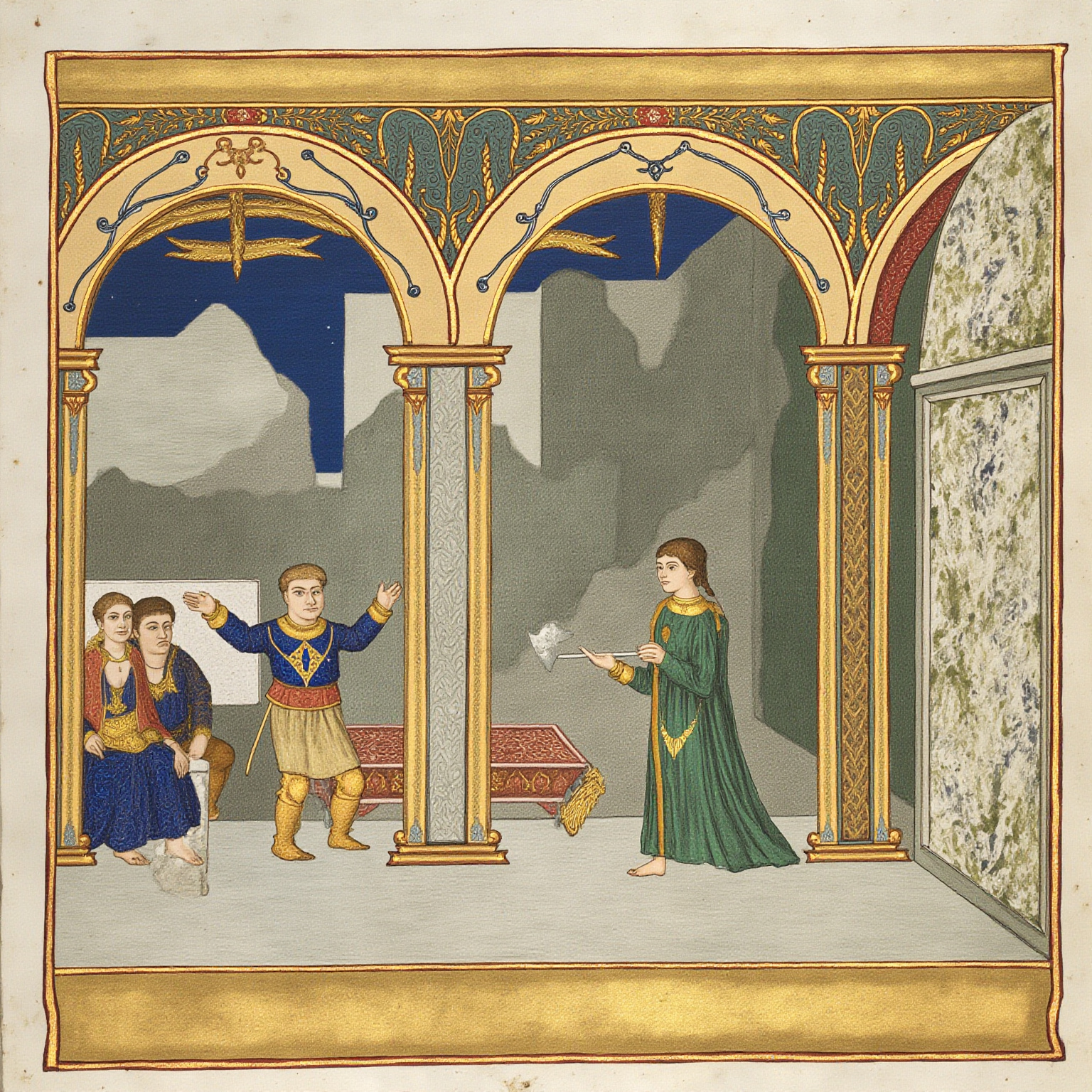
He rode through the wild of the world, and every hill was white with snow; he was alone, and he had no friend.
他独骑穿行于天地之荒原,群山皆白,四野寂寂——孤独而无友。
金句 · 第2章 · 雪原独行
The lord of the castle is Sir Bertilak — stout, red-faced, generous, and delighted the moment he hears why Gawain has come: you've timed it perfectly for my Christmas feast. He keeps Gawain there three days. By day, Bertilak rides out to hunt, and the two of them strike a bargain: whatever he brings home, Gawain gets a share of it; whatever Gawain receives inside the castle, he has to hand over in kind. That's the deal out in the open. There's a second wager running underneath it, one Gawain has to survive on his own: Lady Bertilak. She is young, strikingly beautiful, and her conversation has an edge to it. On three successive mornings she sits at the edge of Gawain's bed, trading looks and words with him at close range. The first morning she teases him, needles him, pushes him toward a kiss; Gawain stays correct throughout, and she only manages to steal one kiss. The second morning plays out the same way. On the third, she goes further — she produces a green silk sash and tells him it's a charm: whoever wears it, no axe can touch him. Gawain hesitates. He takes the sash and tucks it inside his clothing, against his skin — and this time, he doesn't hand it over to Bertilak as agreed. It's the one time all year that he breaks his word.
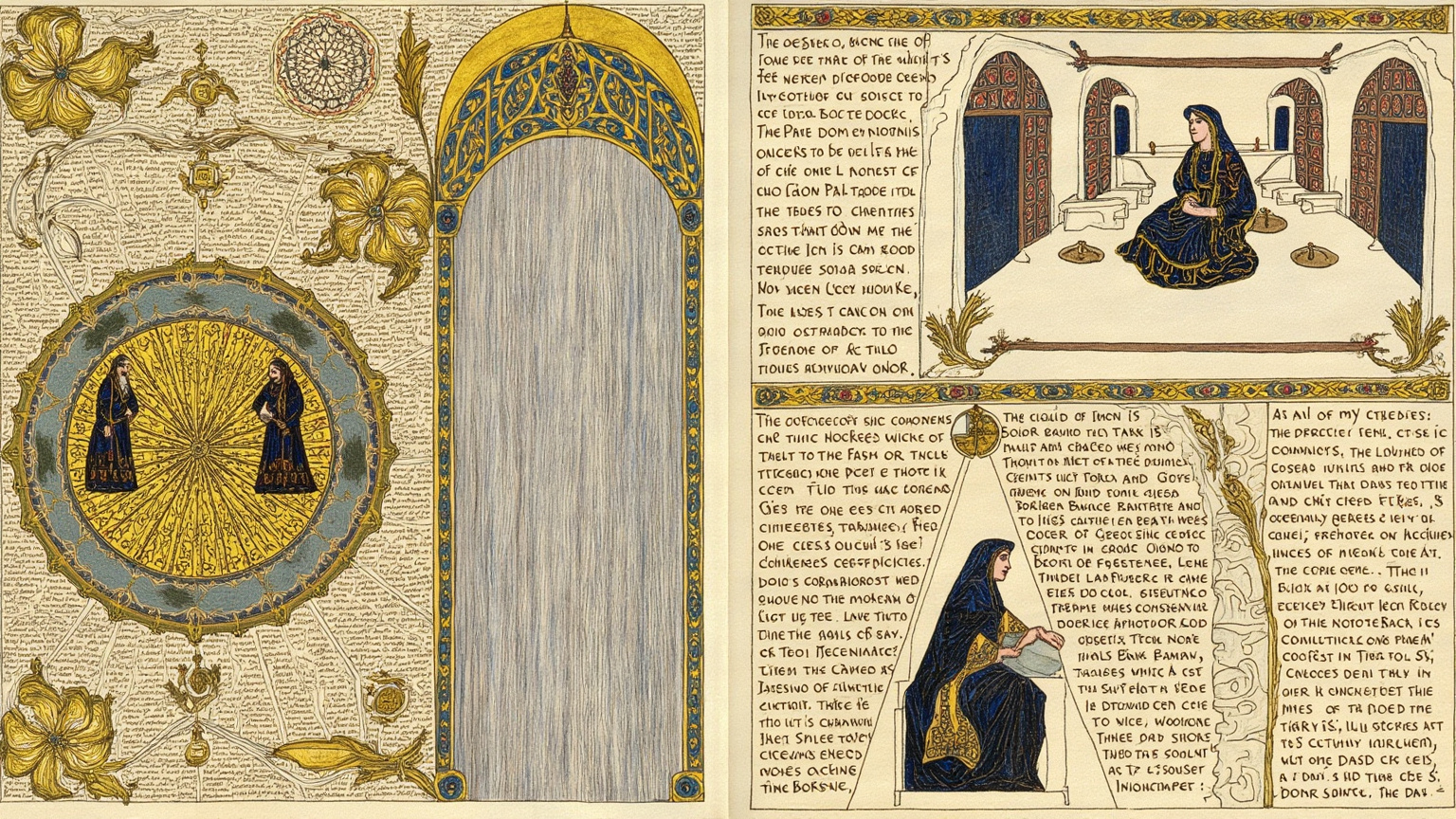
What I win in the wood shall be yours, and what you win here shall be mine; let us swear a true oath between us.
我在林中所获归君,君于堡中所得归我——愿你我以真誓相约。
金句 · 第3章 · 伯特利克的约定
When the third day ends, Gawain rides back out into the wild — this time knowing exactly where the Green Chapel is. It doesn't look like a chapel. It's a mound of moss-covered rock out on the moor, like the throat of some enormous beast grown up out of the ground. The Green Knight is already waiting inside. He raises the axe. First stroke: it hovers, the blade grazing past Gawain's neck, half a cut and half a measurement. Second stroke: it hovers again. Third stroke, and the Green Knight lets out a low growl and lets it fall. It nicks the skin at Gawain's neck; blood drips into the snow. Three strokes done, the Green Knight lowers the axe and throws his head back, laughing. He wipes a hand across his face — the green skin peels away, the beard peels away, and underneath is Sir Bertilak's own ruddy face. The trick is out: the Green Knight was Bertilak all along. The entire ordeal, from the beheading at Camelot to the three days of temptation in the castle, was one man's staging. And behind him, directing the whole thing, stands Arthur's half-sister, Morgan le Fay. What she was testing was the reputation of Arthur's court, and whether Gawain, its most promising young knight, really was as flawless as everyone believed.
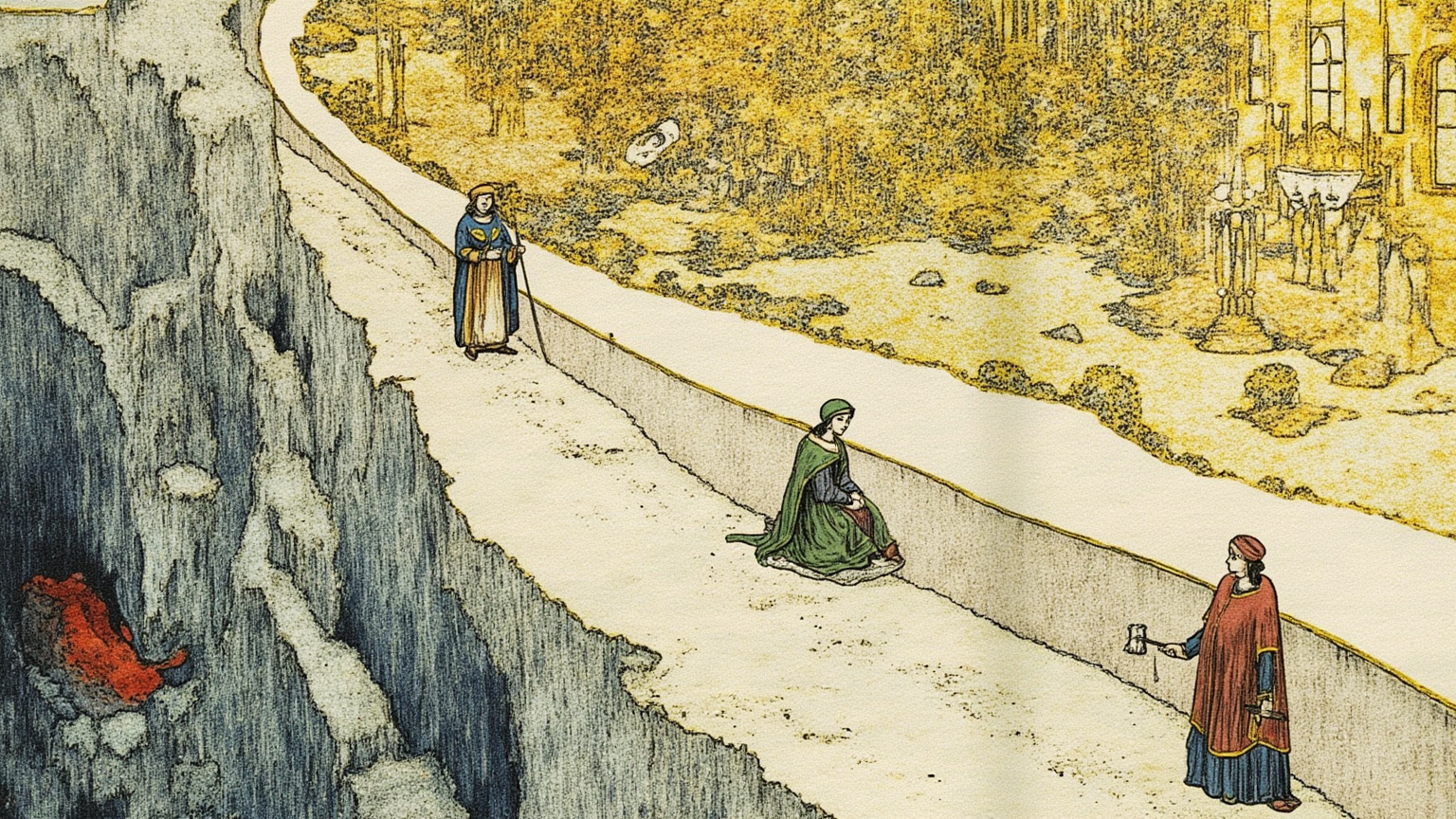
Now is thy time, Gawain; think on thy neck, for it shall have a stroke.
时辰已到,高文——请想着你的颈项,它今日必要受一斧。
金句 · 第4章 · 绿教堂三击
Gawain believes he has failed — at least, that's how he sees it. He pulls the green sash out of his clothing and, hands shaking, ties it around his neck, bracing for Camelot to tear into him. A knight who stood for all five virtues had hidden a charm to save his own life and lied to his host about it. If word of that reaches the Round Table, his name is finished. But when he reaches Camelot, Arthur doesn't rebuke him. Arthur looks at the green sash around his nephew's neck, goes still for a moment, then laughs and pulls Gawain in by the shoulder. One by one, the knights of the Round Table untie their own belts, take the sash from Gawain's hands, and each cuts off a strip to tie around his own waist. From then on, every Round Table knight wears a green sash — a standing reminder that even the bravest man can be afraid. The name Gawain carries forward in Arthurian legend is no longer the model of the five virtues. It's the man whose spotless name carries one flaw.
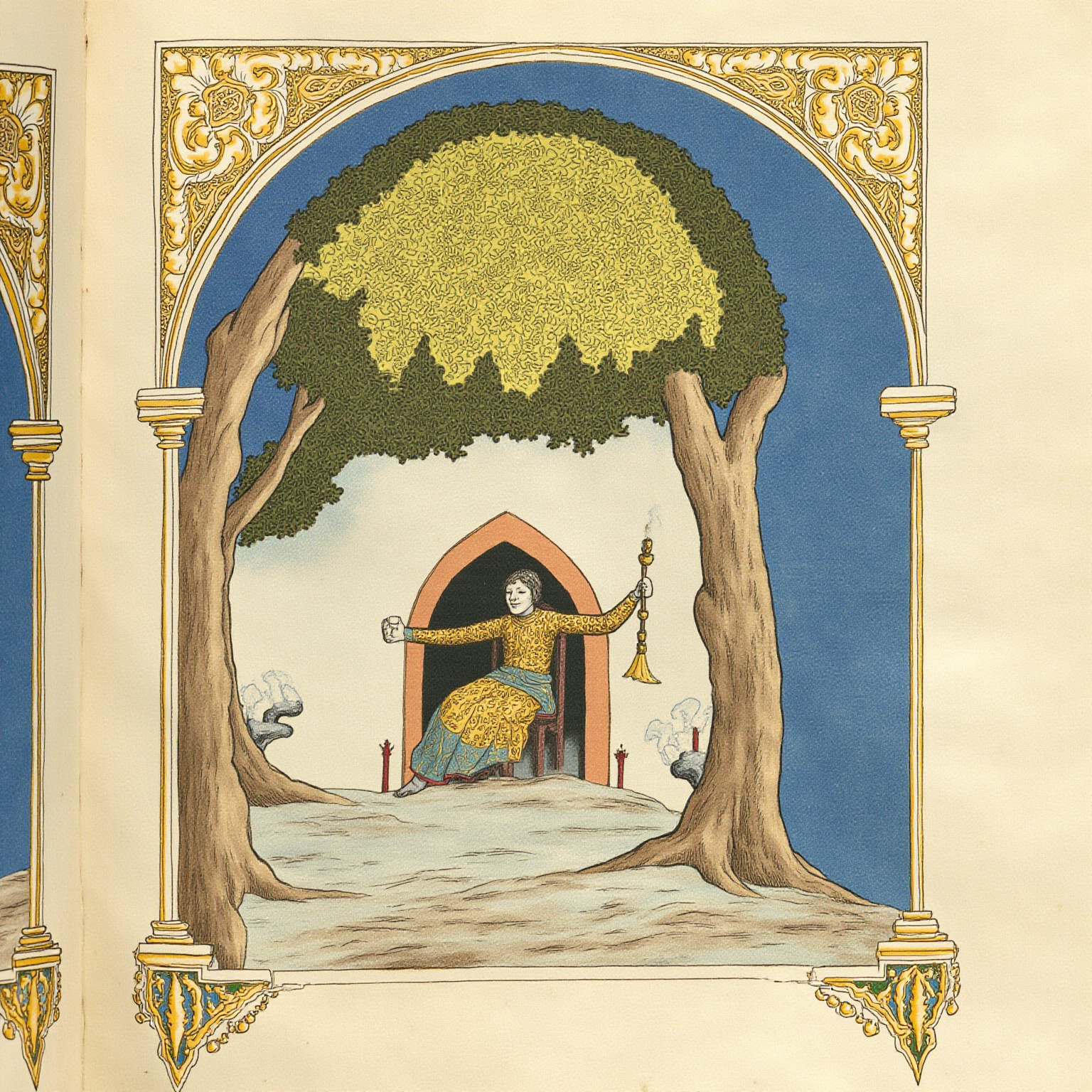
I am the more shame; though I caught a little, the loss is full great; I have been false to my word.
我应当更觉羞愧——纵有所得,所失更重:我已对誓言失信。
金句 · 第5章 · 归来的高文
What It's Really Saying
A fourteenth-century poem that's still being translated, adapted, and cited as a root of modern fantasy — and not because of its novelty value. It's testing an old question: is perfection even possible. Gawain takes up the axe on the strength of his reputation, the model-of-five-virtues label pinned to his chest. But reputation gets heavier the brighter it shines — it puts you where everyone is watching, and it won't let you admit you're afraid. Whether the Green Knight's axe actually lands stops mattering; what really breaks Gawain on the third day at the castle is that after a whole year of walking alone through the wild, someone finally hands him a rope that promises he won't die. That's human nature, not a flaw in him. The poem saves its sharpest turn for the last scene. Arthur doesn't scold him — the king who should care most about his court's reputation instead turns Gawain's failing into a badge every Round Table knight wears. The point is: admitting you're flawed comes closer to courage than pretending you're not. That edge hasn't dulled.
Why People Are Still Talking About This Book
Reputation cuts both ways — the brighter the blade, the less it lets you admit you're afraid. The snowfield Gawain crossed that year isn't his alone. It's the stretch every one of us has to walk.
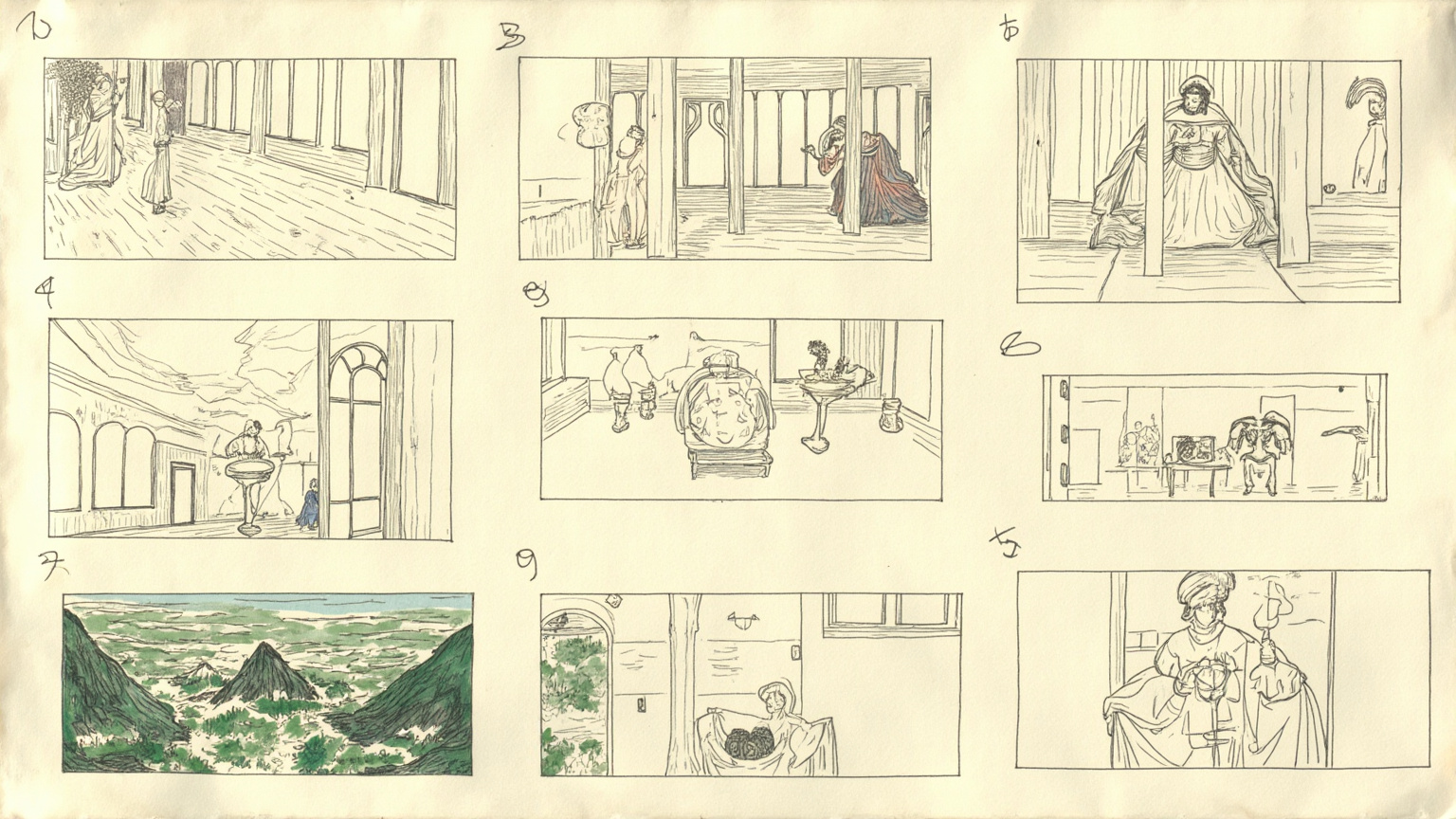
Art Direction4 plates
Before the guide was written, this book got a visual foundation — every illustration you just read grew out of it.