A bedridden woman writes herself out of a cage in forty-four sonnets
Text and illustrations produced by the pipeline
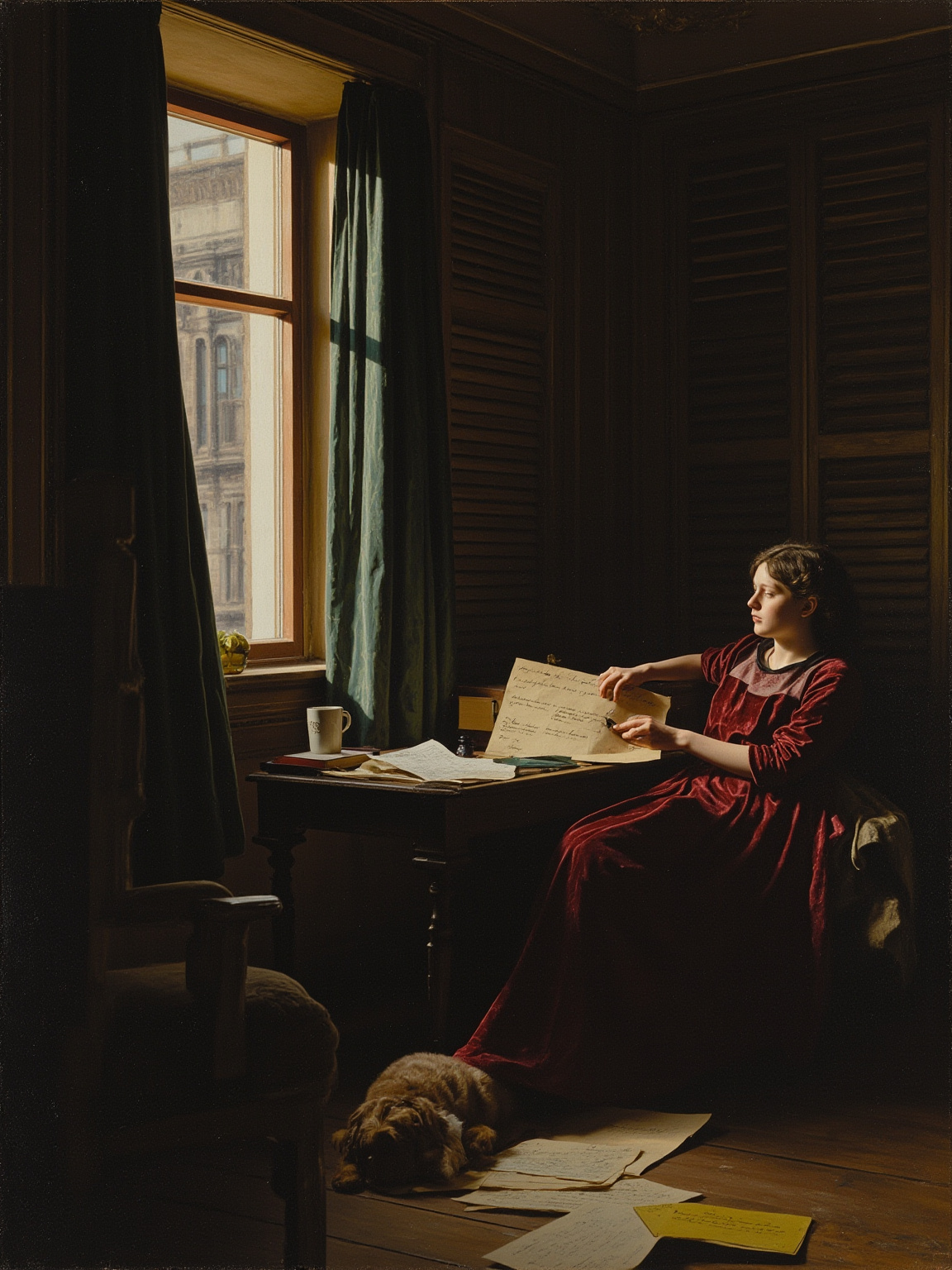
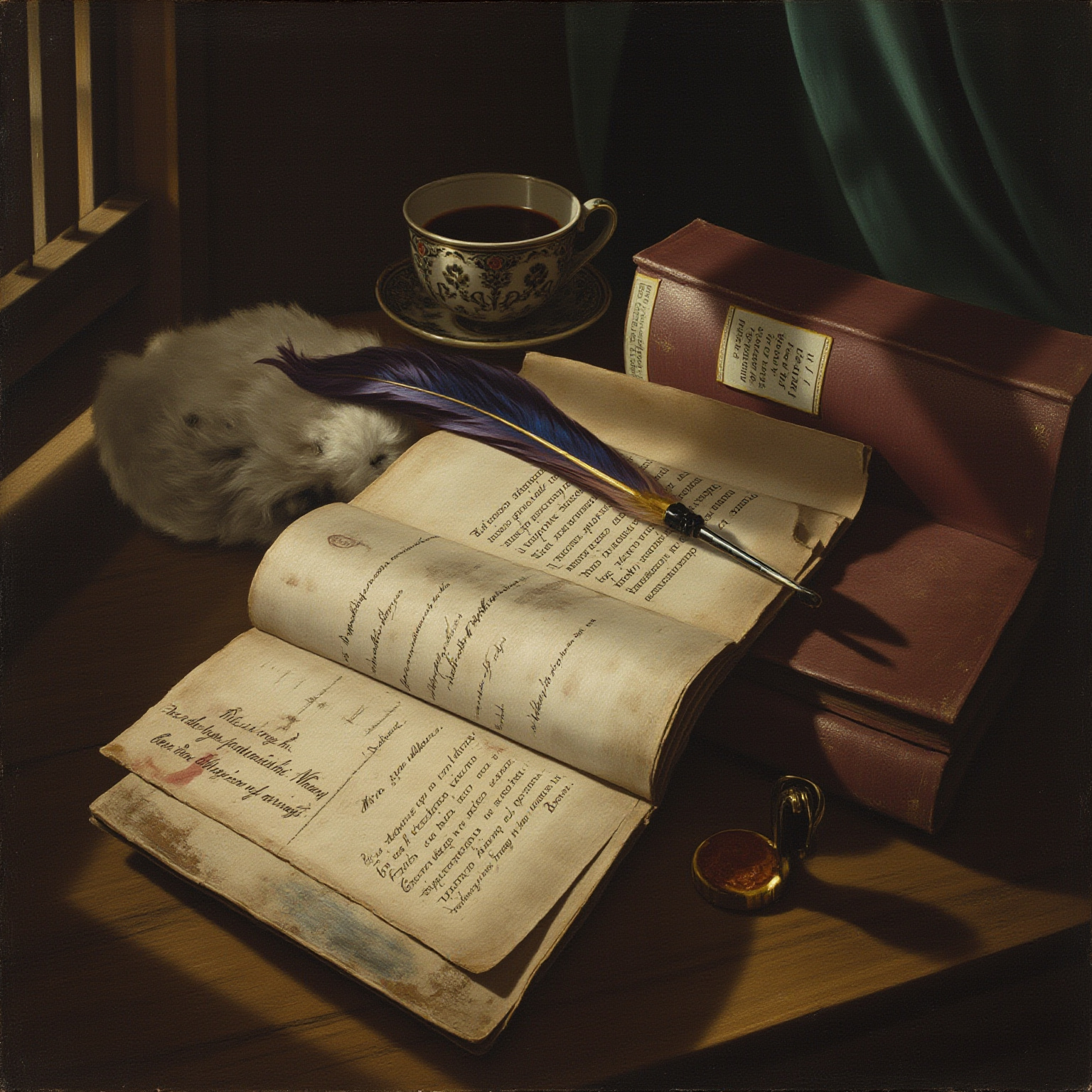
On the second floor of a house on Wimpole Street in London, the heavy curtains stayed drawn to a single crack, year after year. A bed, a table piled with books and letters, a small spaniel named Flush curled at its foot. The woman lying in that bed was thirty-nine, chronically ill, forbidden to marry by her own father's decree. She had kept the world shut out behind that curtain for a long time. What broke through the crack was a string of letters, from a poet six years her junior who had read her Poems and written to her unprompted, so ardently that she was afraid to answer.
The first time I read this, I stopped short: a woman forbidden to fall in love, forbidden to leave the house, who found it hard even to walk downstairs, and across from her a young poet full of energy, the author of Dramatic Lyrics. Two worlds collided on that stack of paper on her desk, and out of the collision came nearly six hundred letters. She wrote back, then pulled away; he wrote again, she pulled away again. This is not a story settled by one love letter. It is hundreds of rounds of tug-of-war over two years.
It is a sequence of forty-four sonnets that Elizabeth Barrett wrote in the Victorian era. The poems were written between 1844 and 1846, before she married Robert Browning, while she still went by Barrett. They were published anonymously in 1850, after the marriage, by Chapman and Hall in London; by then she was Mrs. Browning. The title was her husband's idea: disguise it as a translation, so a collection this nakedly confessional would not seem quite so exposed. Go looking for a Portuguese poet by the title and you will come up empty. The voice is entirely her own.
It is remembered for one reason. It took the sonnet, an old and restrained form, and turned it into a complete psychological record. And it was written under conditions about as confined as a life gets: bedridden, housebound, no company, no sunlight. Nothing in English love poetry has surpassed it, because no other collection has dared to open in a cell and end in daylight.
The whole sequence has one point of view: Elizabeth's. She is the I of the poems, and the reader's guide through every turn of her inner life. Chronically ill, regarded by her father as a family disgrace, she had long since stopped thinking of herself as someone who could be loved. The you across from her never once appears directly. He is written only through her eyes, her reactions, her retreats; his name is Robert Browning, her husband, and the one who wrote first.


The arc ends with Sonnet 43, one of the most quoted love poems in the English-speaking world: How do I love thee? Let me count the ways. Across the octave she takes love apart and counts it item by item, the depth of the soul, the small facts of daily life, the heights of the sacred, the low ordinary ground, each one a separate, specific I love thee thus. People still read it aloud at weddings.
Rereading Sonnet 43, I keep getting the same strange feeling: as she takes love apart and counts it piece by piece, what she arrives at is the shape of love itself. The counting is the declaration.
Because a guide is, in the end, a map, and the poems are the actual ground. There are two things nothing here can substitute for. One is the rhythm of reading all forty-four in sequence, each sonnet looser, each one bolder than the last, a gradual change no summary can reproduce; you have to read them one after another yourself. The other is the physical texture of the language itself. The sonnet form carries its own music, and every poem's rhymes, line breaks, and breath are exactly what translation and paraphrase lose.
There is one more thing: the sense of the body. A woman confined to her bed for years, standing again, that fact does not stop mattering just because you already know how the story ends. The light on that first morning on the Florence balcony, the breath of it, is something you can only feel by reading your way into it. So the best way to read this book is to forget you know the ending, start at the first sonnet's crack in the curtain, and walk out into the world with her, slowly.
She counts love out, one specific thing at a time: the soul, freedom, the daily round. The counting itself is the declaration.
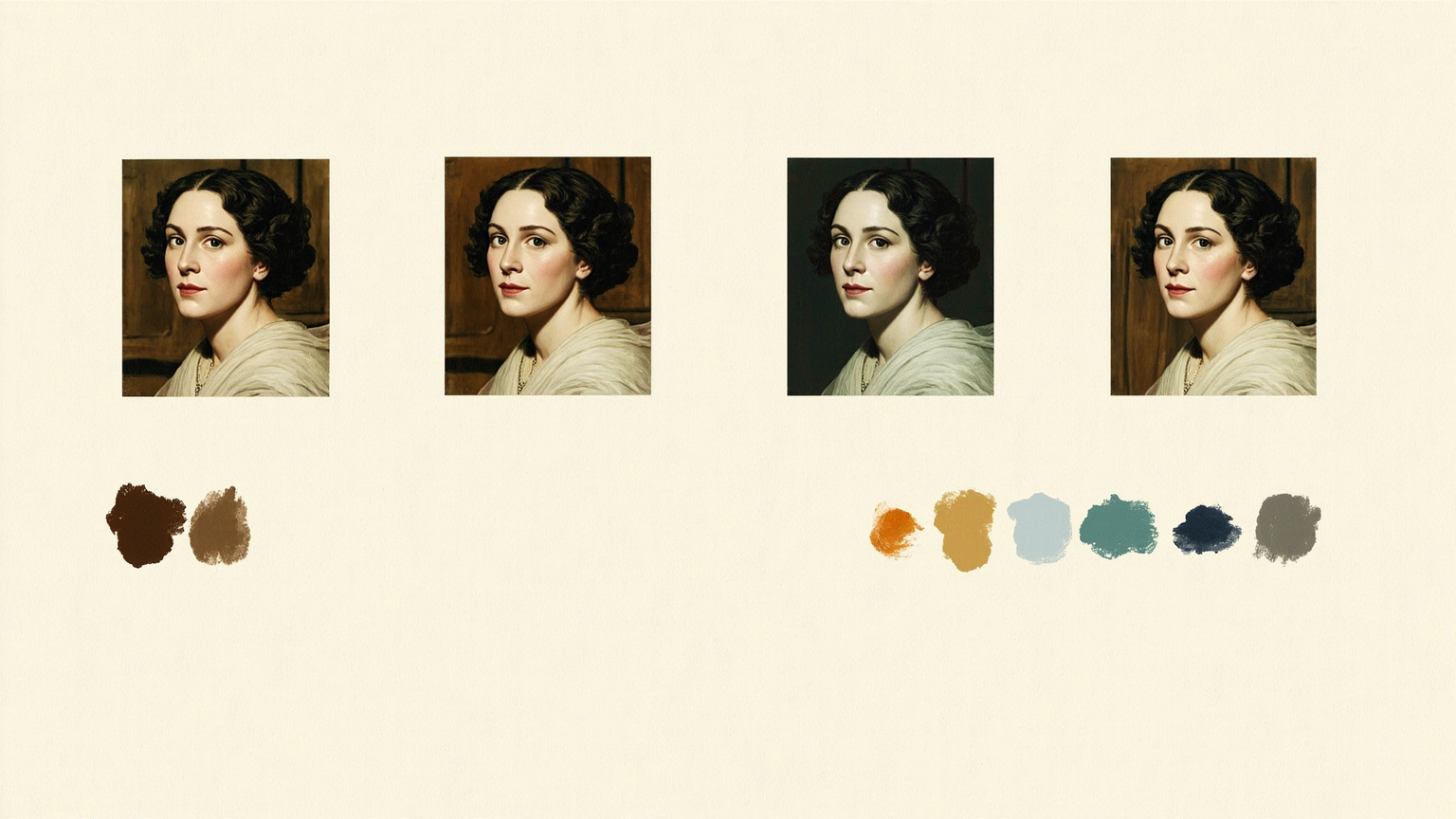
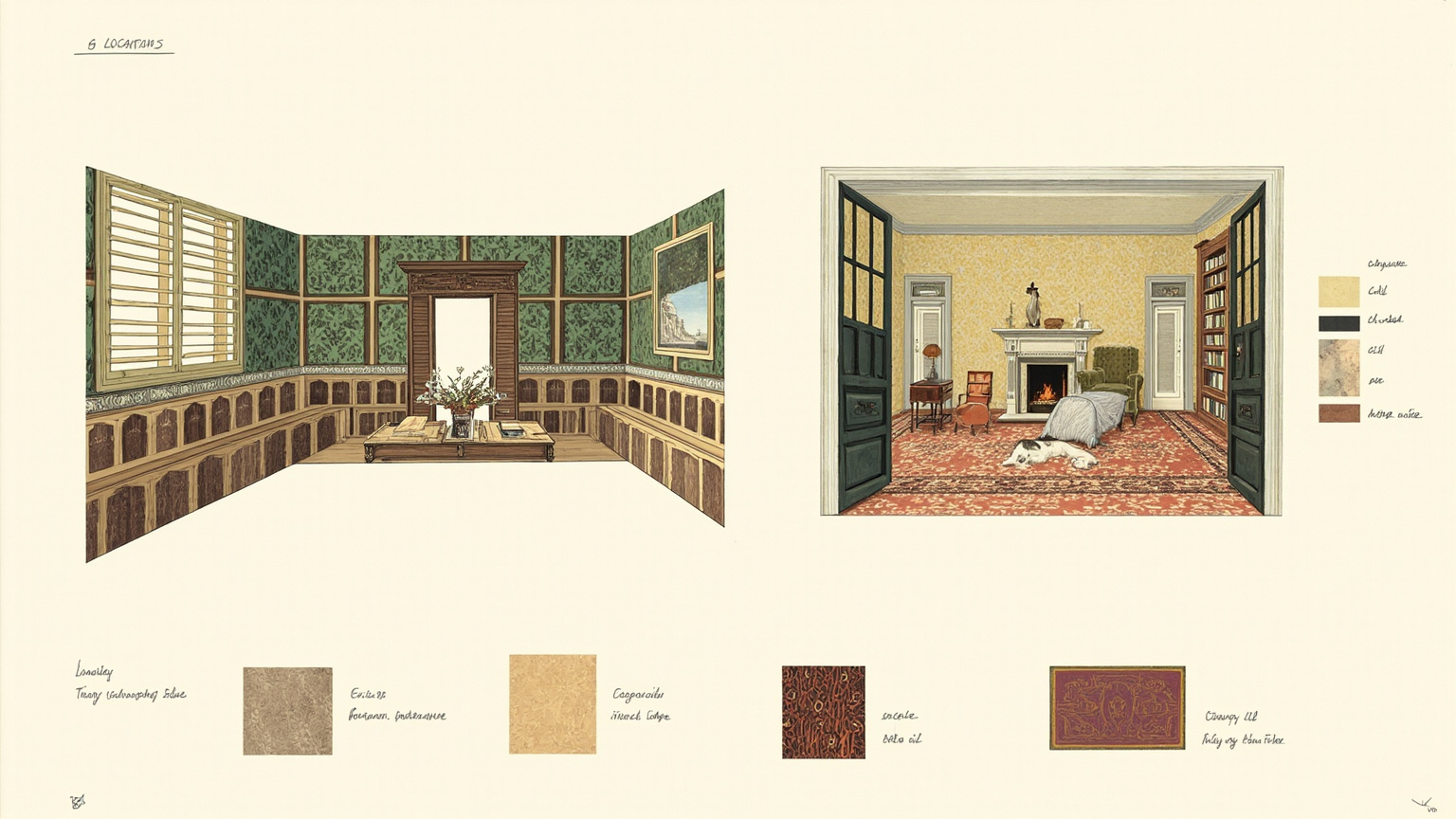
Before the guide was written, this book got a visual foundation — every illustration you just read grew out of it.
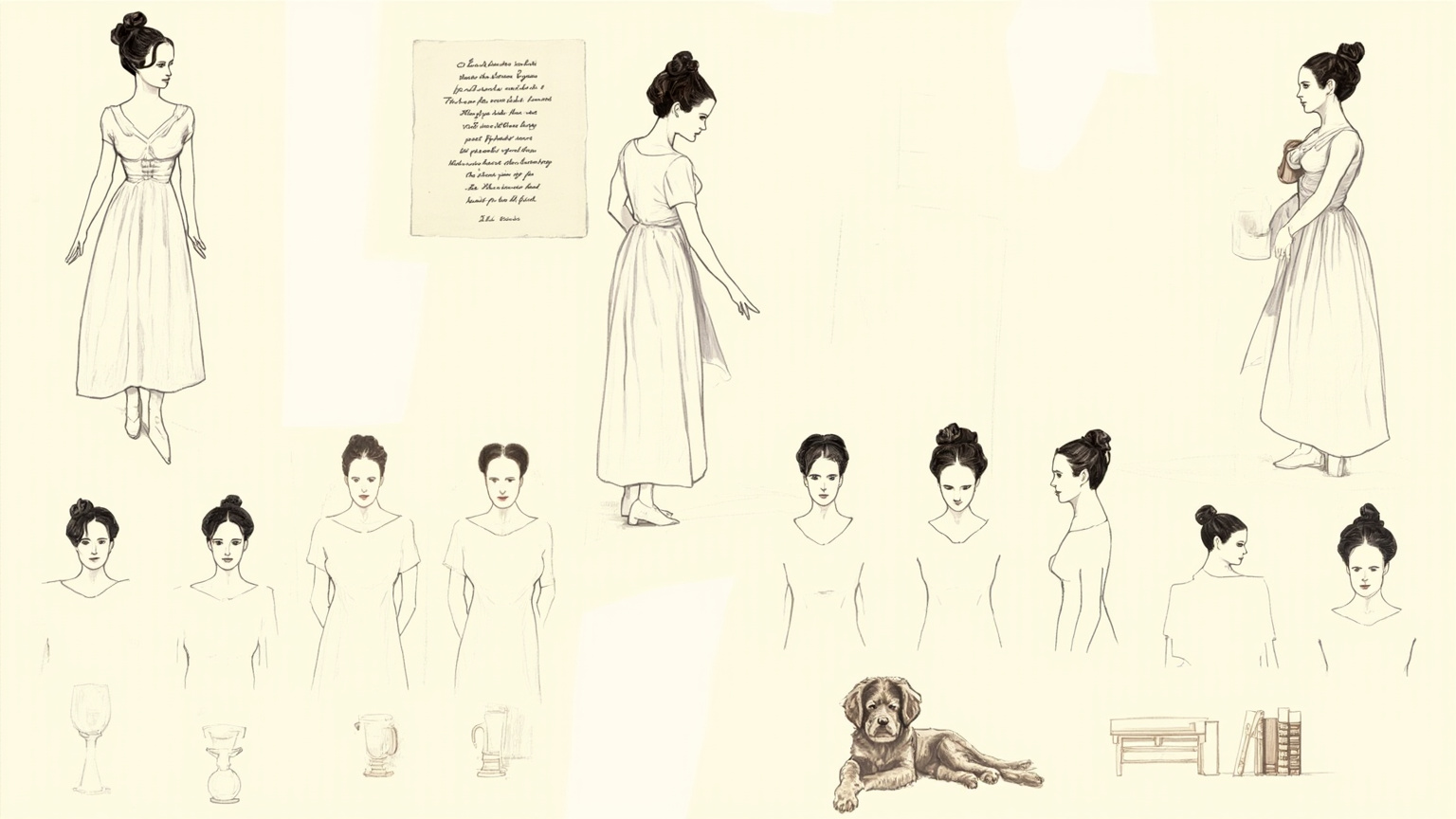
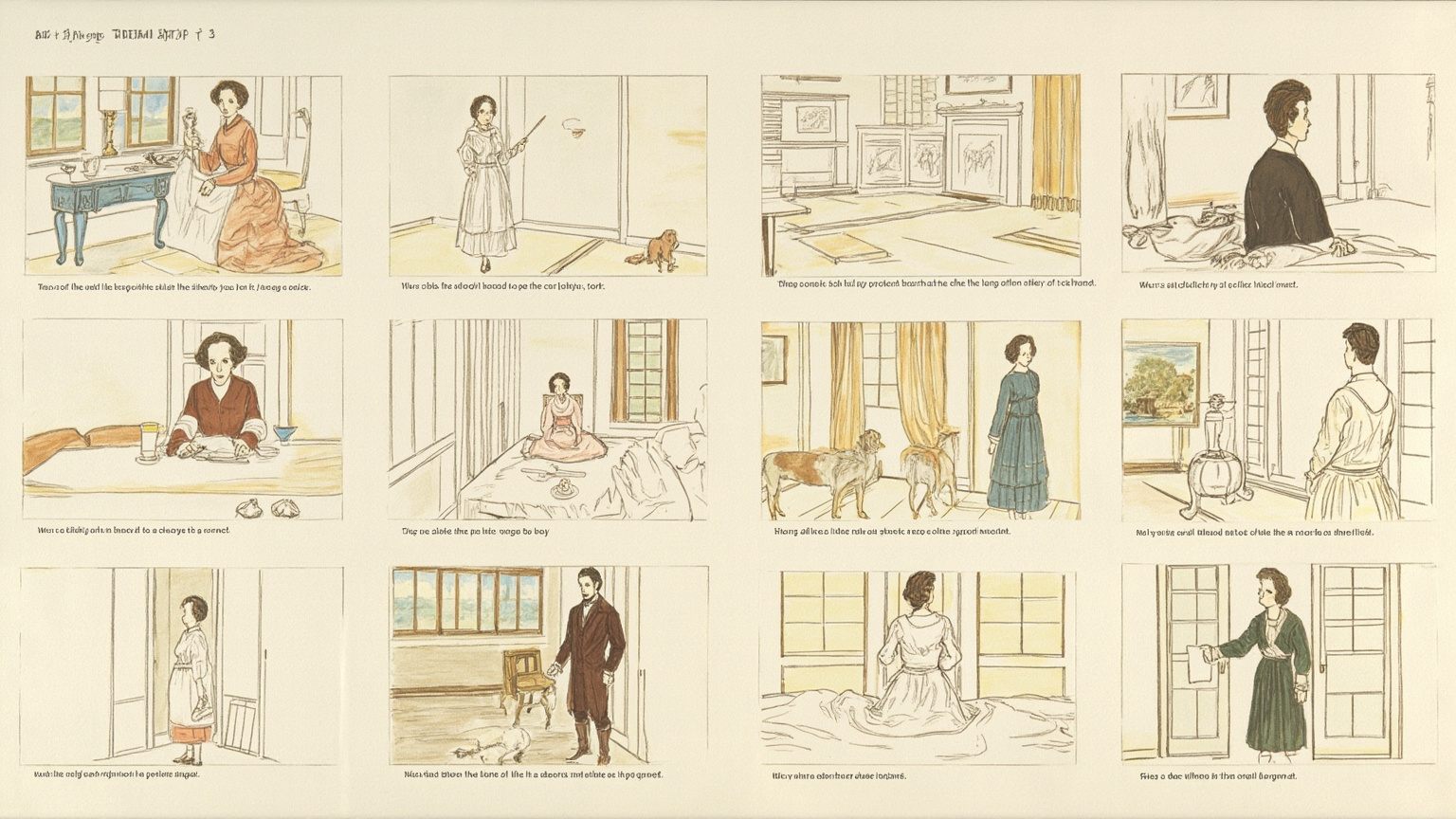
Between them, too, sat a small dog named Flush, who later got a poem of his own. The world behind this sequence runs on two rules: a woman does not leave the house, and a woman does not marry. Those two rules locked down everything, no church on Sundays, no meeting a man alone, barely even a trip downstairs. So every meeting in this book happens on paper, between letters and lines of verse.
The sequence begins in disbelief. She took the letters at first for a fellow poet's kindness, and once she realized it was courtship, her first instinct was to pull back. Again and again she speaks in a register close to self-erasure: I am not worth it, I am a burden, I am an invalid, my father forbids it. This is not coyness. It is someone who has been shut away too long, relearning, from scratch, what it means for someone to want to be near her.
She writes that what you take for lightning is really light, my favorite single line of judgment in the whole book. Lightning strikes and is gone; light stays, and slowly fills the room. With that one line she overturns everything she used to believe about love. She had thought love meant being struck. Now she knows it means someone who keeps writing, keeps coming back, keeps refusing to give up.
The retreat does not happen once. Each pullback gets its own sonnet, and each sonnet edges a little closer to that curtain, that light, that name. She moves from I cannot believe this to I will let myself be seen. Nothing so obvious as plot drives the change; it is tone, inching forward line by line. A careless reader might think she is circling in place. She is not. Every sonnet moves her one step further.
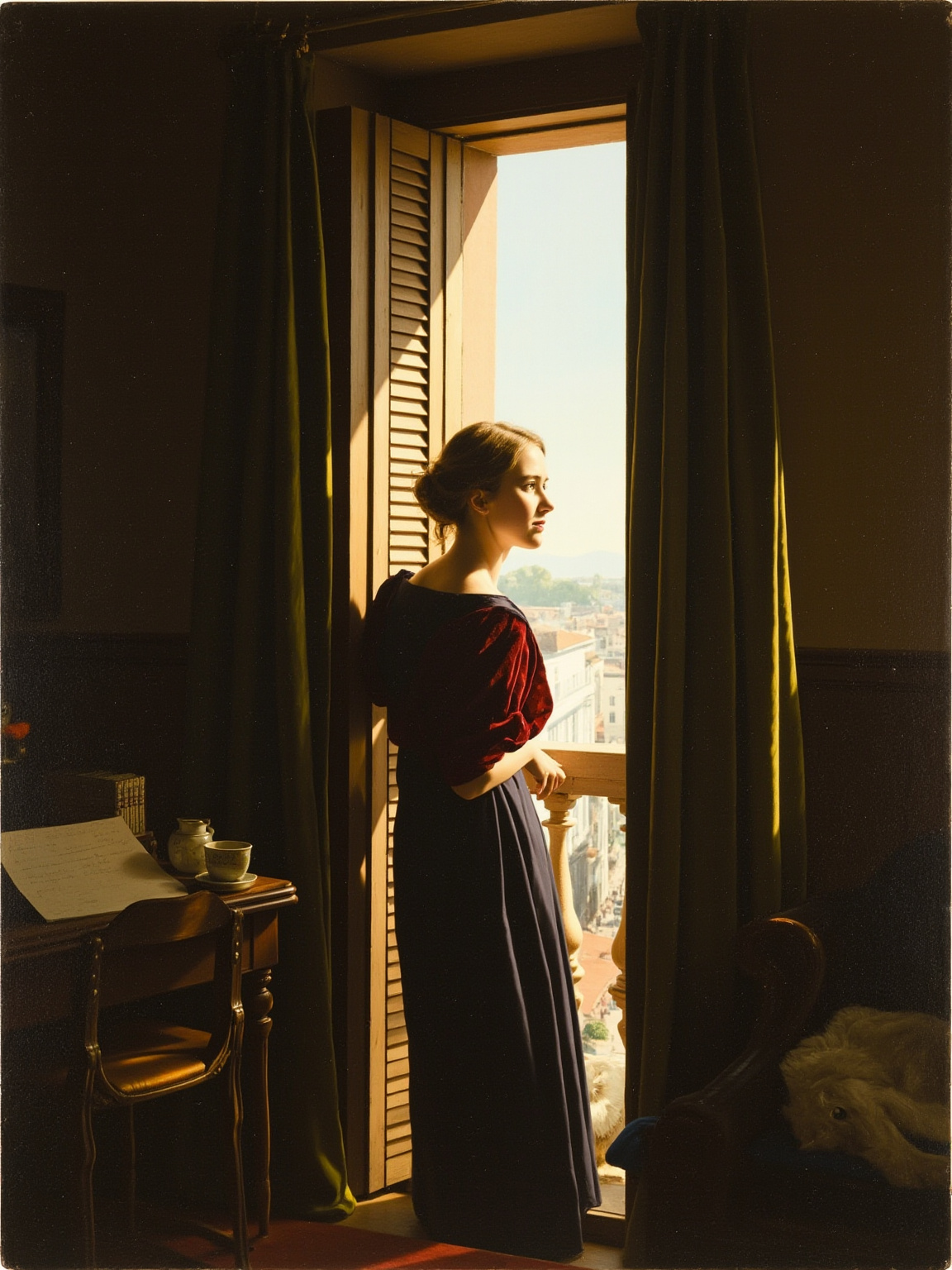
In 1846 the two married in secret and eloped abroad. She left her father, left Wimpole Street, left the bed. Their destination was Casa Guidi in Florence, an old house with a shuttered balcony on the second floor, a market in the street below, church bells overhead. For the first time, a woman who had been bedridden for years had sunlight. For the first time she went outside. For the first time she saw the bright ochre of southern Europe.
That move is the whole book's decisive shift in imagery. London was a heavy curtain and one dim brown thread of light. Florence is a shutter thrown open, a breeze that can actually get in, a balcony where she can stand without running out of breath. Love here is not only a feeling. It is also a departure on the map, out of a house where a woman was not allowed to exist, into one where she finally was.
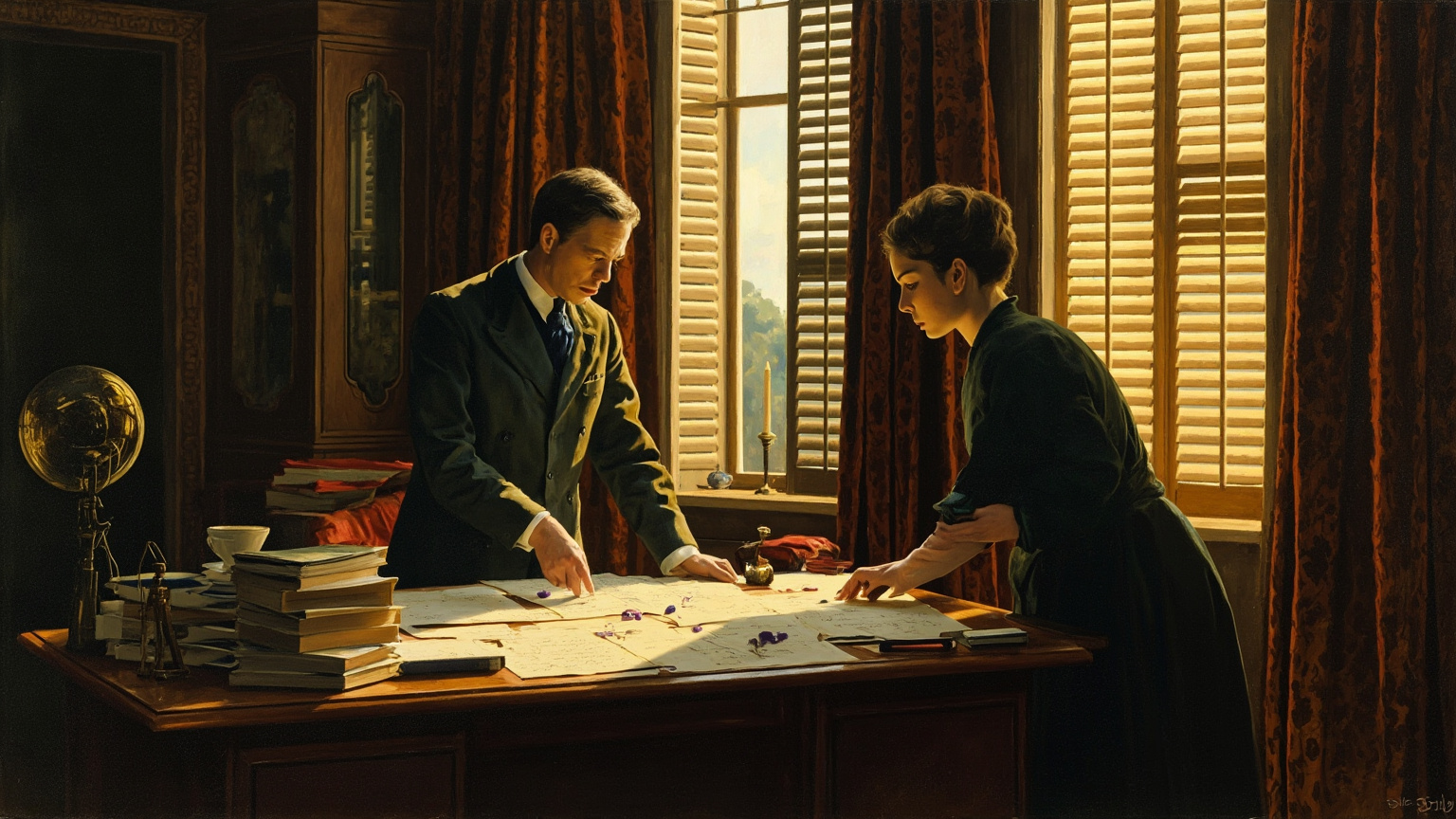
But it is worth pausing here. She was able to leave not simply because of love, but because he persisted. So running under the main story is another thread, a kind of power balance between the two of them: he writes, she answers; he pushes, and only then does she move. Read carelessly, she looks like a weak woman rescued. She is not. She is a woman someone refused to stop believing in.
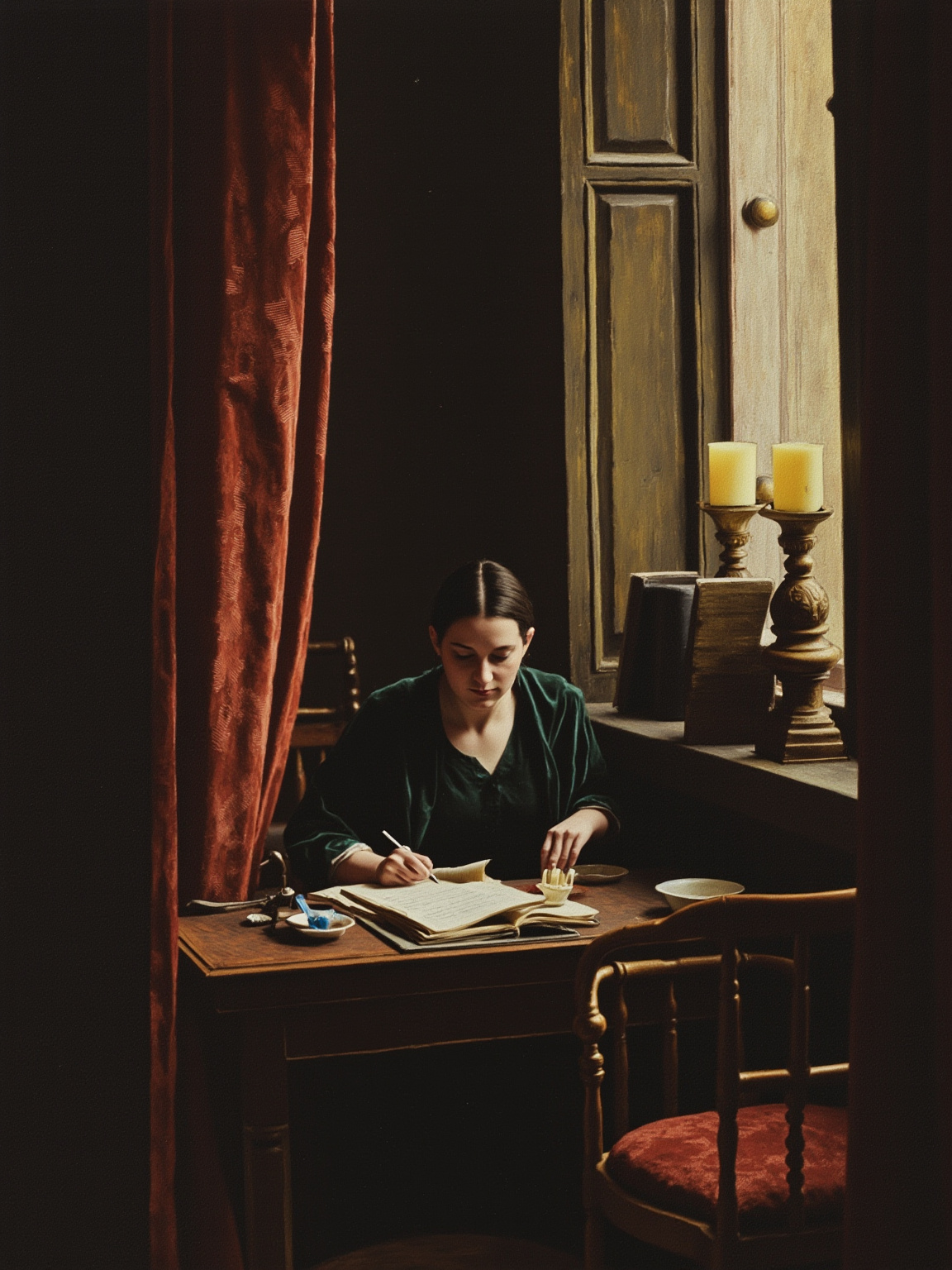
These forty-four sonnets are not a diary written in order and read out in order. She wrote them as they came and kept them hidden. After the marriage, Browning found the manuscript and insisted it be published; she refused at first, frightened by how much the poems confessed. In the end she gave her consent. In 1850, Chapman and Hall brought them out anonymously in London, the cover reading Sonnets from the Portuguese, letting readers assume they were looking at a translation.
The decoy title was Browning's idea. He knew that if the poems went out under her own name, everyone would see at once that a woman was narrating her own courtship. So he chose a title that sounded like a foreign translation, the Portuguese, and hid her behind the mask of a translator. The choice is itself a kind of metaphor. Everything she most needed to say, her whole life, had to pass first as something else before it was allowed to be said at all.
Treating this as forty-four love poems stacked together is the most common way to miss the point. It is one continuous inward arc: from I cannot believe I deserve to be loved, to I dare to give myself over, to I see love now in a light higher than anything human. The early sonnets are still retreating. The middle stretch is her slowly allowing herself to be seen. The last dozen or so push love, degree by degree, from an earthly feeling toward something close to a divine force.
The Barrett fortune came from slave plantations in Jamaica. It was money her father's generation made off slavery, and she grew up inside that money without choosing it. She herself was plainly troubled by this, and confronted it directly in another 1848 work, taking an explicit abolitionist stand. That same unease sits underneath the Sonnets too; even as she writes about love, she is also writing about enjoying a peace she did not come by cleanly.
Guides to the book rarely dwell on this, but it explains why she keeps pushing love, later on, toward the divine. Outside the love story, she was carrying her family's unease as well. That self-questioning made her, writing this collection in her forties, a far more complicated woman than someone simply absorbed in falling in love.
Three reasons. First, Sonnet 43 entered the English quotation stock: weddings, letters, advertising, television, anywhere someone needs to say what love is, it turns up there, almost impossible to avoid. Second, she turned the sonnet into a psychological record, and that trick of remaking an old form into a personal inner history is one of the rare landmark achievements in English poetry. Third, it was written under real constraint, bedridden, housebound, an entire world sustained by a stack of letters, and that hard contrast gives it a weight no other love-poetry collection carries.
It is still being translated, rewritten, parodied, and no later vocabulary of English love poetry has ever fully replaced it. Not because it is beautifully written, because it is truly written. A thirty-nine-year-old woman, leaving her bedroom for the first time, allowed to love for the first time, set down every bit of the panic, the accounting, the gratitude of that moment. That kind of truth is not something later writers can fake.