Taiheiki (Chronicle of Great Peace) · Companion Guide
太平记
五十年南北乱世,怨灵讨债、忠魂难熄——日本两大军记物语中,无常之上又叠因果。
One. Kyoto, Rokuhara: a fire that opens fifty years
The story opens with the Hōjō's Rokuhara Tandai in Kyoto burned to the ground. In the glow of the fire, word reaches Emperor Go-Daigo at his palace, and he lifts his head — he has been waiting for this day a long time. That is how Japan's age of the Northern and Southern Courts begins. The book is called The Taiheiki, the Chronicle of Great Peace, but what it opens with is not peace. It is the opposite of peace.
From the day he took the throne, Go-Daigo refused to be a rubber stamp for the Kamakura shogunate. He plotted to bring the shogunate down, surrounded by Confucian advisers like Kitabatake Chikafusa and a circle of warriors willing to stake their heads on it. The first to move was Kusunoki Masashige, a local lord from Kawachi, who used a string of stratagems around Kanegasaki and Chihaya Castle to hold off the Hōjō armies and buy the loyalist forces around the capital time to gather.
Two. The fall of Kamakura and the Kenmu Restoration: a reign that bloomed and died
At almost the same moment, Nitta Yoshisada raised an army in the Kantō and fought his way into Kamakura. The Hōjō's Tokusō government fell, and a shogunate that had stood for more than a hundred years collapsed in a single night. Go-Daigo took real power back into his own hands — this is the Kenmu Restoration. It is the most breathless chapter in the whole book: a century-old shogunate overturned, the old order settled, and a new one standing right there in front of you.
The restoration did not last two years. The Kenmu court tried to rebuild direct imperial rule — abolishing shogunal offices, reorganizing estates, clawing back power from the warrior class. The trouble was simple: the men who had done the fighting were not about to lay down their swords on their own.
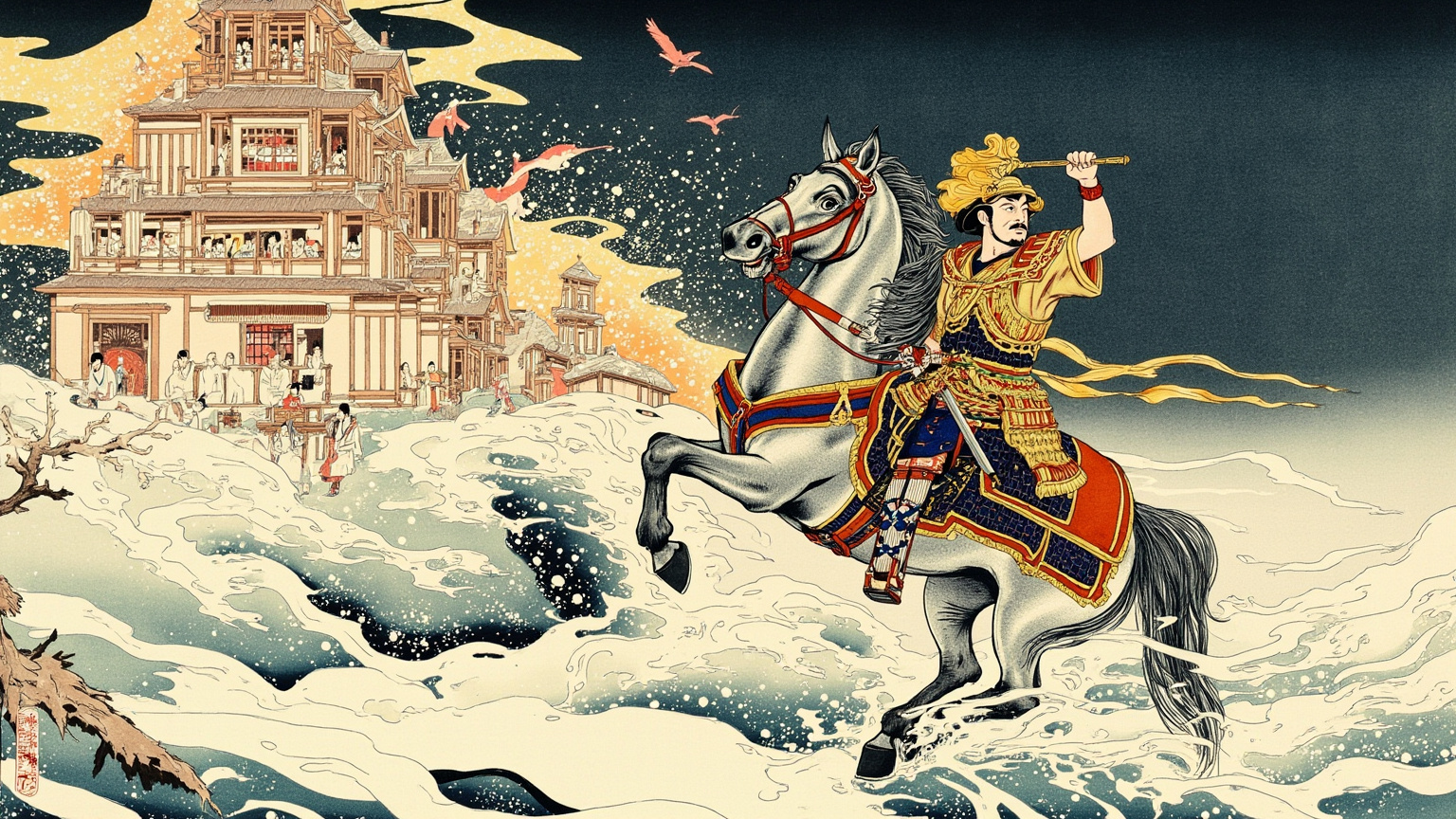
The realm shall have peace; yet in this world there is none who abides.
雖曰太平,於此世未嘗有焉。
金句 · 卷一 · 太平記開題
Three. Defeat at Minatogawa: Ashikaga Takauji turns his sword, and Kusunoki Masashige leaves seven words behind
Ashikaga Takauji had been a Hōjō vassal, a gokenin, who turned on his lord to help the emperor destroy the Hōjō, then turned on the emperor in his turn. In the mid-1330s he defeated the imperial army at Minatogawa. The battle is often painted as a straight duel between Takauji and Kusunoki Masashige, but the real matchup was Takauji reinforced by Hōjō remnants against two loyalist armies advancing in tandem, Kusunoki's and Nitta Yoshisada's — and they still lost.
At the end, Kusunoki Masashige left his son seven words: shichishō hōkoku — may I be reborn seven times to serve the throne. Nineteenth-century Japanese nationalists seized on the line and built him into a modern icon, but in the Nanboku-chō world where the Taiheiki was written, he is first of all the type of the loyalist warrior sent by the court to fight a battle he could barely win. The scene works because the author does not give him a speech. He simply has Masashige pull his son close, murmur the seven words, and then die alongside him.
Four. Yoshino and Kyoto: two courts, fifty years face to face
After Minatogawa, Go-Daigo was driven out of Kyoto and withdrew to Yoshino, where he set up a Southern Court in exile. Ashikaga Takauji installed Emperor Kōmyō, of the rival Jimyōin line, in Kyoto, named himself shogun, and opened the Muromachi shogunate. Japan now had one nation and two courts, Southern and Northern, and which one was legitimate would be fought over for fifty years.
This is where the Taiheiki's real ambition shows: every scroll circles back to the question of which court holds legitimacy. Kitabatake Chikafusa's Jinnō Shōtōki is the Southern Court's own contemporary case for itself, and the Taiheiki leans the same way — Imagawa Ryōshun says outright, in his Nan-Taiheiki, that its author was a steady partisan of the imperial side. That stance puts legitimacy on the same footing the Tale of the Heike gives to impermanence: who holds the rightful claim matters more here than who wins the battle.
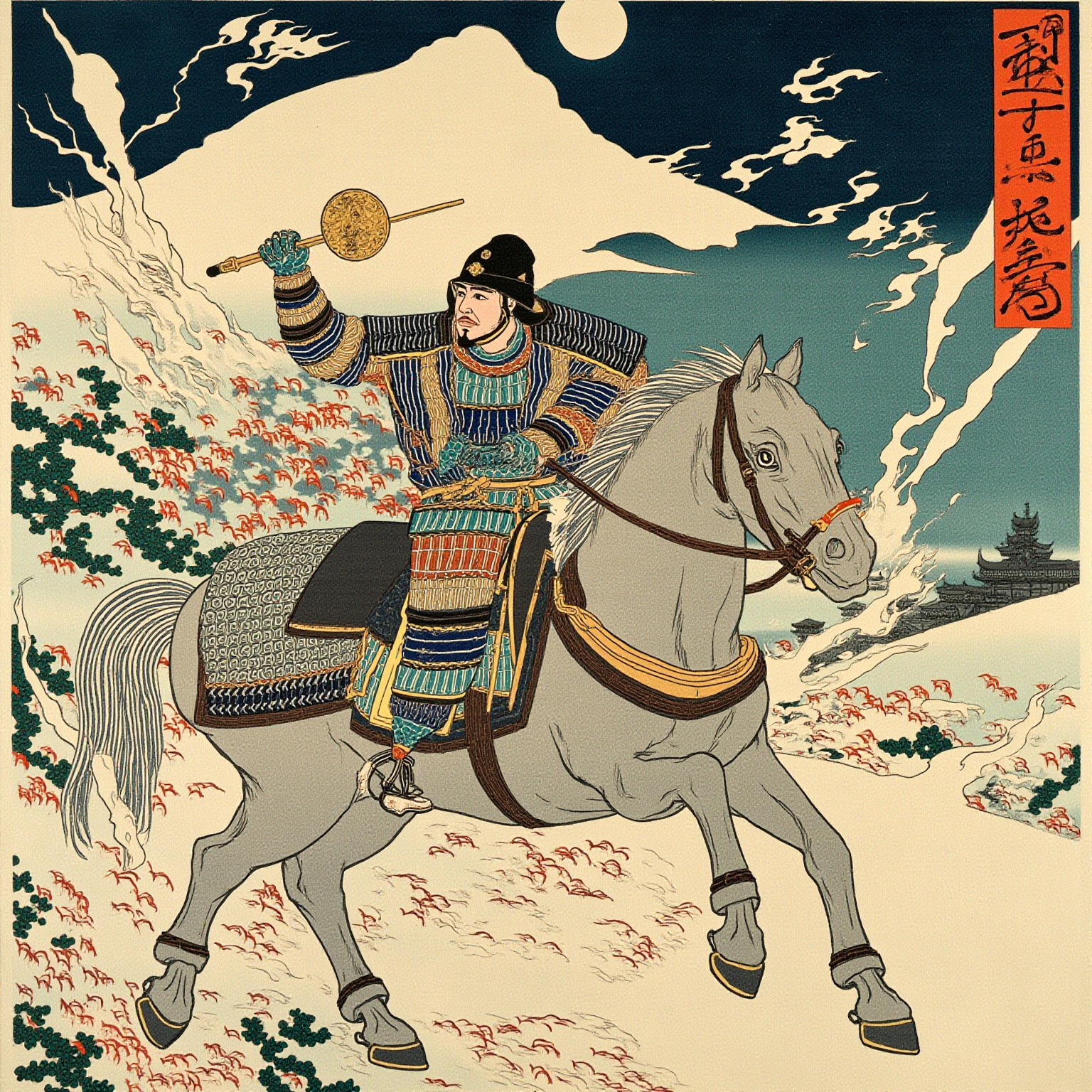
To give one's life for the sovereign, what after-life can claim more?
爲君則可捐生,何事更論身後。
金句 · 卷十七 · 楠木正成湊川訣別
Five. The death of Go-Daigo, and the engine of vengeful spirits starts turning
In the late 1330s Go-Daigo died at Yoshino. This is the hinge of the whole book — the instant he dies, the narrative engine switches gears. From this scroll on, the struggle between men gives way to grudge and karma. The author will not let the emperor die at peace: he goes unreconciled, his resentment turns into a vengeful spirit, and that spirit becomes the distant cause behind every civil war the Ashikaga shogunate suffers afterward.
This vengeful-spirit machinery has an almost tactile presence in the book. In the account of the Kannō Disturbance, Tadayoshi flees Kyoto and takes shelter one night at a temple in Hokuriku; the late emperor's figure suddenly stands at his pillow in a dream, and he wakes disoriented, then makes the decision that will get him killed. Elsewhere a veteran shogunate general with no thought of rebellion dreams one night that the emperor is calling him to account, wakes, and draws his sword on a fellow officer — and the author moves straight into a fresh round of civil war. A man gets pulled under by the grudge, and the plot turns on it. That is the gear that only the Taiheiki runs on.
This is what sets the Taiheiki apart from the Tale of the Heike. The Heike settles for impermanence — the mighty fall, and that is that. The Taiheiki stacks a second layer on top of impermanence: the pacification of a vengeful spirit. That spirit is not decoration, it is the force driving the plot — every later crisis in the Ashikaga shogunate carries the emperor's shadow inside it.
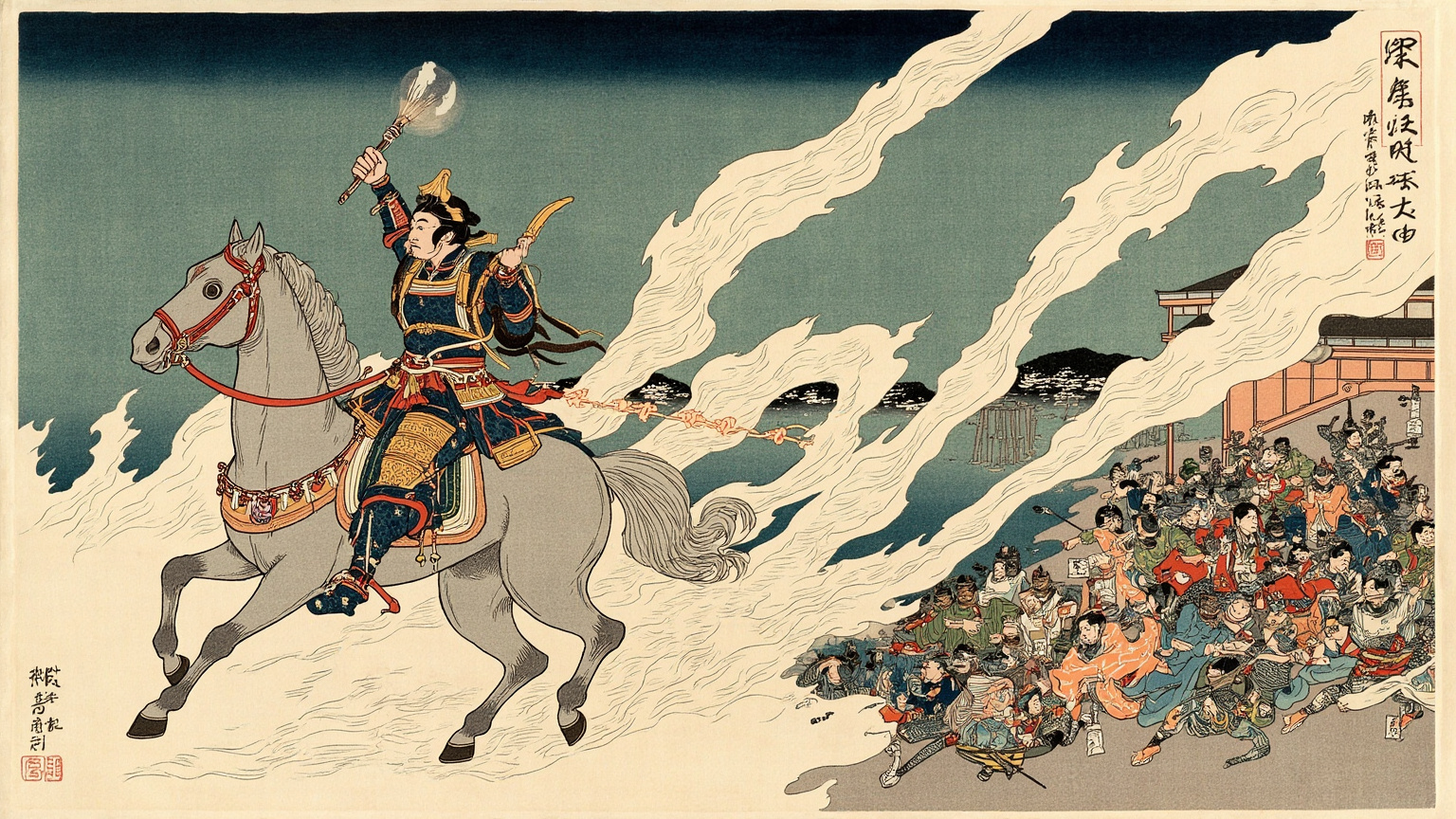
When the sovereign's wrath walks abroad, no gate of the realm can hold.
王靈怨氣所鍾,山河亦爲震動。
金句 · 卷二十九 · 後醍醐天皇怨靈
Six. The Kannō Disturbance: brothers turn on each other, and karma comes into focus
In the mid-fourteenth century Ashikaga Takauji turned against his own brother, Tadayoshi — the Kannō Disturbance. On the surface it was a power struggle inside the shogunate between the deputy Kō no Moronao and Tadayoshi; underneath, it was a real split between the brothers over which road the warrior government should take. Tadayoshi leaned toward respecting the Southern Court's claim; Takauji leaned toward the politics of the possible.
The Taiheiki tells this story with restraint. It never puts the brothers in a room shouting at each other. Instead Tadayoshi flees Kyoto, drifts through Hokuriku, and is finally captured; Takauji, having won, sits staring at an empty seat. That restraint is what makes the word karma land — the reader can see this is the first debt to come due after the emperor's death.
Seven. Hosokawa Yoriyuki becomes kanrei: fifty years draw to a close
The book runs forty scrolls, missing the twenty-second, and its narrative ends around the late 1360s, with the second shogun, Ashikaga Yoshiakira, dead and Hosokawa Yoriyuki installed as kanrei. Yoriyuki's arrival is the thin thread that finally draws all the scattered cause and effect together: he puts Rokuhara back in order, rebuilds security around the capital, and for the first time the word peace in the title looks like it might come true.
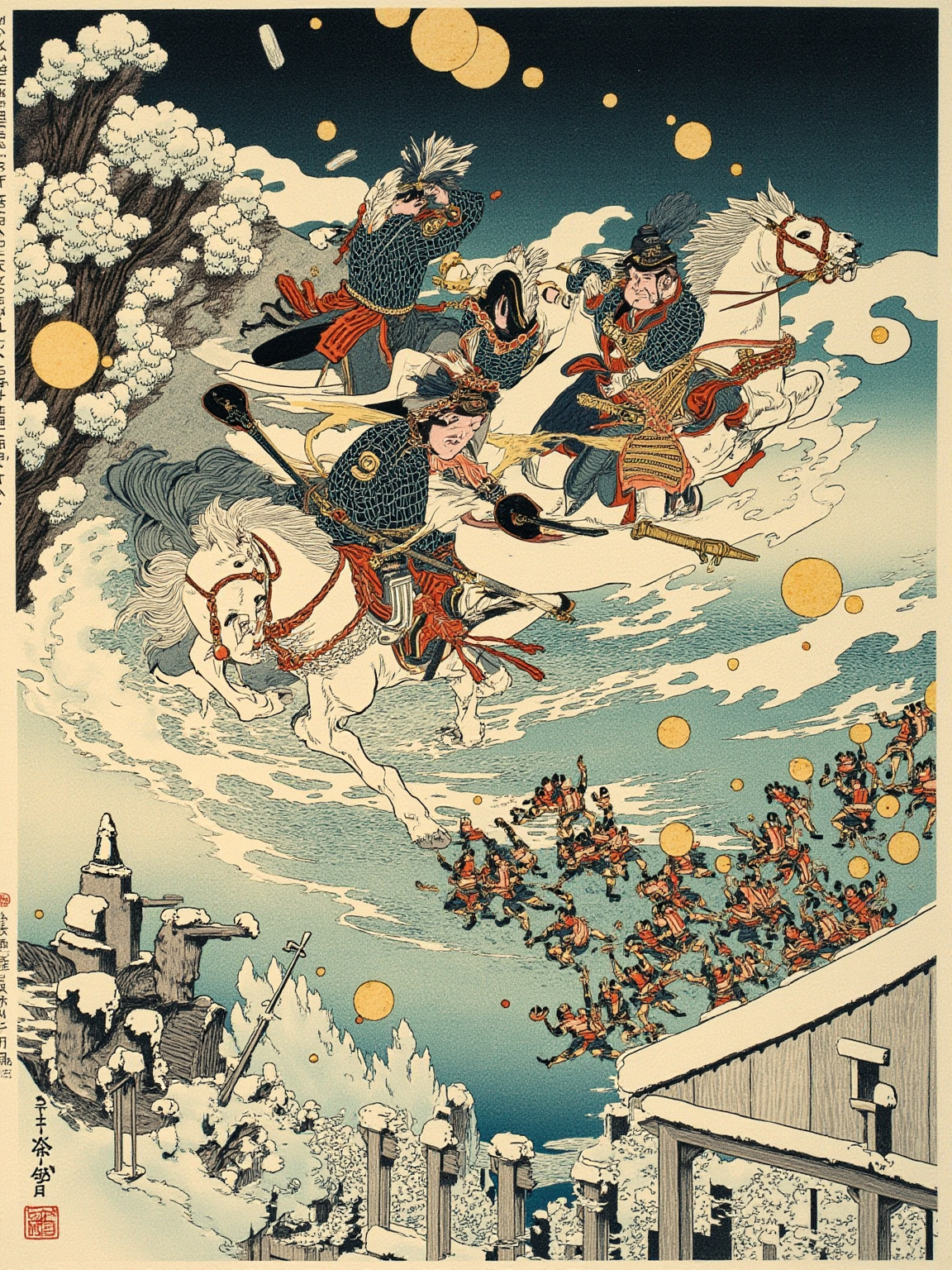
Brother turns against brother; so runs the debt of a house that broke its oath.
兄弟相殘,亦因業所驅然耳。
金句 · 卷三十四 · 觀應之擾亂
But the author will not let the scroll settle into a golden age. He wants the reader to remember what bought this peace: fifty years of lives, vengeful spirits, and the fight over legitimacy. The real peace that comes later, under Ashikaga Yoshimitsu, is never written — not a word of it. That is the Taiheiki's sense of its own limits: it shows the karma only half worked out, the chaos only just beginning to be reined in, and leaves the rest of the golden age to history.
Eight. Why this book is worth remembering for a lifetime
It stands alongside the Tale of the Heike as one of Japan's two great war chronicles, but at more than twice the size — forty scrolls, fifty years. On top of impermanence it adds two more supports, legitimacy and the pacification of vengeful spirits, giving the war narrative the hardness of a political philosophy. Blind monks of the medieval period chanted it aloud; the early Edo Kanadehon Chūshingura draws material straight from it; Imagawa Ryōshun answered it in his Nan-Taiheiki, and it was followed by a Go-Taiheiki and a Zoku Taiheiki. A whole chain of texts, with the Taiheiki as their common ancestor, runs on for centuries.
What is especially worth remembering is the book's second life: even as it was being fixed into text, it was already being sung. A settled version of the Taiheiki did not really take shape until the 1370s, and long before that it was shifting shape in oral performance — blind monks carried it village to village on the biwa, and the text moved with the place, with the audience, with the memory of each new war and each new peace. Reading it is not just reading a forty-scroll book. It is reading something that has been rewritten for six hundred years and is still alive. Behind the Enya Hangan episode in Kanadehon Chūshingura, in the shadow of the forty-seven rōnin, stands this same Taiheiki, grown up out of manuscript pages and biwa strings alike.
It is also the starting point nobody discussing the Nanboku-chō period can get around. The author leans Southern Court, forty scrolls were compiled by many hands over time, and there is plenty of embellishment and invention in it — Imagawa Ryōshun was already picking it apart point by point. But as a war chronicle it is living historical material, a text that has been sung for six hundred years, the same kind of ground floor that the Romance of the Three Kingdoms is for China.
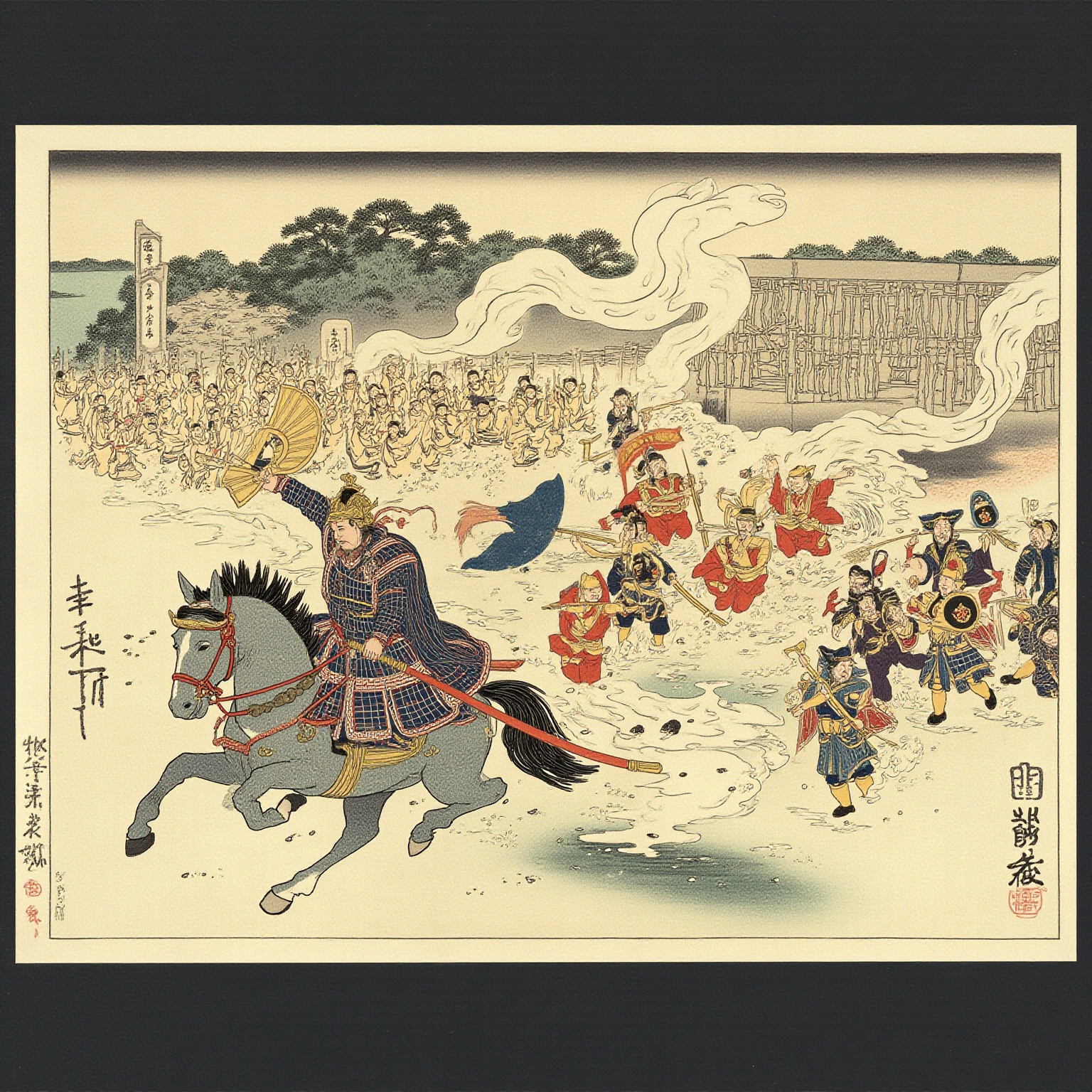
The Heike says the mighty fall. The Taiheiki says after they fall, the vengeful spirits still come to collect.
Nine. You know the plot now, so why read the original
A guide can only give you the skeleton. Beyond it, the Taiheiki has a texture of its own: its sentences mix medieval Sino-Japanese with native Japanese prose, and the rhythm moves like a blind monk's plectrum on the biwa — the same stretch of battle can race by breathless, then stop dead on a single waka and hold you there for a few seconds. Its armor, its castles, its banners are not props; they are a second skin the characters move through. Its vengeful spirits are not fantasy furniture; they are political disorder given a face.
And to this day only the first twelve scrolls of the Taiheiki have a complete English translation; the rest are still being worked through. Most Chinese readers, for that matter, are still going at the raw Japanese original, or its classical-Chinese-inflected prose, with no translation at all. That unfinished state of translation is itself a reason to read it: what you are reading is the same work that has been chanted, rewritten, and continued for six hundred years.
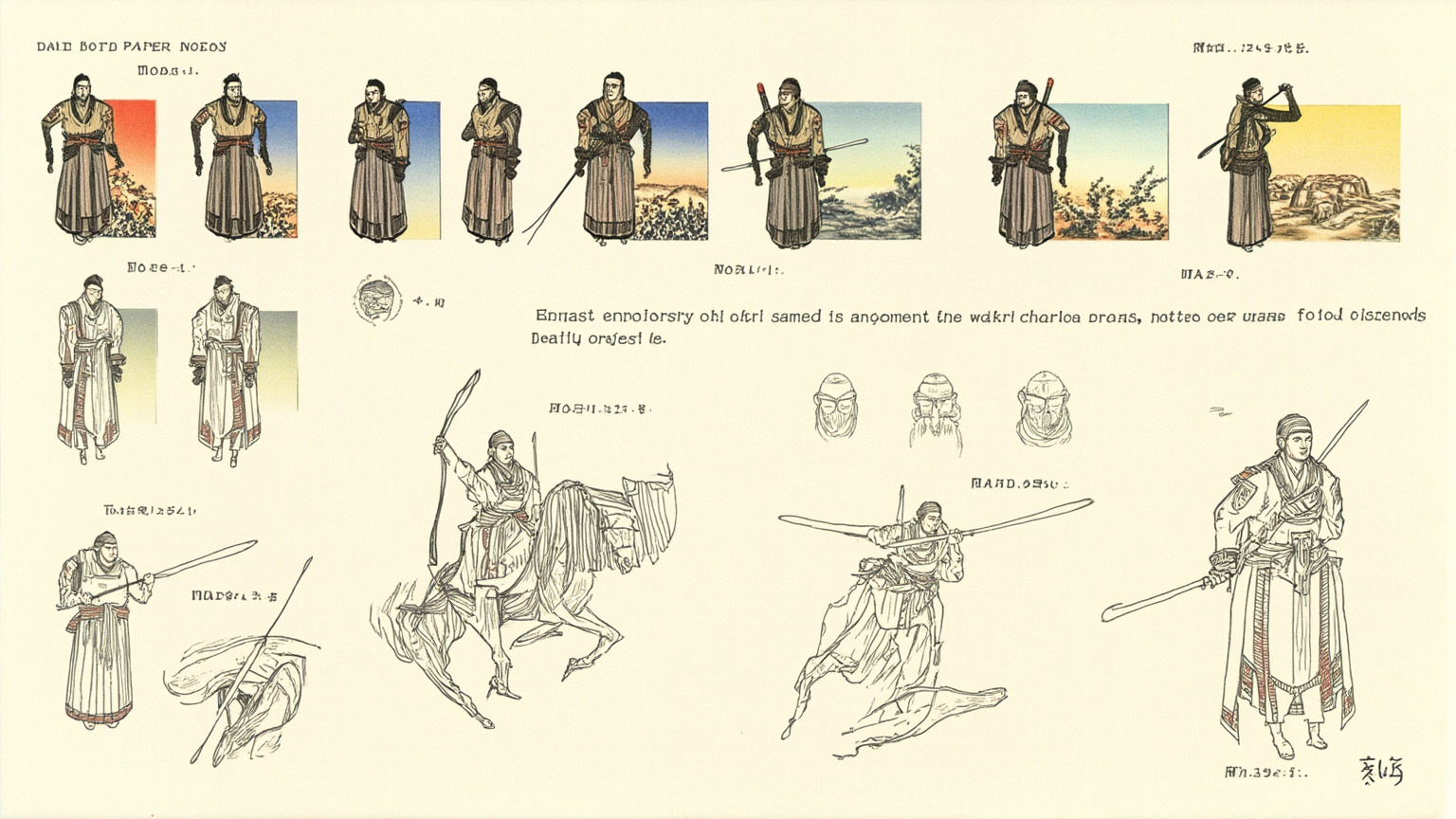
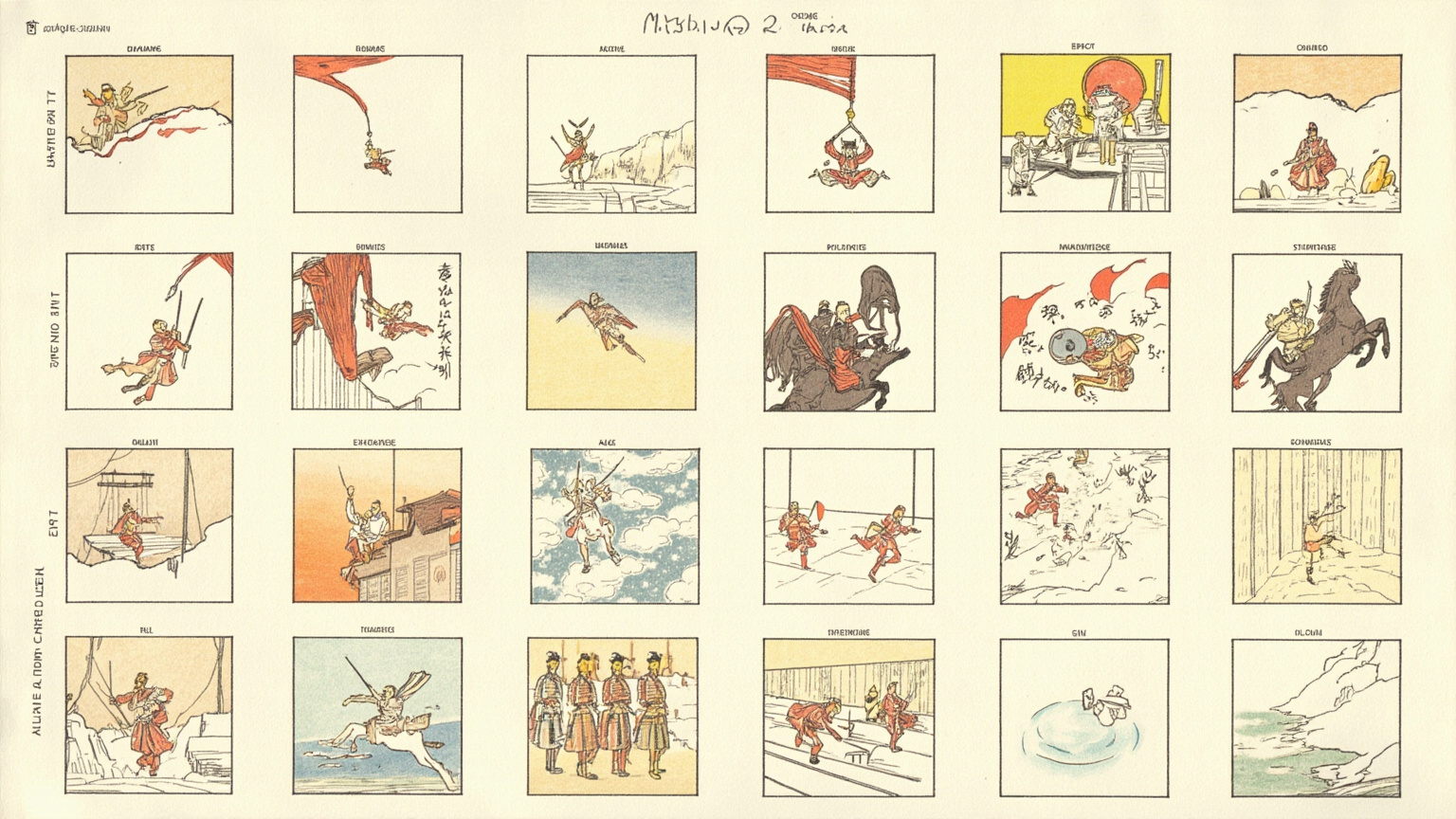
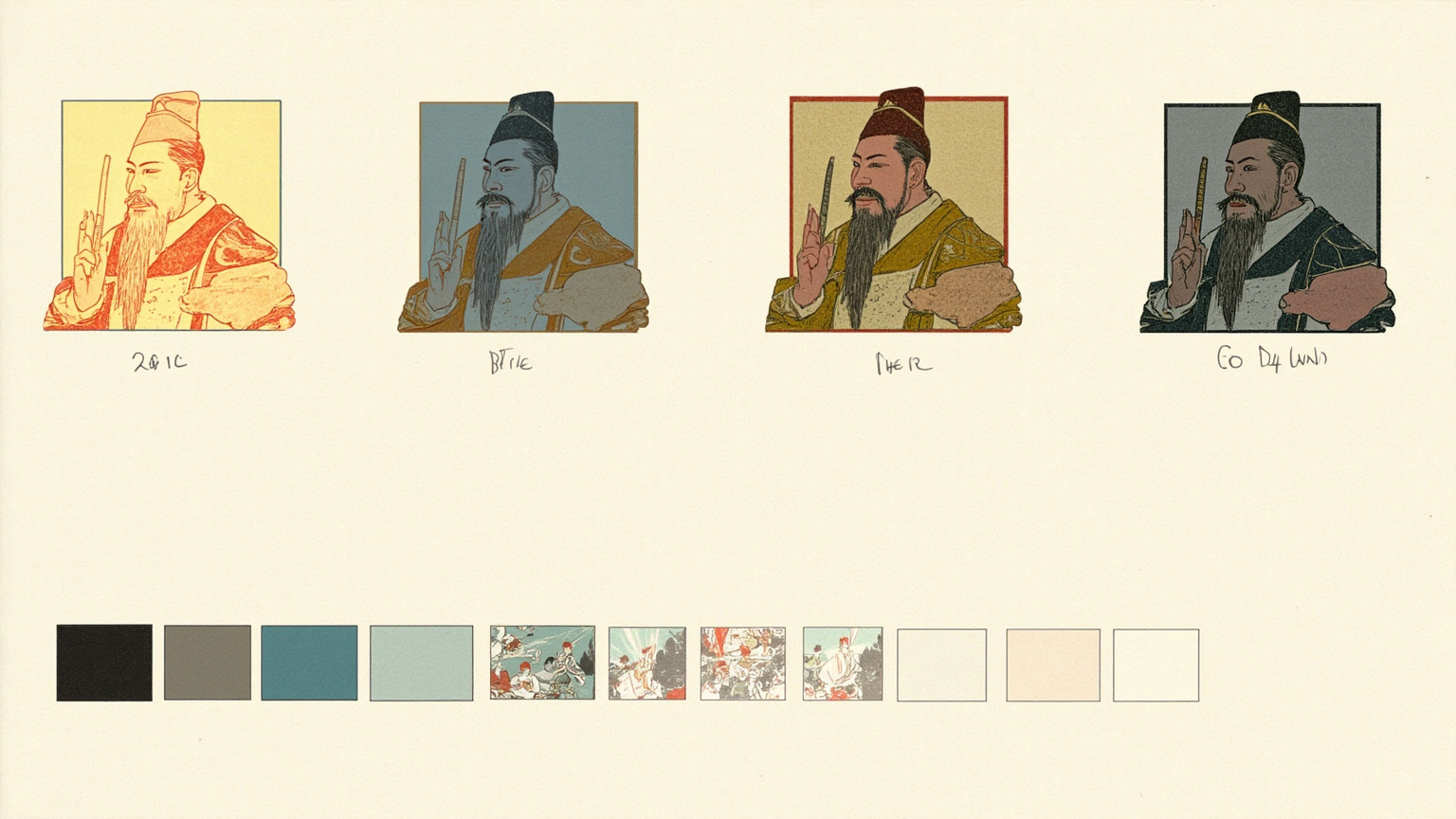
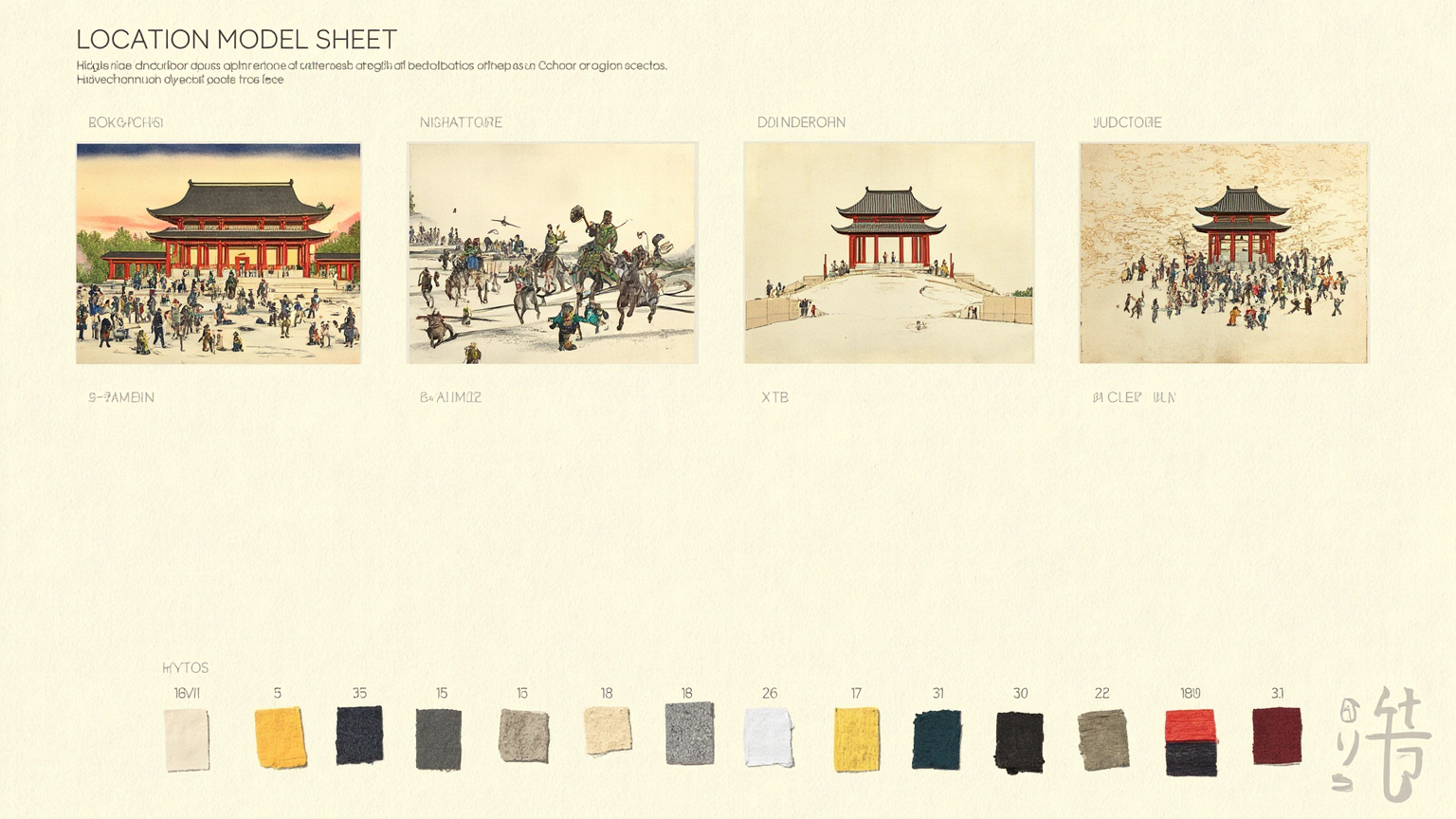
Art Direction4 plates
Before the guide was written, this book got a visual foundation — every illustration you just read grew out of it.