Tales of Moonlight and Rain (Ugetsu Monogatari) · Companion Guide
雨月物语
替鬼魂送菊的武士、在驿馆等了亡夫七年的妻子、脊背浮出人面的鲤鱼——把命押在约定上的人,赴的是另一层时间里的约。
A samurai delivers a chrysanthemum to a ghost
On the day before the Chrysanthemum Festival, a samurai from Kii province named Katsushiro sets out carrying a single wilted chrysanthemum. He is not going to admire flowers. He is going to keep an appointment with a dead man. His old friend Sohaku, back in the capital, once made a pact with him: they would watch the chrysanthemums together every year on the ninth day of the ninth month, and if one of them died first, his spirit would return to keep the date. Sohaku's grave has long since grown over. This flower is for his tomb.
Why this book of ghost stories is remembered
Tales of Moonlight and Rain took shape in the mid-to-late eighteenth century, in Edo-period Japan. Its author, Ueda Akinari, spent much of his life poor and sick, a townsman who worked as both painter and writer, a city dweller who was never comfortable. The book gathers nine ghost stories, and it takes apart the karmic, vengeance-driven ghosts of Qu You's New Tales Told While Trimming the Wick and Feng Menglong's Sanyan story collections piece by piece, then reassembles them under Japanese moons, at wayside inns, at river crossings, in overgrown grass and forgotten graves. Japanese ghost fiction reaches its high point here. Lafcadio Hearn later retold these tales in English, Kenji Mizoguchi put them on film, and neither ever quite got past this thin little book.
The title, Tales of Moonlight and Rain, comes from a line in the author's own preface: a night of moon and rain. That is not weather. It is the name for another kind of time running through human life, the layer you cannot see by day but that keeps flowing underneath anyway.
The people in it, and what they cannot let go of
The book turns on four people who stake everything on a promise. Katsushiro stakes a samurai's word, a chrysanthemum vow as unbreakable as iron, kept alone in a house belonging to the dead. Miyagi stakes a single night's warmth from an innkeeper: at the Asaji waystation in Mino, the very one he had once kept as its master, he meets a gentle woman who receives him like any living guest, for one night. Only months later, back in the capital, does he learn that the waystation had lain in ruins for ten years, burned in the Sadato wars, its keeper and his wife long since bone. What had kept him company that night was that same wife, sustained seven years by nothing but waiting for a husband who was never coming home. Fujiwara no Sanekata stakes a parting courtesy, a plain safe travels, on the road to his posting in Mutsu, and finds it answered by his dead friend Akazome Emon's face, rising from the back of a carp. And an old man, telling stories under a mountain temple's eaves on a rainy night, stakes something else again: an argument, ghost story as its vehicle, between a townsman-scholar and his own fate.
Four people, four different things they cannot put down. What they share is this: every one of them is dealing with someone who is no longer there.
The Chrysanthemum Vow: keeping an appointment with a ghost
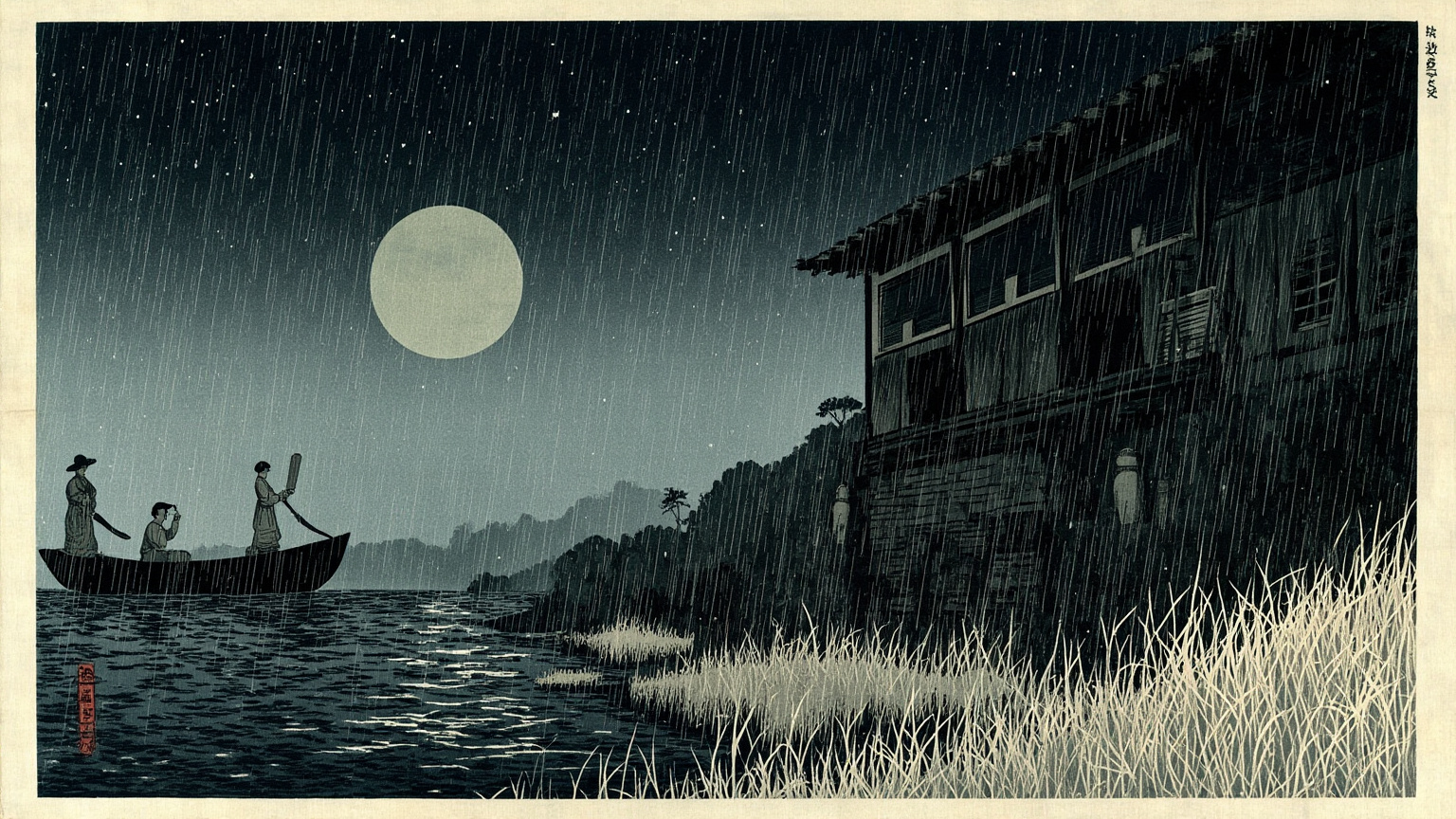
Katsushiro crosses the sea from Kii toward the capital, is set upon by a band of pirates, and is saved by a strange monk who seems to appear from nowhere. He boards a boat on a moonlit night, and a woman aboard gives him a fan inscribed with a poem. The more beautiful the journey gets, the colder it ought to make your spine, because the end of it is not a chrysanthemum-viewing party. It is a house that has stood empty and falling apart for years. He pushes the door open, and beneath the plain curtain lies an old friend of Sohaku's, already nothing but bone. That was the appointment he never got to keep in life, honored after death in this shape. Planting that single wilted chrysanthemum in the grave earth is as far as a samurai's good faith can go.
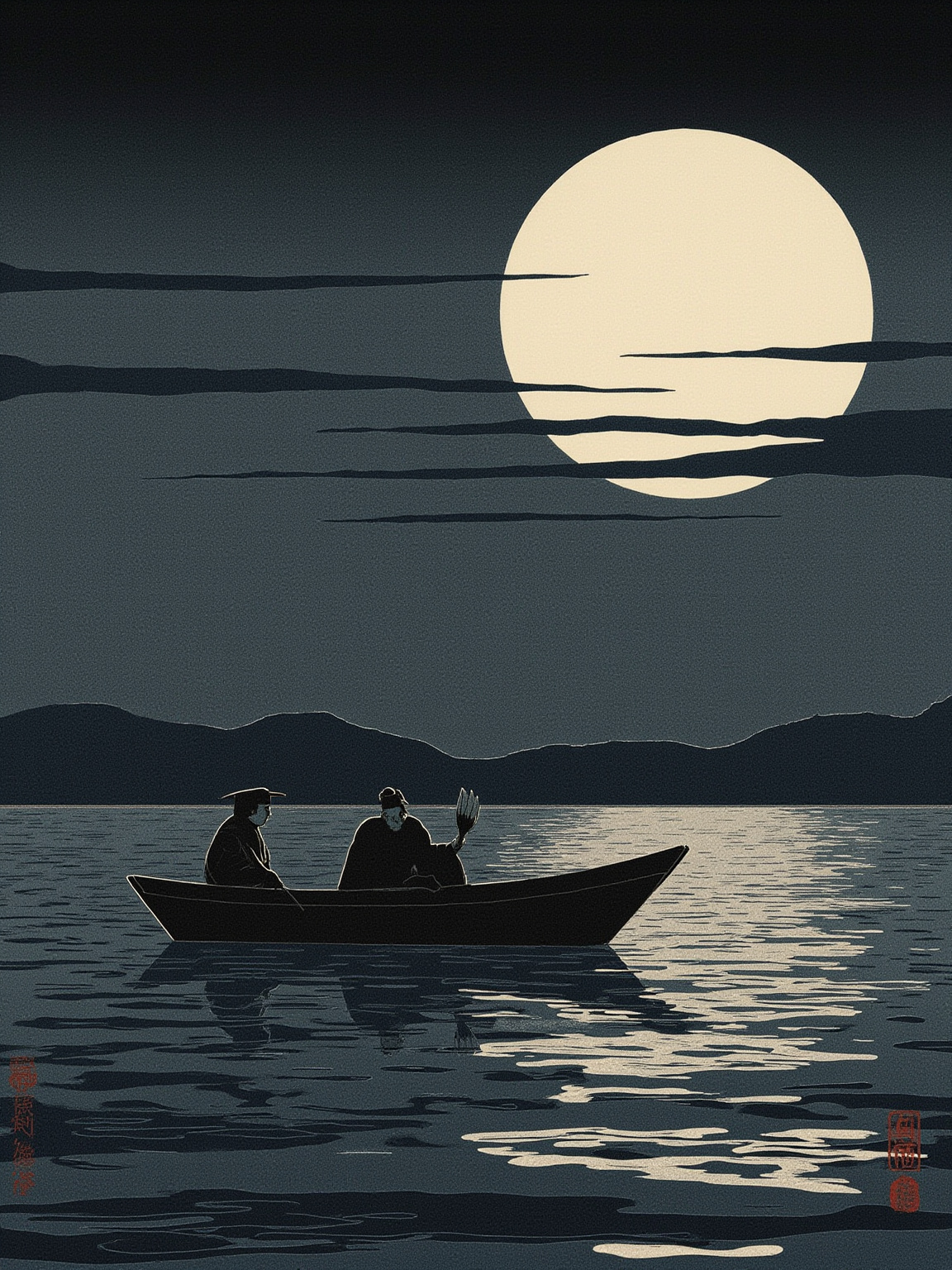
The moon hung low above the mast, and the girl in the boat pressed a fan of song into his hand without a word.
月色低低落在桅上,舟中女子不语,只将一柄歌扇递到他掌心。
金句 · 自序 · 月与雨的夜
Here is where the craft shows. Akinari never lets Katsushiro see a ghost. What he writes instead is the contrast between outside the door and inside it, between what is in front of the curtain and what is behind it. Outside: moonlight, the boat ride, a fan with a poem on it. Inside: a ruined house, bare bone, a plain curtain. Life and death are pressed into the same frame, and not one line ever announces I am a ghost. The first time I read the passage where Sohaku turns out to be bone, I went back and reread the page before it. This is Akinari's real skill: he lets the reader arrive at the truth half a beat behind Katsushiro, never ahead of him.
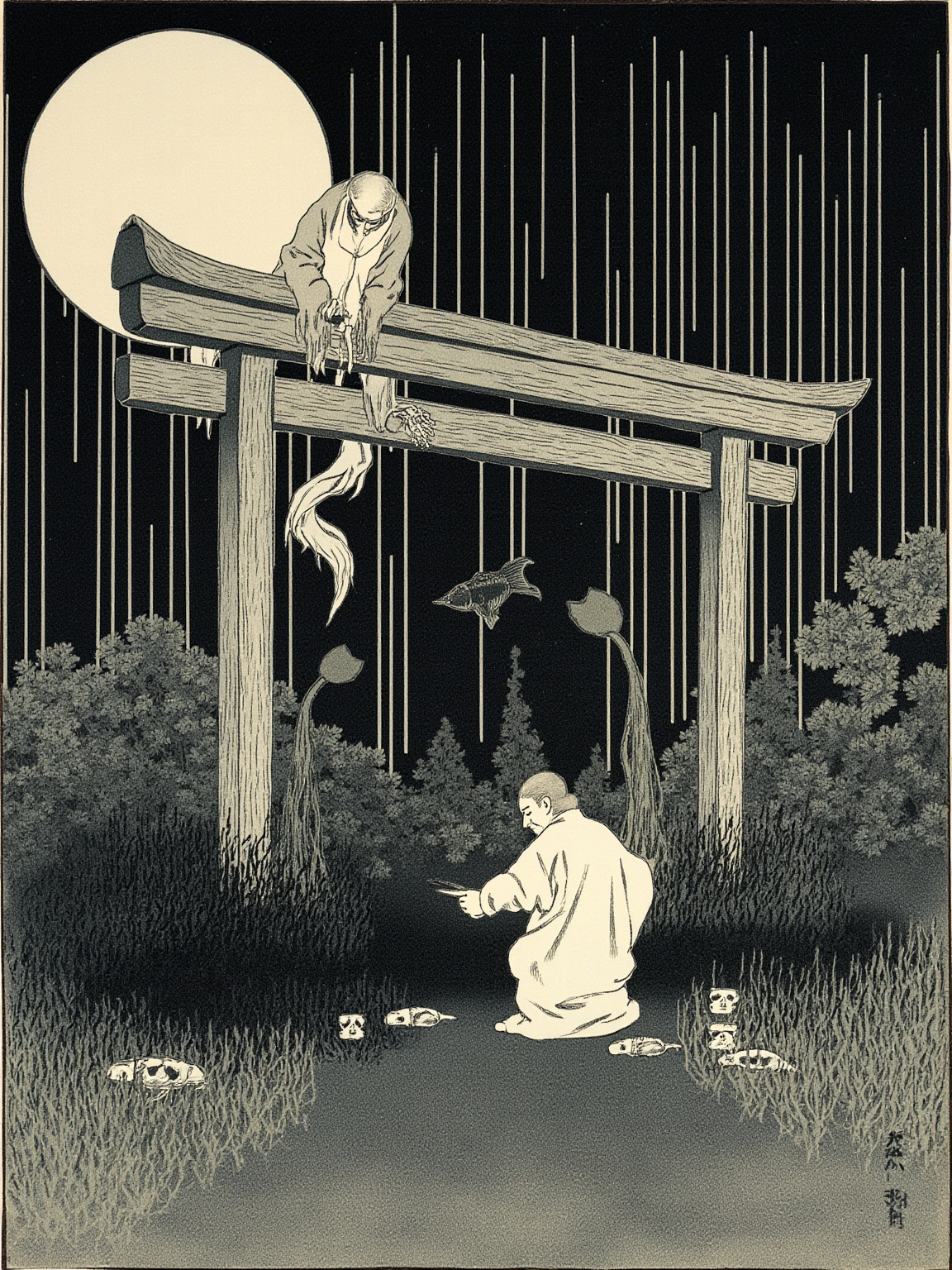
He pushed open the gate; within, the pale curtain stirred of itself, and beneath it lay nothing but white bone.
他推门而入,素帷自顾拂动,帷下森然,唯余白骨。
金句 · 菊花之约 · 荒邸之骨
The House Amid the Thickets: what waited seven years for you was a grave
On to another story. Late in the Heian period, a man named Miyagi keeps a waystation called Asaji, in Kagano, Mino province. Sent away on business after the Sadato rebellion, he finishes his errand and beds down for the night at the very Asaji station under his own charge, or so he believes it still to be. A woman who runs the place lets him in, warm and easy as any living host, and gives him a night of comfort. He sets out again at dawn. Only months later, back in the capital, does he slowly learn the truth: that Asaji waystation had already lain in ruins for ten years, its keeper and his wife killed in the fighting a decade before. He had not come home. He had spent the night inside a grave. What kept him there was the innkeeper's wife, a bond of lodging conjured out of seven years of waiting alone for a husband who would not return.
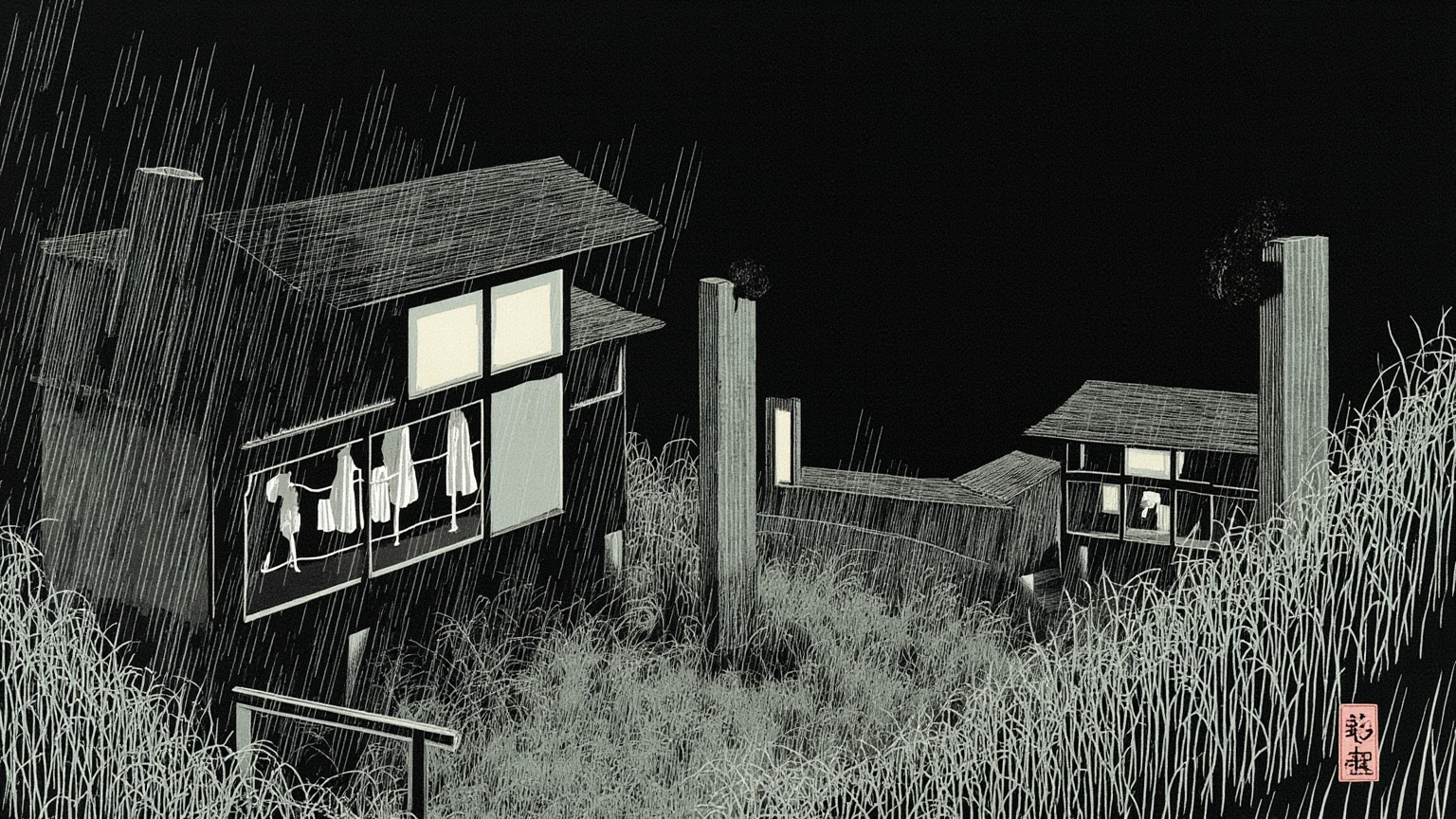
She welcomed him as any wife welcomes home a husband long delayed, and no candle showed him the truth.
她迎他如久客归家之妇,灯下未示其真相于万一。
金句 · 浅茅之宿 · 亡妻候夫
Worse still, Miyagi's living wife back in the capital shares this dead woman's name and face. Akinari never explains it. He simply lets the two faces overlap. This is deliberate: an overgrown waystation, a dead wife waiting for her husband, seven years of it, is one of the most reworked motifs in Japanese ghost literature. In 1953 Kenji Mizoguchi drew on both The House Amid the Thickets and The Chrysanthemum Vow for his film of the same name, Ugetsu, the moment this book has been most seen abroad. But the film leans harder into war and chaos. The original is lighter, quieter, more like a dream you cannot wake from.
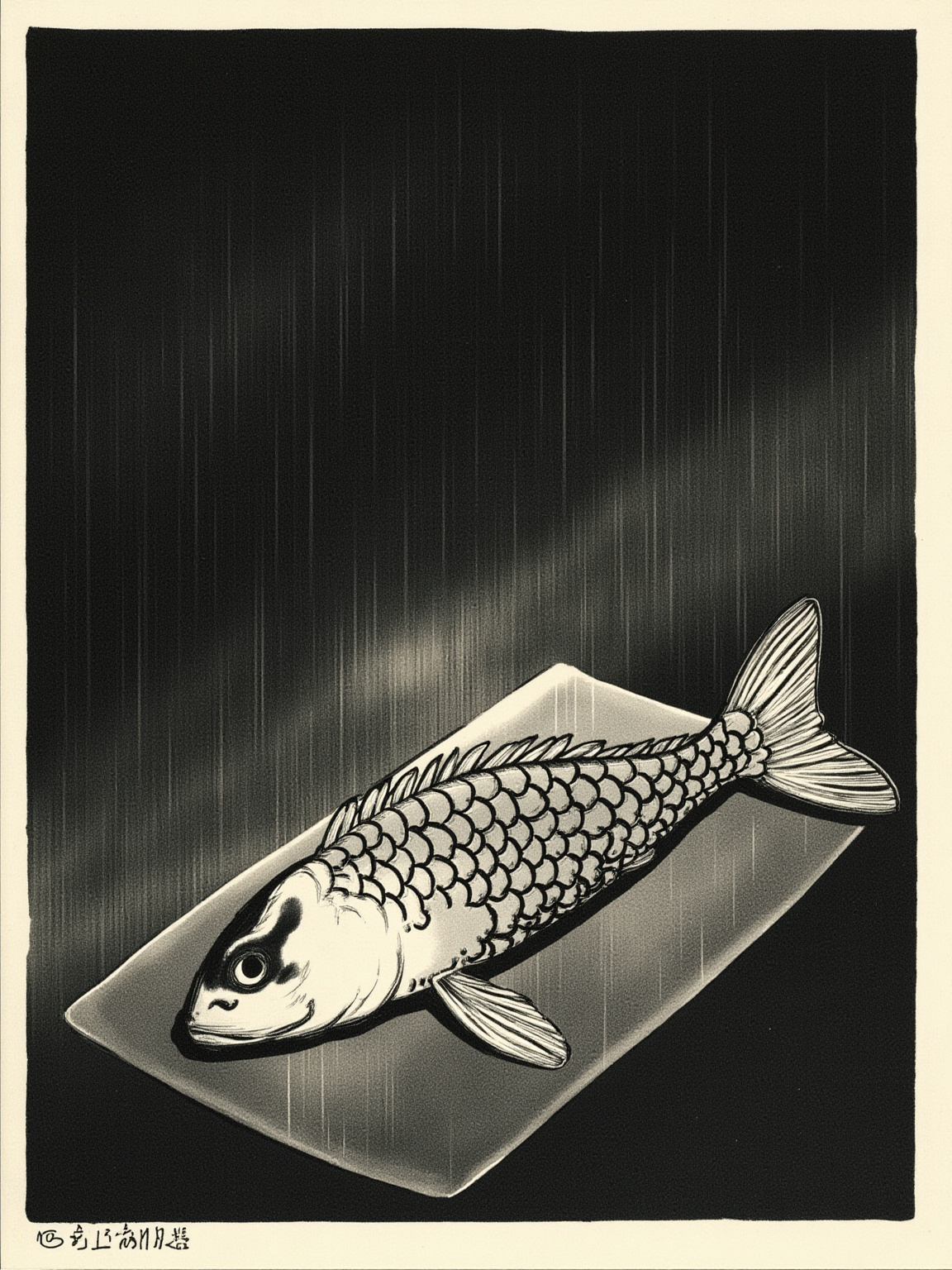
Between the scales of the carp rose a face he knew—the face of one long dead—and the eye rolled from the board.
鲤鳞之间,浮出一张久故人之面;鱼眼自案上滚落。
金句 · 梦应之鲤鱼 · 人面之鳞
The Carp of My Dreams: an old friend's face on a fish's back
The third story moves to a master of waka poetry in the Heian court, Fujiwara no Sanekata. Demoted and sent to take up a post in Mutsu, he is on the road when a fisherman offers him a carp. Between the scales along its back, a human face rises faintly into view: the face of his dead friend Akazome Emon. Sanekata has the fish cooked, and when its eye rolls loose onto the cutting board, the words spoken at his send-off, safe travels, turn into an omen. That same year he does in fact die in Mutsu, and he never sees the capital again.
When he drew the last stroke, the fish came alive—then the brush fell, and the joy of the work died with him.
待最后一点落下,鱼活了——而笔也落了,画师的欢喜便随笔同死。
金句 · 梦应之鲤鱼 · 画鲤之僧
What this story really turns on is the monk who paints carp. He spends his whole life painting them, and not one painting has any life in it, until the very last one, where the fish finally comes alive. The painter-monk is a mirror image of Ueda Akinari himself, a painter by trade: a lifetime spent chasing truth and never catching it, until the final brushstroke finds it. This is the standard move for an Edo-period townsman-scholar writing himself into his own fiction, smuggling himself into the last panel of the ghost story.
On Poverty and Wealth: an argument about fate, under the eaves on a rainy night
In the last story, the narrator ducks out of the rain under the eaves of a mountain temple. An old man is already sitting there, and he answers him with a ghost story of his own: a poor man, driven by obsession, is reborn as a great whale in the sea, only to find that wealth, once gained, becomes its own burden, and he ends up poor again. That is the costume. What is inside it is Akinari's self-portrait as a townsman-intellectual, a lifetime spent seeking the way, worn down by poverty and illness. Writing ghost stories was never about chasing the strange for its own sake. It was how he argued with the ordinary world of Edo, and with his own fate.
Read through all four of these stories and a single thread appears. All nine tales in the book begin on a night road, at a river crossing, at a waystation, at a graveside. What moon and rain keep laying down, again and again, is that other layer of time running through human life, the kind you cannot see by day, that keeps flowing after death. A chrysanthemum vow, seven years of waiting, a face on a fish, a lone grave: every one of them is an appointment kept inside that layer of time.
Why this book keeps getting adapted, and why no one has written a second one
Akinari's method is hard for anyone else to copy, because what he did was never just write ghosts. He took the skeleton of Chinese tales of the strange and dressed it in Japanese flesh. The karmic-retribution plots and vengeful ghosts of New Tales Told While Trimming the Wick become, in his hands, a samurai holding a chrysanthemum by moonlight, a wife waiting at an inn for a dead husband, a carp with a human face rising through its scales. The Chinese tales gave him motifs. He supplied the season, the texture, the faint sound of moonlight falling on a straw mat. When Lafcadio Hearn later retold these stories in English, he could carry the meaning across but not the dense, particular style of Edo prose fiction, sentences built from Chinese characters read the Japanese way and mixed with native Japanese script, which carries a restraint in it that borders on cold.
What Tales of Moonlight and Rain does best is not writing ghosts. It is writing people who stake their lives on a promise, keeping not a date but an appointment in another kind of time.
You already know the plots. Here is why you should still read it
Because an explainer is a map, and no matter how carefully it is drawn, a map is never the ground itself. What this book actually gives you is its style, sentences built from Chinese characters read the Japanese way and mixed with native Japanese prose, a rhythm that sounds ancient and new at once, part sutra, part townsman talking. You will meet the dense, unhurried description of that one warm night in The House Amid the Thickets, from stepping through the door to sitting down to the wine being poured to the two of them facing each other, every gesture carrying the sound of its season. You will meet the moment in The Chrysanthemum Vow when Katsushiro steps into the ruined house and the plain curtain, the bare bone, and the chrysanthemum petals all land on him at once, with all their weight. None of that is something an explainer can give you. It has to happen while you are reading it yourself, one word at a time.
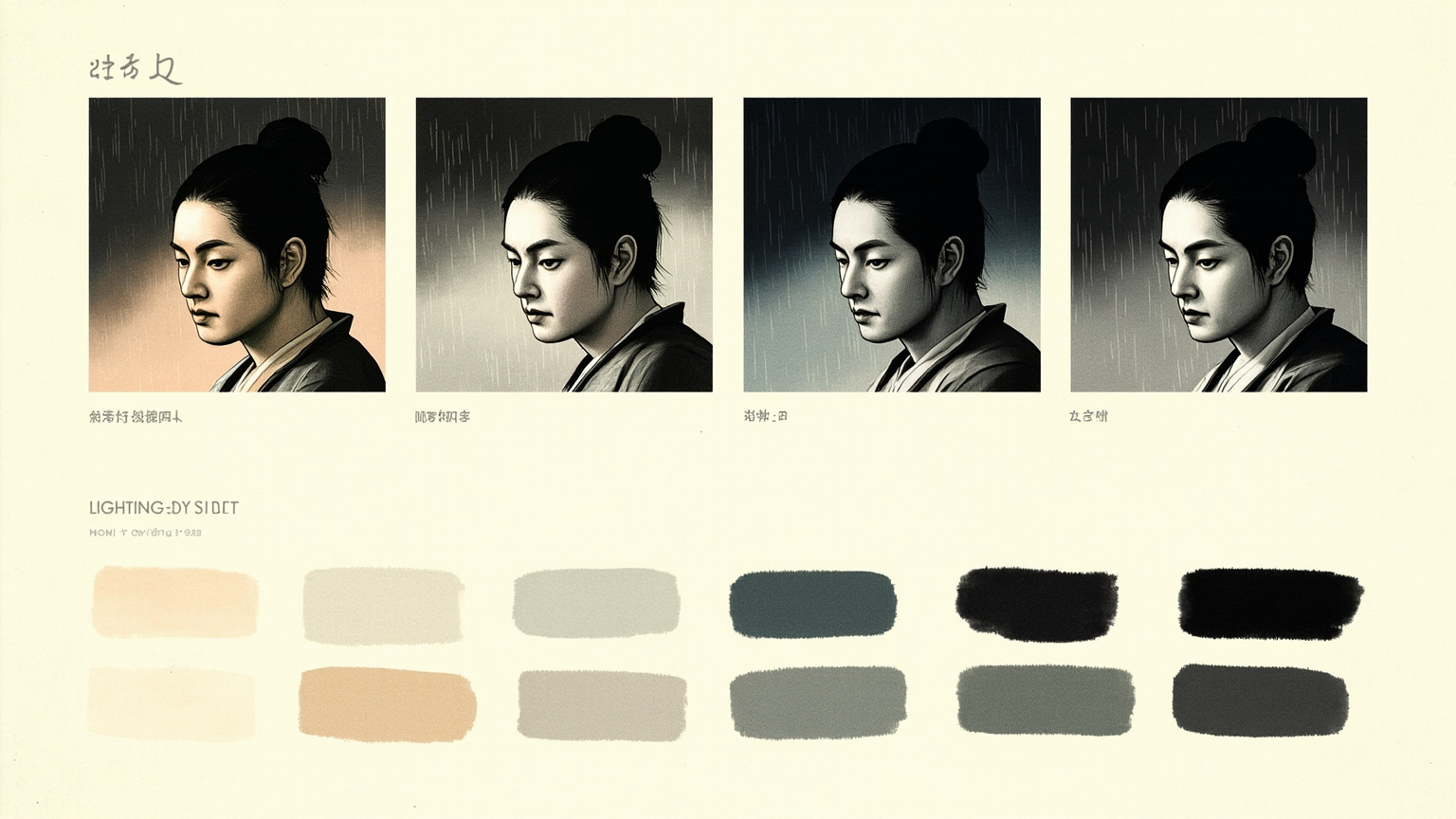
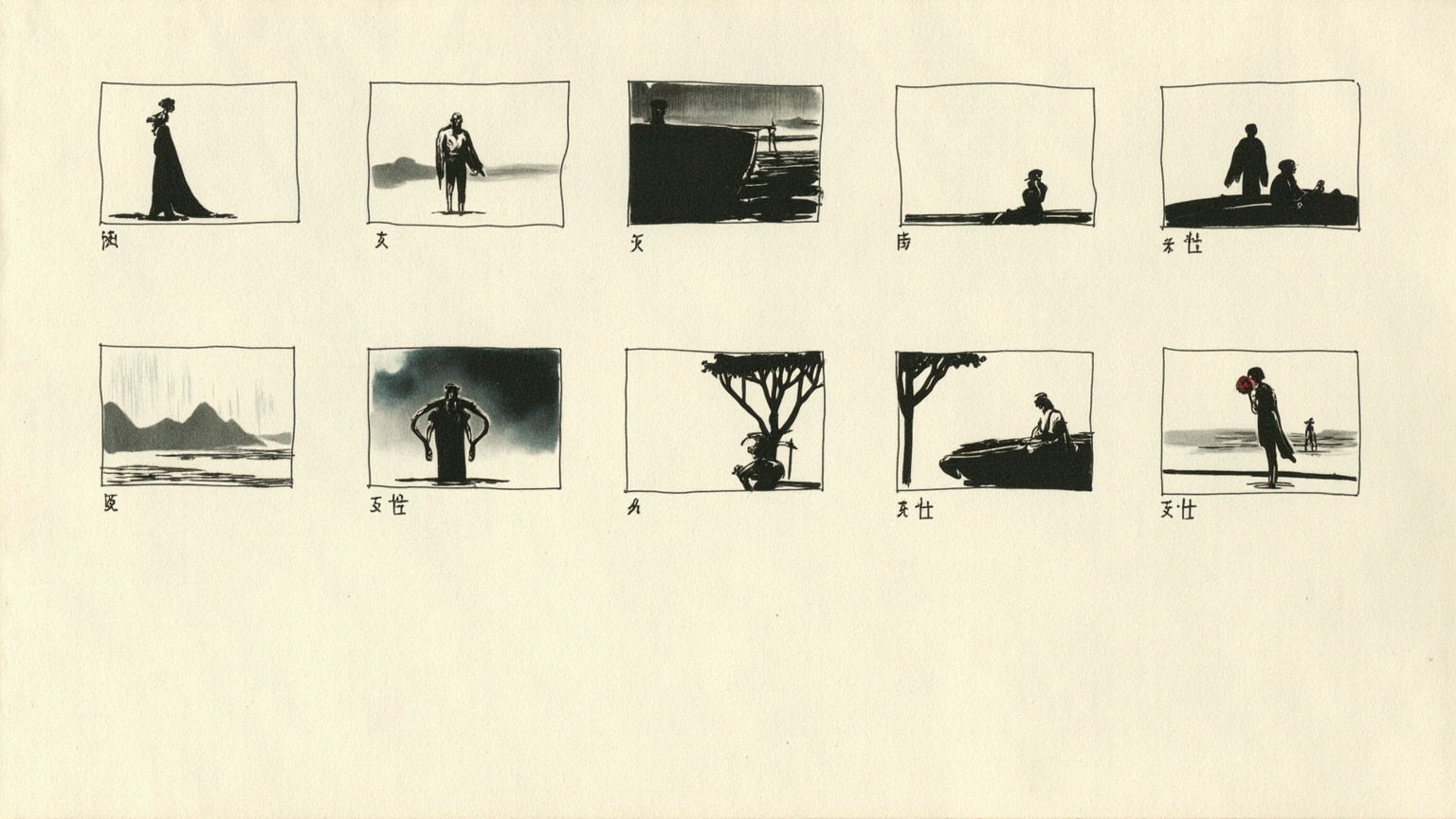
Art Direction4 plates
Before the guide was written, this book got a visual foundation — every illustration you just read grew out of it.