The Adventures of Amir Hamza (Hamzanama / Dastan-e Amir Hamza) · Companion Guide
阿米尔·哈姆扎历险记(哈姆扎那玛)
一句bismillāh落音,三个人、一张大篷车、四十年走不完的夜——说书人在台上不肯下台。
Opening: A Bazaar Storyteller's First Line
A heavyset painter is brushing gold dust onto dragon scales. Beside him the storyteller has just called out bismillah — the paint on that spread-winged demon-bat is still wet, and tonight's performance is already underway. This is what it means to open the Hamzanama: not turning a page, but stepping into a bazaar theater that never closes for the night. Its hero is a man who will never go home.
What Kind of Book Is This
The Hamzanama — in full, The Adventures of Amir Hamza — is the longest-running road epic in the Persian-Islamic world. Its oral roots stretch back centuries to the early spread of Islam, but it only took visual form at the Mughal court in the second half of the sixteenth century, when the emperor Akbar commissioned it and generations of painters spent more than forty years producing over fourteen hundred miniature folios. It is not a mosque chronicle, and it is not dynastic myth dressed as history. It is a bazaar's night entertainment: a new adventure each evening, a new painting for each episode, hundreds of volumes that never quite finish.
Three Men, Forty Years, a Road with No End
The hero, Amir Hamza, is modeled on the Prophet Muhammad's uncle, a legendary warrior of the early Arab battlefields. In this telling he is remade into a superhuman adventurer who spans decades — crossing an imagined map that runs from the Berber coast of North Africa to the northwestern frontier of India, from Baghdad to Damascus, and pushing on into Mount Qāf, the realm of demons, underground fairy cities, and palaces beneath the sea. The historical figure fades, and so does the founding legend; what's left is a face that is always on the road.
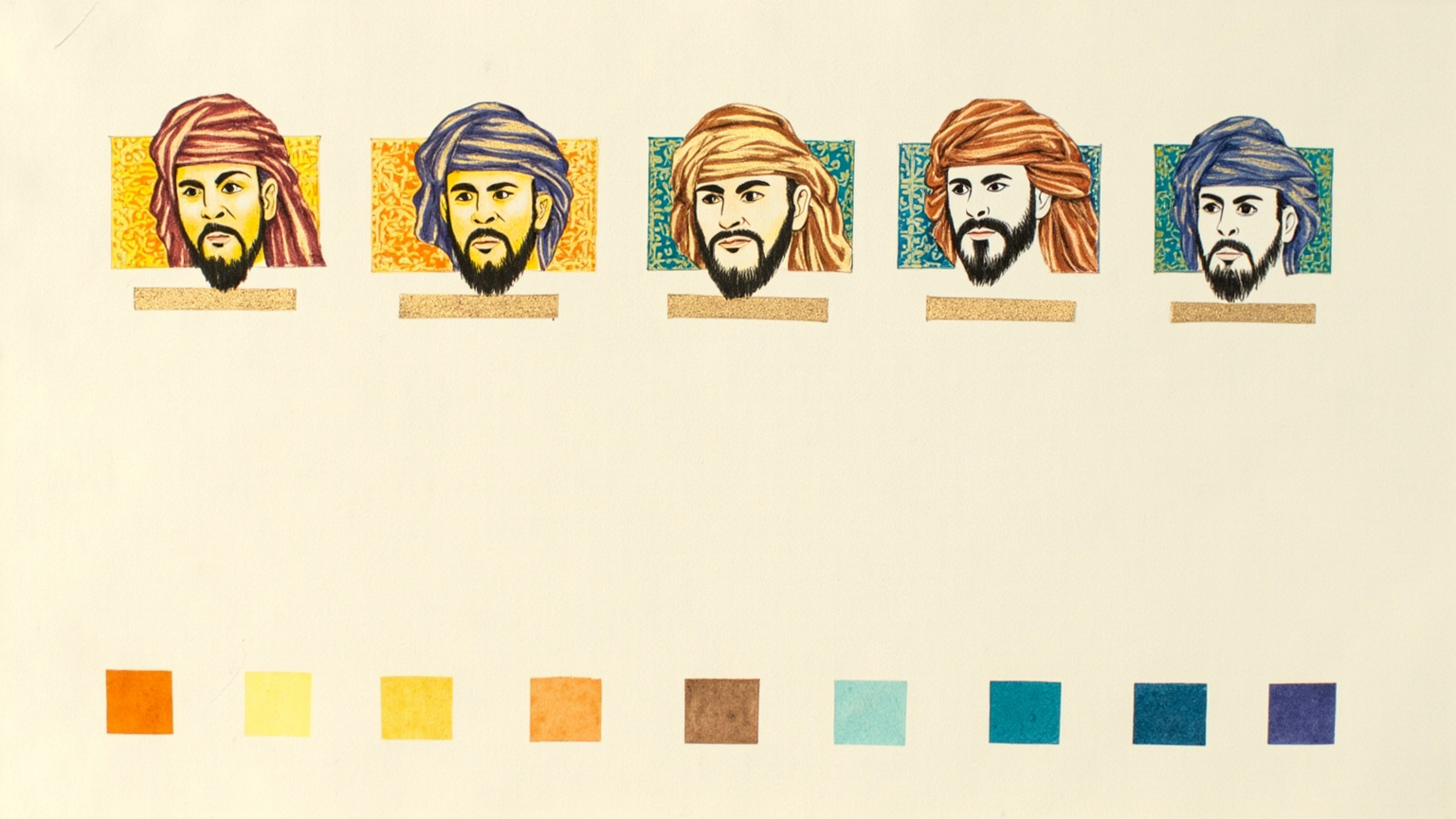
Traveling with him is an inseparable pair: the dark-skinned strongman Mihtar 'Alī Qāpčāq and the old schemer Nāb Khādhān. One does the heavy lifting and loves to brag; the other calculates and plots on Hamza's behalf. Between them they carry most of the storyteller's comic relief and tension — whenever Hamza lands in trouble, one man throws the first punch and the other sits down to work the angles. Storytellers love them, and so do audiences.
The Opening: A Boy's First Departure
The story opens with an orphan of the Quraysh tribe. The young Hamza, led by a foster father or mentor, slips out of Mecca by night and sets off on the road across Central Asia that will become both a spiritual quest and an adventure. This is the storyteller's convention — the tale begins already in motion, with no throat-clearing about how it got there. The word bismillah lands, and the caravan is moving.
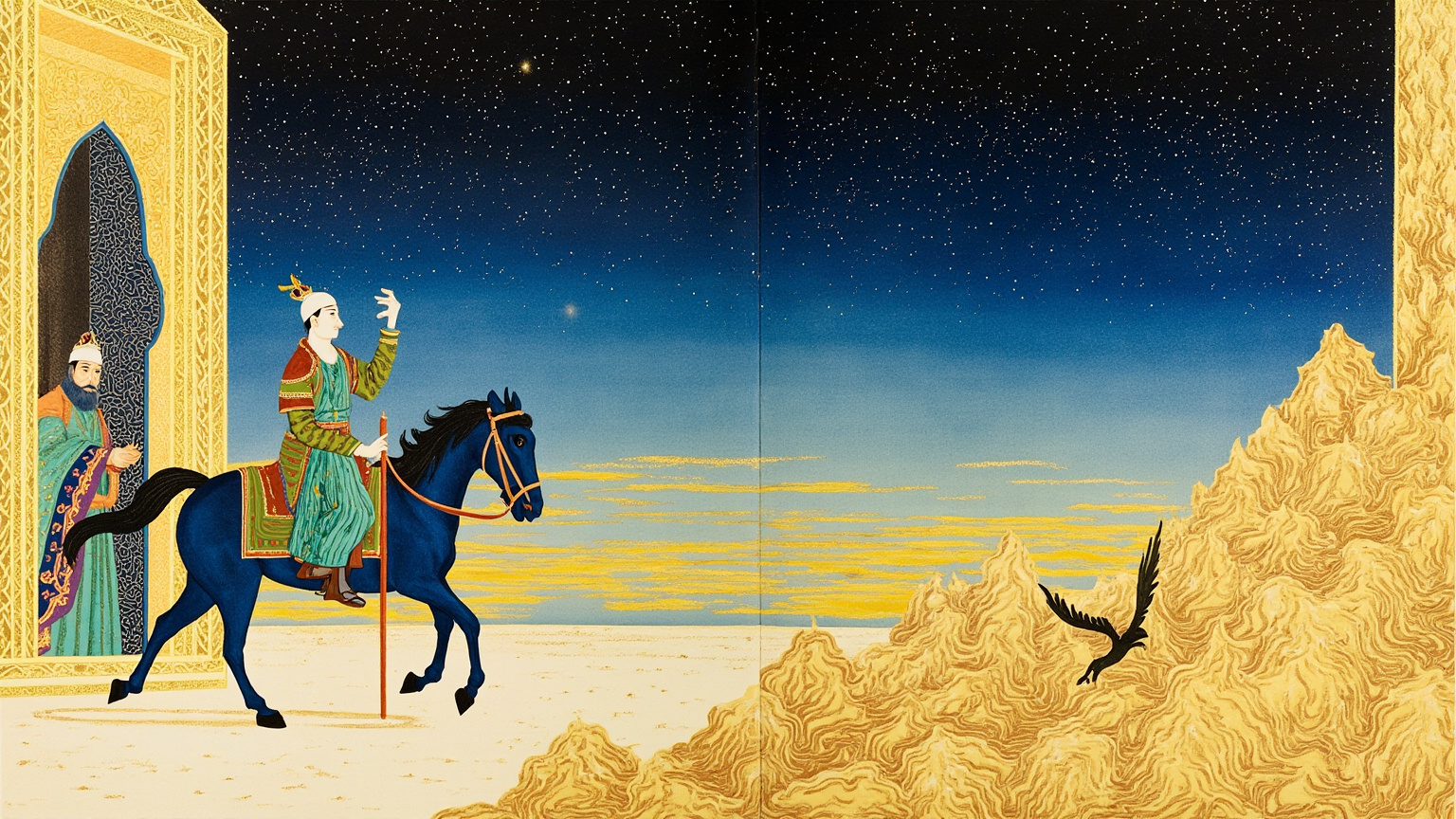
In the name of God, the Merciful, the Compassionate — and the tale is off, and no one is allowed to set it down.
奉至仁至慈的真主之名——故事既开,便无人可令它停下。
金句 · 开场 · 集市说书人的第一句
The Trio Forms: Three Talkers Carry Dozens of Volumes
Not far into the journey, Hamza meets Mihtar 'Alī Qāpčāq in the desert, mid-argument with a camel, and then rescues Nāb Khādhān, a man forever settling accounts, from his creditors in some city or other. The three form an unbreakable trio, and from then on nearly every folio paints them into the same frame — squeezed onto a flying carpet bickering, or crowded around a pot of soup arguing over who got more meat.
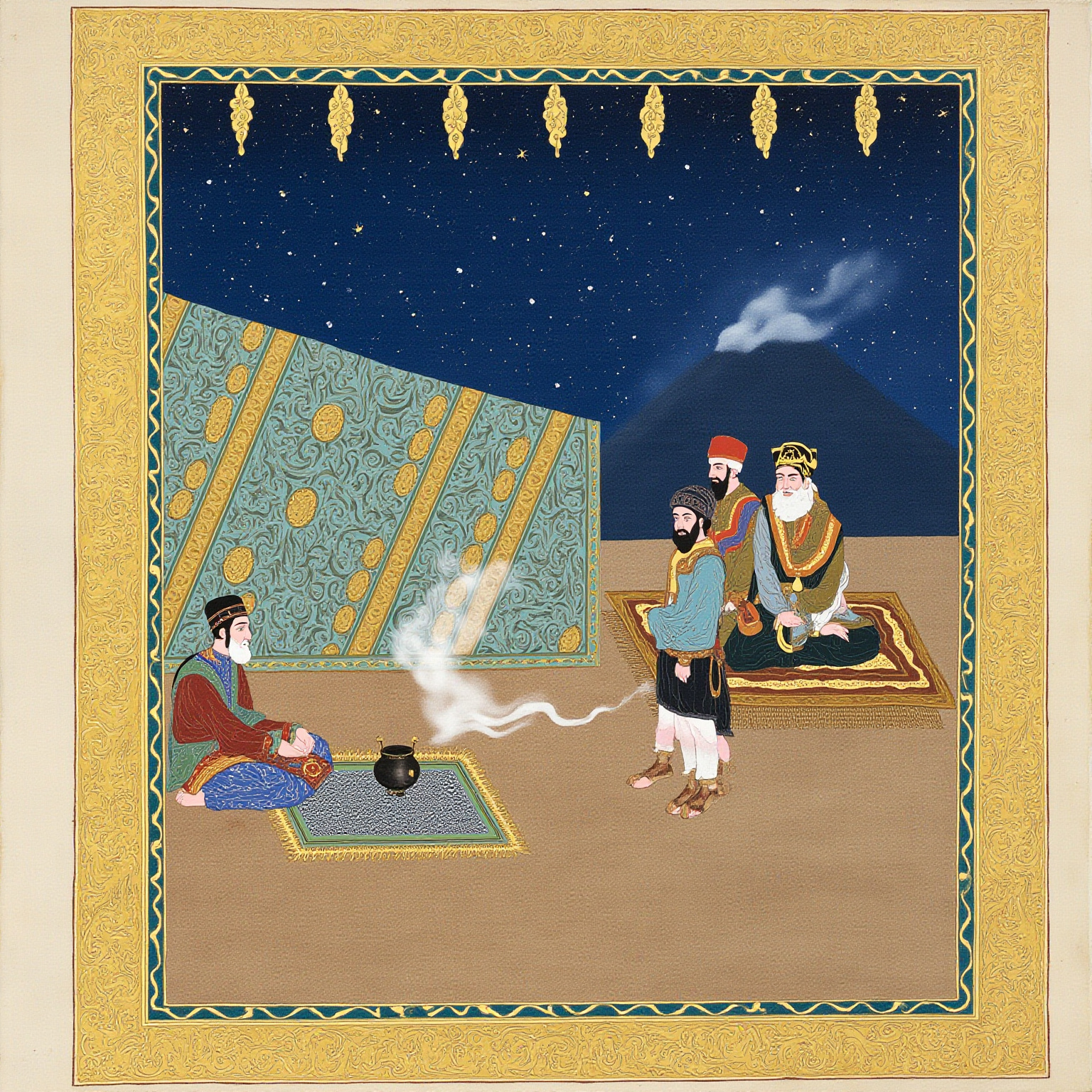
Three companions took the road together, and the road never let any of them go.
三人结伴上路,此后路不曾放过他们任何一个。
金句 · 铁三角结义 · 三人结伴
Dragon-Slaying in the Demon Realm: The Visual Showpiece
The richest passage of the early cycle sends Hamza deep into the demon realm of Mount Qāf. It is home to the most terrifying monsters in the Persian-Islamic imagination: div with multiple heads, long fangs, and scaled hides large enough to dive from a peak to the valley floor in a single stroke. Wearing the talisman his mentor gave him and wielding a curved sword, Hamza takes on their king, and at the same time has to free the captive fairy princess Pari-Banu from the demon's den. The whole fight is wrapped in sorcerous smoke, dragon scales flashing cobalt and vermilion — this is where the Akbar-era painters spent the most gold leaf.
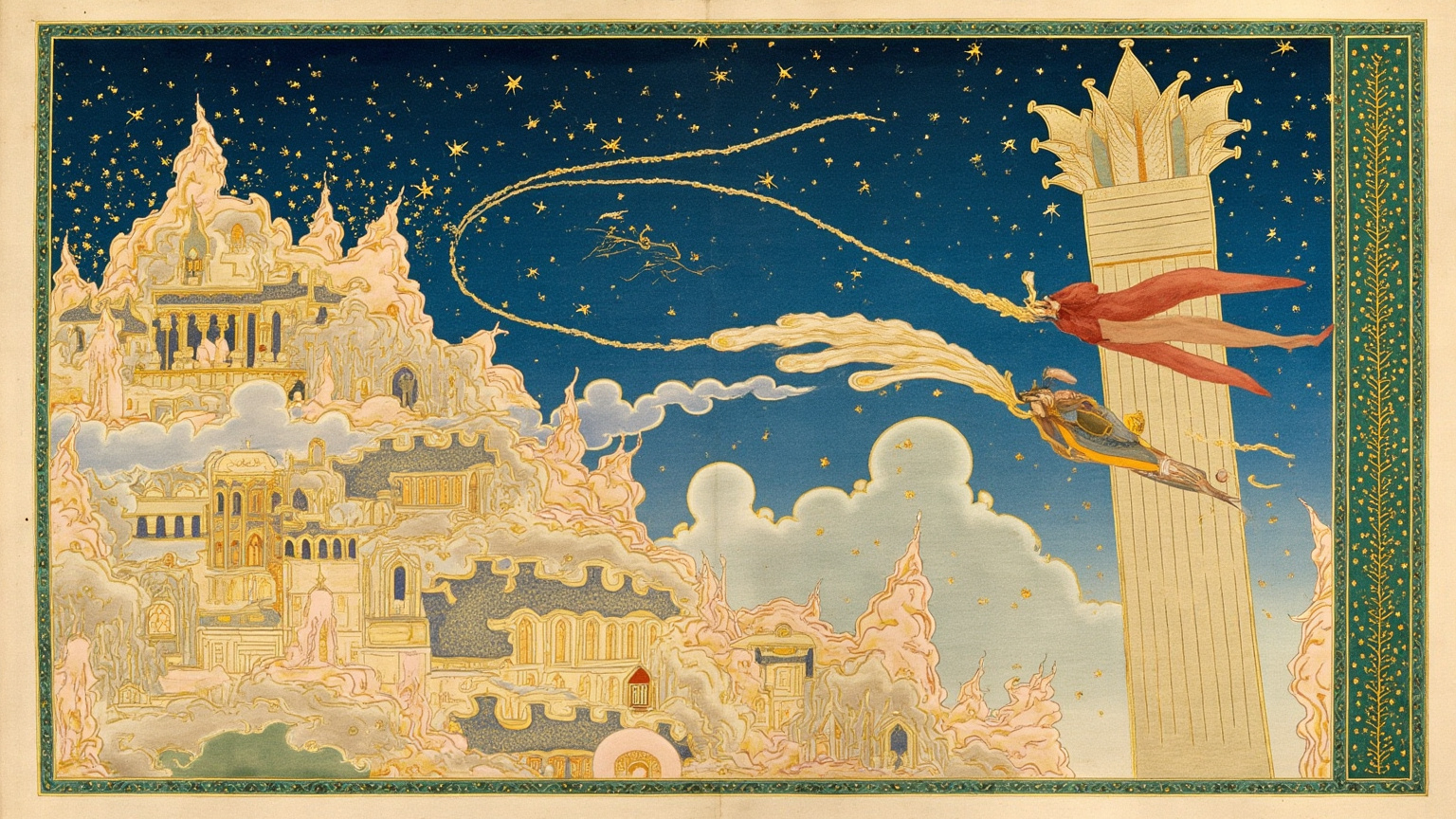
He rode into the mountain of Qāf, where the demons of the old world still kept their thrones.
他策马入Qāf山——那旧世界里的魔王,至今还盘踞在他们的宝座上。
金句 · 妖境屠龙 · 深入Qāf
By the end, the princess is freed and the demon king is dead, and the trio finally gets to catch its breath — but the next volume opens on a new sultan, a new siege, a new trap. The storyteller won't let the hero stop, so the audience doesn't get to stop either.
The Sultan's Schemes: Intrigue and Betrayal
Not every enemy is a demon. Just as often the villain is a corrupt sultan in a gilded palace, dripping with jewels, looking down from a gold-plated tower, poisoning Hamza, laying traps, laying siege, burning cities. Hamza slips up now and then too — talked into a cell by a double agent, transformed by sorcery into a deer or a hawk, thrown into the sea. At moments like this the storyteller breaks off for the night, on purpose, and sends the audience home to work out how Hamza gets free.
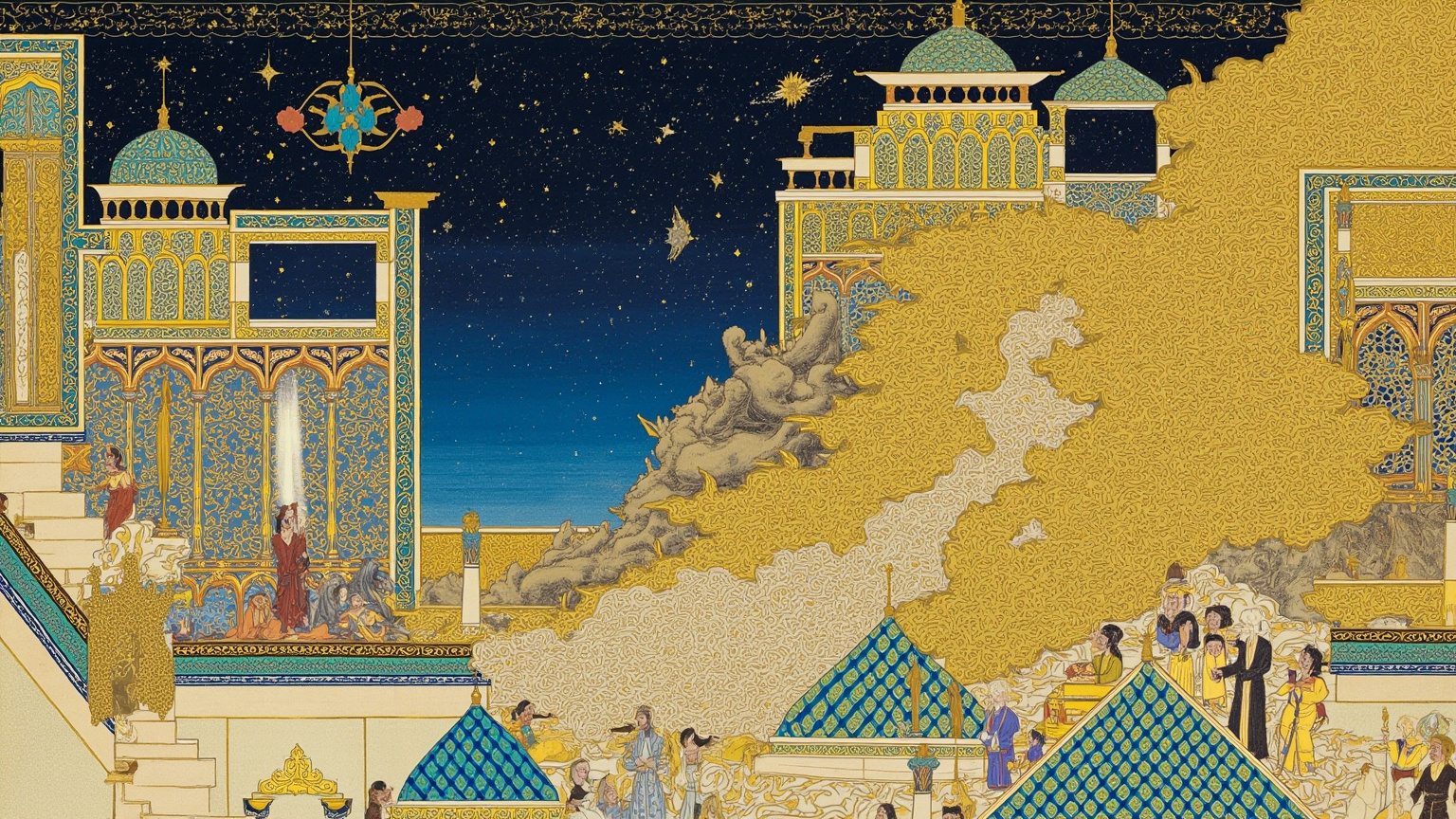
A sultan sits in a tower of gold and lays his trap — and the hero, for once, walks in.
苏丹端坐在金塔之上布下罗网——而英雄,竟也有踏入的那一刻。
金句 · 苏丹的诡计 · 围城与反间
Transformation and Rescue: The Storyteller's Turning Rhythm
The volumes where Hamza is turned into an animal are the storyteller's favorites, because they force the trio apart and let each man carry his own thread: Mihtar hauls the hawk that used to be Hamza across the desert, while Nāb goes hunting the countryside for a pari or an old sorceress who can lift the curse. Their rescuer is usually some fairy queen who happens to be passing through the demon realm, or a mentor with a name too long to get through in one breath. Once the volume closes, the storylines braid back together and the three set off again.
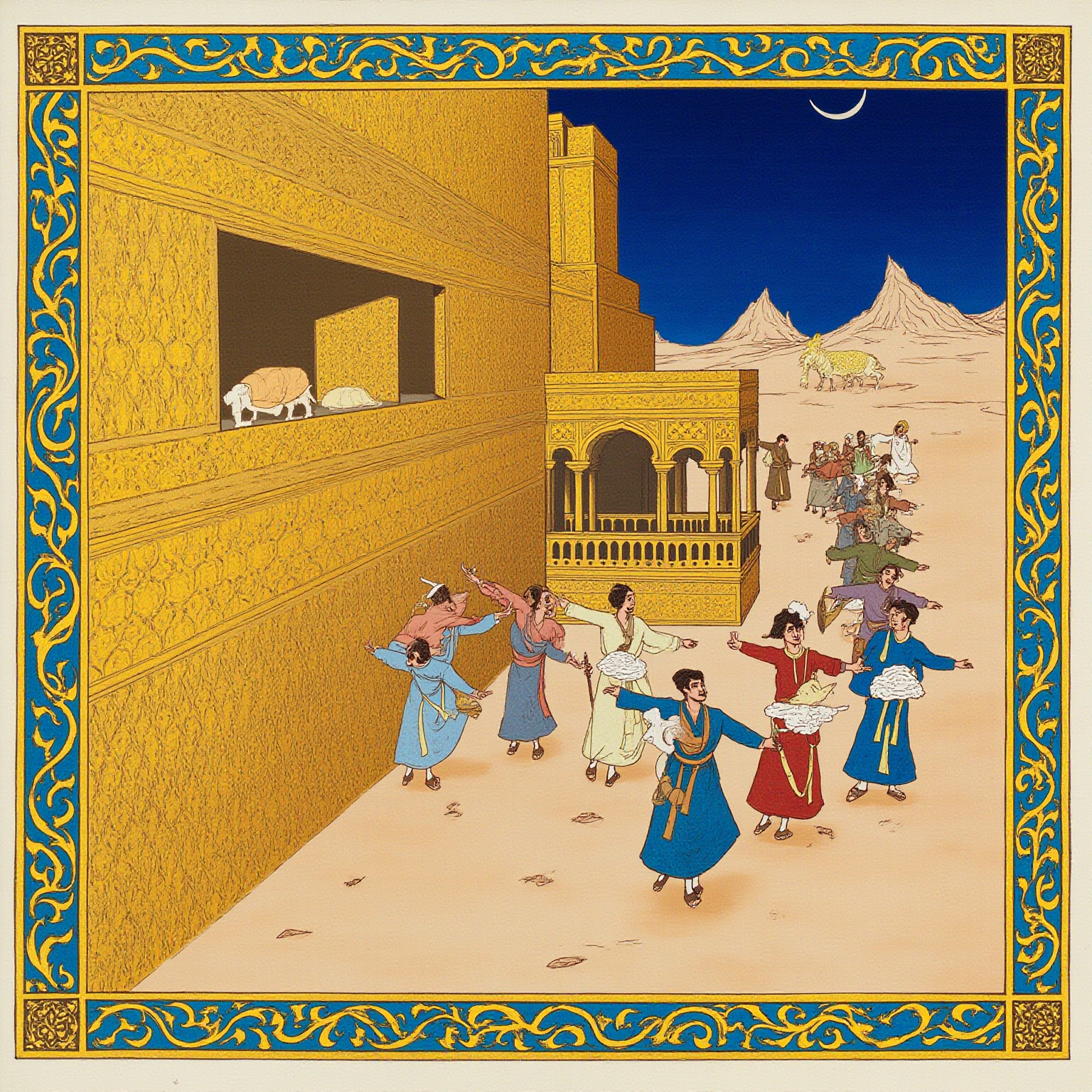
He was turned into a beast; the desert carried him, and a peri came at last to undo the spell.
他被化作一只兽,沙漠驮着他走——直到一位pari仙子赶来解咒。
金句 · 变形与救赎 · 精灵解咒
Weddings in the Great Hall: Every One a Fresh Start
Hamza's romances don't happen behind closed doors either — they happen in palace courtyards with hundreds of witnesses. He marries a string of princesses and fairy queens in public ceremonies, courtiers seated in rows, drums and music going. Then, without warning, the storyteller has the new bride hand Hamza some protective talisman and send him straight back onto the road. Love here is not an ending; it is a supply depot. That is simply how a caravan narrative is built.
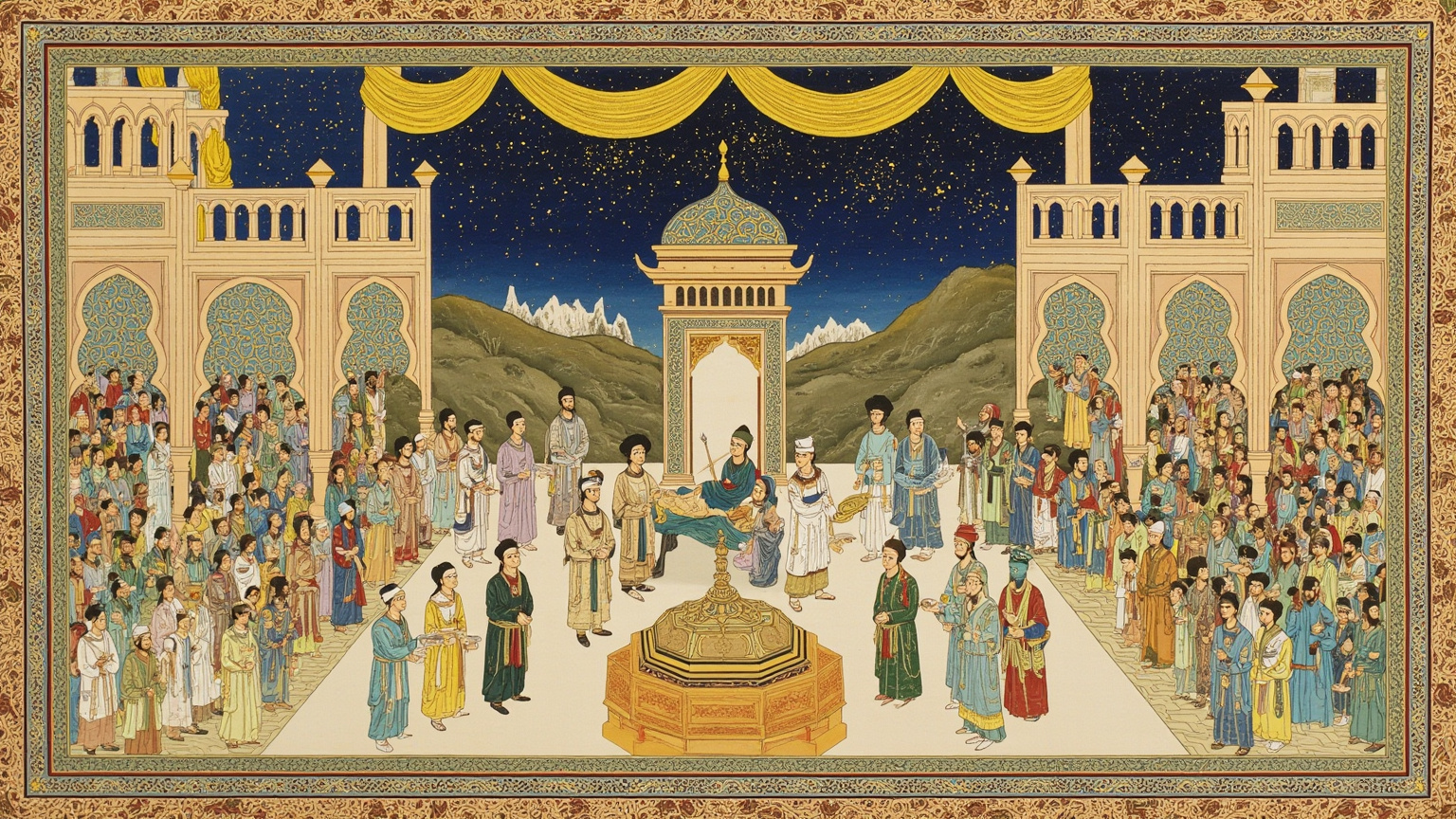
The marriage was sealed in the great hall before a thousand witnesses — and the road, as always, was waiting.
婚盟在千人列席的大殿上缔结——而那条路,照旧在殿外候着他。
金句 · 大殿婚盟 · 群像之约
The Akbar-Era Manuscript: Forty Years to Paint a Story That Never Ends
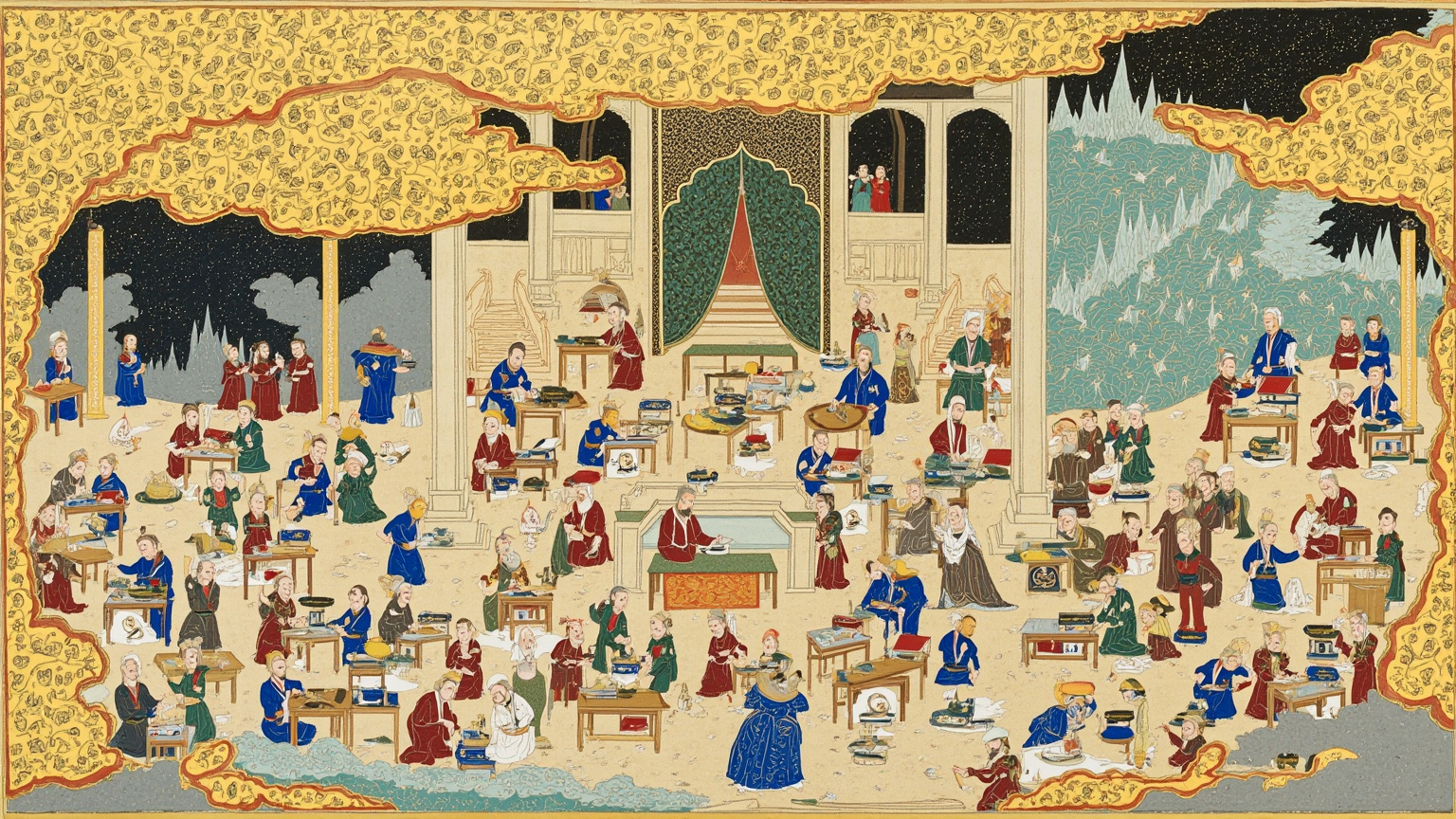
Nothing makes it more visible than the Akbar-era paintings. The Mughal emperor launched the project in the 1560s, rotating a roster of painters — Daswanth, Basawan, Kesu Das, and others — through the work, with Persian captions on the back of each folio keyed to a specific passage the storyteller would have recited. The first campaign produced roughly fourteen hundred double-sided folios, and a later one repainted a further batch. The whole manuscript is a theater built out of cobalt, vermilion, and gold leaf. Around a hundred and forty to a hundred and fifty folios survive today, scattered across the British Museum, the Cleveland Museum of Art, the Albertina in Vienna, and elsewhere.
Why It's Remembered: Being on the Road Itself
The Shahnameh is dynastic myth written as history, the rise and fall of kings and generals. The Hamzanama takes a different road — it is bazaar adventure, a perpetual-motion machine running on a new volume from the storyteller and a new painting from the artist every night. What it is really saying is that a person doesn't have to settle down to be alive; being on the road is itself a kind of faith. Hamza has to set out again after every victory, and that restlessness is the same thread that stitches together the nomad and the city, belief and heresy, here and elsewhere, across the Persian-Islamic imagination.
A Cosmos of Three Realms: Human, Fairy, Demon
Hamza's victories are not just about killing enemies — they place the human at the center of a cosmic order spanning three realms: the human world, the demon world, and the spirit world. That three-part cosmology sits at the core of the Persian-Islamic imagination. Div, peri, pari, dragon — each has its own territory and its own rules, and every demon Hamza defeats pushes the boundary of the human world out another notch. So the most terrifying figures in the paintings, the multi-headed demon kings sheathed in scales, are really an illustrated key to the epic's cosmology.
Why It's Still Worth Reading the Text
Knowing the plot, what haven't you gotten yet? A guide like this one can tell you where Hamza went. It can't give you the sound of listening to him get there — the way a bazaar storyteller drops his voice and then raises it, dragging an audience forward volume by volume. The texture of the language, the physical pull of it, the rhythm built up slowly over centuries of oral transmission — you only hear that by sitting in the storyteller's circle yourself. The first time I read the Mount Qāf episode, I went back and reread the page before it. That rush of gold leaf in the air is something no summary can give back to you.
The Hamzanama is not a book. It is a theater that never closes — the storyteller won't leave the stage, and the audience won't go home.
Art Direction4 plates
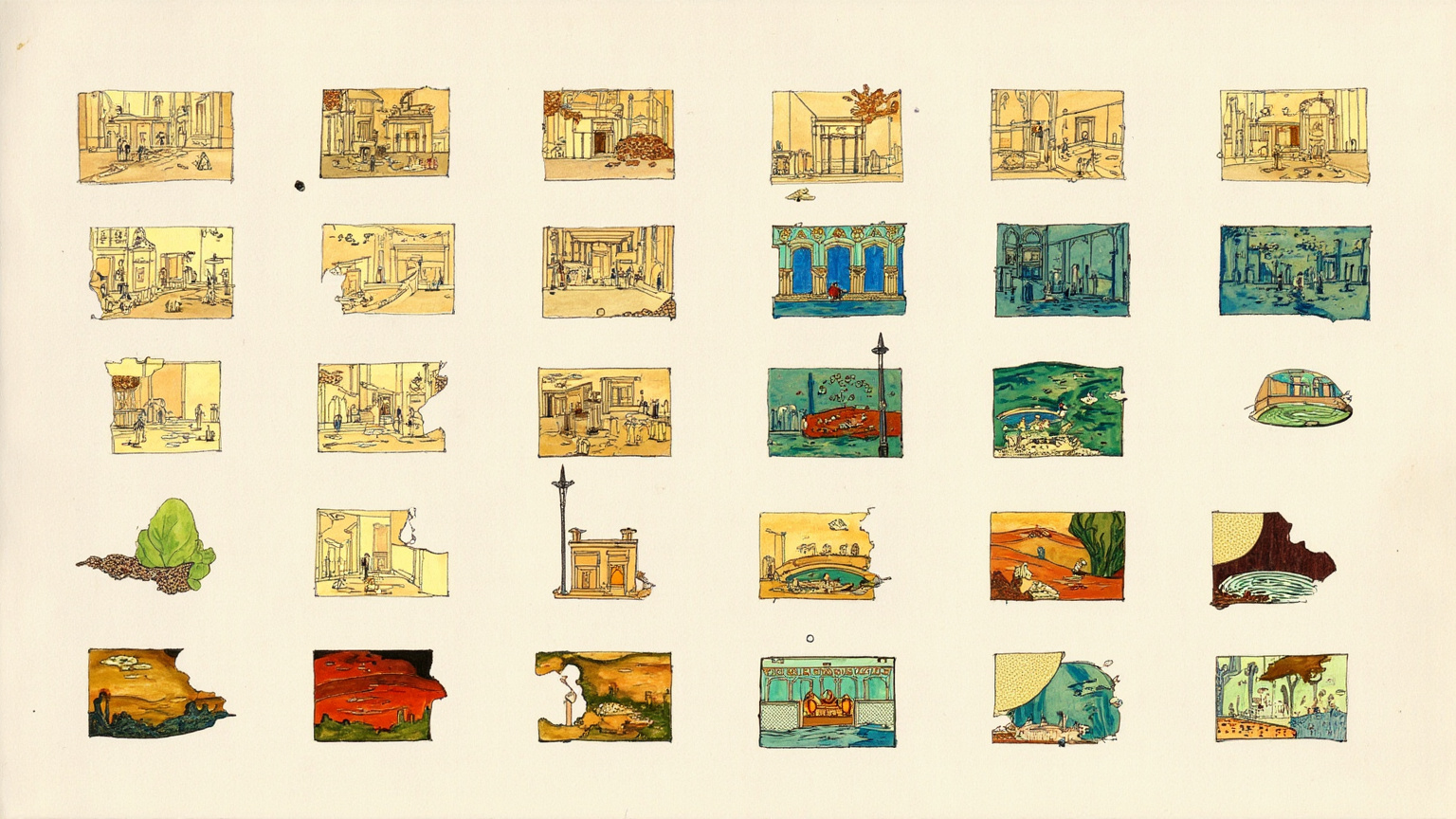
Before the guide was written, this book got a visual foundation — every illustration you just read grew out of it.