The Faerie Queene · Companion Guide
仙后
十二天宴会上,仙后格罗丽安娜派出的骑士们奔赴各自的寓言,一部未竟的史诗向第六卷以后永远敞开着
A White Ass and a Veiled Woman
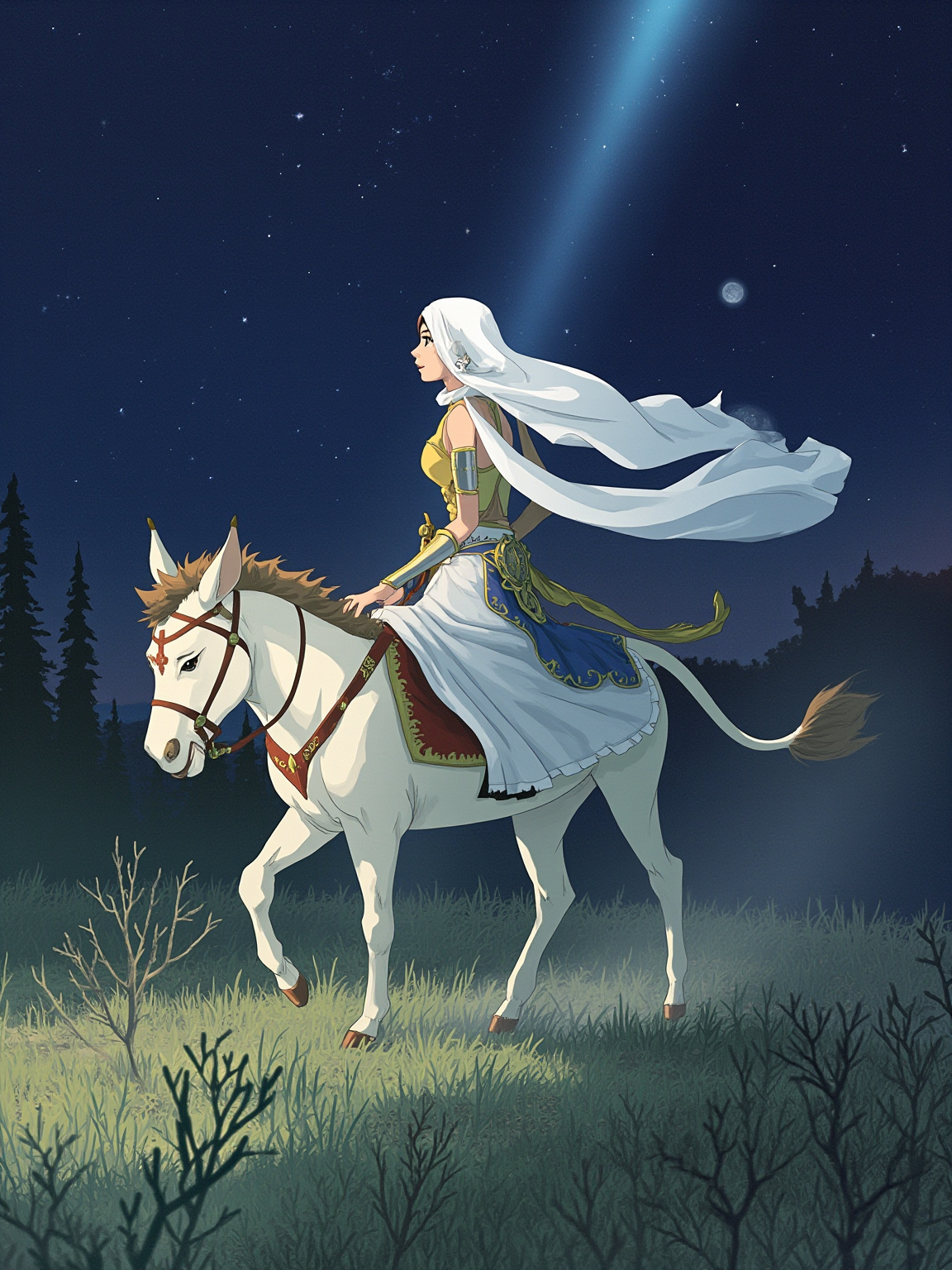
A white ass walks in front, carrying a woman veiled in white. No one can make out her face. Beside her walks a lion — one that by rights should eat her, but instead clears her path. This is Spenser's Faerie Queene, not far past the opening: Una and her retinue. She stands for Truth, and the veil marks her apart from every counterfeit she meets; the lion handles whatever trouble the road throws up. She is looking for a knight in white armor with a red cross on his shield. She wants him to come home with her and kill the dragon that has held her parents' kingdom for years.
What This Enormous Book Is
The Faerie Queene is Edmund Spenser's long allegorical poem, written under Elizabeth I. The first three books came out in 1590, the next three in 1596, roughly thirty-five thousand lines in all — one of the largest single works in English poetry. It borrows the shape of medieval chivalric romance and folds in classical epic and Christian moral allegory. Spenser opens with a prefatory letter that says plainly what the poem is for: to fashion a gentleman's character through what he calls a 'cloudy allegory.' It is also, just as plainly, a political education aimed at Elizabeth herself.
Spenser was born around 1552 and died in 1599. In his early thirties he took a post as secretary to a colonial administrator in Ireland, and that experience works its way into Book V, where it has become the controversy no later reader of the poem can avoid. He planned twelve books, one for each moral virtue. He finished six, plus a fragment of a seventh — so the poem has always been, and will always be, unfinished.
Twelve Days of Feasting in Faerieland
The Faerie Queene, Gloriana (the name means radiance), holds a feast every year that runs twelve days, and each day she sends out one knight to right some wrong in the world. Each knight stands for a single virtue. Running through every book is Prince Arthur, who embodies all twelve virtues at once under the name Magnificence, and who turns up at the crisis point of each book to pull that book's knight out of trouble. His reason for being there is almost embarrassingly romantic: he saw the Faerie Queene in a dream and has been looking for her ever since.
So the poem isn't built on one story line but six, each fairly independent, each following its own knight. Every knight sets out from the Faerie Queene's court into a land crowded with giants, sorcerers, witches, monsters, and tyrants. On the surface it's a medieval fantasy landscape. Underneath, it's a moral and political allegory for Protestant England.
Book I: The Redcrosse Knight Falls, and Finds His Way Back
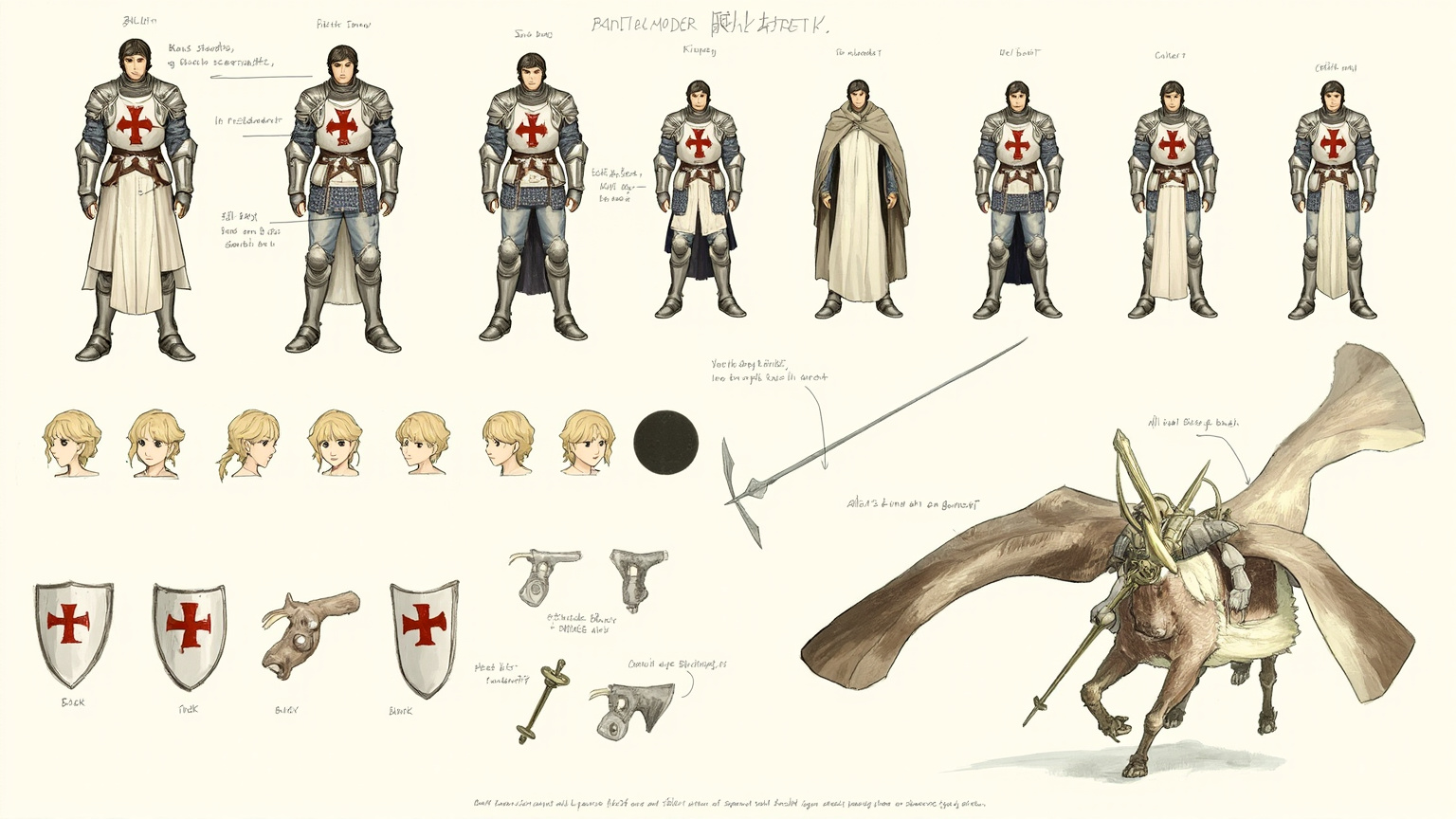
The Redcrosse Knight — a stand-in for Saint George, and the emblem of Holiness — sets out with Una at his side. His swordwork is good enough, his armor bright enough; what fails him is his judgment. The sorcerer Archimago conjures a false dream that convinces the knight Una has betrayed him. He sends her away. Una rides on alone with her ass and her lion. She doesn't wait around. She goes looking for someone who can save him.
A gentle knight was pricking on the plaine, / Yclad in mightie armes and silver shielde.
一位温良的骑士正驰骋于平原之上,身披坚甲,银盾在手中闪光。
金句 · 第一卷 · 红十字骑士出场
The knight, meanwhile, runs into a woman in distress named Duessa — one of the best villains in the whole poem. She plays the devout, wronged maiden and leads him straight into the dungeon of the giant Orgoglio. His swordwork is no use to him now; it was his judgment that got him there. Una finds Arthur, and Arthur breaks the dungeon open. The two of them recover afterward at the House of Holiness, nursed by Caelia and her daughters, and it's there that the knight sees a vision of things to come. He pulls himself together, kills the dragon, frees Una's parents, and gets engaged to Una.
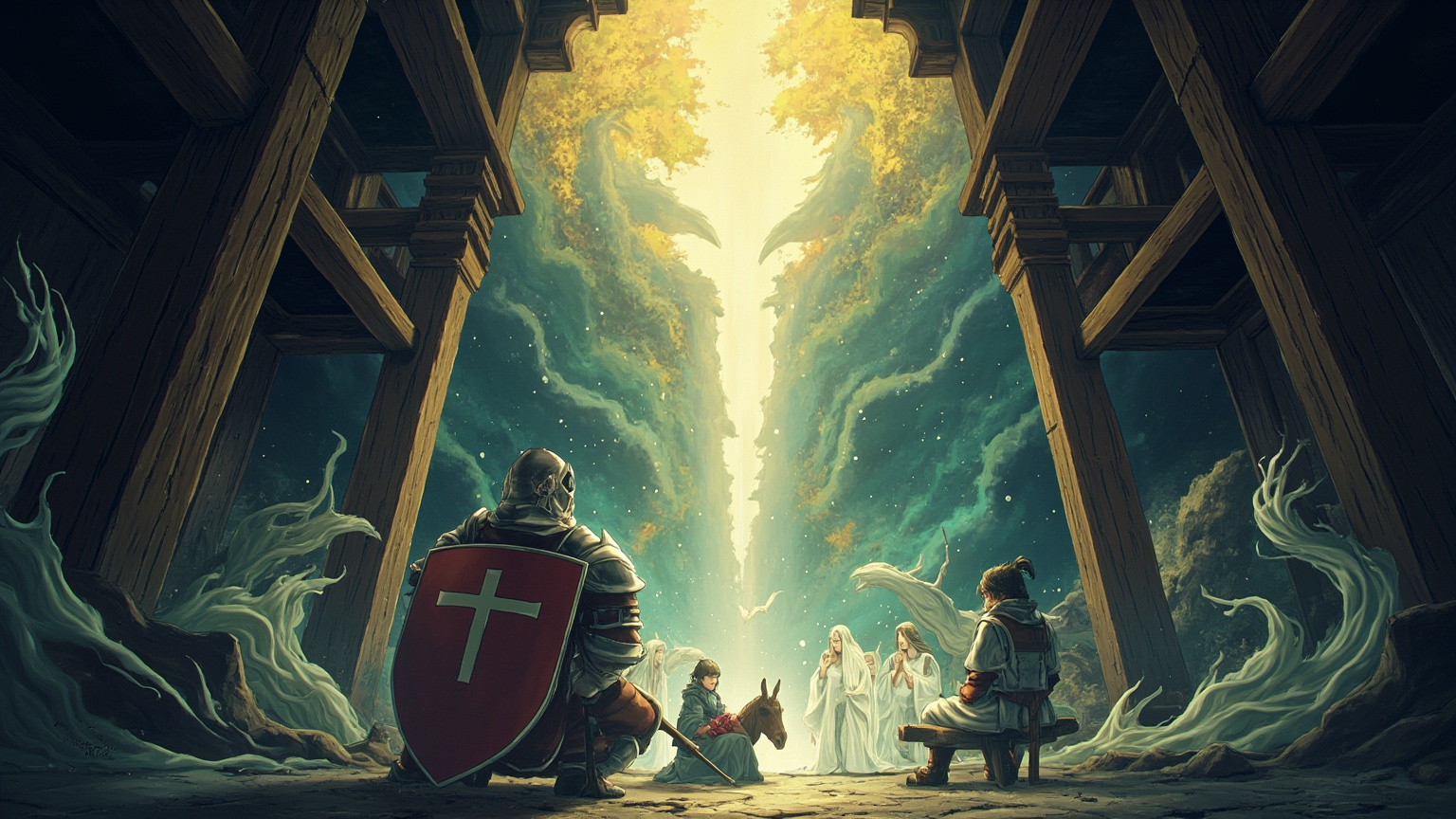
And she herselfe hath taide in her hand / A sprig of virgin green, and blossomes faire.
她亲手握着一枝嫩绿的新芽,与尚未绽开的素净花蕾。
金句 · 第一卷 · 乌娜与真理之象
The real point of Book I isn't the dragon fight. It's holiness lost and then recovered, and the passage worth reading in the original is the House of Holiness itself: the knight lying wounded on a couch, Caelia's three daughters tending him, and then the wall lighting up, stanza by stanza, into visions of mountains, cities, and the royal line still to come. That stanza-by-stanza climb is doing the real work — it's how Spenser gets the moral arc of holiness onto the page: the fall, the rescue, and then a glimpse of something further off. He doesn't explain any of this. He lets the rhythm of the stanzas carry the knight the rest of the way.
Book II: Sir Guyon and the Bower of Bliss
Book II belongs to Sir Guyon, the figure of Temperance, and it plays almost like a checklist of temptations. First he descends into Mammon's underground cave, where the heaps of gold and silver nearly keep him from finding his way back out. Then he fights the demon Maleger. Finally, with Arthur, he storms the witch Acrasia's Bower of Bliss, a garden engineered to hit every sense at once.
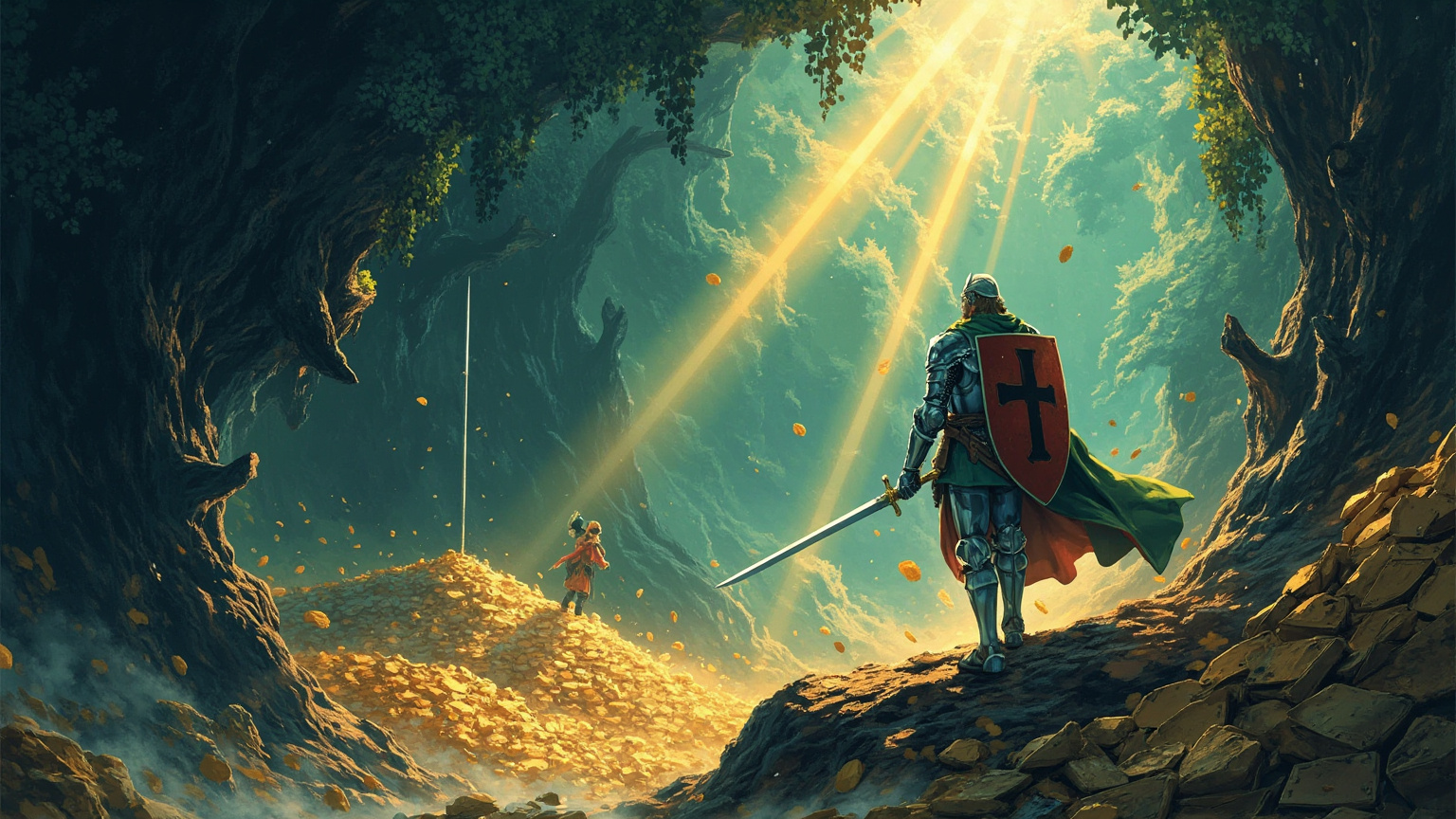
And all that els was in that goodly place, / The which did ill become his manly face.
那美好境地中的一切,其实都配不上他那张男子的脸。
金句 · 第二卷 · 阿克拉西亚的极乐之亭
Inside the garden, Guyon faces down violence, sloth, and lust in turn, and none of it pulls him under. He binds the witch in a net, tears down the garden's machinery of pleasure, and frees the men trapped inside it. Temperance here isn't abstinence — it's rescue from excess. By the end, the wrecked garden sits next to the freed men as a kind of answer: restraint isn't coldness. It's a different way of taking the world seriously.

The whiles the one did sing, the other buye, / And wanton Pansgood, to enflame the spright.
一个在歌唱,一个在低买,潘神的淫巧在旁拨弄着火焰。
金句 · 第二卷 · 快活林的诱惑三重奏
Book III: Britomart in Disguise
Book III hands Chastity to a woman knight, Britomart, which is itself a break from convention. She disguises herself as a man and sets out to find Artegall, the man fate showed her in a magic mirror. Along the way she unhorses Guyon in a joust and frees Amoret — a figure for love trapped by the wrong kind of desire — from the sorcerer Busirane's dungeon.
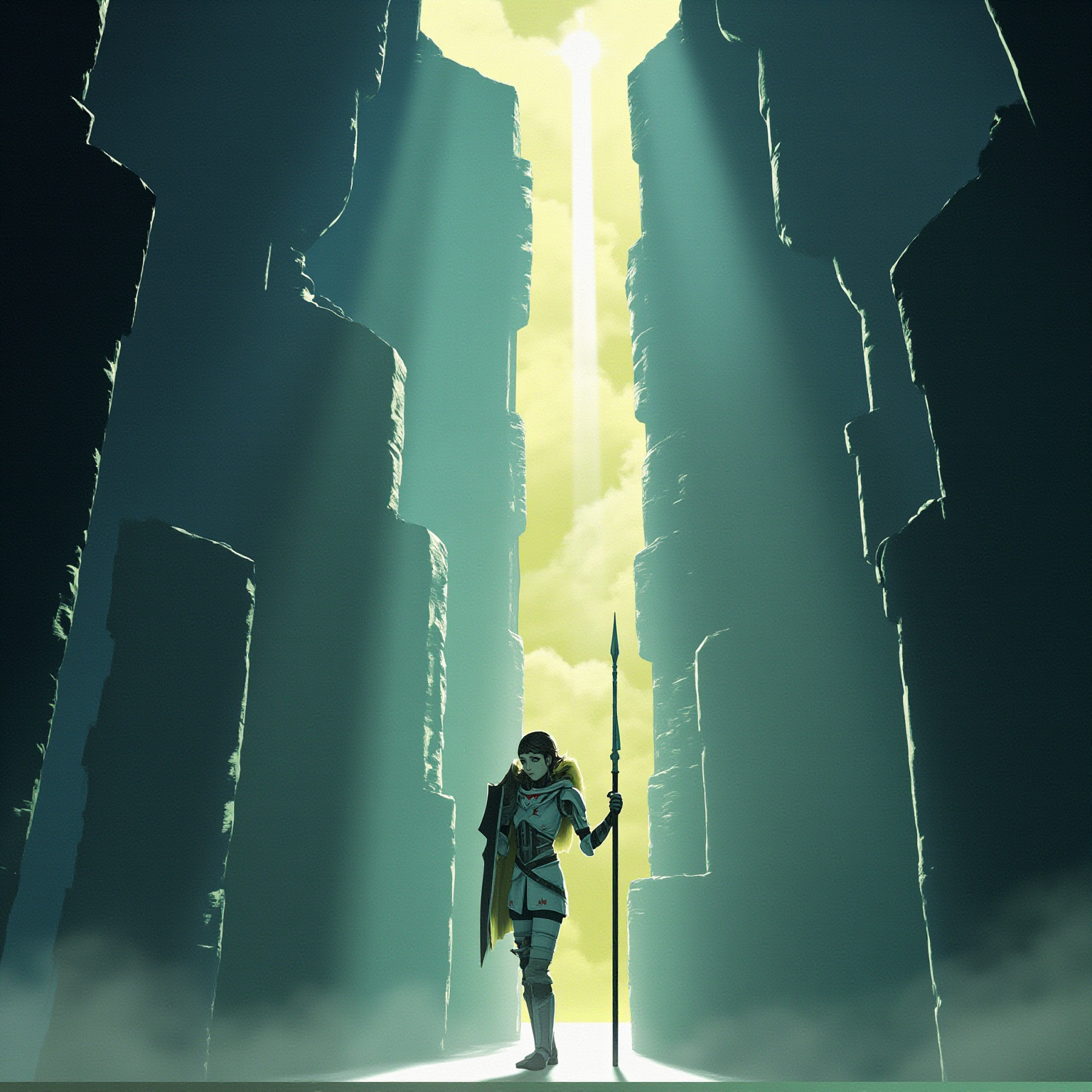
Her face so faire, as flesh it seemed not, / But hevenly pourtraict of bright Angels wit.
她的面容美得不似血肉,倒像明亮天使笔下的天国画像。
金句 · 第三卷 · 布里托马特与魔镜之影
Merlin appears in this book and tells Britomart that her union with Artegall will found the Tudor line. That single prophecy ties the whole poem to English history: Britomart isn't just the figure of Chastity, she's also a mother of the Tudor dynasty. It's a bold move — writing a woman knight's fate directly into the royal family tree.
Book V: The Trouble with Talus
Book V follows Artegall, the figure of Justice, and he's never without Talus, an iron man who swings a flail and grinds down whoever Artegall condemns. Artegall drives off the tyrant Grantorto on Irena's behalf and later clashes with the Amazon queen Radigund. Talus is the coldest thing in the whole poem — he doesn't think, doesn't argue, doesn't show mercy. He's justice with a body.
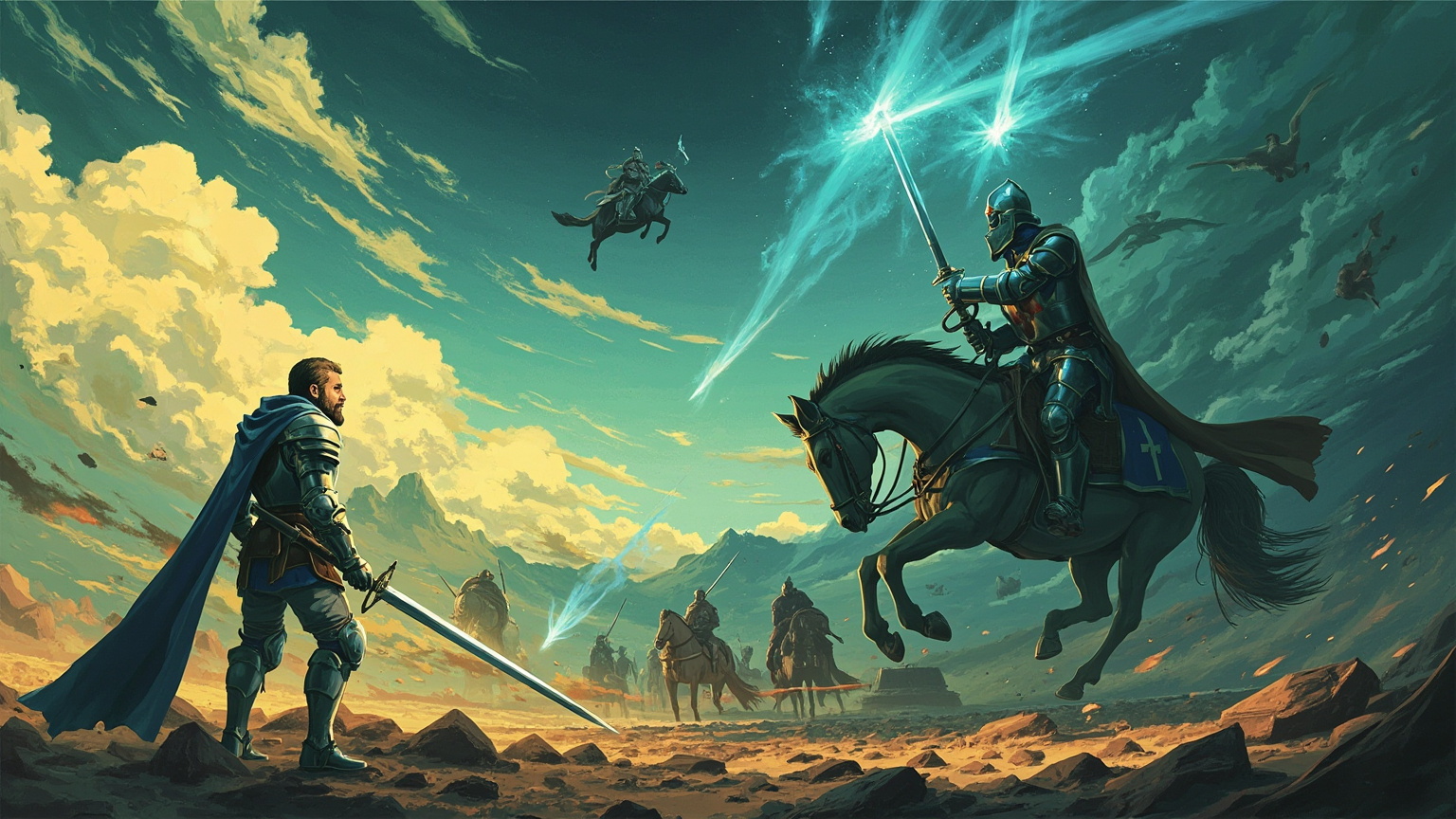
For that same wicked Tantalus he lent, / With fainting gripes to holde the wretched soule.
正如那凶恶的坦塔罗斯,伸出虚弱的握爪,去扣住悲苦的灵魂。
金句 · 第五卷 · 铁人塔鲁斯与正义之行
The controversy around this book sits outside the poem, not inside it. Spenser had been a secretary to a colonial administrator in Ireland since 1580, and that same year he published a tract arguing for the violent suppression of the Irish rebellion. The justice and the iron hand he writes about here come out of real colonial experience. It's a fact no later reader can read past, and it means holding two things apart: how well the poem is made, and where its author stood.
Book VI: The Beast That Won't Stay Caught
Book VI follows Calidore, the figure of Courtesy, who spends the book hunting a monster called the Blatant Beast — a stand-in for gossip and slander and every quiet cruelty people inflict on each other. Calidore does catch it. He just can't keep it caught, and the beast slips loose again. Spenser says so outright: slander is the one thing not even virtue can tame for good.
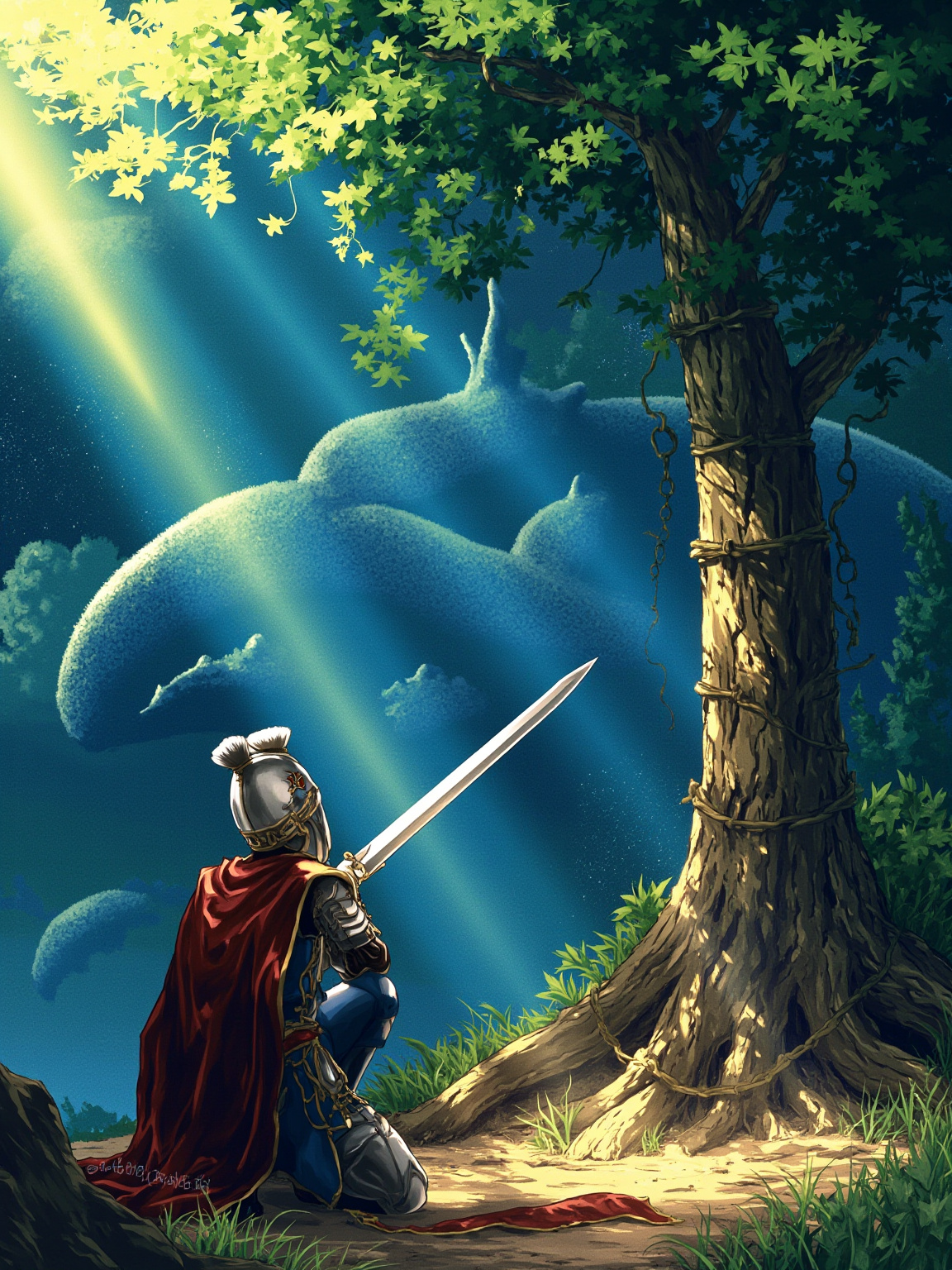
This book reads like the whole poem's closing note: virtue was never a finished state, only an ongoing one. A knight can catch it once. He can't hold it for good.
A Stanza Spenser Invented
Spenser didn't just write a long story. Along the way he invented a stanza form. Later poets call it the Spenserian stanza: eight lines of ten syllables followed by a ninth line of twelve, nine lines total, rhyming ababbcbcc. The meter tightens and loosens as it goes, and that long final line lands like a held breath. Keats used it for 'The Eve of St. Agnes,' Tennyson for 'The Princess' and 'Idylls of the King,' Byron for 'Childe Harold's Pilgrimage,' and Wordsworth wrote in it too. It became one of the standard forms in English verse and fed directly into everything from Romanticism through the Victorians. The stanza itself is one of Spenser's lasting inheritances to English poetry.
Why It's Good, and Why It's Unfinished
The Faerie Queene is remembered for three reasons. First, scale: it's the longest poem in English, and generations of writers have treated it as a peak worth climbing. Second, the double life of its allegory: it's a moral text and a political one at the same time, and every knight is both the embodiment of a virtue and a piece on the Tudor dynasty's chessboard. Third, the form itself — that nine-line stanza became a fixture of English verse.
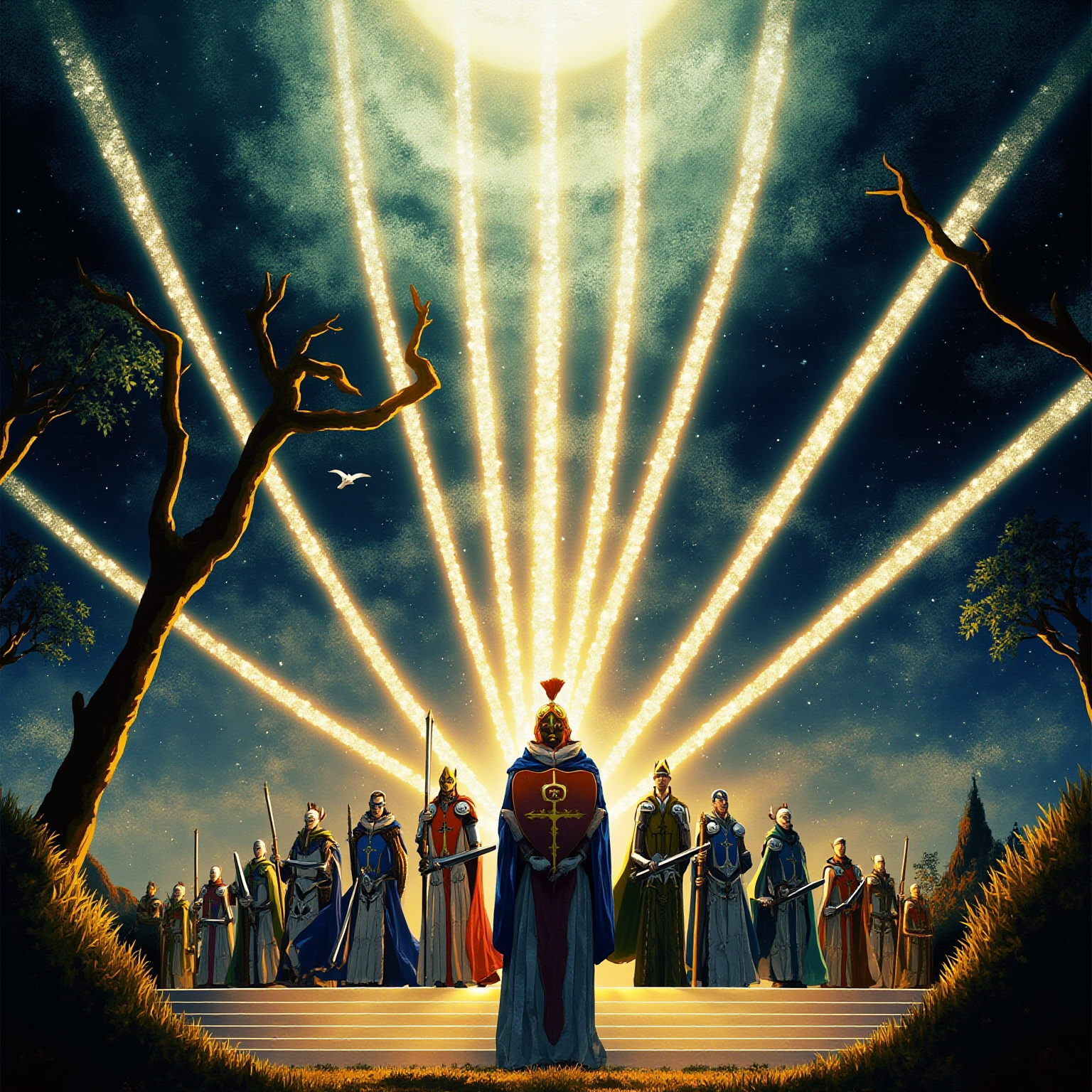
But it was never finished. Twelve books were planned, one per virtue; six were completed, plus a fragment of a seventh. The other six virtues stayed on the drawing board forever. One of the strangest things about reading this poem is that unfinishedness itself — it's a work permanently promising its next installment, and the installment never comes.
Knowing the Plot Doesn't Replace Reading It
A companion guide can tell you what happens in The Faerie Queene, who stands for what, and where it sits in literary history. Three things it can't give you. The first is that suspended, unresolved feeling of reaching the end of Book VI and finding the story still climbing, with a next book that never arrives. It's an odd kind of pull on the reader, and the only way to feel it is to stand at that broken edge yourself. The second is the immersion of the stanzas actually landing on the eye — reading the passage where the Redcrosse Knight sees his vision at the House of Holiness, nine lines building on nine lines, the mountains and cities and royal images on the wall lighting up stanza by stanza. No summary carries that rhythm or that weight. The third is Spenser's language, seen as if through a layer of fog — he deliberately imitates Chaucer's older English, and the word order, the rhythm, the vocabulary are all unlike Shakespeare's. You have to run into that fog yourself. It's still one of the wellsprings of English poetry. The knights, dragons, and quests to save a princess in The Lord of the Rings, Narnia, Star Wars, and Dark Souls all carry a torch lit somewhere in this book. If you want the foundation of English literature filled in, The Faerie Queene is the block you can't build around.
The great irony of The Faerie Queene is that its own unfinishedness completes the argument: virtue was never something you catch. It's something you keep chasing.
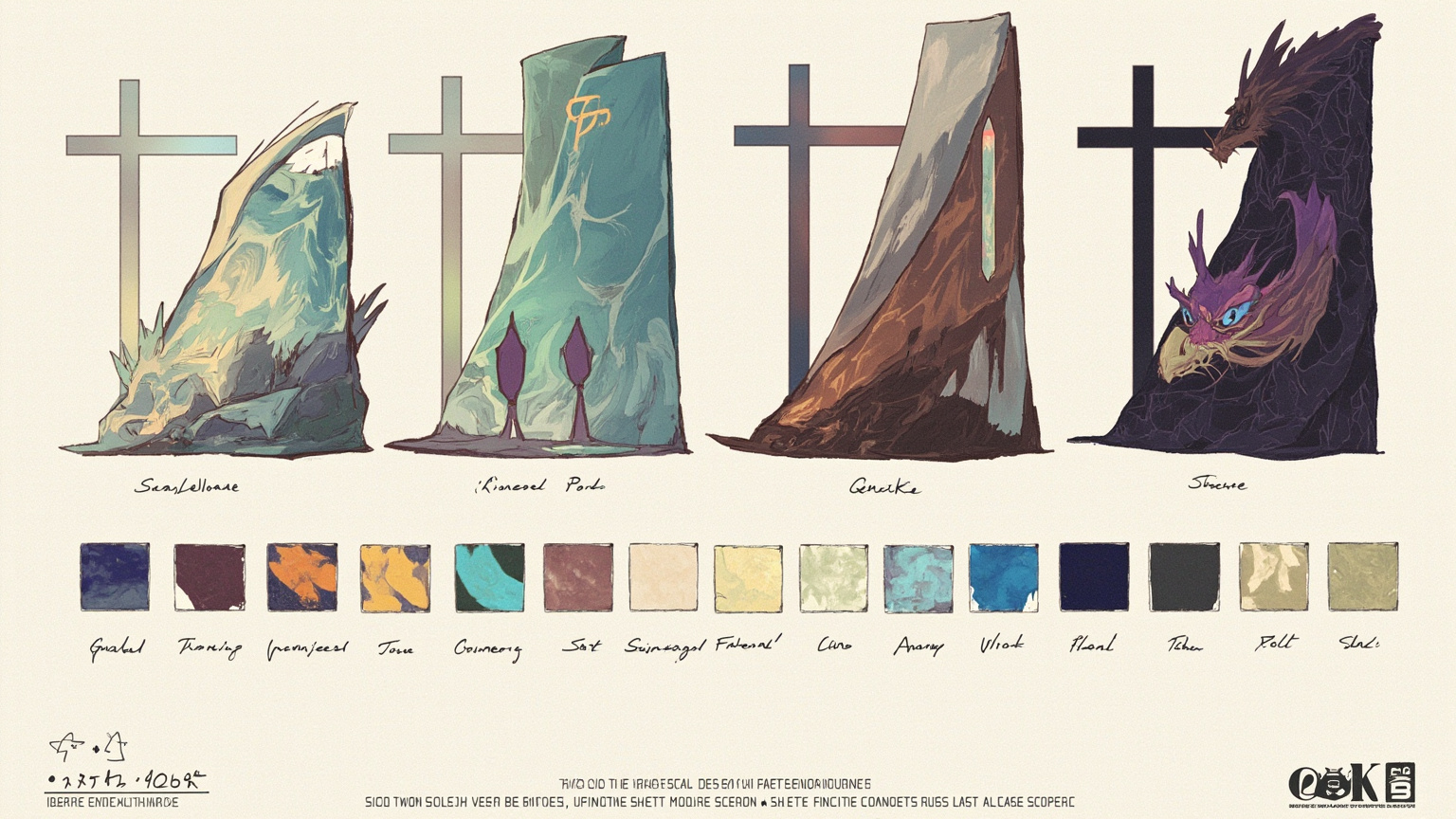
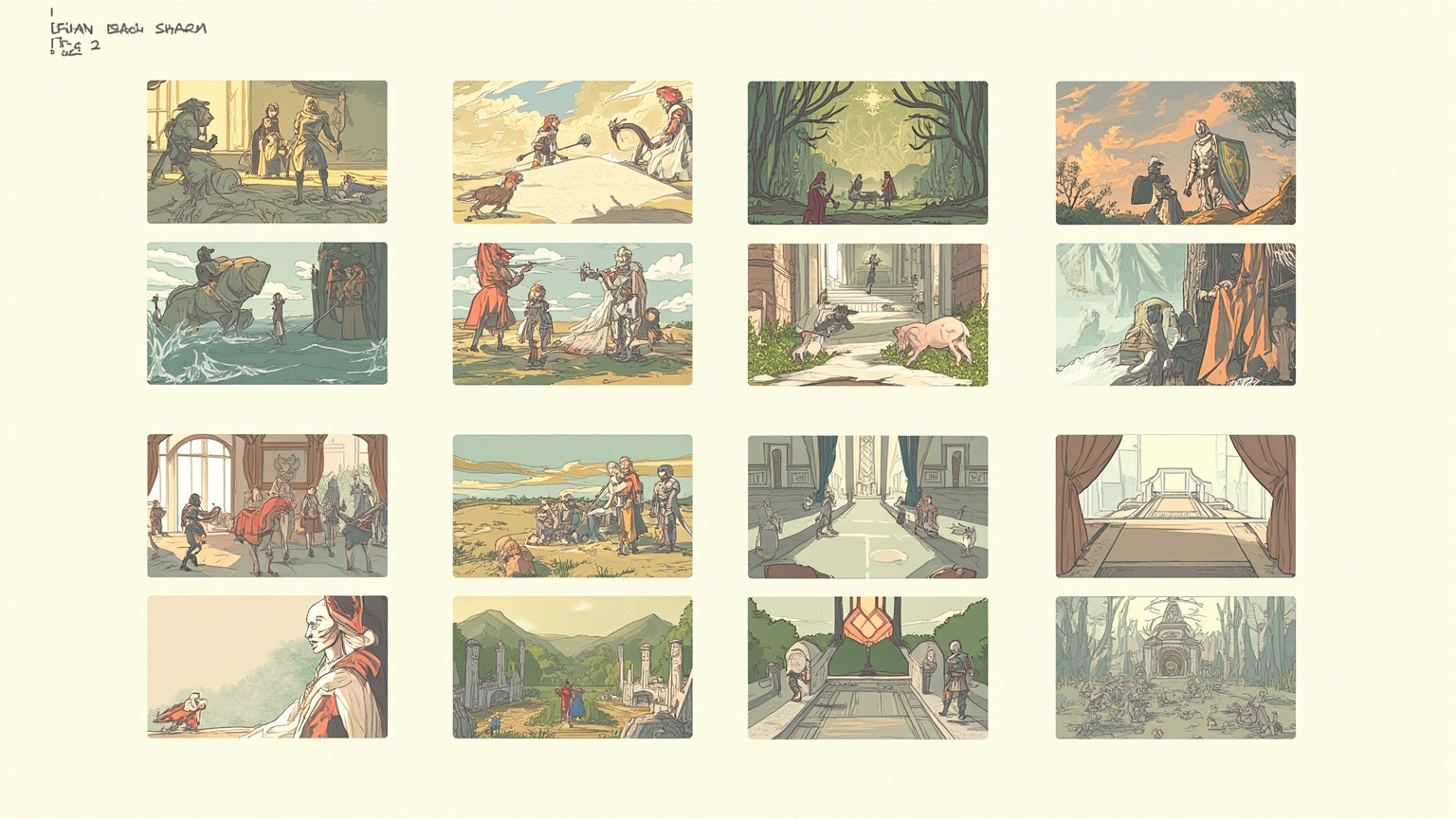
Art Direction4 plates
Before the guide was written, this book got a visual foundation — every illustration you just read grew out of it.