The Imitation of Christ (De Imitatione Christi) · Companion Guide
效法基督
低地隐修院的鹅毛笔下,一位修士对着自己的灵魂打一场没有观众的官司。
A Scribe's Candlelight
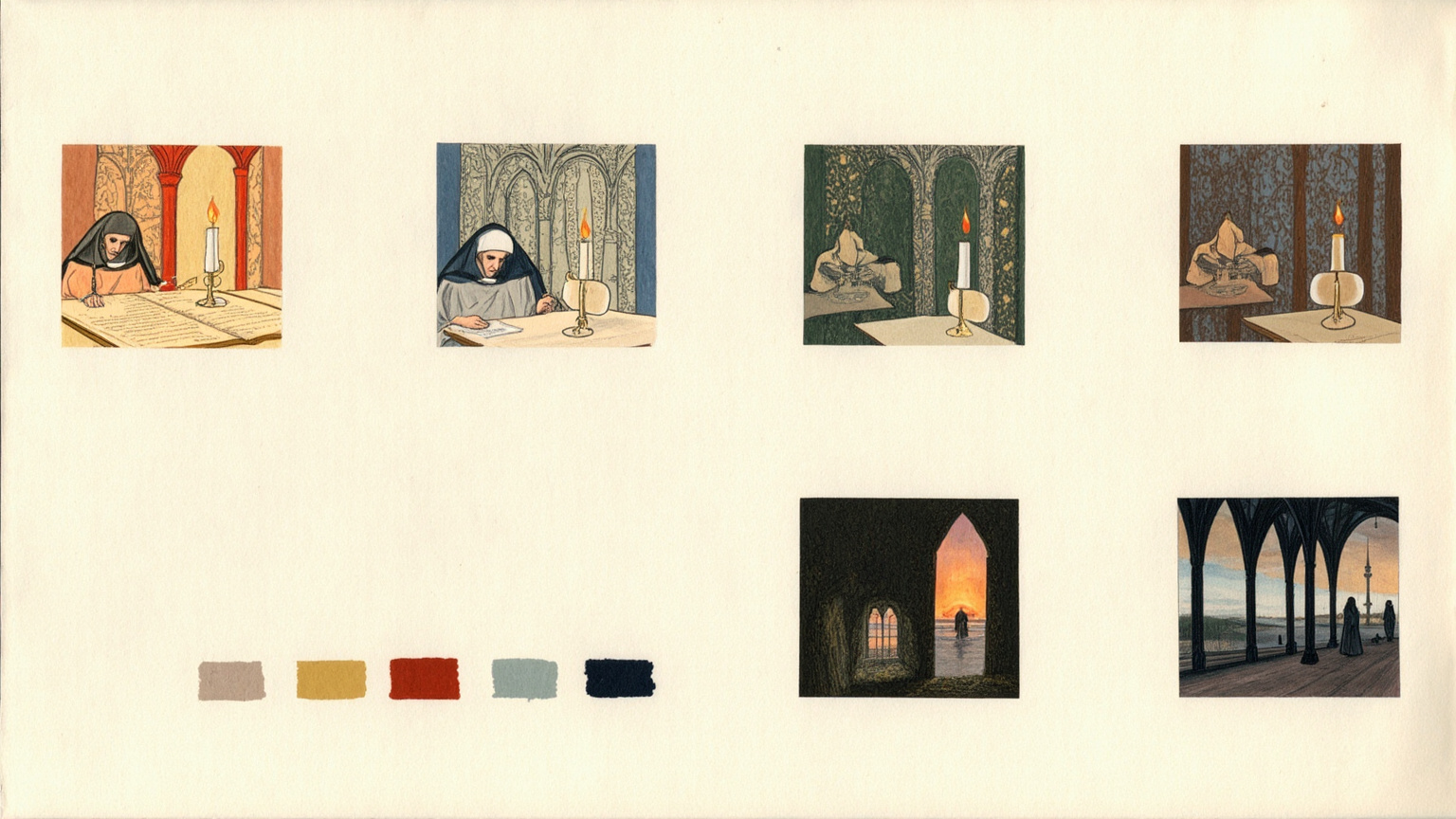
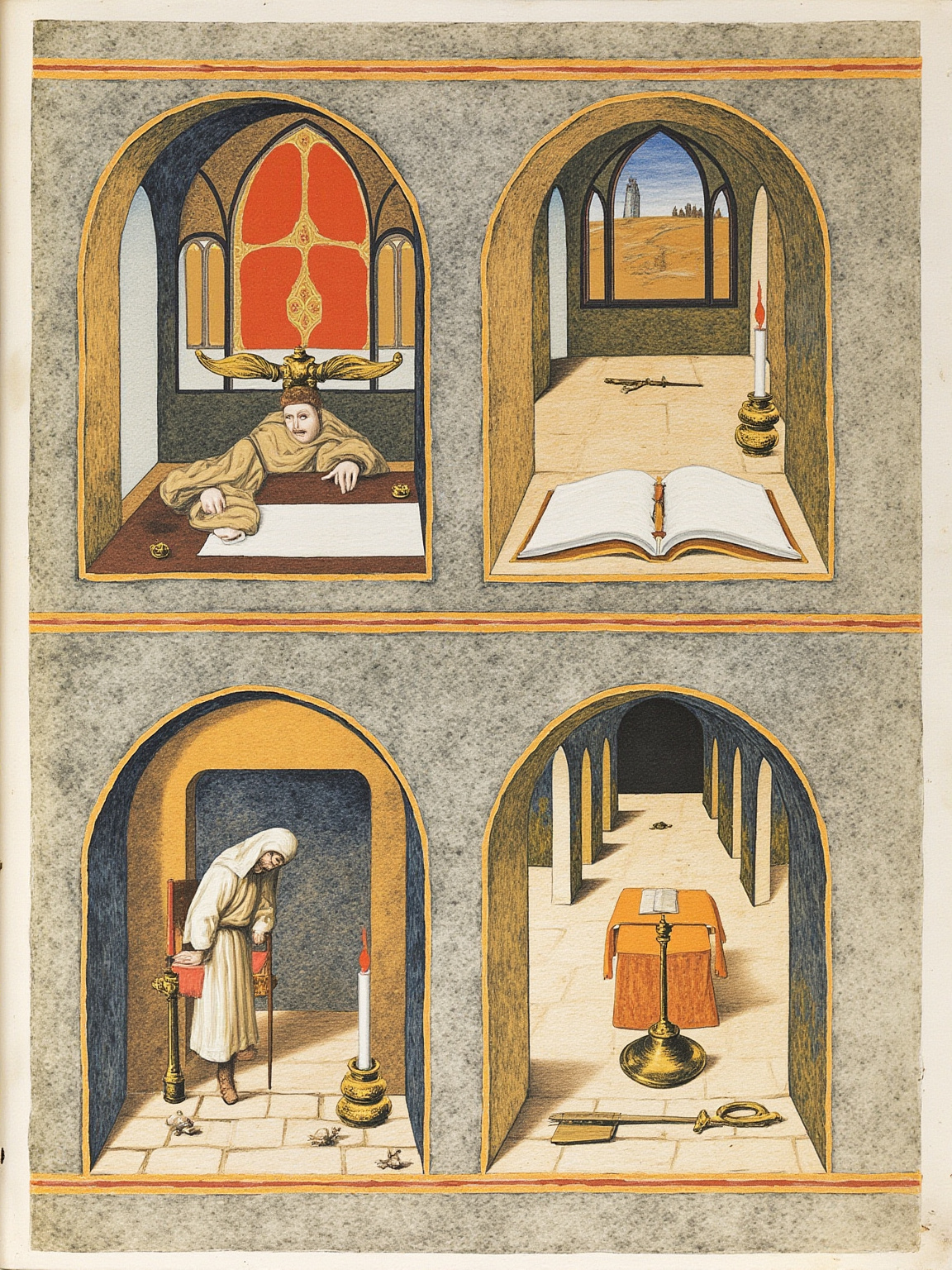
A goose-quill pen lies angled against the inkpot, the parchment open to its second line, the candle flame guttering in a draft from the window seam. The copyist does not look up. What he is copying is not someone else's scripture — it is the endless lawsuit going on inside his own soul.
This is the most familiar image from The Imitation of Christ. In the early fifteenth century, in a gray-stone monastery in the southern Low Countries, a monk named Thomas à Kempis wore his pen down to the nub finishing a book that would later be translated into nearly every language on earth, outsold only by the Bible. There is no story in it, no rising and falling action, no hero — only an unnamed 'I' being counseled again and again, and a long walk back from the outer world into an inner room. The monastery stood in hill country in the southern Low Countries: gray stone walls, a stone-arched cloister, fields below the bell tower. That is the entire stage this book ever needs.
What Kind of Book Is This
Its author, Thomas à Kempis, lived roughly from 1380 to 1471. He spent most of his life at the monastery of Mount St. Agnes, near Nijmegen in the Netherlands, and stands as a leading voice of his congregation's Devotio Moderna, the 'modern devotion' movement. The book was written around 1418 to 1427, in Latin, in four books: the first on counsel and instruction, the second and third on inward consolation, the fourth on the Eucharist. It is remembered for doing what no one else had done. It is not Augustine's earth-shaking confessional autobiography, nor Bunyan's allegory of a man walking out of the city and onto the road. It is a manual for inward practice that a reader can open to any chapter and use as the day's exercise. Whatever page a reader happens to open to is the exercise the book means for that day.
Literary history files it under late-medieval devotional writing, in the same lineage as Meister Eckhart, Johannes Tauler, and Jan van Ruusbroec. But its sentences run shorter than theirs, closer to aphorism, and more accessible — which is exactly why it kept being used as a daily exercise across the centuries that followed. Ignatius of Loyola's Spiritual Exercises and the devotional practices of Francis of Assisi both carried this same inward discipline forward, each in its own way.
Vanity of vanities; all is vanity, save to love God and serve Him alone.
虚空之虚空,凡事皆虚;唯独爱慕上帝、单单事奉祂,纔不是虚空。
金句 · 卷一 · 论万事的虚空
Characters and World
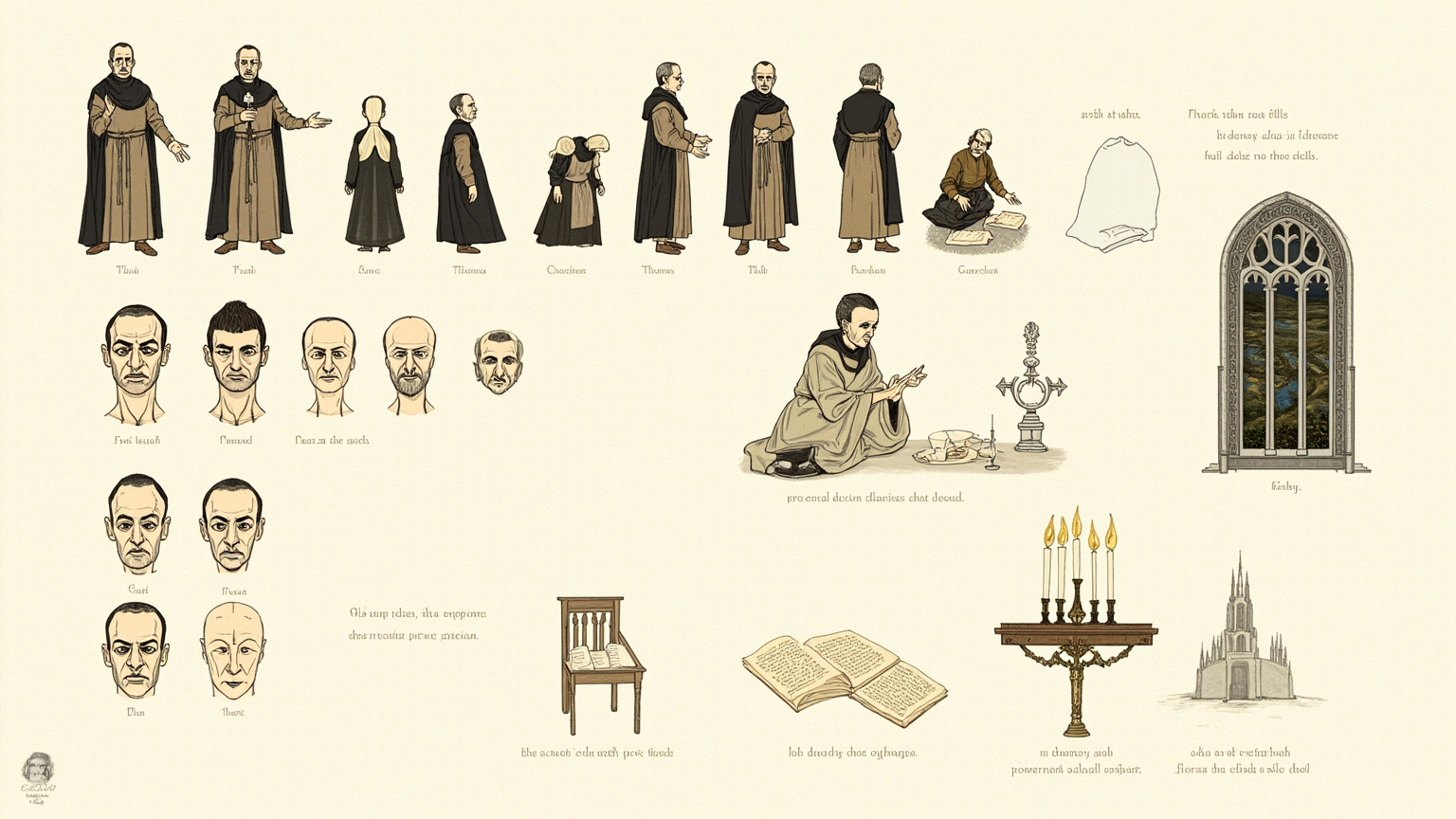
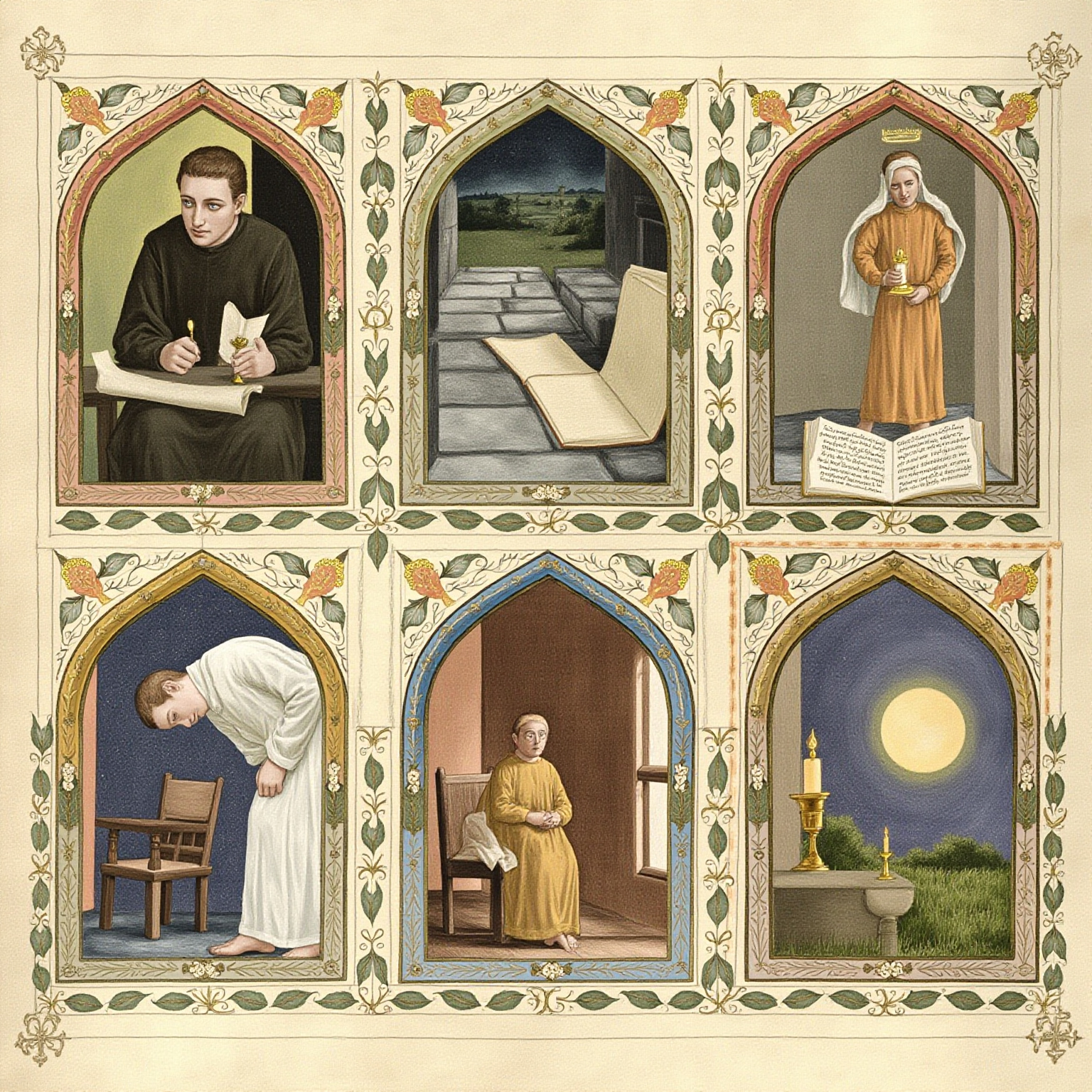
The book has three 'characters,' but none of them has a face. The entire perspective belongs to an unnamed monk, who is at once the one giving counsel and the 'I' being counseled, talking to himself. In the second and third books a strange dialogue form appears: 'The Lord says — I say,' each exchange only a few lines long, going back and forth. That 'Lord' is never physically present; he is present in the text only as a voice being recited, someone the monk listens to rather than a character in a drama. The third 'character' is whoever opens this book — a novice still learning silence, still tasting the bitterness of self-denial, pinned to his seat by the line: read little, argue little, look hard at your own heart.
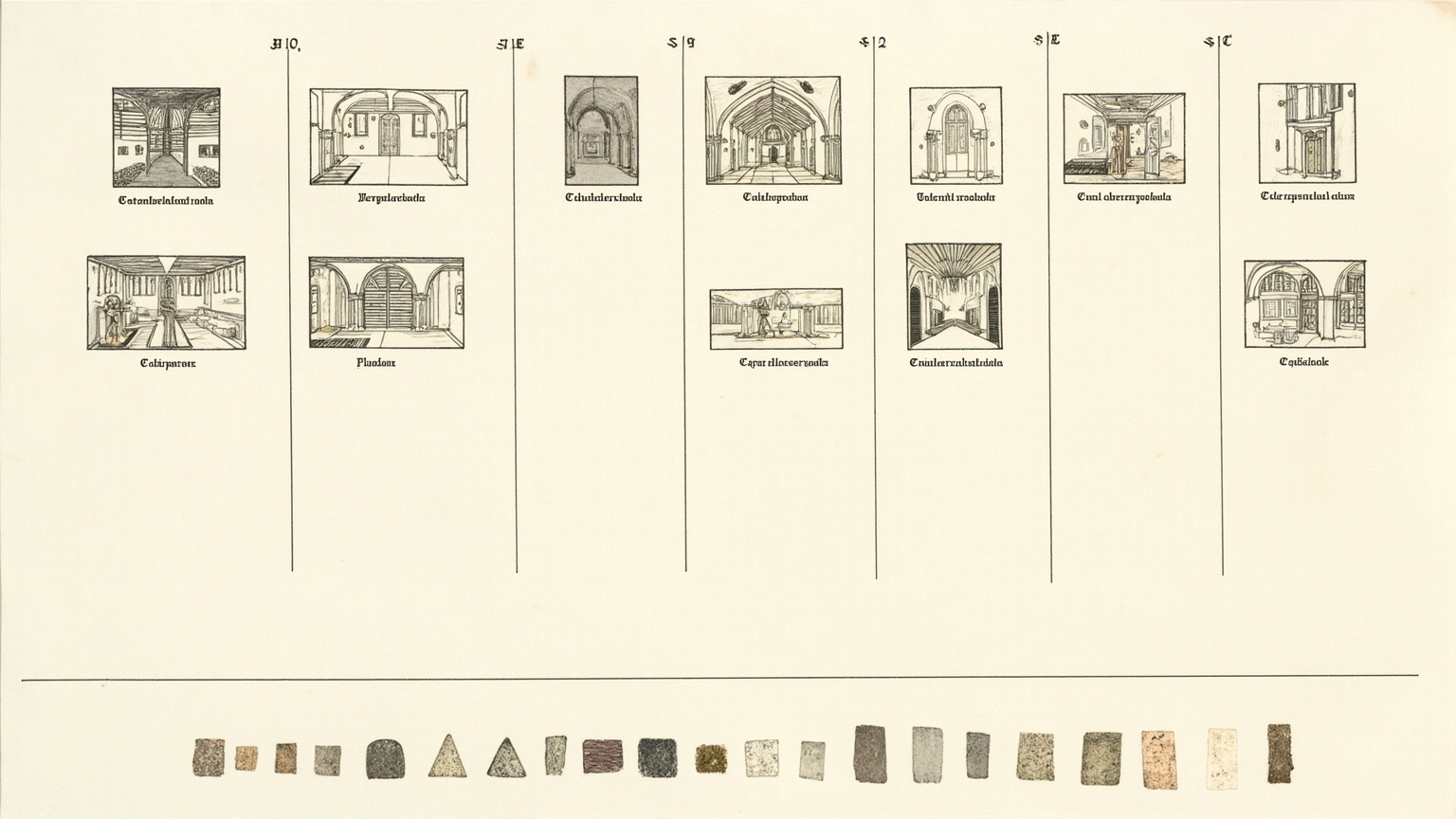
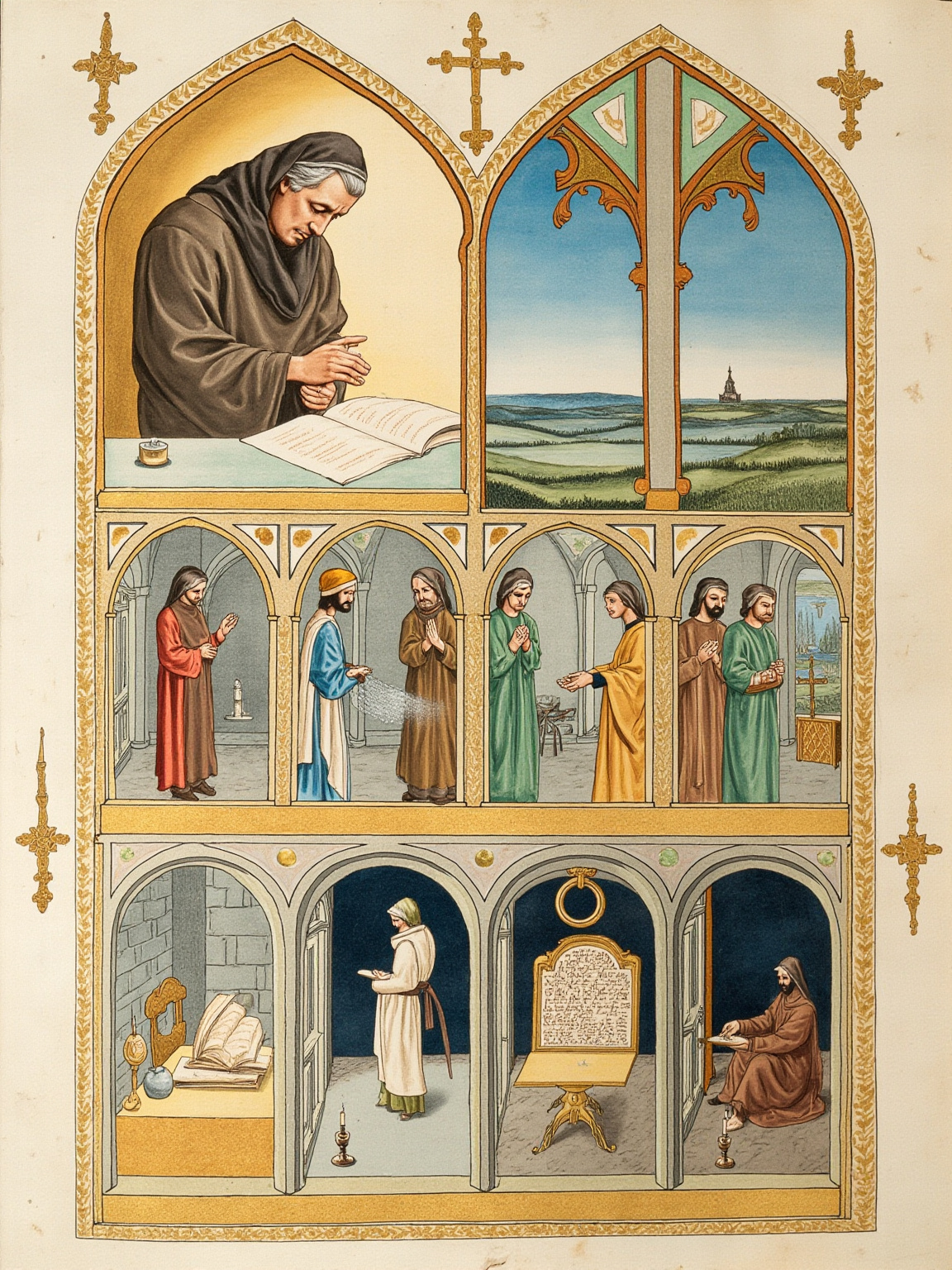
The world is a plain monastery in the southern Low Countries in the early fifteenth century: a scriptorium, a stone-arched cloister, a bare refectory, a bell tower, fields lying below. No stained glass of the Italian Renaissance, no French Gothic spires, no sieges, no heresy trials, no royal weddings. Bells, footsteps in the cloister, the scratch of a pen nib on paper — that is the entire soundtrack this book allows itself. The refectory serves coarse bread, water, boiled beans: no meat, no wine, salt rationed even there. This is the body's cooperation with the lawsuit going on inside.
Book One: Renouncing the World, the Scriptorium's First Counsel
Book One opens by urging the monk to renounce the world, to be humble, to deny himself. Worldly learning steps aside before the learning of God — this is the point Kempis keeps hammering. The highest knowledge is to admit your own nothingness. His sentences run short, plain, almost proverbs, and they land on one clear point: read little, argue little, look hard at your own heart. At the end of every chapter he leaves a short line, like a teacher marking homework, tossing back a question such as how many times did you act rashly today. A monk in the scriptorium reading that line usually has to set down his pen for a moment.
He who knows himself, knows God; and he who knows God, knows himself.
认识自己的人,便认识上帝;认识上帝的人,便更深地认识了自己。
金句 · 卷一 · 论认识自己与谦卑
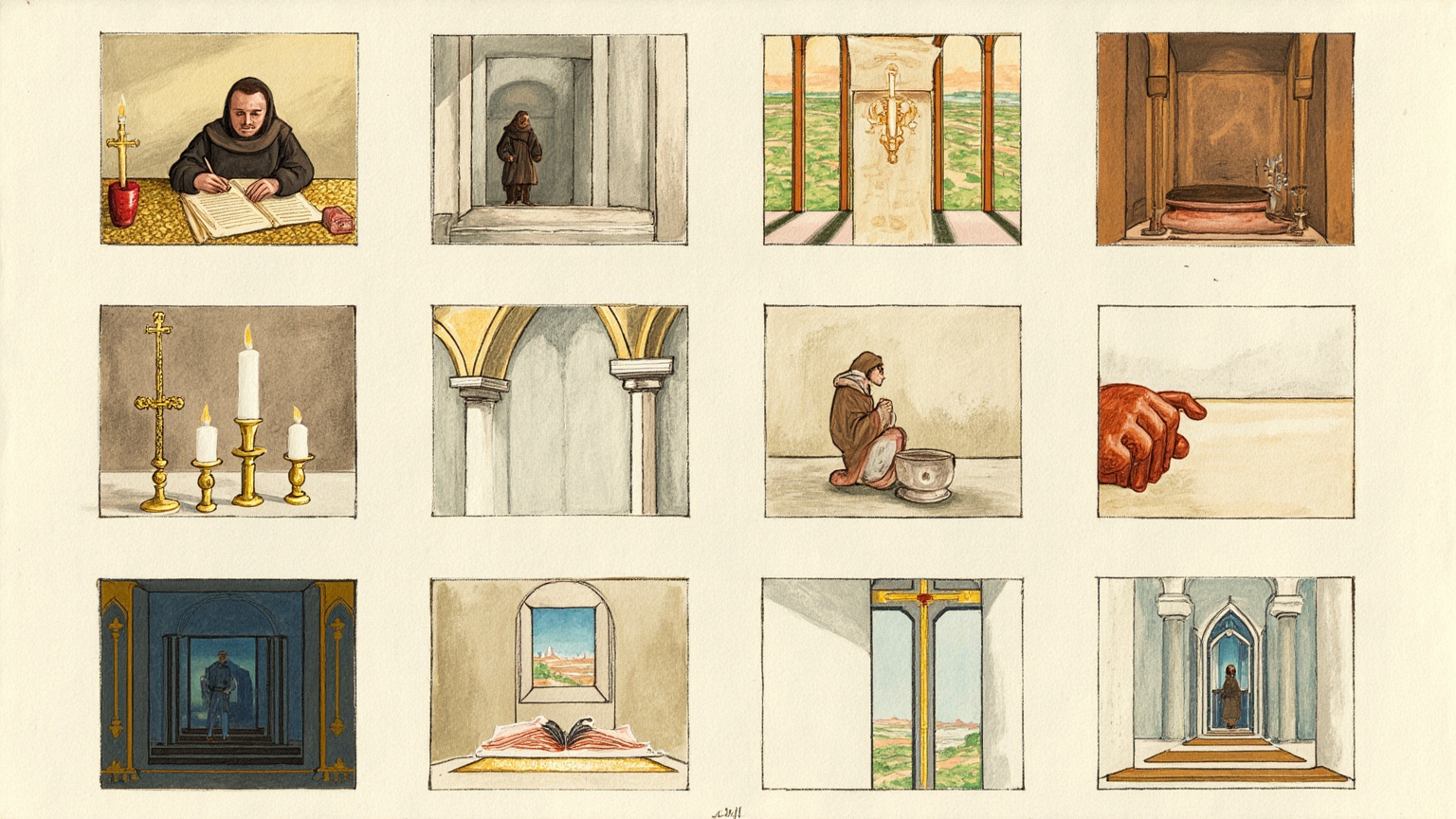
In form, Book One reads most like a collection of proverbs: each chapter stands on its own and doubles as the day's exercise. This section is also the most commonly misread part of the whole book. Readers arrive expecting instruments of the Passion, scourging, a crown of thorns. That is not what Kempis means by 'the cross.' The cross is a figure of speech — daily patience, self-watchfulness, self-denial, the kind of weight an empty chair, folded hands, an open blank page can bear. If this book were illustrated, the scene would not be blood and thorns but folded hands, a page left open halfway through, a pen resting motionless on the parchment. That is the cross Kempis actually wants you to carry.
Withdrawing Inward: The Road from Noise to Silence
Starting in Book Two, Kempis changes his voice. Counsel steps back; dialogue steps forward. 'The Lord says — I say' proceeds line by line, as though the monk were listening for a still, small voice inside all that silence. The book's most famous line is buried in these chapters: God does not dwell in noise, but in stillness. This line is no slogan. It marks the whole book's turn, from 'you should' to 'he says to me,' from law to listening. In this stretch the monk tends to shut the scriptorium door tight, trim the candle to its smallest flame, even hold his footsteps quiet in the cloister. The whole of Book Two carries the mood of four in the morning, when only one lamp is still lit in the monastery.
Eastern Chan Buddhism has a turn of phrase very like it. A Song-dynasty Chan master once wrote: all sound falls silent now, and heard this way, each thing shows what it is. Set beside Kempis's dialogue form, the two nearly line up. What Kempis wrote in a scriptorium in the European Low Countries and what was said in an Eastern meditation hall are separated by centuries and an entire continent, yet they breathe the same air. That is not coincidence. Inward practice, taken far enough, arrives at the same kind of quiet no matter where it starts.
God does not speak to souls that love the world; He speaks only to those who renounce all things and withdraw into the inner chamber.
神不向贪爱世界的人说话,祂只向那放下万物、退入内室的人低声开口。
金句 · 卷二 · 论默观与内在安慰
Book Four: Rest in the Eucharist
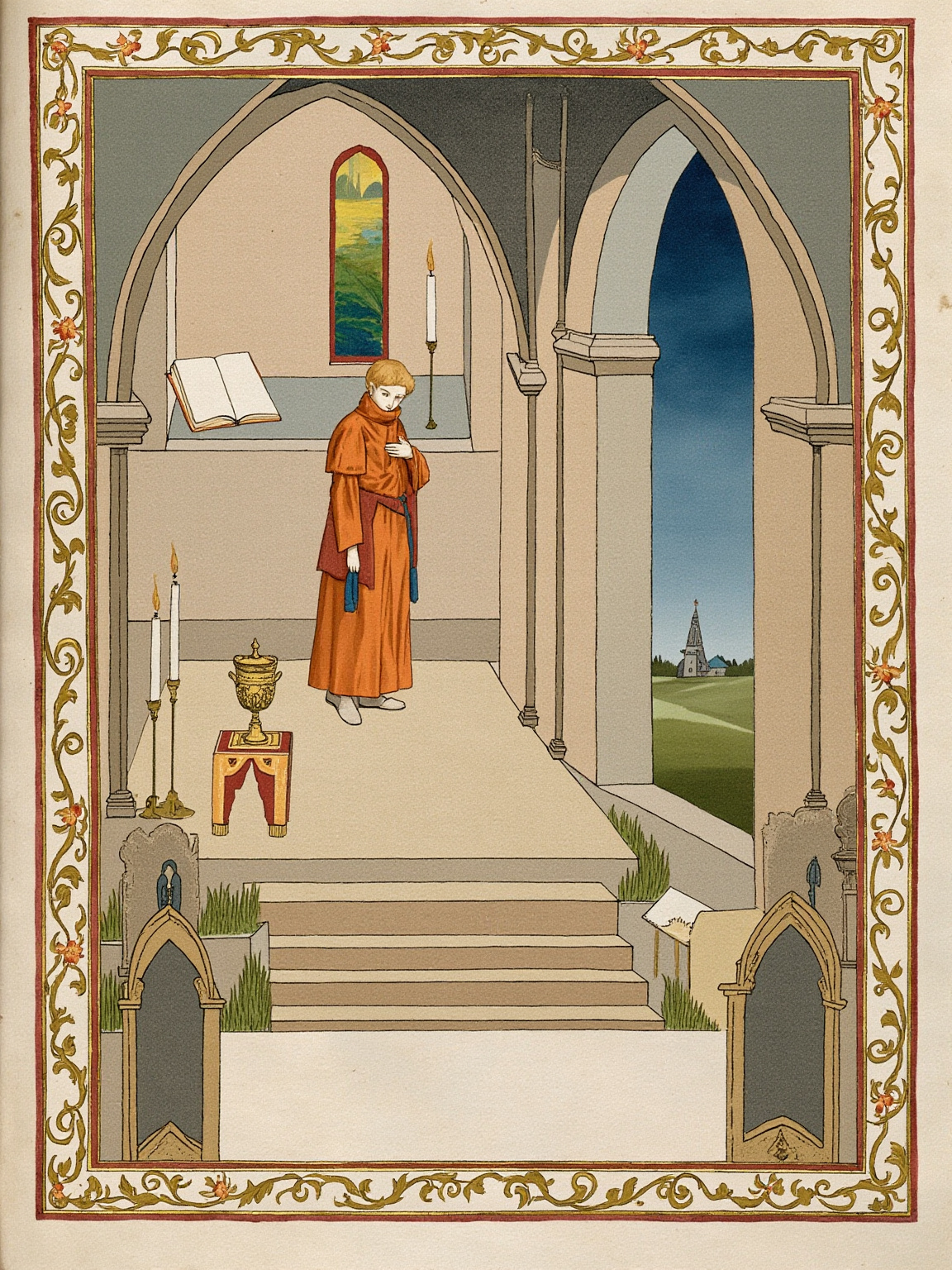
The final book reads almost as one long meditative poem on the Eucharist. Two beeswax candles before the altar, a silver pyx, a crucifix: these are the book's visual relics. The monk kneels at the altar and repeats, Lord, come into my heart, gathering the counsel, the inward consolation, and the inward practice of the first three books into one moment of rest he can touch, inside an ordinary Mass. Every chapter here reads like the monk taking a deep breath before receiving communion: the tightness in his throat, his knees hitting the floor, the instant the little silver box is opened on the white altar cloth.
Ignatius of Loyola's later Spiritual Exercises, the devotions of Francis of Assisi, the church's whole retreat tradition: trace almost any later spiritual practice back far enough and it lands here. Kempis handed later generations a template of gestures — be still, read, listen, kneel, receive. That template fits on a single page, and it still held up Europe's daily devotional life for centuries afterward. Open the book six hundred years later and you can still hear Book Two's echo in the instant that silver box is opened before the altar: the absent 'Lord,' returning, for that one moment, into the monk's heart.
Why It Is Still Read
Six hundred years on, this book is still being read. Part of the reason is that it promises no miracles. Ignatius gives you a vividly staged meditation, Bunyan gives you monsters on the road and a Celestial City waiting at the end, and Kempis gives you nothing of the kind — only an open hand, an empty chair, a silence waiting for you to sit down in it. A reader today, scrolling through hundreds of messages on a phone, opens this book at two in the morning and finds its old counsel landing harder than it did six hundred years ago: read little, argue little, look hard at your own heart.
O God, my God, the whole comfort of my soul and the hope of my heart — come to me in the stillness, and be my rest.
我的主,我的神,我灵魂的全部安慰、心中的唯一所望——请在静默中降临,作我心灵的安息。
金句 · 卷四 · 吁请基督降临之祷
Another reason is its bare-bones aesthetic. Gray stone walls, warm candlelight, plain wool robes, a stone-arched cloister: this visual vocabulary travels well. The Japanese Sōtō school's shikantaza, or 'just sitting'; the recorded sayings of Song-dynasty Chan masters; the copying monks of the European Low Countries — in all three, the posture of sitting down is nearly identical. A small medieval Latin book can walk through that door not because it lays out doctrine, but because of its inward temperament. It is so plain that every era can slot its own present moment into that empty chair: the seat a monk once occupied, taken today by someone lying awake at night.
It does not give you a road. It only urges you to shut the door.
Why You Still Have to Read It Yourself
An explainer can tell you what counsel the book gives, what the dialogue sounds like, what relics it names. What it cannot give you is this: opening Book Two at some odd hour, reading three lines, and suddenly going quiet — whether that still small voice actually reaches your ear, and on which line. Kempis wrote in aphorisms, and an aphorism only has power depending on what state you are in the second you open the page, when the counsel and the person hearing it happen to line up. The book only finishes itself in your hands, on some quiet afternoon or some sleepless night. Even one book will do — read only Book Four, that long meditation on the Eucharist, and it is enough to hold an entire evening.
Art Direction4 plates
Before the guide was written, this book got a visual foundation — every illustration you just read grew out of it.