
The Knights of the Cross (Krzyżacy) · Companion Guide
十字军骑士
一个少年为爱拔剑,赔进红颜;一支民族为脊梁开战,赢回黎明——代价写在雪原上,也写在每个人的断臂与空眼眶里。
Opening: a white cloth embroidered with a black cross, and the blow that came down on it
The story begins on a night at an inn. Zbyszko, a Polish boy of nineteen, is on the road with his uncle Maćko, headed for Kraków. In the tavern, a girl is singing — Danusia, young and bright. Across from her sits Kuno von Lichtenstein, envoy of the Teutonic Order, mocking her, mocking the Poles. The blood rises, and the boy is on his feet from the bench before he knows it. It isn't love or honor that drives him, so much as that white mantle with the black cross, hanging too close to her. One sword-stroke, and he's committed a capital crime.
What kind of book is this
The Teutonic Knights is a historical novel by the Polish writer Henryk Sienkiewicz, written at the end of the nineteenth century and published in 1900, five years before he took the Nobel Prize in Literature. The book turns the Battle of Grunwald, the decisive victory of the Polish-Lithuanian forces over the Teutonic Order, into national memory. Inside Poland it ranks alongside Pan Tadeusz as a national epic; outside, it serves as a door into medieval Central Europe. When Sienkiewicz wrote it, Poland had been wiped off the map for more than a century, so those armored ancestors of his aren't nostalgia. They are backing up the living.
People and world
Zbyszko is the sort who'd die over a single look. Young, brave, reckless — a blade just out of the forge, not yet tempered. Maćko is his uncle, a soldier who took an injury early, was discharged young, and lived on calculation and experience; his job is to put a brake on his nephew's headlong charges. The pair form the steadiest scaffold in the book: one lunges forward, the other covers behind.
Danusia is the Duchess of Masovia's adopted daughter. She sings, and there's always a light in her eyes. Her father, Jurand of Spychów, is a lord consumed by hatred: family killed by the Order years ago, and he's lived for revenge ever since. Jagienka is the girl from Zbyszko's home country — she can ride, she can shoot, she can keep accounts, and she doesn't blink while she waits. She's no supporting character. She's the one who catches the story when it falls.

The young knight struck as if a single insult outweighed the whole world.
血涌上头的那一瞬,世上万物都不及那句话重。
金句 · 第1章 · 客栈之夜
The rules of the world are harsh. Early-fifteenth-century Central Europe isn't the gilded ballroom of knightly romance — it's muddy post-roads, oak forests, timber fortresses, the low winter sun. On the Polish-Lithuanian side, dress is mixed and varied; on the Order's side, the uniform is the white mantle and the black cross. That cross is the Order's emblem. The Order did take part in the Crusades historically, but the story here is set on the Polish-Lithuanian border in Central Europe, not in the Holy Land. Don't get the two mixed up.
After the inn: The headscarf on the scaffold
Zbyszko has been sentenced to death. The moment he is brought to the scaffold, Danusia appears and, following Polish custom, covers his face with her headscarf, declaring him her husband. She has now taken on a life-debt, and the paying of it falls to her. The blade stops. They are betrothed on the spot, and later married. Sienkiewicz writes the whole scene without a single grand word; one gesture holds up the entire weight of law and custom. When the headscarf falls, a life comes back.
The blade truly stops only when the headscarf falls.
Yurand's fall: Three things cut out of him
The Teutonic Knights want to draw Yurand out, so they send false word that Danusia is in their hands. Yurand knows it is a trap, and rides in alone. He falls into the hands of two Teutonic officers, Siegfried de Löwe and Rotgier, who gouge out his eyes, cut out his tongue, and chop off his right arm. A man who came for vengeance is whittled down to a mutilated husk, then thrown back for the Poles to see. Danusia is bound and carried off, to be tormented at leisure as a hostage.
This is the darkest chapter in the book. Sienkiewicz does not linger on the blood. He writes only that three things are gone — light, sound, the hand that held the sword. What remains he leaves to the reader. In craft, he practices a cruelty of the most austere kind: not blood, but emptiness.

They did not shed his blood — they emptied him of light, of voice, of hand.
他们没让他流血,只是抽走了光、声音,和握剑的手。
金句 · 第12章 · 尤兰德之陷
The road to find his wife: Walking all of Central Europe
Zbyszko sets out to find Danusia. The road stretches as long as the Middle Ages: through the forests of Mazovia, into territory held by the Teutonic Knights, suspected, seized, beaten, locked up. Macko fares worse. He too falls into the Knights' hands and is thrown into a castle dungeon; by the time he is ransomed, he can barely recognize his nephew. Two generations take turns gnawing at the same iron.
When Zbyszko finally found Danusia, she no longer recognized him. Long imprisonment, fear, and torture had burned through her mind. She wasted away in his arms. Whether she remembered him at the end, no one can say. Sienkiewicz did not give the reader the release of a good cry. He gave us this: she stopped singing. A singer who stops singing — that cuts deeper than any wound.
Jagienka: The Hand That Caught Everything
Home again, Zbyszko was a bird with a broken wing. Jagienka was there, waiting. She did not weep, did not rage, did not ask whether he still wanted her. She set the table, hung up his hunting clothes, sorted the accounts. She had waited years — waited for him to come back, waited for him to be willing. They married in the end. But Sienkiewicz was honest about it: Danusia's shadow stayed in that house, like a mark on the wall that won't come off.
The first time I read this, I stopped short too. A boy of nineteen storms off to die for his beloved; the beloved dies; he comes home and finds that someone else has been standing by the stove for years, steady as the walls. Sienkiewicz did not write Jagienka as a consolation prize. She is herself — a woman in a broken age who can hold a household together, harder than any knight.

She no longer sang — and silence fell heavier than any blow.
她不再唱了,寂静比刀还重地落下来。
金句 · 第18章 · 寻回与永失
Grunwald: The Reckoning on the Snow Plain
In the summer of 1410, the Polish king Władysław Jagiełło marched the Polish-Lithuanian host north — he was Grand Duke of Lithuania too, though his cousin Vytautas commanded the Lithuanian wing in the field. The Grand Master of the Teutonic Order, Ulrich von Jungingen, led the Knights out to meet them. The two armies met at Grunwald, an open plain, that summer afternoon, with the dust and the shadows of the lances crossing over the same ground.
Zbyszko and Macko were both with the host. Macko came face to face at last with the man who had tortured him, and settled the account on the field. Jurand was carried to the line as well — blind, one-armed, unable to speak. When Siegfried de Löwe appeared before him, he used the one hand he still had to drag his enemy from the saddle and press him into the dirt. This is the climax of the book, but Sienkiewicz does not give the reader the pleasure of cheering. He gives the reader a chill.
The allied host won a crushing victory. Grand Master Ulrich von Jungingen fell with the rest. The Teutonic Order never recovered its strength. This is the spine of Polish national memory — Sienkiewicz wrote it when Poland had not yet returned to the map, and the ancestors on his pages fought the fight for the living.

What one must pay for a single heartbeat of anger — that is the question the book asks.
为一秒钟的心跳,你愿付多少——这才是这本书真正在问的。
金句 · 第21章 · 雅金卡的灯下
What it's actually saying
Looks like revenge and war on the surface. Read deeper and it's about cost. A young man acts on love's impulse and pays with the woman he loves. An old warrior rides out for vengeance and pays with his body. A father wades into danger for his daughter and pays with every sense he has. Each one lays down something real for the obsession driving him. This is not a book that celebrates courage. It asks whether you would hand over the weight of a whole life for a single second of impulse.
Another theme is the spine of the oppressed. The Teutonic Order is no simple villain — Sienkiewicz has his own people inside it — but as a body it stands for a kind of order: white mantle, black cross, iron discipline, a system designed to grind foreign peoples flat. This is what the Poles of that era were up against. That's why this book has stayed alight in Poland for a hundred years: it held the ledger for a country that had been wiped off the map.
Why this book is considered well-written
Sienkiewicz is the rare kind of storyteller who can really tell a story. He braids historical figures — Władysław Jagiełło, Ulrich von Jungingen — onto the same thread as his fictional ones, fact and fiction so tightly interwoven you can't tell which stroke is history and which is invention. He's brutal with character too. Macko opens his mouth and you hear the old soldier in him. Jagienka lifts a hand and you see a woman who can carry the load. Jurand, at his most terrifying, is the one saying nothing.
More remarkable is how he writes cruelty without rendering blood. The passage where Jurand has three things cut from him — he doesn't let the reader see the blood. He lets the reader hear the hollowness. That restraint is what keeps literature alive. Cruelty piled high with adjectives is unbearable in the moment and forgotten inside ten years. Cruelty pared down to the action itself is still there a hundred years on.

Old men were carried to the field on horseback, that with their ruin they might see their master's ruin.
残破的老将被人扶上马背,让他们以自己的残破,亲眼看见仇敌的覆灭。
金句 · 第24章 · 格伦瓦德的黎明
Reasons to read the original
The explainer can give you the map. What it can't give you is the medieval body-sense of the actual text — the mud, the horse-sweat, armor striking armor, winter sun at a low angle, a harp picking up at the long-table feast, a deer crashing through the oak wood. These things aren't in the plot. They live in the cracks between the sentences. The song Danusia never gets to sing. The glance Jagienka doesn't lift when she sets the food down. The wind moving through Jurand's empty sleeve when they carry him onto the field. You have to sit inside the original to catch them.
The snowfields of Grunwald are something you have to be there to see. I can tell you the allied forces won, the Grand Master died, Macko got his revenge. But I can't find words for that single second that afternoon, when the dust rose and an old man who'd lost his right arm was propped up at the head of the line, his one remaining left hand clenching open and shut. Go read it — Sienkiewicz spent a full page on that one second.
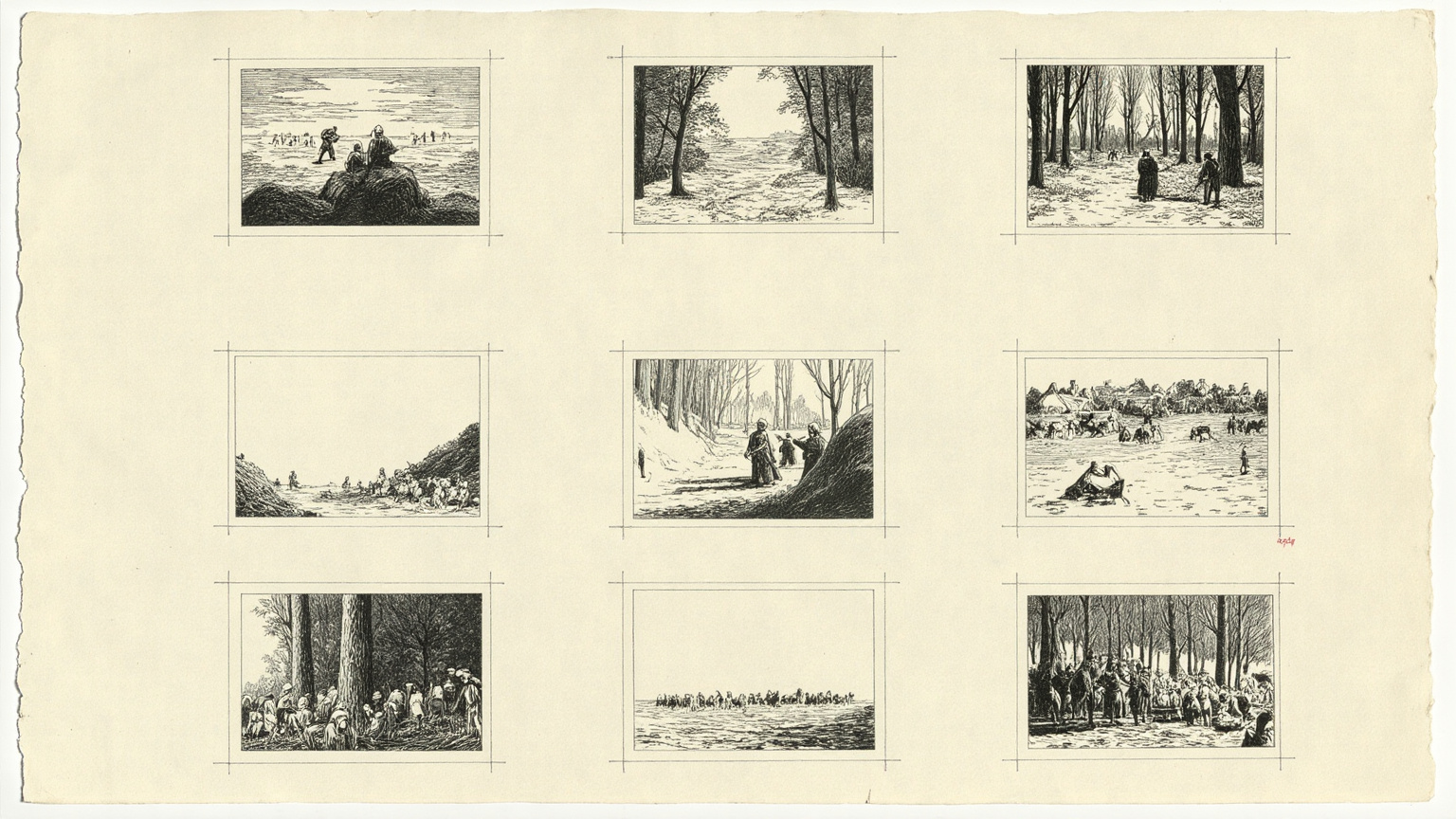
Art Direction4 plates
Before the guide was written, this book got a visual foundation — every illustration you just read grew out of it.


