The Sandman (Der Sandmann) · Companion Guide
沙人
烛火里取出一枚滚烫眼球,从此童年阴影长出腿,循着他穿过大学城,直到钟塔顶端那一道清明的回望。
Opening
A red-hot eyeball rises out of the hearth fire. A child screams in the study doorway. A man named Coppelius looks up — and right there, the whole book's ruin takes root.
That is Nathanael's childhood. He blurts out the word — Sandman! — and is seized and flung out of the room. His father drops dead six months later, and from then on that name becomes the curse he mutters through the night. Years afterward, on a street in the university town, he runs into an Italian optician — Coppola, a man who looks almost exactly like the figure from his childhood — and he starts shaking all over again.
What kind of book this is
The Sandman is a novella by E. T. A. Hoffmann, the German Romantic, published in 1816 and collected in the first volume of Night Pieces. Its place in literary history is a strange one: a high point of German Gothic, and also the source text for what psychoanalysis would later call the uncanny — das Unheimliche. Freud's 1919 essay on the uncanny reads almost like a dissection performed on this one story.
It is also the founding text of the falling-in-love-with-an-automaton motif. Olimpia, the mechanical girl, predates Mary Shelley's Frankenstein by two years, and she drags the question of what counts as a person out of horror spectacle and into real infatuation. What Hoffmann actually pulls off, in the span of a novella, is fitting four escalating movements — a childhood trauma, a set of paranoid letters, a love affair with an automaton, a fatal fall from a bell tower — into that short a space, each one vivid enough to stand as a scene on its own.
Characters and world
The story is set in a fictional university town, generally taken as a stand-in for Königsberg, where Hoffmann himself studied. Its skyline is dominated at dusk by a tall town-hall bell tower — the site where the ending's tragedy plays out. As a world, it is a small city soaked in Enlightenment talk: a physics professor can build automatons indistinguishable from the real thing, telescopes and barometers and stills crowd every study, and reason is supposed to win every argument. But in the gap between candlelight and moonlight, a childhood terror that was never digested keeps finding its way back.
Nathanael is both victim and engine of all this — a nervous, high-strung student who still carries, behind his eyes, the afterimage of that red-hot eyeball from childhood. Clara is his childhood sweetheart, rational, clear-headed, convinced the world isn't as frightening as he thinks. Lothar is Clara's brother, practical and protective — he doesn't just rail against Nathanael's delusions in words, he grabs him, physically hauls him back from obsession into the world in front of him, one of the few people in this story who acts rather than just talks. Facing them are two shadow figures: Coppola, an itinerant Italian optician whose name and build echo Coppelius from Nathanael's childhood closely enough that Nathanael, and the reader, are tempted to treat them as one and the same — he deals in glass eyeballs, selling them to the wealthy households of the town; and Spalanzani, a physics professor who has built a mechanical girl named Olimpia and presents her at a ball as his own daughter.
The red-hot eyeball of childhood
The story opens on Nathanael's memory. One night he sneaks to the door of his father's study and finds his father hunched over the table with a sinister visitor, Coppelius. What comes out of the fire is a red-hot eyeball. The boy bursts in shouting Sandman! and Coppelius seizes him by the arm. His father begs for the boy to be let go, and the child is thrown back into his room. Six months later the father dies in what looks like an explosion tied to some alchemical experiment. From then on Sandman becomes Nathanael's private curse — muttered at night, sketched on paper, written into letters to his friends.
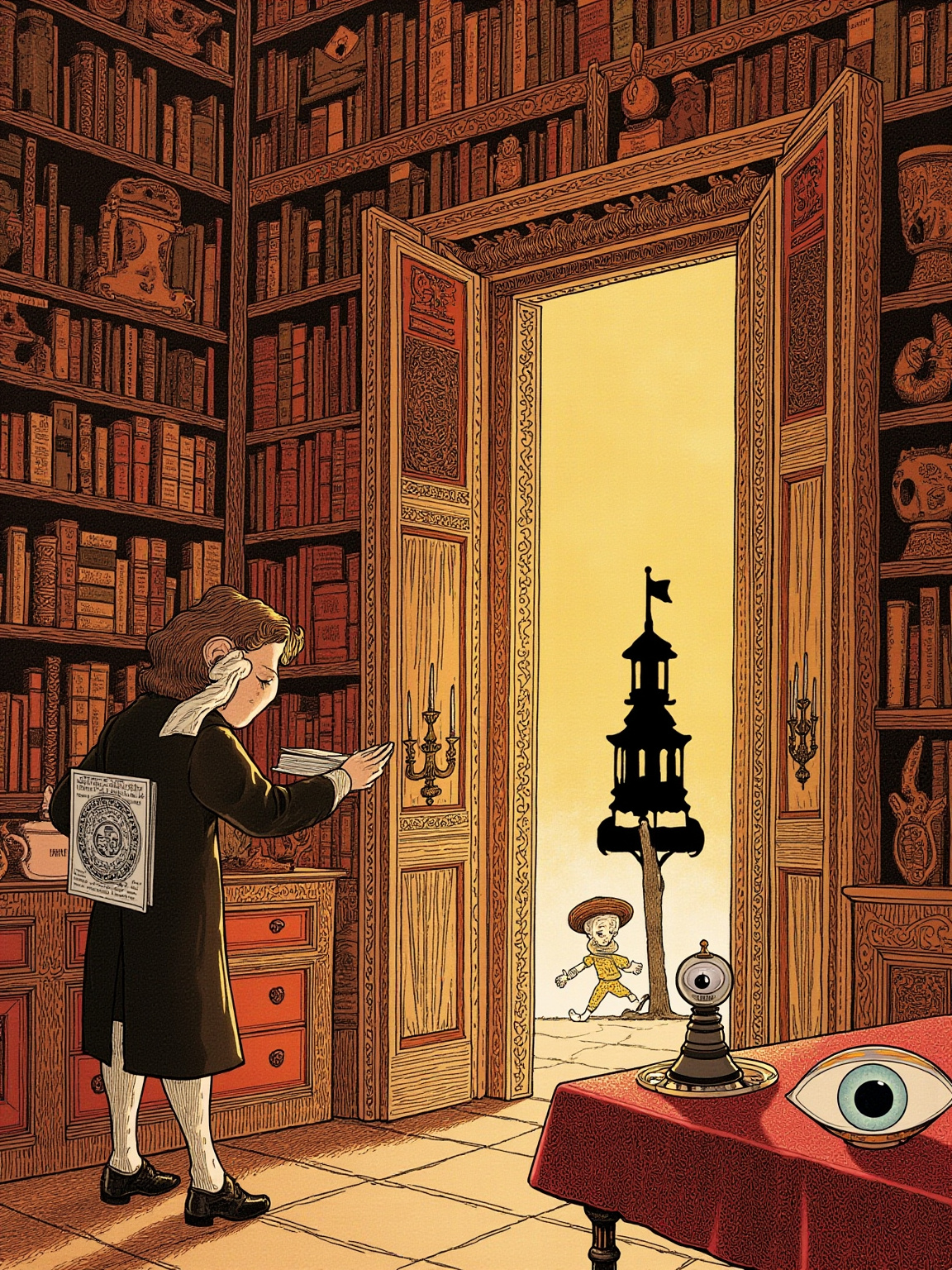
The horrible Sandman! The horrible Sandman!
可怕的沙人来了!可怕的沙人来了!
金句 · 童年夜书房 · 第一声喊出的咒
Hoffmann's method here is sly: he never states outright that Coppelius is frightening, he writes the child's sense that something is wrong without being able to say what. The optician's expression, the mechanical stiffness of his movements, a faint shift in the room's temperature — this is the core recipe of the uncanny: nothing here should be frightening, and yet it is.
In the university town, an old shadow finds its legs again
Years later Nathanael is back in the university town as a student. On the street he runs into Coppola, an Italian peddler of eyeglasses and optical instruments who looks almost exactly like Coppelius from his childhood. The note in Nathanael's hand reads: Coppola, optician, beware the Sandman. Around the same time, a daughter appears at Professor Spalanzani's house — Olimpia, absurdly, impossibly perfect.
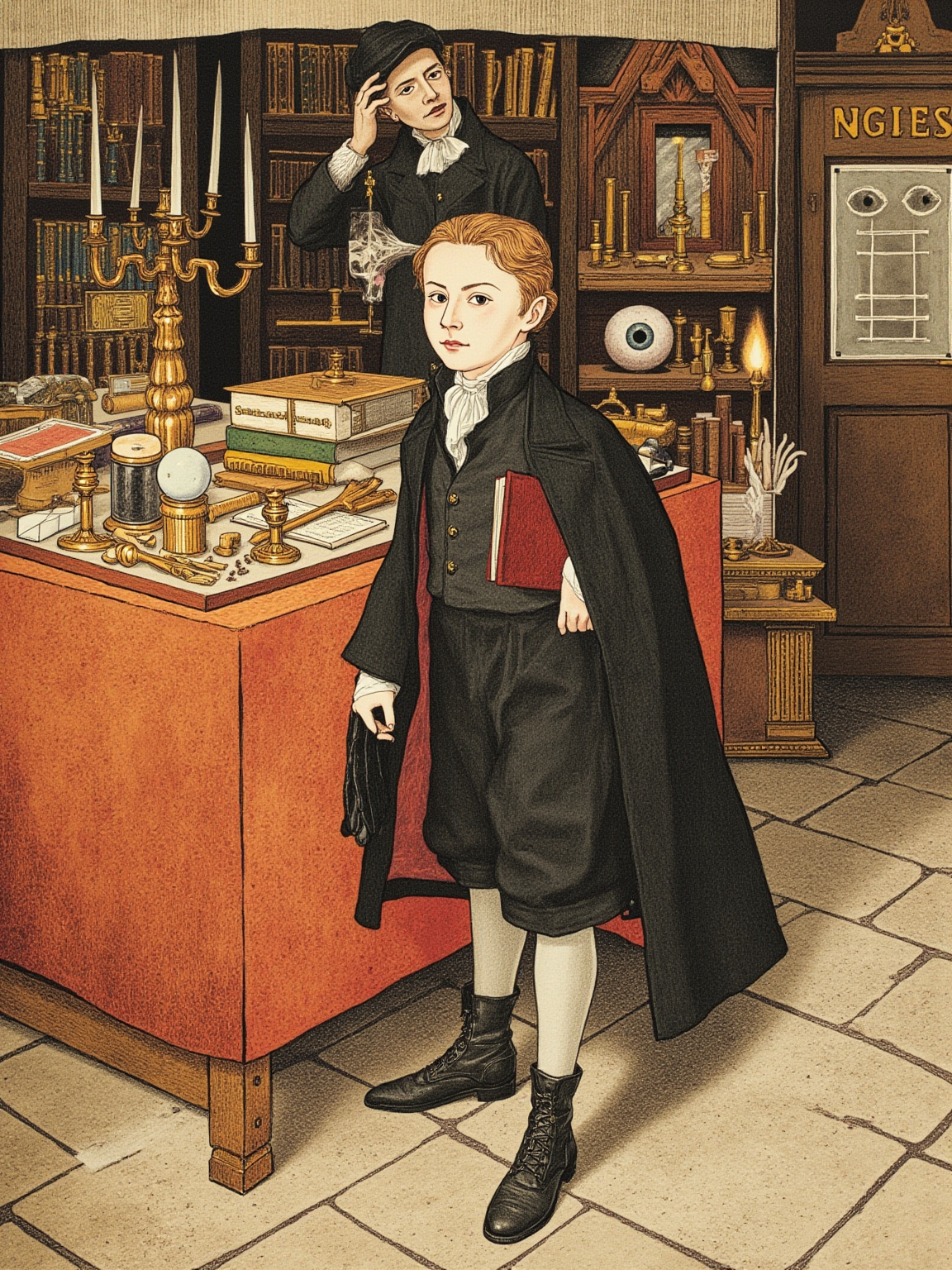
The bright, fiery eyes of the glass spectacles sparkled and gleamed.
眼镜片上那双明亮、火热的眼睛闪着冷光。
金句 · 大学城街角 · 与柯普拉的对视
He weaves his childhood shadow, Coppola, Olimpia, and Clara into a single web of persecution, and pours it into letter after letter to Clara and her brother. Clara answers calmly: there is no Sandman, there are no living dolls. Lothar explodes: this is madness. Nathanael takes in none of it.
In love with a doll: that Ah was only a machine's echo
At a ball, Nathanael speaks to Olimpia for the first time. She sits in a corner, silent, beautiful, her eyes strangely clear. He pours his heart out to her, and she answers only with a flat Ah — which he hears as sympathy, as response, as a soul that understands his own. After the ball he walks her home, and in the moonlight, outside the professor's window, he sees a horrifying scene: Spalanzani and Coppola grappling in the street over who owns Olimpia. They tear at each other, a glove drops to the ground, and Coppola runs off clutching a pair of eyes. Spalanzani turns and storms away, leaving behind an eyeless shell — its fate left in the background, in the shadow of the streetlamp, with nothing but that one abandoned glove to close the scene.
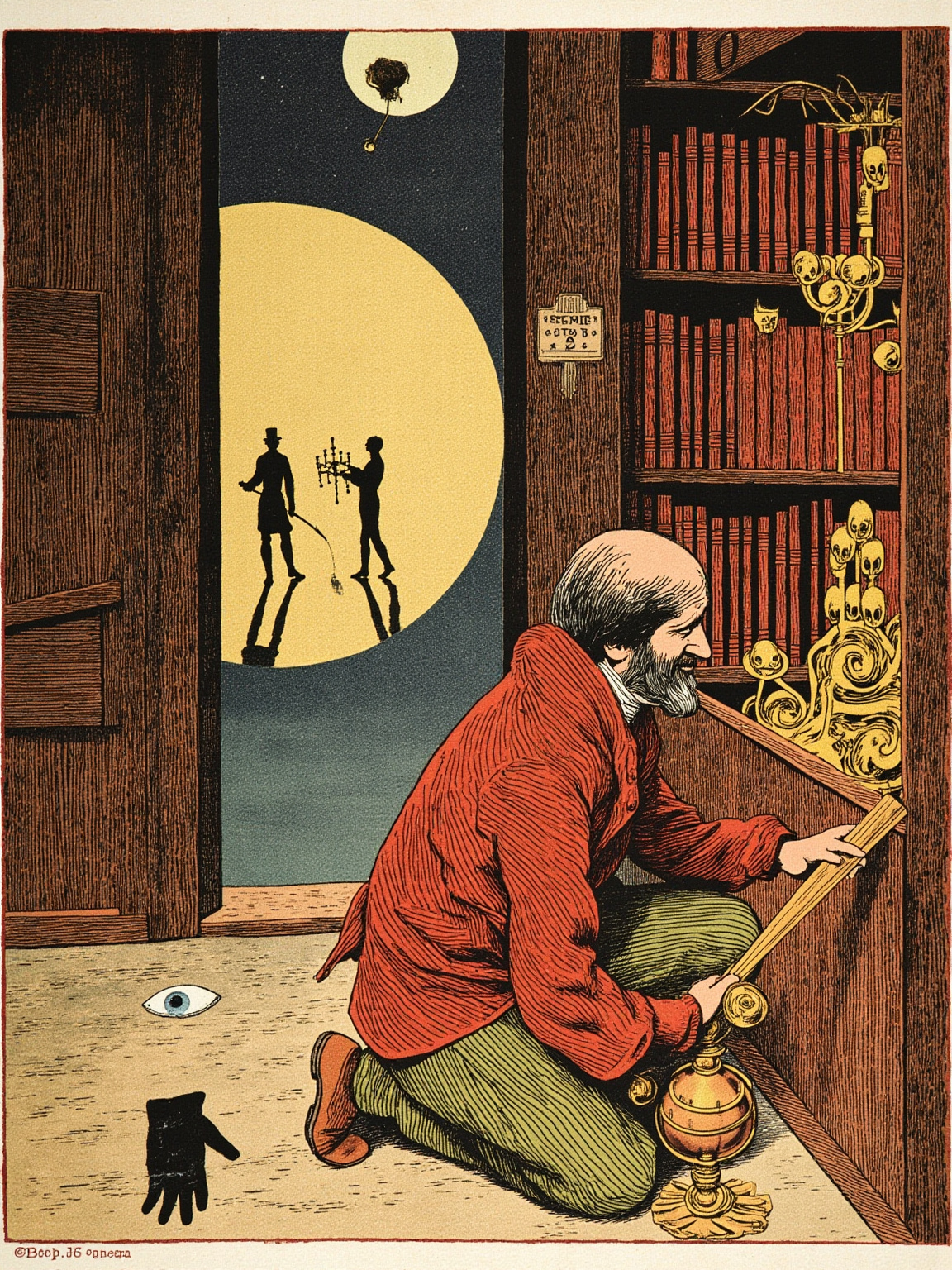
Ah, ah, ah! — cried Olympia, and it was her only word.
啊啊,啊啊——奥林匹娅这样应着,那是她全部的语言。
金句 · 舞会回廊 · 唯一的应答
This scene is the book's cruelest unmasking: the she Nathanael poured all his passion into was, from the start, a mechanism whose gaze and whose sighs he had simply misread. Hoffmann writes the machine's Ah so that it is nearly indistinguishable from a lover's murmur — and that near-indistinguishability is itself the horror. Nathanael's mind breaks completely, for the first time, right here.
The cliff, the engagement, a brief lucidity
In despair, Nathanael runs home and climbs a cliff meaning to jump. Clara chases after him and pulls him back. His reason returns, for a while — he proposes, and they become engaged. Those months are the quietest stretch in the whole book, and Hoffmann covers them in a few lines, which makes them feel more fragile still, because the reader already knows this pane of clarity is thin enough to shatter at a touch.
The first time I read the engagement passage, I stopped short too — a Gothic novel doesn't usually grant its protagonist a breath like this. Hoffmann grants it, then breaks it with his own hands. That rhythm is harder to sit with than a story that stays dark from start to finish.
The last look, from the bell tower
Months later Nathanael returns to the university town. He climbs the town-hall bell tower and looks through a spyglass — and what fills the lens is not the view but a face, the Sandman's face. His paranoia gives way entirely. He drags Clara up to the top of the tower.
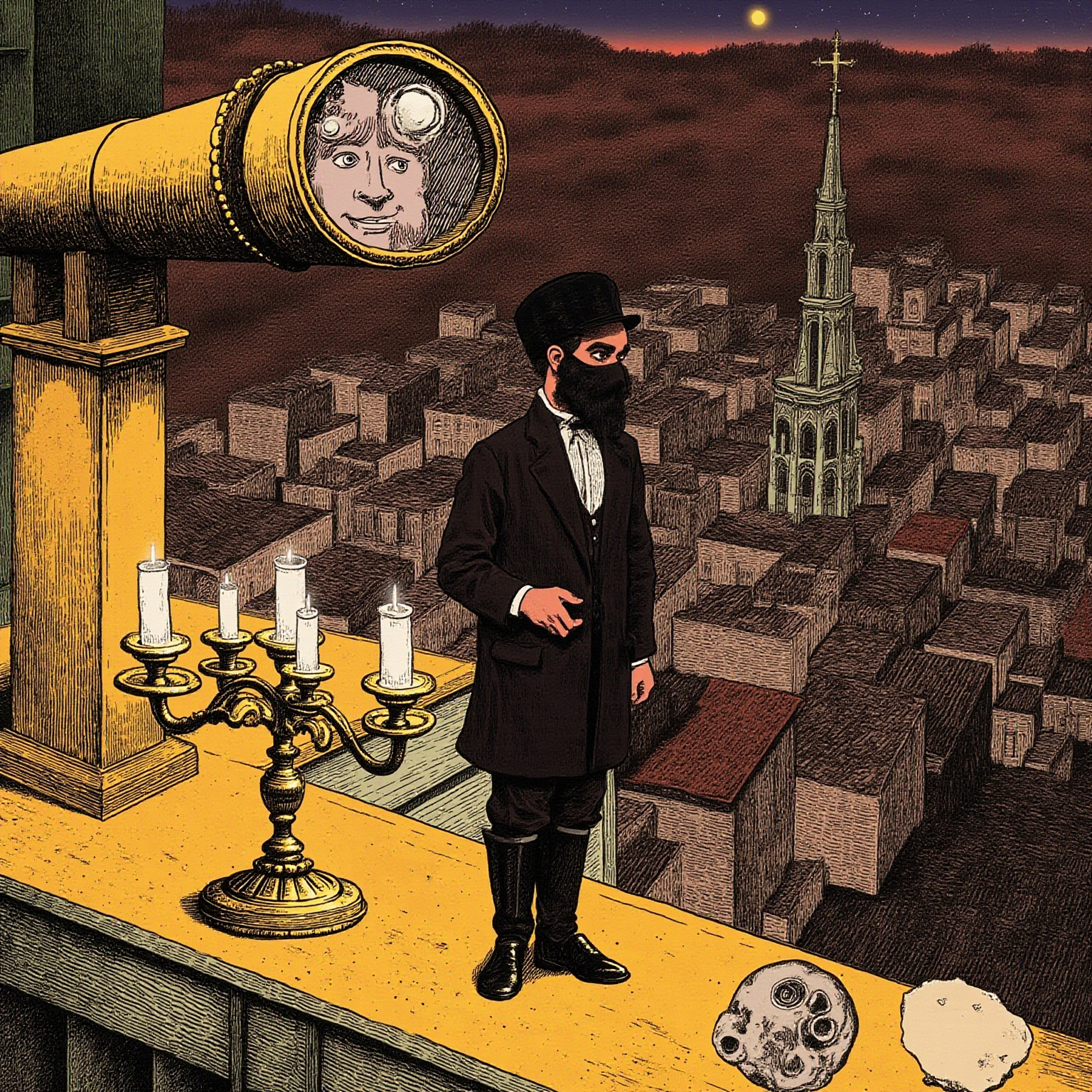
A terrible pair of eyes burned upon him from the tube.
那筒镜里烧出的一双眼睛,正死死盯着他。
金句 · 钟塔望远镜 · 再遇沙人
At the top, Clara turns toward the sunset and calls out, on instinct, that she hasn't yet spotted the beautiful lime tree on the rooftops across the way — and that one clear-eyed glance lands square on Nathanael's madness. He screams and throws himself from the tower, dying on the paving stones below. A passerby pulls Clara back from the tower's edge; she is unhurt.
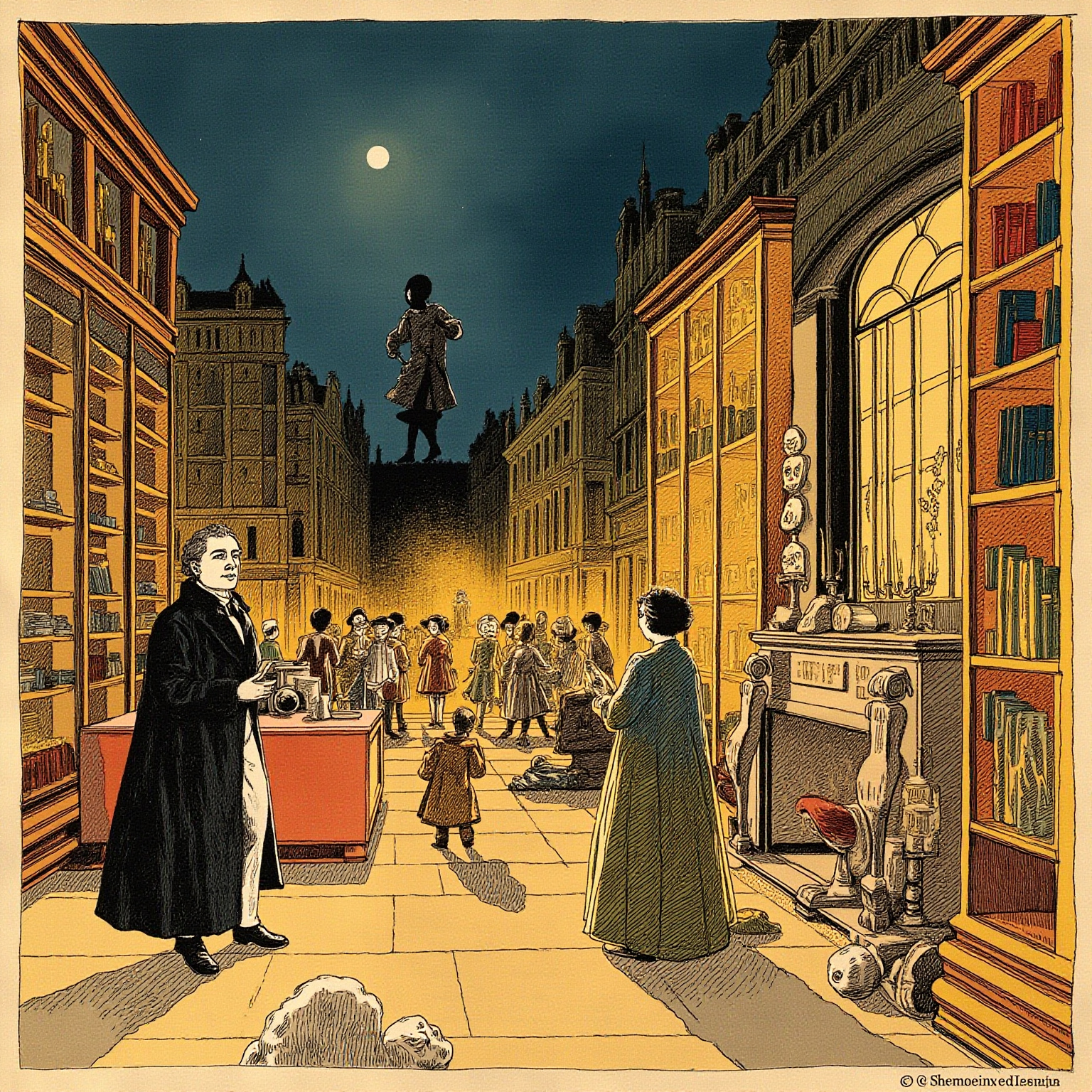
There, there, on the linden across the way, the golden evening sun still glimmers — !
那边,那边,对岸屋脊上的椴树,金色的夕照还照着呢——!
金句 · 钟塔塔缘 · 最后一道清明
The restraint here is almost cruel. Hoffmann writes no impact, no blood — only Clara standing at the tower's edge and a stranger's hand reaching out. The cause of death is Nathanael's own paranoia. Not the Sandman, not Clara pushing him, not even the automaton that undid him. What finally turns on him is that red-hot eyeball from his childhood.
What it is actually about
On the surface this is Gothic horror; underneath it, a psychological mechanism. What Hoffmann is writing is the uncanny — the thing that has no business being frightening and frightens anyway. Pupils, glass eyes, dolls, a figure that keeps recurring in different guises all belong to that category. Freud's 1919 essay The Uncanny takes this story apart almost as a textbook case. His claim is that horror doesn't come from the unfamiliar, it comes from the familiar once it has been repressed. Nathanael's Sandman is not an outsider — he is the part of Nathanael's own childhood that was never worked through.
One layer deeper, this is the tug-of-war between Enlightenment reason and childhood shadow. Clara and Lothar stand for a faith in reason; the Sandman, Coppola, and Olimpia stand for its opposite. That tug-of-war plays out inside Nathanael over and over, and it decides how the story ends. And the Olimpia thread pulls the modern anxiety over whether a doll or a machine counts as a person all the way back to 1816. Hoffmann isn't writing farce — he's writing a real psychological state. You can genuinely fall in love with something that never responds to you, because your own projection is doing more work than any response ever could.
Hoffmann's cruelest move: he makes the reader hear the machine's Ah as a lover's word right alongside Nathanael, and neither of you knows you've been fooled until the truth lands.
Why the original text is worth reading
A guide gives you the map; the text is the ground. A map can tell you where the cliff is, but you only feel the wind at its edge by standing there. The real texture of this book lives in Hoffmann's sentences — those long nineteenth-century German constructions that wind until you're dizzy and land with a precision that raises the hair on your arms. Take the paranoid letter Nathanael writes to Clara: a summary tells you he's losing his mind, but the original shows you that he himself has no idea he's losing it — and that particular blindness, the character not knowing what the reader can see, is something a retelling can never hand you. Or take the line Clara calls out at the end about the lime tree — a summary tells you she turns to look at the sunset, but in the original that turn has a sound to it, a breath, one specific tree. She is genuinely happy in that instant, and it's that happiness that ends up saving her.
There is also the restraint of the bell-tower scene, shot from a distance — Hoffmann's whole account of the fall lands on the paving stones, four words that carry more weight than any blood-soaked description could. That physical charge in the prose is something you can only feel in the original.
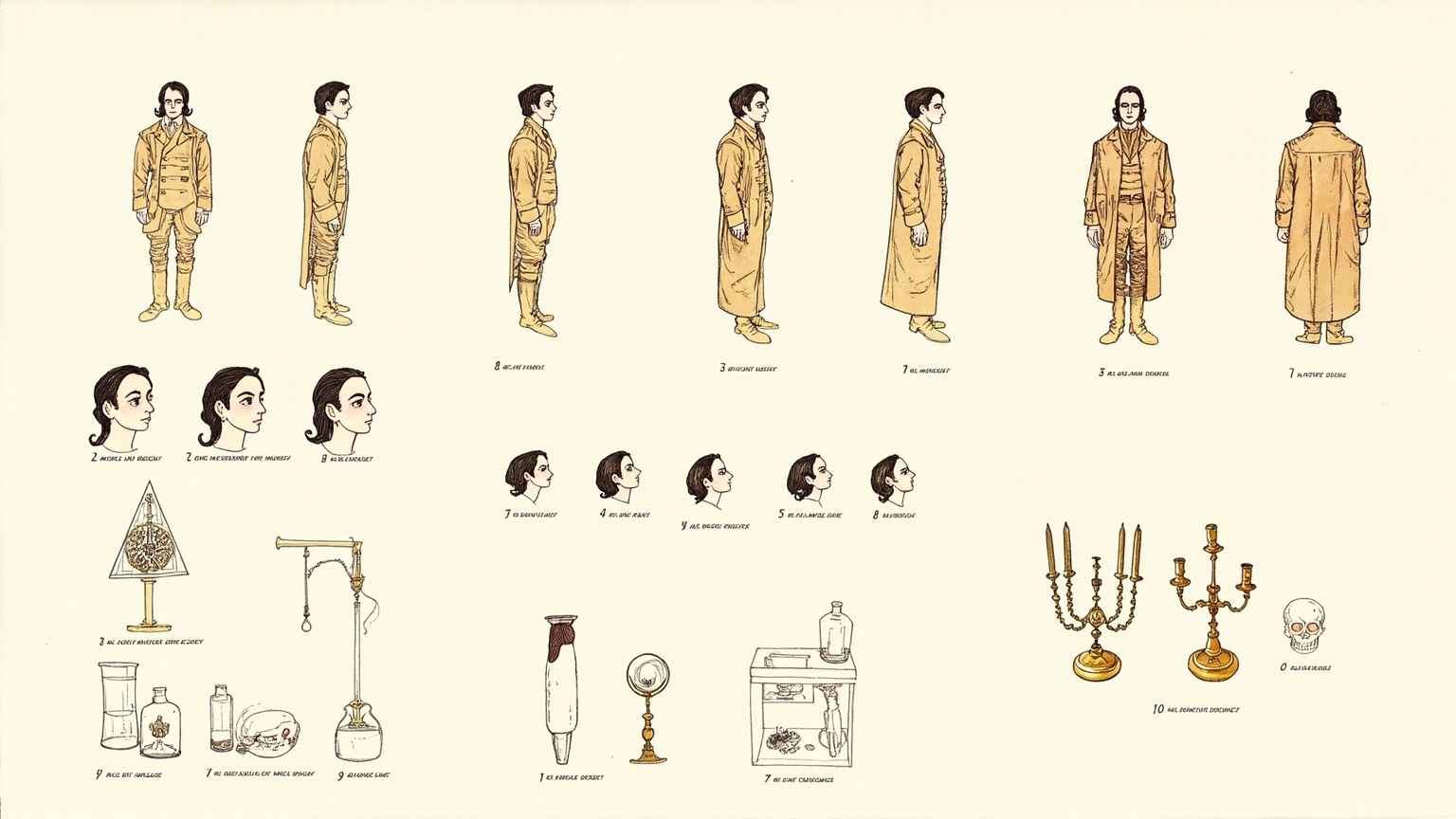
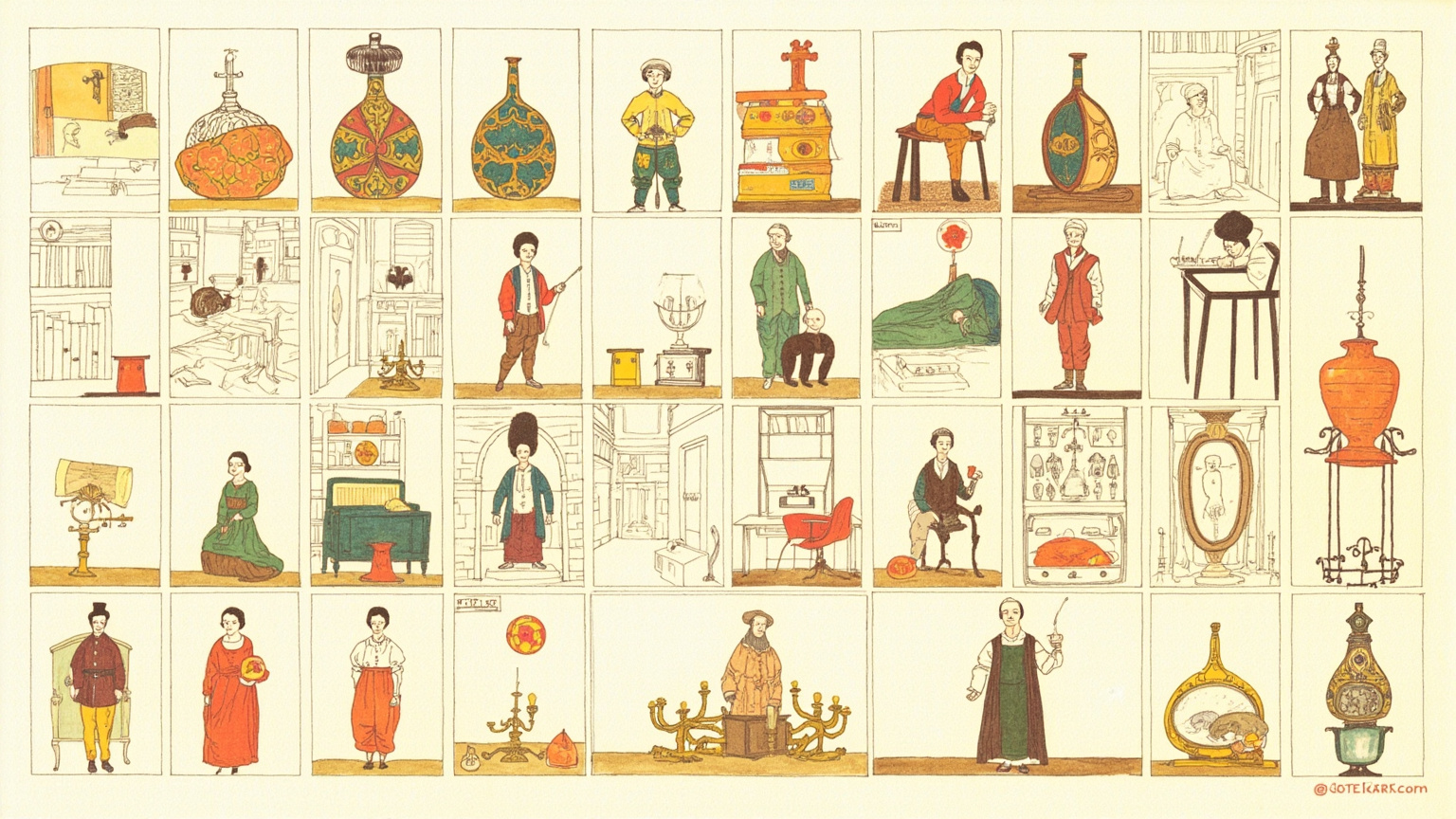
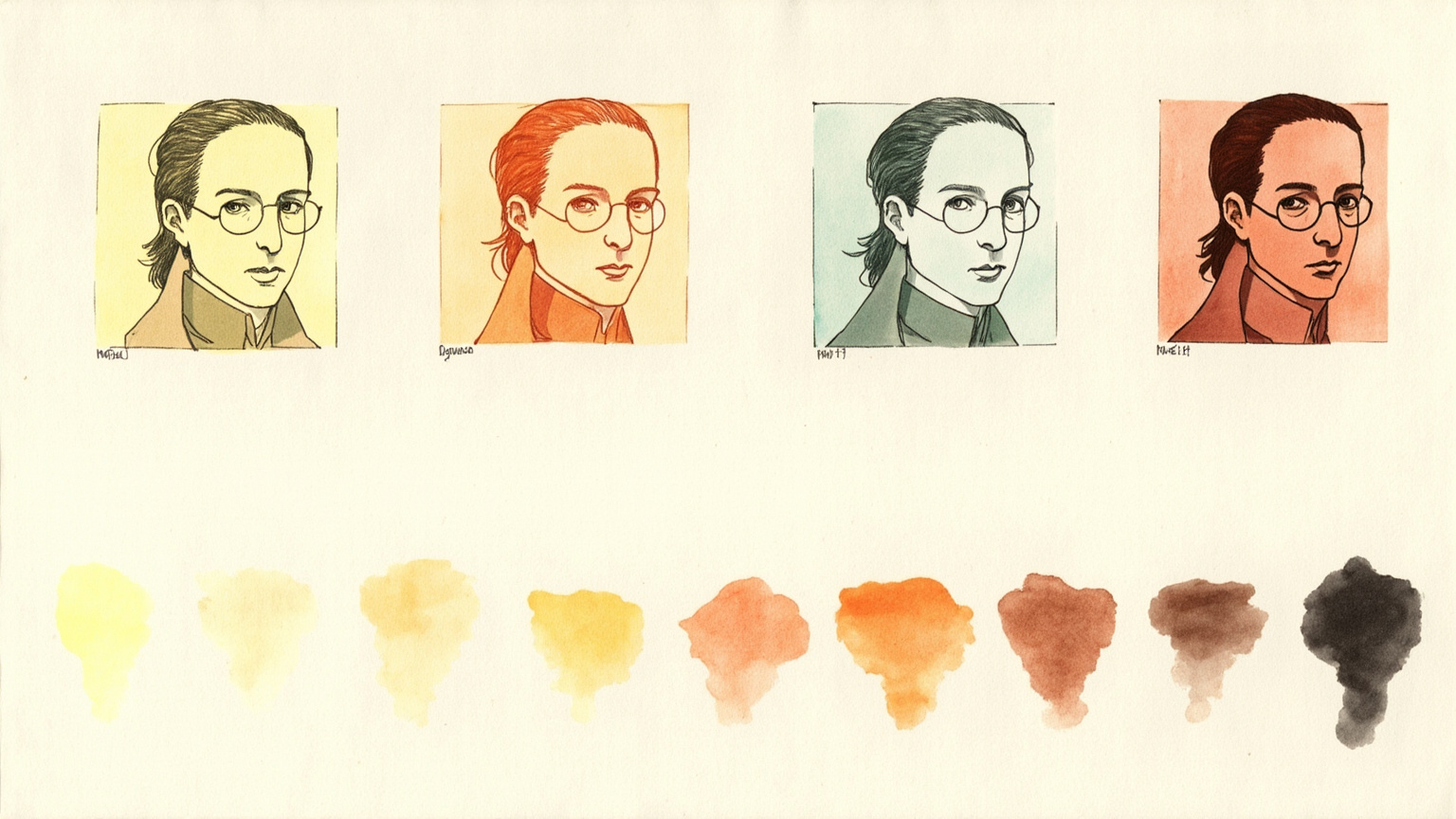
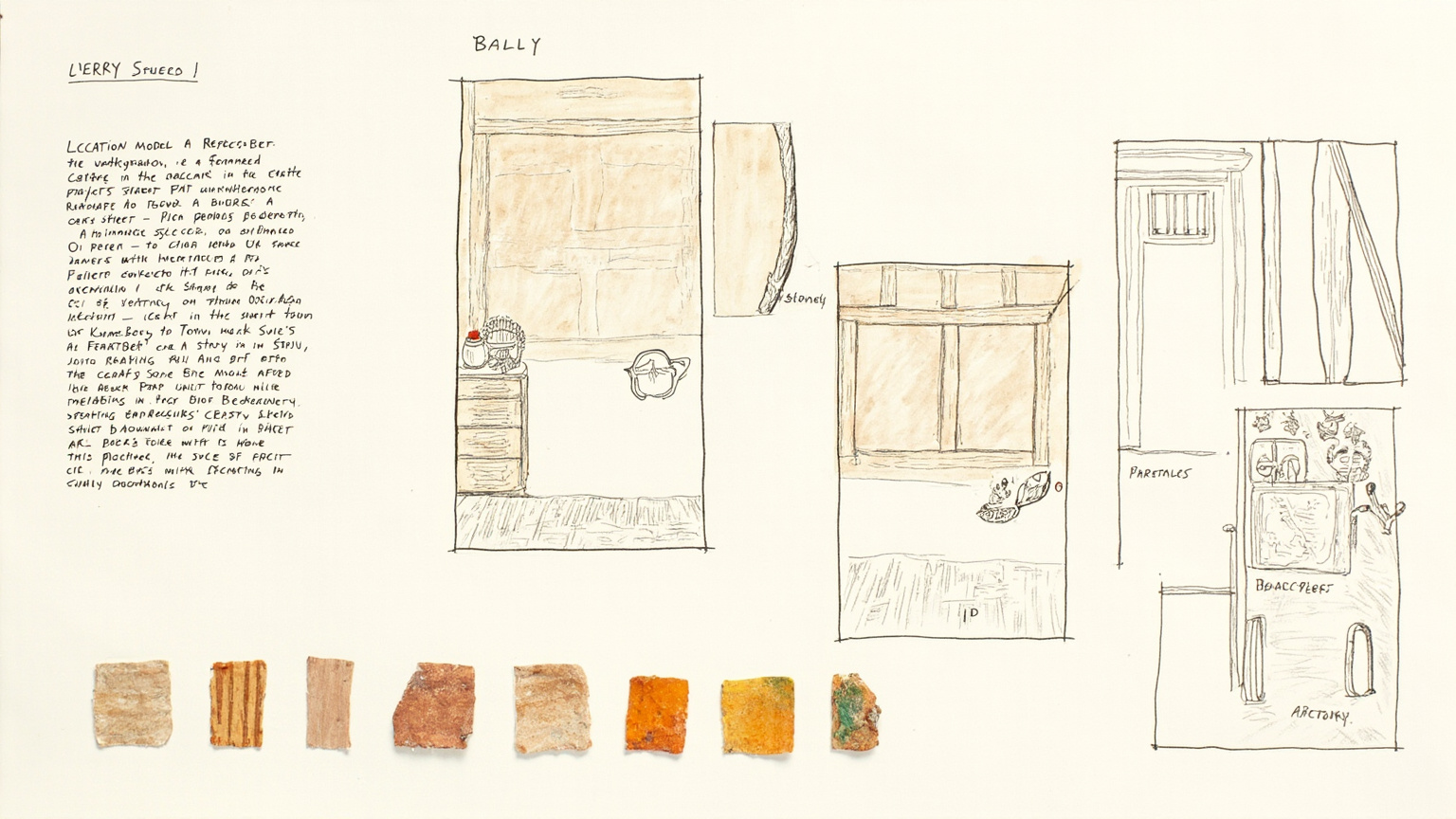
Art Direction4 plates
Before the guide was written, this book got a visual foundation — every illustration you just read grew out of it.