
The Secret History of the Mongols (Mongqol-un ni'uča tobči'an / 忙豁仑·纽察·脱卜察安) · Companion Guide
蒙古秘史
一个孤儿在斡难河边的寒风里,被命运推到草原之巅——苍狼白鹿的子孙,如何把离散揉成帝国。
The Hook
A wool cart rolls through the Tayichiud camp in the dark. Nine-year-old Temüjin crouches inside, gasping for breath among the fleece, while Sorkan-Shira and Jelme's father have stuffed him in and now play the part of ordinary cart drivers to fool the mounted search party. The boy has just killed his own half-brother Begter with his own hands, and now his clan has cast him out and his enemies are hunting him down — yet he survives. Ten years later he will sit on a rise of earth at the source of the Onon River and be raised up by every chieftain on the steppe as Genghis Khan. This is where The Secret History of the Mongols begins.
What Kind of Book Is This
The Secret History of the Mongols was written in the mid-thirteenth century by a group of court scribes and oral narrators at the Mongol court, fluent in Mongolian, Chinese, and Uyghur script, and it records the entire life of Genghis Khan, Temüjin, from birth to death. Its composition can be dated to around 1240 at the latest, decades before Marco Polo ever reached China, and it remains the only first-hand chronicle of Genghis Khan ever written by Mongols themselves. The book originally circulated only inside the Mongol royal household, closed to outsiders, which is where the name Secret History comes from. The earliest complete text that survives is a transliteration made in 1382, early in the Ming dynasty, by the official Huoyuanjie: Mongolian read aloud and spelled out character by character in Chinese, with a Chinese translation running alongside. Even today, there is almost no book for a general Chinese readership that walks through this text from beginning to end.
What makes it unusual is that it stitches two different things together. One layer is origin myth — a grey wolf and a white doe crossing the sea to found the line, Alan Gua teaching her sons the lesson of the five arrows, a shaft of light in a golden tent fathering Qasar. The other is hard political and military record: in such a year, on such a river, a battle against such a tribe, so-and-so made commander of a thousand households, so-and-so granted so many subjects. It is epic and dynastic archive at once. Modern Mongolia marks the date of its composition as one of the country's national holidays, which tells you how much weight it still carries in the Mongol imagination.
People and World
Our protagonist, Temüjin, was born in the early 1160s on the Mongolian steppe by the Onon River. His father, Yesügei, was a chief of the Kiyat clan. When Temüjin was nine, the Tatars poisoned his father, who died within three days. From then on he was left by the Onon River with his mother Hoelun and his siblings Qasar, Begter, and Qada'an, surviving on dug-up roots and scavenged bones. Hoelun is the true architect of the book's first half: she called the family's abandoned servants back and, out of a widow and her orphaned children, forged something that could still be called a household. She is a rare figure in the nomadic world, a widowed matriarch turned political operator, and the book gives her weight through one long, unbroken speech in which she tears into Temüjin on the banks of the Onon.
Börte is Temüjin's principal wife, from the Qonggirat clan, betrothed to him by her father when she was nine. After the marriage she was abducted once by the Merkits, and Temüjin, with the Kereit's Ong Khan and the Jadaran's Jamukha as allies, won her back; his eldest son, Jochi, was born in camp not long after her return. Jamukha was Temüjin's earliest anda, his sworn brother — the two lived and ate together year after year as boys, before a dispute over which clan their followers belonged to drove them apart for good. Ong Khan was Temüjin's overlord and adoptive father, and that bond of vassalage would itself be broken beyond repair at the battle of Qalaqaljid Sands.
The rule of this world was simple: no walls on the steppe, so whoever had the most livestock and could raise the most riders was in charge. The nökör, the sworn companion bound to his lord unto death, sat at the center of this whole structure of power. Bo'orchu, Jelme, and Khubilai were Temüjin's earliest nökör; Jelme once sucked the clotted blood from an arrow wound in Temüjin's throat, spitting out black blood three times, and later carried his unconscious lord on his back to hide out on his own family's grazing ground. Sorkan-Shira was the man who saved the boy Temüjin's life by hiding him in a wool cart to fool the Tayichiud search party. None of these men are minor characters — they are the load-bearing walls of Temüjin's empire.
The Grey Wolf, the White Doe, and Temüjin's Birth
The book opens not with a man but with a wolf. Genghis Khan's ancestors, it says, were born of a grey wolf mated to a white doe, who crossed Lake Tengis to reach this steppe — the founding image of the Mongol clans. After that comes Alan Gua's lesson of the five arrows to her sons, then Qabul Khan and Qutula Khan succeeding one another in turn, each generation stacking another layer onto the golden bloodline of the Kiyat.
The craft is worth noticing here: myth and event are stitched together. Right after Alan Gua conceives by a shaft of golden light entering her belly and gives birth, a moment the text treats as the first omen of Temüjin's bloodline, the very next passage has Yesügei leading troops against the Tatars, where he happens to capture an enemy commander named Temüjin-üge, and names his own newborn son Temüjin after him. In Mongolian, Temüjin means something close to a man fated to be strong, so the name itself is already a piece of foreshadowing. He does not become Genghis Khan and get written into legend after the fact; the bloodline narrative claims him from the moment he is born.

A grey wolf and a fallow doe, mates they were, and crossed the Tengge Sea. From them was born the lineage of the Mongols.
苍狼与白鹿相配,渡腾汲思海而来,蒙古的命脉便由此而生。
金句 · 卷一 · 苍狼白鹿起源
A Father Dead in Three Days, a Mother Rebuilds the Family
On his way back to camp from battle, Yesügei was recognized by the Tatars as an old enemy. They pretended to make peace with him and poisoned his food and drink. He made it home, but was dead within three days. His followers scattered at once — the hard law of the steppe: once the chief is gone, the small clans bound to him fly apart like startled birds. What remained was Hoelun, left with a few children and a handful of loyal old servants, pitching a few worn tents by the Onon River and living off wild onions, scavenged cattle bones, and whatever fish they could catch. Hoelun called back the servants who had abandoned them one by one, and drove off the son of an old retainer whom others had sent to try to take over her sons' inheritance. By sheer will she pieced a household that was falling apart back together.
The craft shows in the mother's rebuke. As a boy, Temüjin's conflict with his half-brother Begter came to a head — Begter had taken a lark Temüjin had shot, then taken a fish from him and Qada'an — and in the end Temüjin and Qasar killed Begter by the Onon River. His mother Hoelun's reproach is one of the heaviest scenes of maternal instruction in the whole book: she describes her own labor in the dead of night, digging roots and gathering bones along the Onon, raising these children mouthful by mouthful, and as she speaks, the text puts her wet eyes and the quiver still hanging at her son's waist in the same frame. The whole passage is written with remarkable restraint, no blood, no chase, no brawling brothers — just a mother standing by the river, the quiver still on her son's hip, a few sentences driving every humiliation and every duty of his boyhood straight into his bones.

Take one arrow and snap it. Now take five arrows bound together — break them if you can.
你取一枝箭来,试着折断它;再取五枝来,束在一起,看你折得动么?
金句 · 卷二 · 阿兰豁阿五箭之训
The Wool Cart, the Stolen Wife, and a Broken Blood-Brotherhood
The killing of Begter was barely behind him before the Tayichiud came hunting Temüjin again. The boy fled into the forest, where Sorkan-Shira and his son Jelme hid him in a wool cart, Jelme's father posing as an ordinary carter to fool the mounted search party, in the most vivid piece of pure escape writing in the whole book. Once he was safe, Temüjin faced another humiliation: not long after his marriage, his wife Börte was carried off in the night by the Merkits, his old enemies. Temüjin appealed for help to the Kereit's Ong Khan and the Jadaran's Jamukha, and the three of them together won her back. His eldest son, Jochi, was born in camp soon after — a child whose nominal paternity got pinned, in steppe politics, on Jamukha, and became a slow-burning source of mutual suspicion between the brothers for years afterward.
After winning his wife back, Temüjin went to join his boyhood friend Jamukha. The two lived and ate together year after year, and their followers merged and grew by the day. Then one day Jamukha told Temüjin it was time the two households moved apart — those who lived by the mountains and herded horses, and those who lived by the water and herded sheep, could not camp together — the standard steppe signal that a blood-brotherhood is over. Temüjin struck his tents that same night. The two later faced each other at the Battle of the Thirteen Wings, where Temüjin lost, yet more of Jamukha's followers were drawn to Temüjin's side by the way he carried himself afterward. The author writes this defeat as the real turning point in Temüjin's rise.

Let those who would camp by the mountains pitch their tents apart from those who would water their flocks by the river.
依山住的、牧马的,与依水住的、牧羊的,原是合不到一处。
金句 · 卷六 · 与札木合分营
Qalaqaljid Sands: The Kereit Destroyed, an Old Lord Undone
After the break with Jamukha, Temüjin took the Kereit's Ong Khan as his adoptive father. The trouble was Ong Khan's son Senggum, who was turned against Temüjin by the slander of a woman referred to as his wife, Alahei Zha'er, and further stirred up by Jamukha, until father and son finally decided to move against him. In the spring of the early thirteenth century, the combined forces of Jamukha and Ong Khan surrounded Temüjin's camp near Mau-Ündür, at Qalaqaljid Sands. Temüjin's forces were badly outnumbered and nearly wiped out in the battle; he survived only because Jelme carried his wounded lord through the chaos to hide out on his own family's grazing ground.
This is the tightest-paced section in the whole book, almost no lyricism, just marching, deployment, breakout, rout. But after the disaster, the author cuts to a strikingly cool turn: Temüjin withdraws to hide by the muddy waters of Baljuna, wringing out what is barely more than bloodied water to give his horses to drink. Once he has regrouped, he strikes back with a night raid and meets Ong Khan again at Qalaqaljid Sands. This time Ong Khan is routed, fleeing with only a handful of riders into Naiman territory, where he dies. The Kereit, once the largest tribe on the steppe, belong to Temüjin from this point on.

They watered their horses with the brown flood of the Banchu River, and from that mud their resolve was born again.
班朱泥河的浊水,他们饮了马;正是那泥水般的日子,养出了反手的刀锋。
金句 · 卷八 · 合兰真沙陀夜袭
The Naiman Campaign and the Raising of the Nine-Legged White Banner
With the Kereit gone, one rival remained on the steppe: the Naiman. The Naiman's Tayang Khan held the southern slopes of the Altai Mountains and had given refuge to the fugitive Jamukha. Temüjin marched his army across the desert and struck the Naiman from behind in a surprise attack at the Khangai Mountains, and the author writes this campaign remarkably sparingly. Before the battle: a brief reading of the sky, a war council, Jamukha's contemptuous advice to Tayang Khan. During the battle: Tayang Khan takes an arrow and dies, his forces broken. After the battle: Jamukha is bound and handed over by the very followers he once sheltered, and Temüjin grants him a death without shedding blood.
Then comes the close of the first decade of the thirteenth century. At the source of the Onon River, the place where he was born, Temüjin gathers a kuriltai of every chief, great and small, on the steppe, and is raised up as Genghis Khan, meaning something like ruler of all under heaven. The nine-legged white banner is planted high, and for the first time in the book the narrator calls Temüjin by the name Genghis Khan. Rewards go out at the same time: Muqali, Bo'orchu, Jelme, and Khubilai are named the Four Heroes, and the whole system of the Four Dogs and the commanders of thousands and hundreds is put in place in one stroke. This is not the victory of one battle. It is the source code of a new order on the steppe.

Upon the head of the Onon they raised the nine-tail white standard, and all the peoples of the felt-walled tents gave him the title of Chinggis Khan.
斡难河源,九脚白旄纛高高竖起;毡帐万帐的百姓,齐上他成吉思汗的尊号。
金句 · 卷九 · 树九脚白旄纛
After the Founding: Western Campaigns, the Fall of Jin, and a Deathbed Charge
The story after the founding is told colder and faster than the first half. The remaining Naiman are destroyed, the Merkit are campaigned against, the Tatars are put down — a single line, blood must always be repaid on the Tatar clans, folds generations of grievance and several wars into one breath. From the second decade of the thirteenth century the wars against the Jin dynasty begin, and within a few years the Jin capital falls; from the third decade, the western campaign against Khwarazm takes Samarkand and Bukhara, and crosses the Amu Darya in pursuit of Jalal al-Din. This section reads as if the camera has pulled back: the battles are still there, but the people have become silhouettes, and Temüjin himself has become Genghis Khan.
The ending lands on the last year of his life. In the late 1220s, Genghis Khan dies at the foot of the Liupan Mountains, in Qingshui county, during the campaign against Western Xia. The histories disagree on the cause: the older account says illness, another says a fall from his horse that proved fatal. On his deathbed he dictates the strategy for finishing off the Jin, borrow passage through Song territory, since Song and Jin are old enemies, and once Jin falls, deal with Song, and warns his ministers never to let women run the state. He is buried in the Qi'nian valley, on the main range of Burkhan Khaldun, closing his eyes back where he was born. The book ends with a long stretch of family instruction and lament. It is the last will a ruler of the steppe left behind with his final breaths, and the real reason this book, a private set of instructions for the royal house, is called a secret history.

Borrow passage through the Song. Let the Song and the Jin spend their old hatred on each other, and when the Jin is gone, the Song shall be your next horizon.
金精兵在潼关,南据连山,北限大河,不如借道于宋;宋金世仇,可坐收渔翁之利。金亡,当图宋。
金句 · 卷十二 · 临终口授灭金方略
Why It's Worth Reading
What actually makes this book compelling isn't the story of an emperor. It's the way it writes people. Hoelun's rebuke of the young Temüjin on the banks of the Onon outweighs every state ceremony that comes later; Sorkan-Shira's whole family driving a wool cart past Tayichiud riders is the highest register of common courage the steppe world has to offer; Jelme sucking the arrow blood from Temüjin's throat and spitting three pools of black blood onto the ground is what loyalty actually looks like, down to the last detail. These people are not supporting characters. They are the spine of the book. Next to the bronze-statue Genghis Khan that later official histories built, the Temüjin of The Secret History is far more flesh, far more blood, far more alone.
And it doesn't read like any of the Chinese official histories we're used to. Its narrative moves at the density of a television storyboard, one action after another, almost never pausing to reflect, yet every moment it does pause lands exactly where it matters. This chant-like form, prose interrupted by verse, verse folding in ritual incantation, is a fossil of the thirteenth-century Mongol court's oral tradition. It reads easier than most classical Chinese texts, because the rhythm carries you; but it is denser than most classical Chinese texts, because it holds nothing back. A single word, a single line, and that's someone's entire fate.
Knowing the plot before you read only makes it more worth reading, because what The Secret History gives you isn't a story. It's the echo that story left hanging over the steppe when it was first told aloud.
About Reading the Text Itself
What a companion guide gives you is a map. What the text itself gives you is the smell of that grassland, the speed of the wind, the light of a dung fire inside a felt tent. What can't be paraphrased is how light this book's touch is when it writes a person: a boy falling from his horse, a mother standing by the river glaring down her ungrateful son, a nökör wading a river waist-deep with his lord on his back. In The Secret History these are each thrown off in a single line, and yet the instant you read that line, you see the whole picture in front of you. The plot is fixed. What that picture looks like belongs only to whoever opens the book.
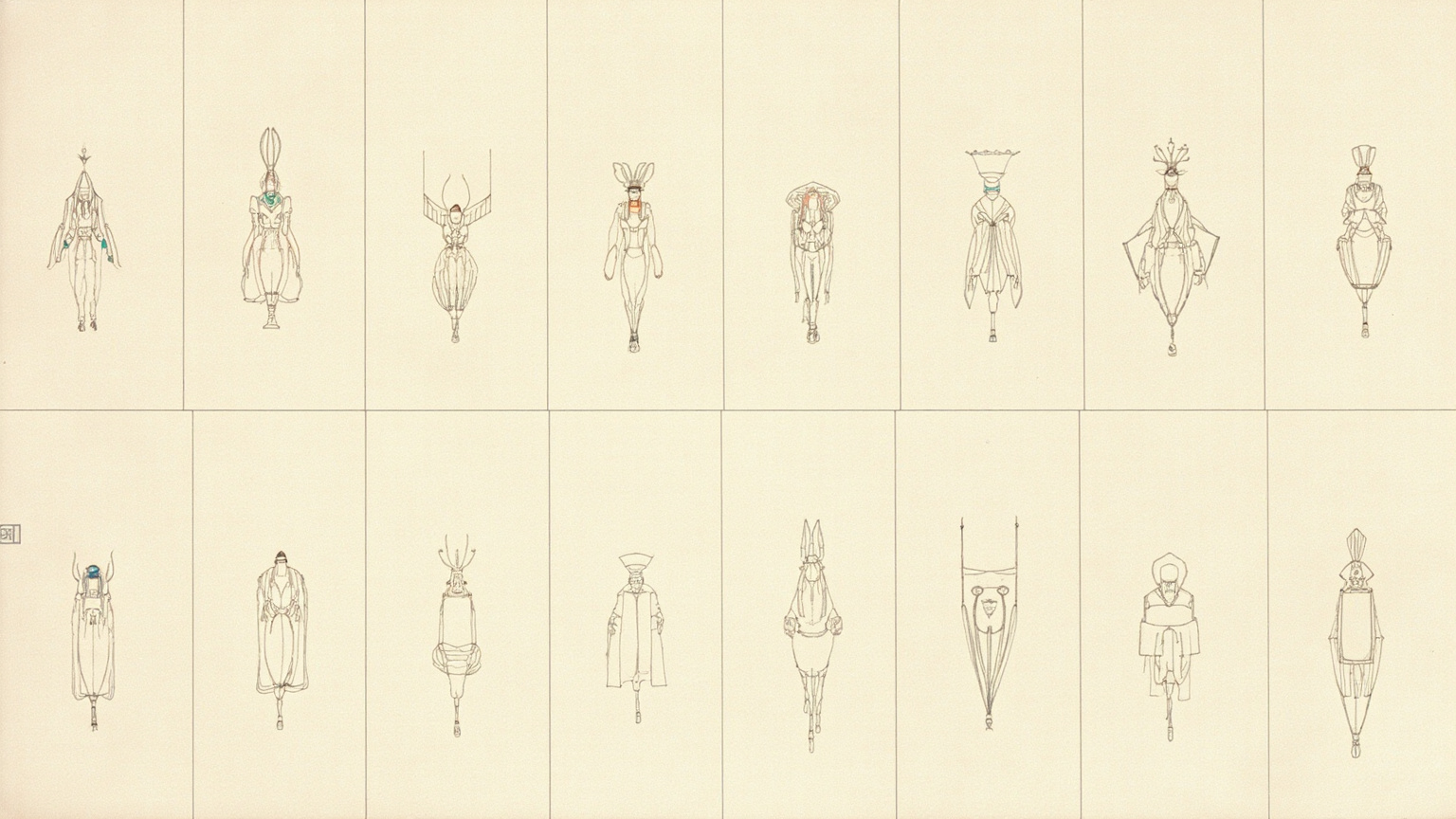
Art Direction4 plates
Before the guide was written, this book got a visual foundation — every illustration you just read grew out of it.