The Tale of Igor's Campaign (Slovo o polku Igoreve) · Companion Guide
伊戈尔远征记
一首写给败仗与被俘之公的古罗斯英雄诗——失败者活着归来,才是它真正要颂的胜利。
Opening: A War-Horse Crosses the Don
The Don was still rising. A column of horsemen waded across from the north bank, hooves churning the river to foam, and Prince Igor rode at their head. He turned back only to say: live or die. Behind him he had nothing but his own retinue, his brother, and a few nephews. No help was coming, and no one even knew. It was a lone campaign one spring more than a thousand years ago, an expedition almost no one would ride out to save. This is where the poem begins.
What Kind of Book Is This
The Tale of Igor's Campaign, in the original Old East Slavic Slovo o polku Igoreve, literally The Song of Igor's Host. The author is unknown, and the poem was written in the late 1180s, more than eight hundred years ago. It is short, the surviving manuscript was thin, but it stands as the East Slavic world's own Song of Roland. Other peoples had their French knights and their Germanic heroes; this one old epic tradition kept, for centuries, only this single copy. It is remembered first because it fills the East Slavic gap that had long sat empty on the map of medieval European epic, and second because it does something almost no other epic is willing to do: it treats a defeat as a story worth telling.
The Cast: A Prince, a Wife, an Old Man
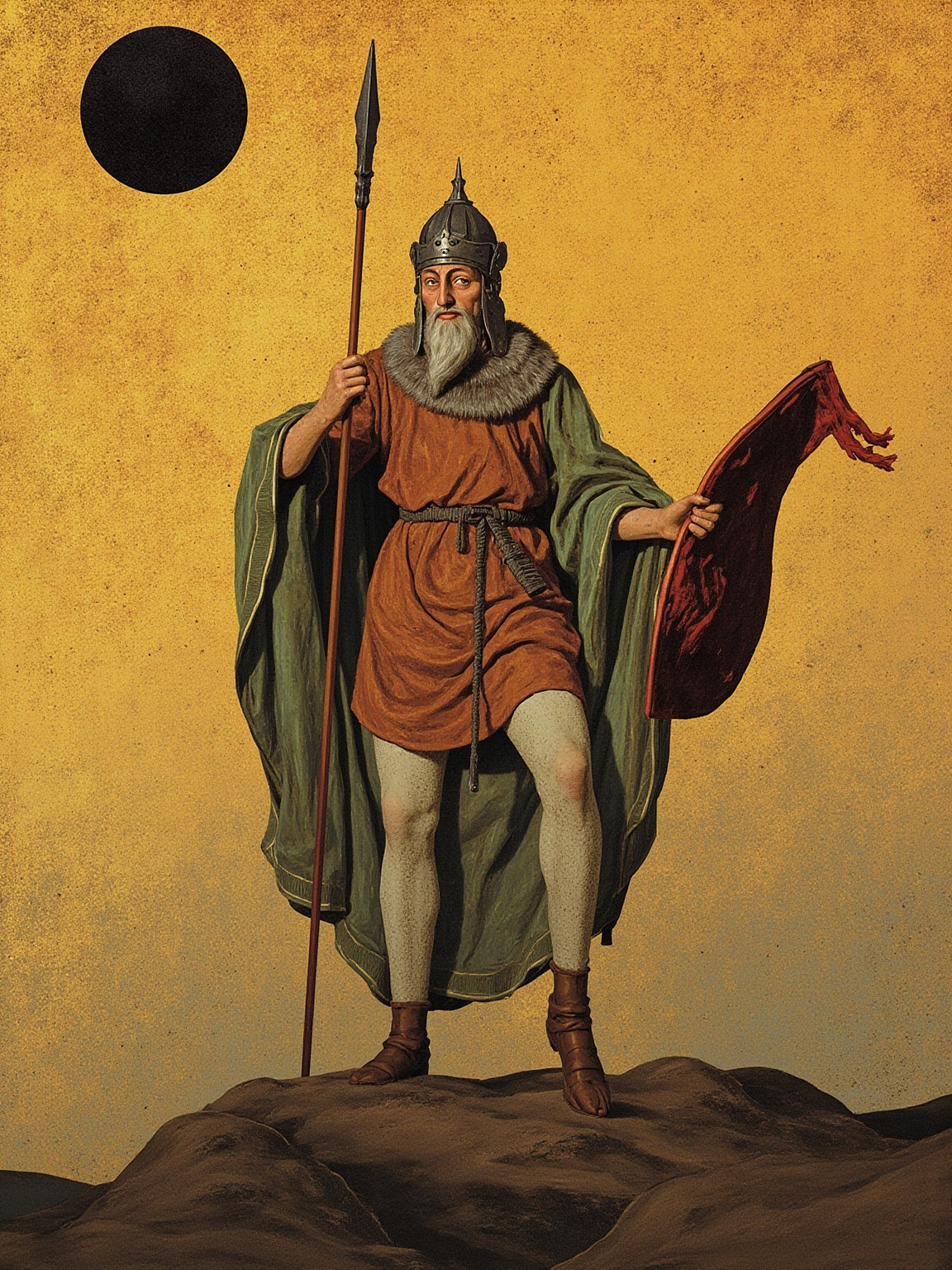
The protagonist is Igor, Prince of Novgorod-Seversk, a middling figure among the Rus princes, neither the Grand Prince of Kiev nor a power in the south. The title never calls him a king; it calls the thing itself a campaign, and its full form, The Song of Igor's Host, does not even use the word knyaz, prince. That restraint is the poem's whole stance. Igor's mistake was never cowardice. It was going it alone: no council with the other princes, no combined force, just a straight ride into the Polovtsian steppe, the land of the Cumans.
His wife Yaroslavna, waiting in the fortress at Putivl, gives the poem its brightest passage. Yaroslavna is not really her name, only her patronymic; she was born into the house of Yaroslav of Galich. She is no bystander. She is the go-between: the wind carries him off to war, the sun scorches his helmet, the Dnieper sweeps him into the enemy camp. She stands on the city wall and weeps at all three. This is where the whole line of Russian lyric poetry begins.
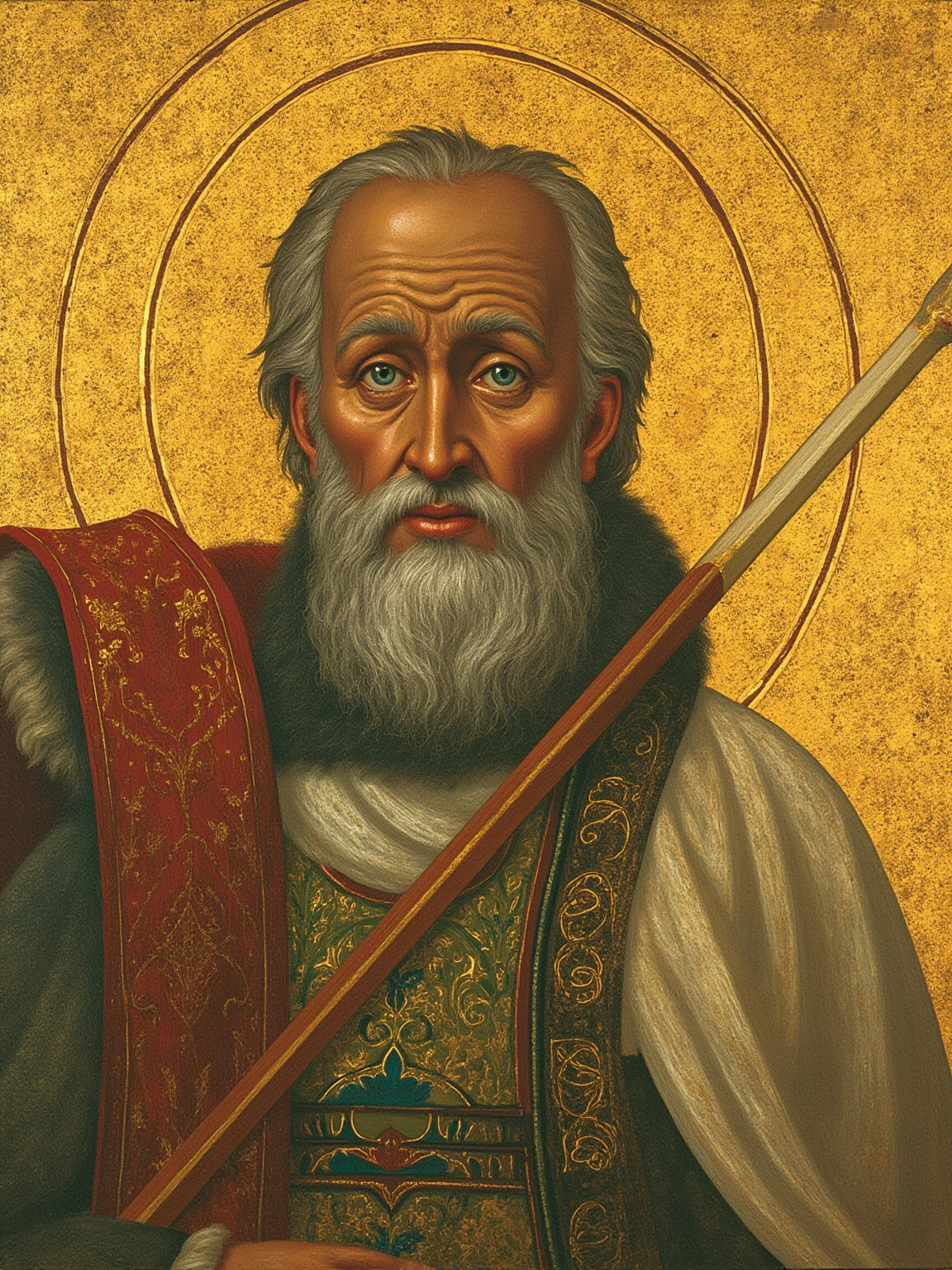
The omens of heaven rebuke the prince, and no one knows whether life or death awaits.
天象以不吉警告王公,无人知晓等待他的将是生,还是死。
金句 · 开篇 · 基辅金顶之梦
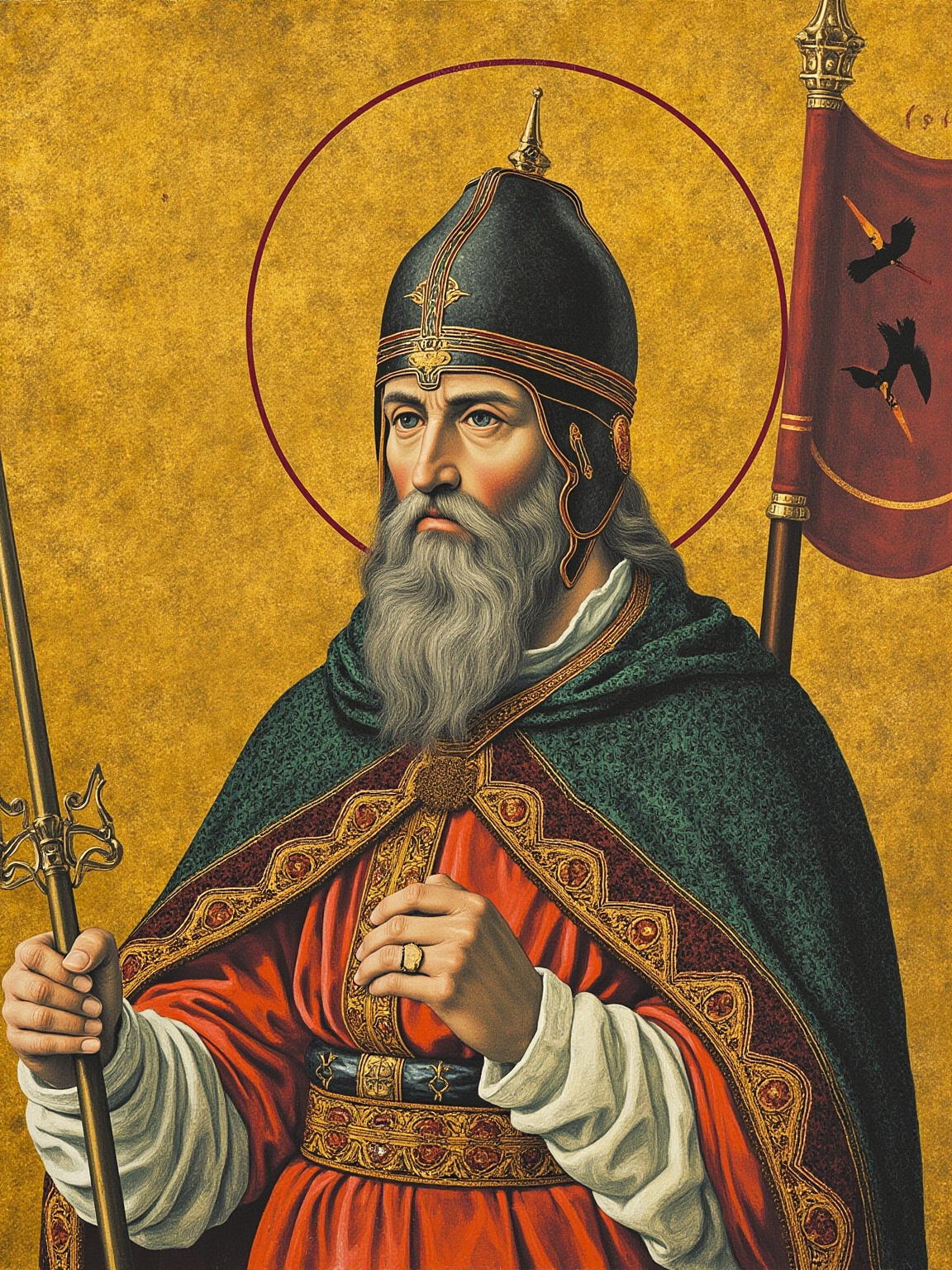
Grand Prince Svyatoslav of Kiev is the poem's paternal voice. He never rides to war. He dreams, in his palace in Kiev, of his own gold-roofed halls on fire, of floodwater pouring back through St. Sophia Cathedral, and wakes to news that Igor's whole army is gone. The speech he gives afterward, later known as his golden word, is the real political heart of the poem.
Before the March: An Ill Dream Under Kiev's Gold Roofs
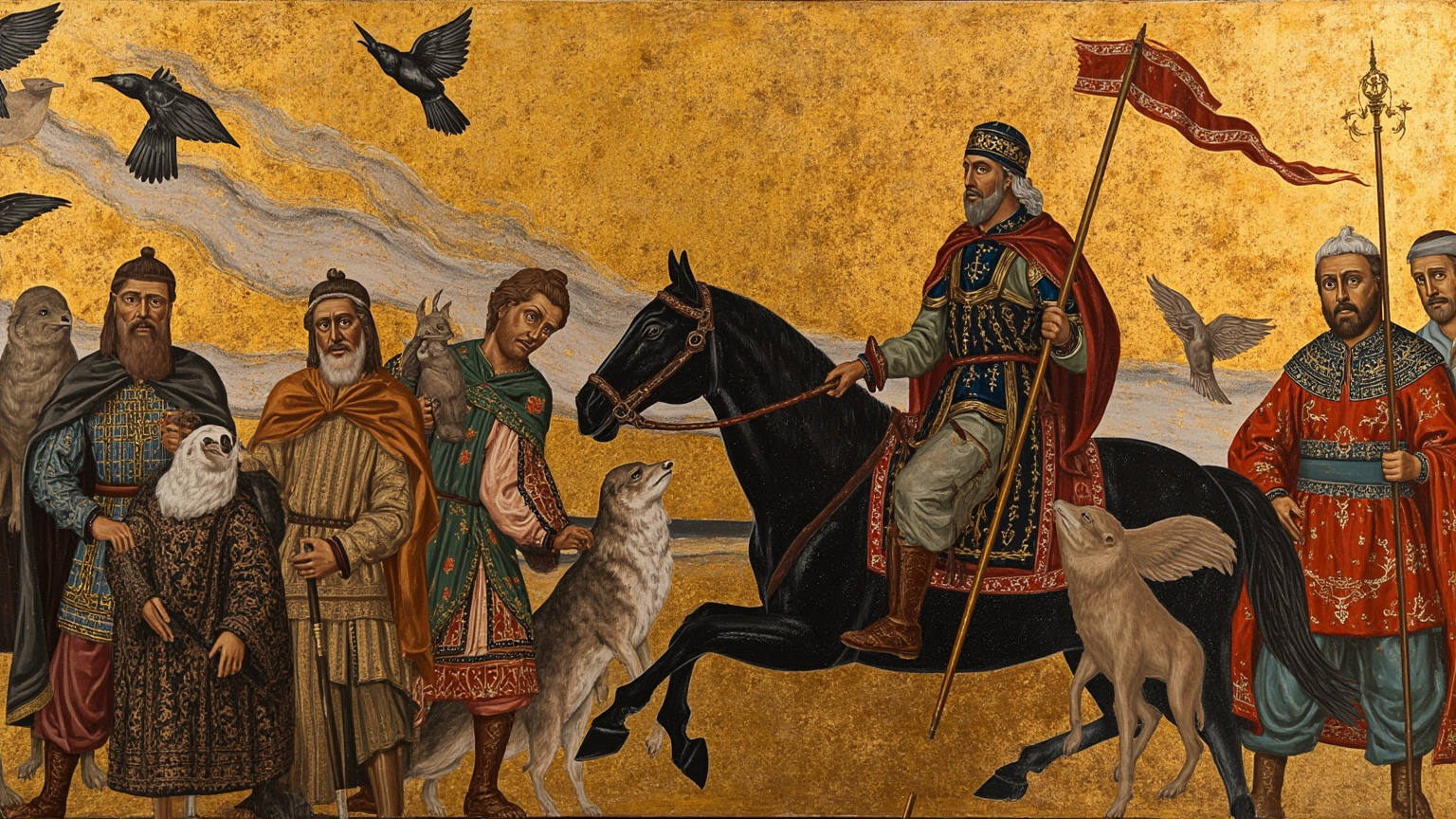
The poem doesn't open with a horn call. It opens with an omen. The poet borrows the voice of an even older bard, Boyan, and rewinds to before the march: under the gold roofs of the capital, Kiev, holy figures appear in dreams through the night to give warning, God, the Mother of God, the saints, even specters said to rise out of the city's own dreams. Two suns appear in the sky, two moons; at midnight a black cloud settles over the city, and ravens call in flocks. As a set of ill omens, this is almost a textbook checklist for medieval heroic literature, but the poet doesn't write it like a checklist. He writes it like pressure building on the chest, one beat after another. Igor never hears any of it. The reader does, and knows from the start that he isn't coming back.
Crossing the River: A Small Force Sets Out Alone
Igor doesn't listen. He joins forces with his brother and his nephews, still no more than the size of his own retinue, and crosses the Don heading south, then the lower Dnieper, and rides straight into the Polovtsian steppe. The poet gives this stretch a long run of praise: sworn oaths from the retinue, catalogs of fine horses and armor, all the trappings of a march toward glory. But the omens have already been spoken, so every word of that glory reads as its own reversal. This is the poem at its most sardonic.
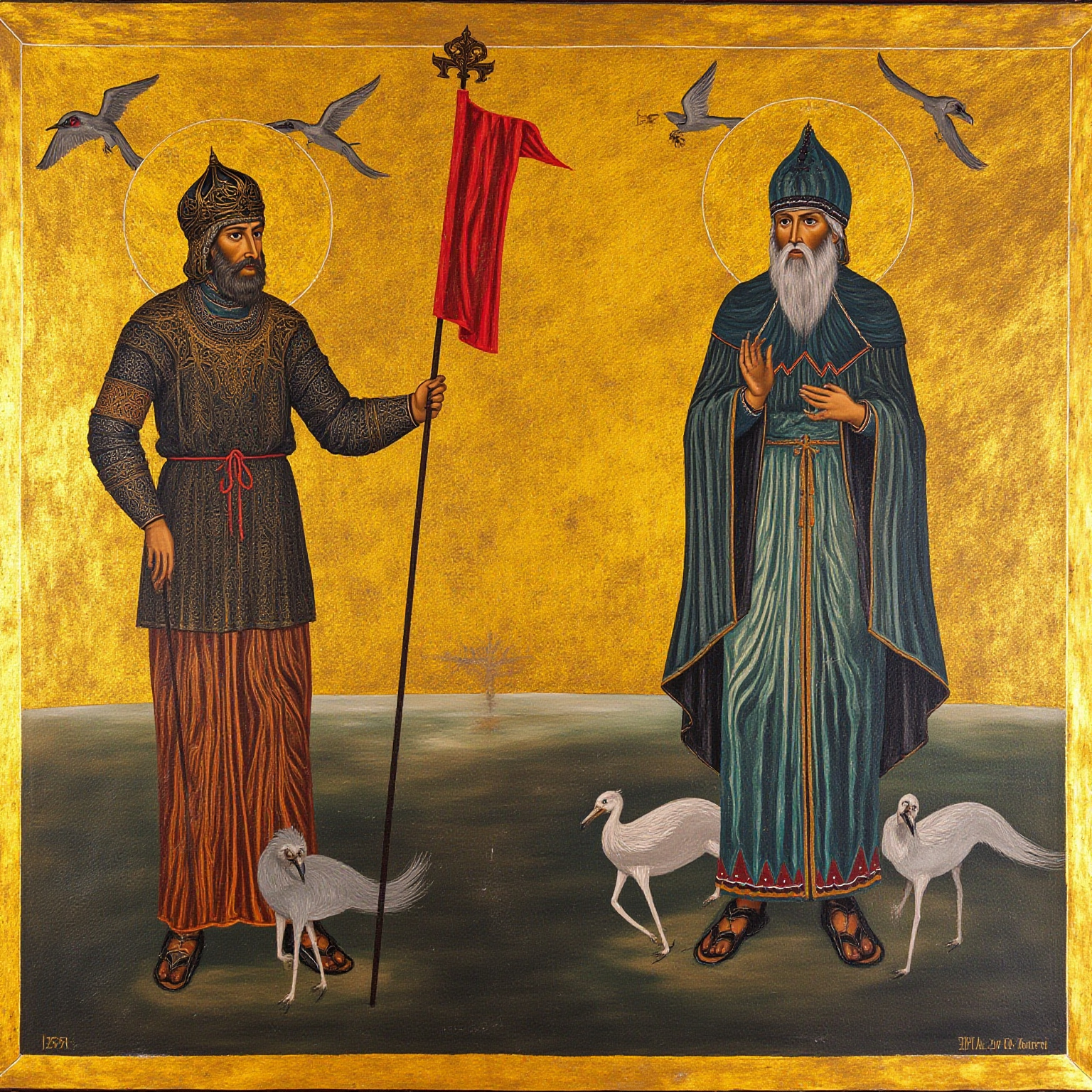
Igor rides forth, saying: I will either die, or I will live.
伊戈尔策马向前,说:我要么死,要么活。
金句 · 渡河 · 公爵的誓辞
What they meet is a joint force under the Polovtsian khans Konchak and Gzak. The poem doesn't flatten the steppe side into stock villains; they have their own camps, their wives, their horse herds, their shamans. The poet spends exactly as many lines describing them as he spends on the Rus princes. That refusal to make the enemy less than human is one of the poem's rare moments of clear sight.
On the Kayala: Defeat Made into a Subject
The decisive battle is fought on the Kayala. The Rus cavalry is wiped out, and Igor is taken prisoner. The poem doesn't skirt the defeat, and it doesn't shrink it into a minor setback. It answers with a whole stretch of dense, ominous imagery: ravens shrieking over the Kayala, hungry kites squabbling over carrion, wolves howling through the night, crows keening. To put a defeat at the center of a medieval heroic poem, and to render it at this density, breaks a real convention. Most of the world's epics are written for the winners. The Tale of Igor's Campaign refuses to be one of them.
The Lament on the Walls of Putivl
On the walls of Putivl, Yaroslavna weeps to the wind, to the Dnieper, to the sun, one after another. She isn't describing how the wind blows or the river runs or the sun burns. She is demanding an answer: why did you scatter my husband's plumes? Why did you carry him into the enemy's camp? Why did you scorch his helmet until it burned? Each of the three laments takes on one force of nature in turn, the wind that carried him off, the river that swept him away, the sun that seared him. This isn't prayer. It's a song that binds a person, the natural world, and the life or death of someone far away into a single knot. Every later Russian poem about parting, about waiting, about one person shouting at the whole world on another's behalf, traces its furthest root back to this passage.
The first time I read the line give me back his sorrow, I went back and reread the whole passage. That isn't a prayer to the gods. It's an order to heaven and earth to hand him back.
O wind, O wind! Why, O lord, dost thou blow so contrary to my husband's wings?
呜呼风啊,呜呼你啊,为甚将我夫君的羽翎吹向你的翅膀?
金句 · 普季夫尔哭诉 · 雅罗斯拉夫娜之歌
The Grand Prince's Golden Word: An Old Man Under the Gold Roofs Calls for Unity
When word of Igor's defeat reaches Kiev, Grand Prince Svyatoslav speaks under the gold roofs. He doesn't call Igor reckless. He rebukes every Rus prince at once: each of you guards his own city, fights his own war, and no one man can move the steppe alone. He measures the present against a brighter past, reaching back to an earlier Svyatoslav, a figure from generations before, who once beat the Bulgars on the Danube and struck a treaty with Byzantium. The further that glory recedes, the sharper today's fragmentation looks by comparison. This isn't a political tract dropped into a poem. The poem itself is the political argument.
The Final Turn: Fleeing Home as Ermine, Duck, and Gray Wolf
The following year, Igor escapes the Polovtsian steppe alone. The poet doesn't tell us how he talked his way out or bribed a guard. Instead he gives us Igor's own men, Ovlur and Lagon, turning into three animals to smuggle him through the grassland: an ermine bounding into the reeds, a wild duck diving into the water, a gray wolf running loose across the open steppe. The man stays in plain sight while the animals move in shadow, clearing his path, keeping him hidden. One man crossing the steppe wearing three animal shapes, this kind of animal transformation strung across a long journey is rare in medieval poetry. Reeds, grass, nightfall, hoofbeats all give way to animal paws, and these images keep coming back through later Russian poetry. This is an epic about defeat, and its final victory isn't a battle won. It's simply staying alive long enough to come home to your own people.
The Poet Calls the Roll: One Man's Defeat as a Warning to the Nation
By its close, the poem has stopped writing about Igor and turned to every Rus prince at once. The poet calls the roll: three men all named Vsevolod, Vsevolod the Big Nest of Suzdal, Vsevolod of Trubchevsk (Igor's own brother), and Vsevolod Chermny; Yaroslav of Chernigov, Yaroslavna's father; Yaroslav Osmomysl of Galicia; and the wise prince of Rostov. The poet's real skill is a technique of singing the old songs into the present and the present's deeds forward to those still to come, turning one man's specific failure into a summons to the whole of Rus. One man lost, and everyone else is being called home to stand together.
What It's Really About: An Ethics of Writing for the Losers
The poem's real subject isn't victory, and it isn't war. It's what a person actually looks like inside a defeat. On the shelf of world epic, The Song of Roland, The Nibelungenlied, The Poem of the Cid, Beowulf, nearly all of them are written for winners, or for men who died gloriously. The Tale of Igor's Campaign hands its subject to a prince who was captured and came home alive. A loser as the hero of heroic literature is a thing the medieval period almost never allows twice. What the poem wants to say isn't how brave Igor personally was. It's how much a single act of going it alone actually costs. Courage on its own can't hold a whole steppe.
Nature in this poem is never mere scenery. The solar eclipse, the ravens' cries, the roar of wind, the weeping river, all of it is omen, all of it is intermediary, all of it mourns. Yaroslavna's lament to the wind, the river, and the sun goes further still and turns nature itself into the speaker of the lyric. Bringing the world itself into the song like this is rare in medieval poetry, and her lament became an archetype that keeps echoing through later Russian verse.
Why It's Remembered: A Poem as Famous as Its Own Fate
The fate of the manuscript has become part of the poem itself. The only surviving copy burned in the Moscow fire of 1812, a fire the French brought with them, turning an eight-hundred-year-old poem to ash. For two centuries after, scholars have argued fiercely over whether it's genuine. Genuine or a later imitation, the scholars working in the late eighteenth and early nineteenth centuries had already done credible work on that manuscript before it was lost. The loss itself became a literary event in its own right: the poem survives half through its text and half through the fame of being an irreplaceable copy that can never be recovered.
Wrens whisper the glory of Svyatoslav, while Igor's tale is woven of grief and sorrow.
鹪鹩在呢喃斯维亚托斯拉夫的荣光,伊戈尔的故事,却用哀伤织成。
金句 · 终章 · 古荣与今哀之对照
Then there's the music. Alexander Borodin's opera Prince Igor premiered in 1890, and the Polovtsian Dances in its second act have become one of the loudest passages in Western classical music, a steppe encampment at night, moonlight, whips cracking, a chorus of women. The epic and the opera gloss each other: the epic gives the opera its narrative skeleton, and the opera gives the epic an independent life in another medium. They remain two separate works, but Borodin sang this defeat and homecoming on the steppe all over again, and gave the poem a second life of its own in the history of music.
This is one of the world's few heroic tales written for a loser: other epics praise the victor, this one praises the man who made it home alive.
A Hook to Read the Poem Itself: The Map Is Not the Land
What you've just read is a map, and a map is not the land. The Tale of Igor's Campaign is short, but its language, sentences that mix Old Church Slavonic with Old East Slavic, long verse lines built by stacking verbs, a rhythm generations of translators have kept polishing, survives a retelling only as an outline. You have to sit with the original, or a good translation, to feel that density where every clause is a pause and every pause is an image, to hear the breath held between Yaroslavna's three laments, to run out of air among the crowding ravens and kites on the Kayala. The adjectives a summary drops, the connectors a translator adds, the pauses an explainer flattens out: all of that you have to go back and read for yourself.
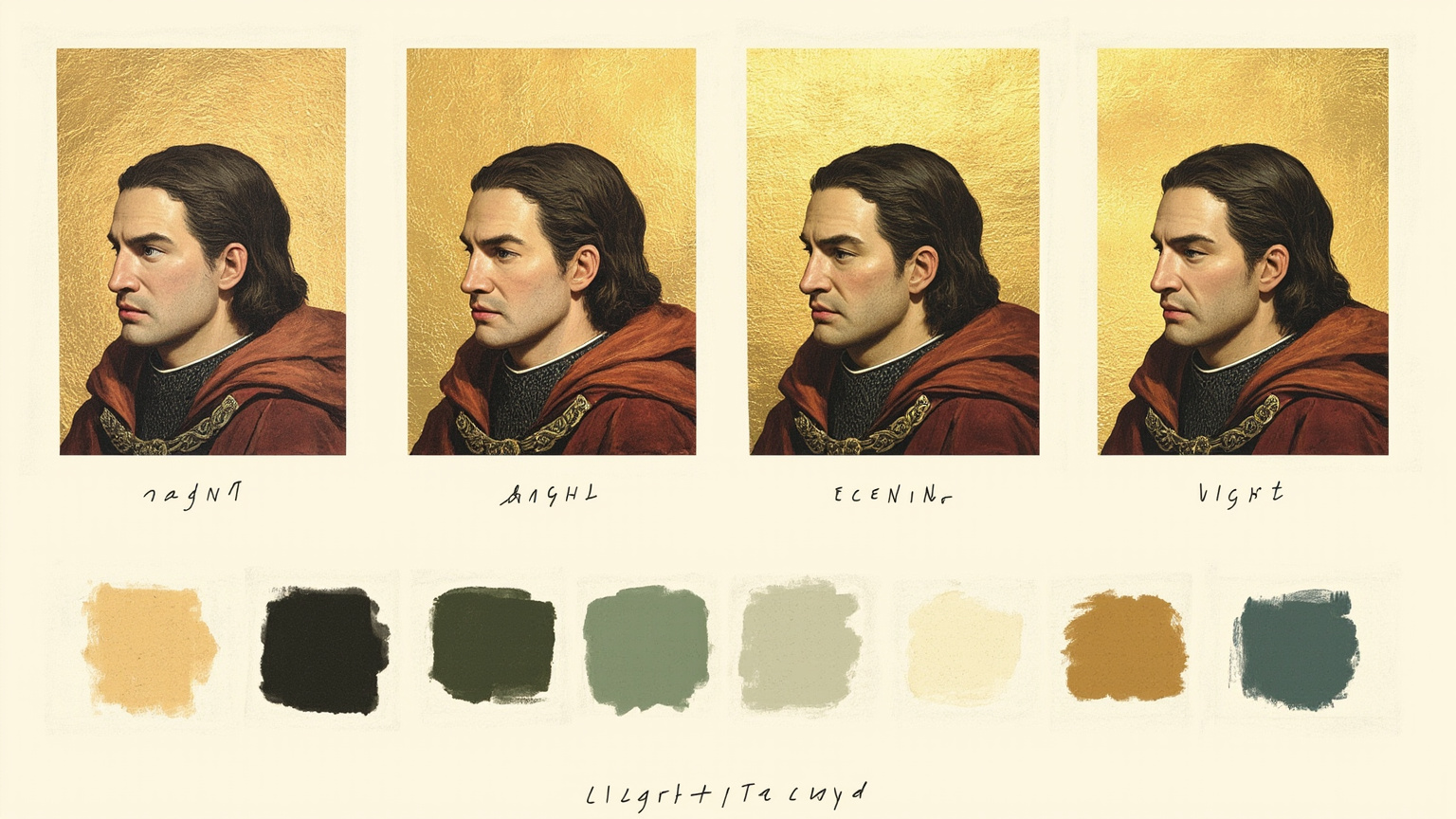
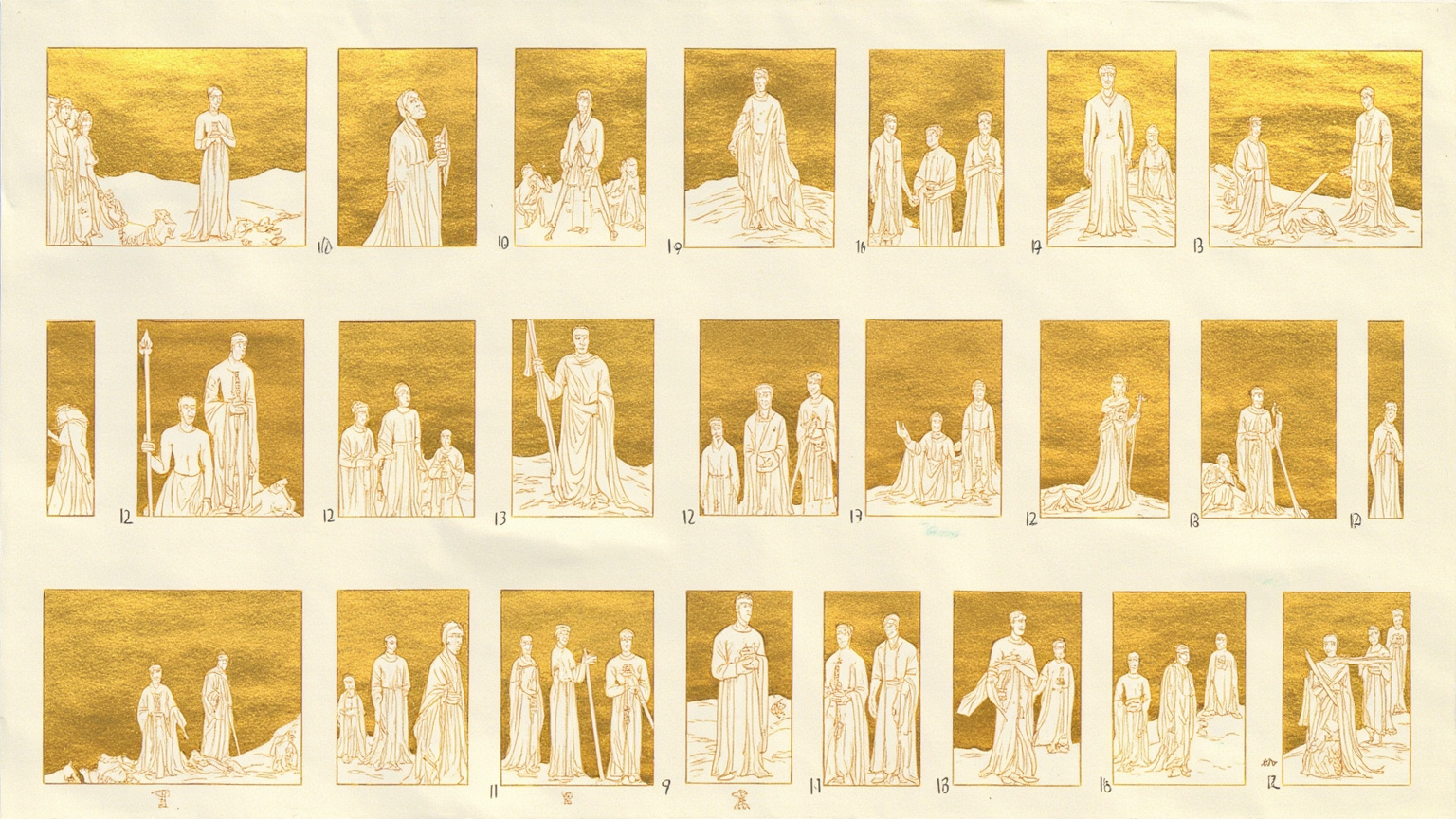
Art Direction4 plates
Before the guide was written, this book got a visual foundation — every illustration you just read grew out of it.