
The Tales of Ise (Ise monogatari) · Companion Guide
伊势物语
一名多情贵公子以和歌为刃,将每一段恋慕刻入帘后——歌成即情生,人去只余空庭月色。
Opening: The First Verse of the Night, Behind a Curtain
A curtain hangs between them. Outside it lies the garden of a noble house somewhere in Kyoto; behind it sits the younger sister of the boy next door, who has just come of age. The man does not call at the gate. At night he murmurs a verse through the curtain and asks whether she will answer. She does not show her face. She sends a verse back through the same curtain. That exchange, back and forth, is the oldest shape of what later readers would call courtship behind a curtain — before the two have ever met, the love has already taken root in verse.
What Kind of Book Is This
The Tales of Ise took shape in Heian-kyo around the middle of the tenth century, and its author is listed simply as unknown. The scholarly consensus is that most of its poems were built around verses by Ariwara no Narihira — one of the six poets later canonized as the great masters of early Heian verse, said in his day to have been strikingly handsome — and that later hands wove prose around them. It is the founding work of uta monogatari, the poem-tale: a hundred and twenty-five episodes, each turning on a single verse, with just enough prose around it to set the scene. When Murasaki Shikibu opens The Tale of Genji with the words "Once there was a man," she is reaching straight back to this book.
The Hero and His World: Who He Is, What He Wants
The hero is never given a name. From start to finish he is only "a man, once." He is tender and faithless at once — one love after another begins, and he sets each one down as gently as he picked it up. What he actually wants is hard to pin down; it is probably not any one woman but the unsettled air that hangs over a love just as it starts to form. Verse is his passport. He courts the sister behind the curtain with a verse. He pulls an old acquaintance now serving at court back into memory with a verse. Walking an East Country mountain road and finding Mount Fuji still capped with snow in the sixth month, he presses his own quiet ache into the scene with a verse. The book runs on one rule only: love, parting, the seasons passing, the man aging alongside his own songs. Nothing else gets written down.
Route One: The Kyoto Overture — Courtship Behind a Curtain
The story opens with two houses standing side by side in Kyoto. The man hears that the sister of the boy next door, who has just had his coming-of-age ceremony, is both beautiful and warm-hearted, and something in him stirs. The two never formally meet; at night they trade verses through a hanging curtain. His verse asks how anyone could bear to sleep alone on a spring night like this one. Hers, sent back, neither answers him outright nor turns him away — only softens in tone. It is the lightest touch in the whole book: no meeting, no contact, the feeling brewed entirely out of verses passed back and forth. She is later consecrated as a priestess at Kamo Shrine, and the story moves on from there.
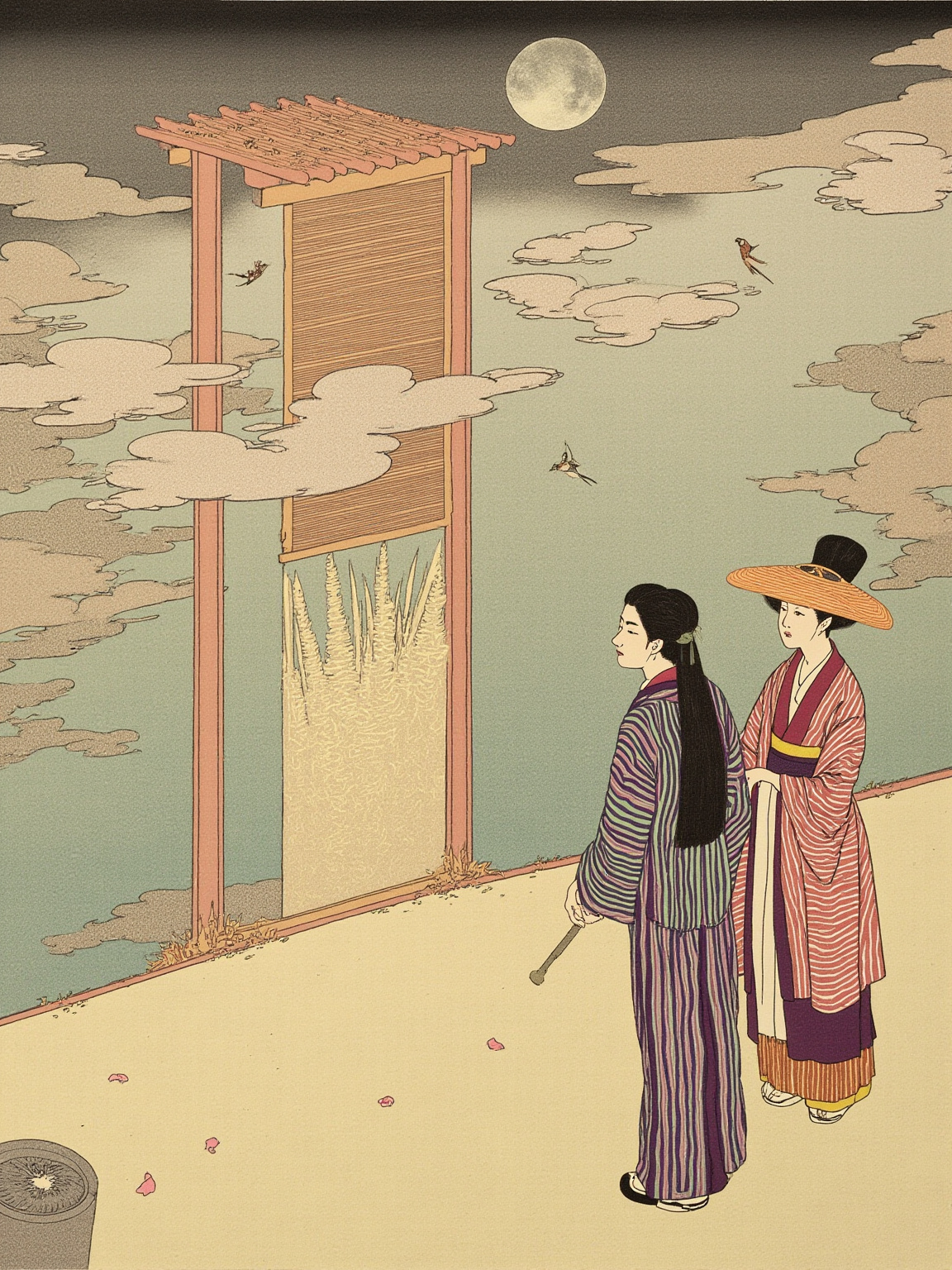
Spring night, brief as a dream—how could I bear to spend it alone?
春宵何其短暂,岂堪独自度过?
金句 · 第1段 · 帘中歌垣
Route Two: Love for the Shrine Priestess — A Forbidden Love Lived in Absence
Chosen to serve as priestess at Kamo Shrine, she is forbidden to see any man for the length of her service. The two of them are left with only the shrine's sacred curtain and a book of exchanged verses, singing out, poem after poem, a longing that can never be acted on. A robe sent to her stands in for him; a verse sent back stands in for her. Not one line in this episode describes anything directly — only the curtain, the poem book, and the shrine's spring cherry blossoms furnish the scene. What the reader is given is simply this: a person on the other side of a curtain, and a verse heard through it. That is enough.
Route Three: Going East — Walking Disappointment Into Verse
Defeated in love in the capital, the man finally resolves to go east. This is the most image-dense stretch in the whole book. At Yatsuhashi, the Eight Bridges, in Mikawa Province, irises grow along the water in two ranks; he crosses the bridges, looks back, and finds their reflection split even more sharply on the water. At Mount Utsu in Suruga Province the path narrows to a single traveler's width, fallen leaves covering the thin track. Looking toward Kamakura, Mount Fuji still wears a cap of old snow in the sixth month — in that age it was still just a mountain along the eastern road, not yet a sacred peak, and no one climbed it. Finally, at the Sumida River in Musashi Province, a bird flies over the water. He asks the boatman what it is called. Miyakodori, the boatman answers — capital-bird. On the spot he composes a short verse beginning "Capital-bird, if that is truly your name—," and through that one water bird drags the shadow of Kyoto straight up out of his own throat.
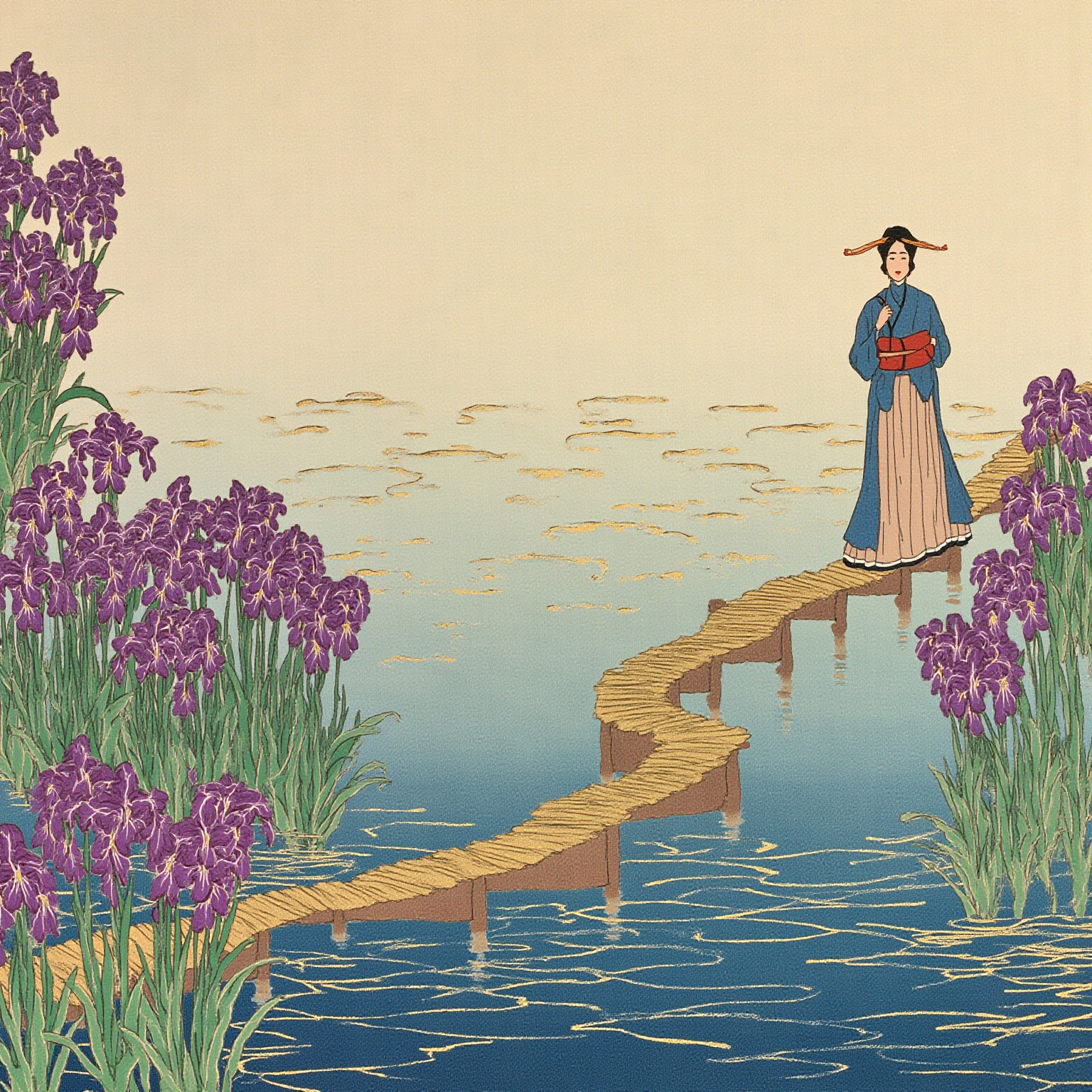
The eightfold bridge where irises bloom in twin rows mirrored in the stream.
八桥之上,燕子花分行倒映水中。
金句 · 第22段 · 三河八桥
What's worth noting about the craft here is how tightly verse and landscape fit together, like a lock and its key. The irises splitting the water, the old snow on Fuji, the fallen leaves at Mount Utsu — none of it is scenery for its own sake. Each is an outward projection of what the man feels at that exact moment. The first time I read the Mount Utsu passage I stopped short: he is supposed to be hurrying along a road, and somehow the fallen leaves on the ground read like a lover's scattered letters.
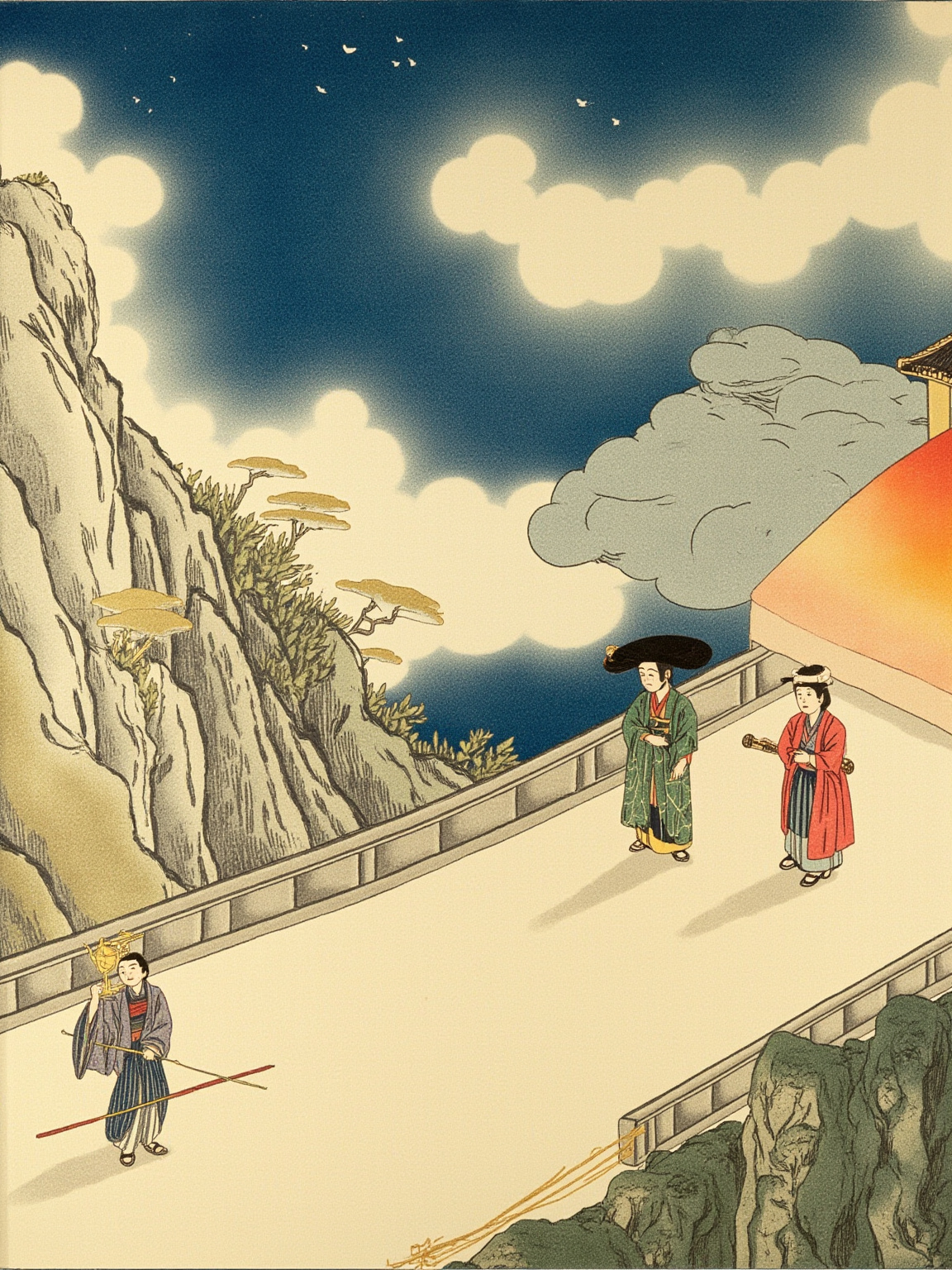
Mount Utsu—falling leaves, a narrow mountain path, no one in sight.
宇津山道,落叶散乱,山中无人。
金句 · 第23段 · 宇津山
On the whole road from Kyoto to the East Country, the author never once mentions what he eats, where he sleeps, or whom he meets along the way — only the handful of points that can trigger a verse. The book's whole aesthetic discipline shows itself right here: any detail that cannot become a poem gets cut.
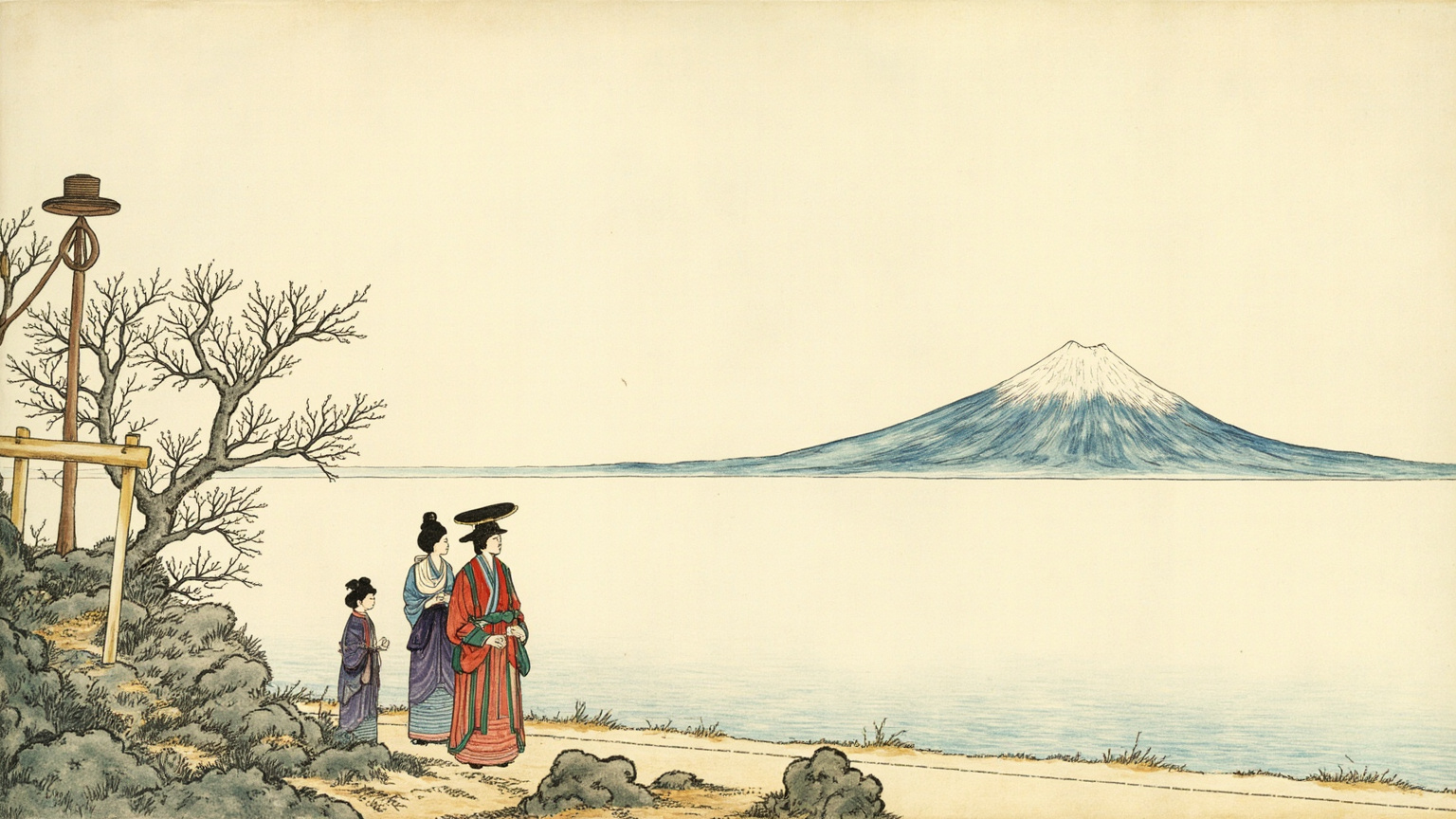
June on Mount Fuji—the snow that lingers, a vestige of spring in the height of summer.
六月中,富士山头,残雪未消——夏中犹见春之遗迹。
金句 · 第26段 · 富士山残雪
Route Four: The God of Sumiyoshi — A Rare Moment of Faith in a Poem-Tale
On the road east the man stops at Sumiyoshi to pray, and the god appears before him, stating plainly that his true form is Yakushi, the Buddha of Healing. It is one of literature's earliest appearances of honji suijaku, the belief that the native gods are local manifestations of Buddhist divinities. In a book given entirely to human feeling, a conversation between man and god drops in like a single bell struck in the middle of a paragraph. The handling stays restrained: the god does not lecture him, only names what he truly is, then vanishes, leaving the man standing alone before the shrine hall.
Route Five: The Woman of Gojo — Moonlit West Wing, Last Year's Plum
Back in Kyoto, the man falls for a woman living at Gojo, a woman later readers would come to call the lady of the great hall. They have children together, yet the love dies out on its own, without any real ending. After she dies, he goes alone to visit the old house. The curtains still hang in their place; only the person is gone. In the empty west wing, under a moon, the plum tree in the garden blooms exactly as it did the year before. This episode produces the most quoted verse in the entire book — the plum tree standing in for an elegy, the empty room standing in for what is left of a love affair. The foundation of Japan's aesthetics of mono no aware, that ache stirred by things passing, is laid right here.
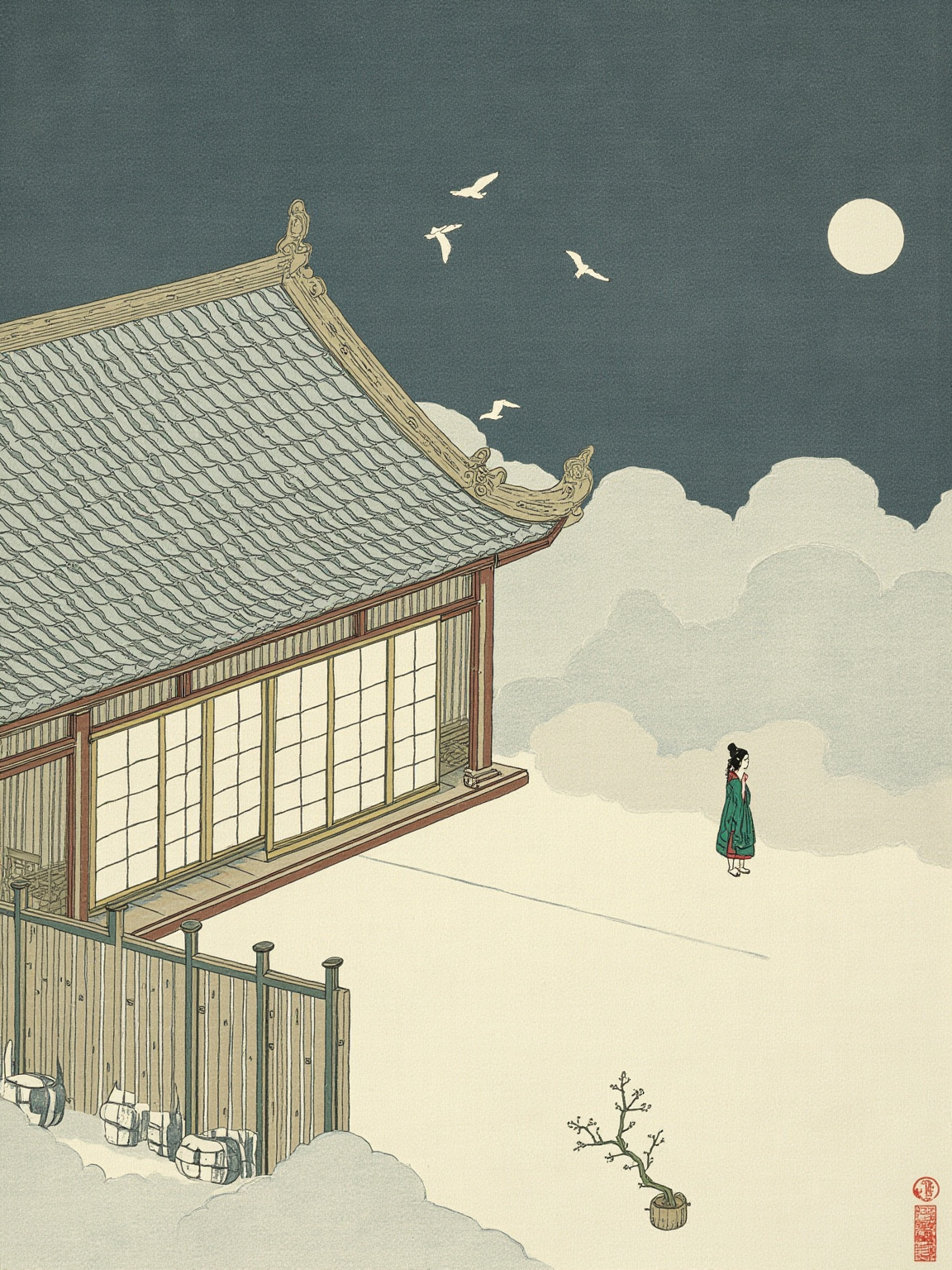
That plum in the western wing—blooming as it did last year, when you were still here.
去年之梅,今又开放——君已不在此。
金句 · 第69段 · 月下西厢
This is a different cut of the same craft. Every earlier love has been written in the present tense of something happening now; here the book switches, without warning, to the empty stage left after someone is gone. Same place, same season, the same objects — curtain, plum, moon — only the person is missing. The author never writes the word grief. He simply lets the old things speak for themselves.
Route Six: Love Deep in the Palace — A Forbidden Love Closed With a Verse
The man falls in love again, this time with a woman deep within the palace — later scholarship generally identifies her as Fujiwara no Takaiko, at the time still ranked among the emperor's consorts rather than empress. The love runs on verses and tokens passed back and forth; at one point he climbs the palace wall to meet her, and in the end the affair is closed off, gently, with a poem. The treatment matches the shrine-priestess episode: the text gives only verse, curtain, and token, nothing described outright, leaving the reader to listen for what stands behind that thin layer of words. She would go on to become the emperor's principal consort, and the author says almost nothing about how the affair actually ended. Closing it offstage is its own kind of decency.
Route Seven: The Final Episode — Death on the Post Road
In the book's last episode, the man goes east once more, falls ill on the road, and dies far from home at a post station. This wandering nobleman spent his life leaving Kyoto, traveling through the East Country, coming back, and setting out again — and this final journey is the one he never finishes. The closing episode is brief: a few lines of prose, one verse, and it is over. What it leaves behind is not an answer but an echo, scattered by the wind and somehow still sounding.
What the Book Is Really About: Mono No Aware, Verse, and Absence
This book is not really telling any one story. It is the same feeling developing again and again, like the same photograph printed from different negatives. Every love turns on a single verse — once the verse is sung, the feeling is complete; once the verse closes, the love settles into place. So although the book moves through so many women, so many places, so many seasons, what actually gets recorded is only that thin sliver of time when something is about to happen and has not happened yet. Cherry blossoms, wild geese descending, the moon, plum flowers — all of them stand in for that one feeling. Mono no aware, the deepest current running through Japanese literature, first takes firm root right here.
Why It Is Remembered: The Paintings and Books That Grew Out of It
The Tales of Ise founded the poem-tale as a genre and fed directly into The Tale of Genji — Murasaki Shikibu's opening words pay tribute to it outright. Painters loved it too. Ogata Korin painted his famous screens of irises. Tawaraya Sotatsu painted his own version of the Eight Bridges. Utagawa Hiroshige turned the road east into an entire series, The Fifty-three Stations of the Tokaido. The Eight Bridges, Fuji under old snow, the capital-bird, the moonlit west wing — these motifs that keep resurfacing across Japanese art all grew out of these hundred and twenty-five episodes.
What the book actually writes is not who he loved, but the instant each love rises and has not yet landed — the verse is sung, the feeling is already spent, and what is left is an empty room, a plum tree under the moon.
Why the Text Is Still Worth Reading Once You Know the Story
A guide like this gives you the map. The text gives you the verse itself, the single line of prose. In the Eight Bridges episode, the original simply notes that the irises split into two ranks reflected on the water, and the verse rises straight out of that split water. The Mount Utsu episode is one line about scattered fallen leaves and a short verse, no one else on the road. In the moonlit west wing, the man stands under last year's plum tree and leaves a single verse behind in the empty room — and that one line outweighs every word of commentary stacked on top of it. And then there is the verse itself: even reading it in translation, read every poem out loud. Only hearing it said aloud tells you why the author refused, every single time, to turn a love into a picture you could simply look at.
Art Direction4 plates
Before the guide was written, this book got a visual foundation — every illustration you just read grew out of it.