
The Unlikely Pilgrimage of Harold Fry · Companion Guide
一个人的朝圣
一封诀别信、六百二十七英里、一双不该走远路的皮鞋——他信的不是上帝,是只要还在走,她就会等
A Farewell Letter, and a Turn at the Postbox
Harold Fry walked up to the postbox, and walked away from it again. The retired brewery salesman had just received a letter from a hospice in the north: Queenie, the one young woman at the brewery who had ever smiled at him, twenty years before, was dying of cancer and writing to say goodbye. Harold meant only to post a reply. He stepped out of the post office, and his feet did not turn back toward home. If I keep walking, he told himself, she will still be there.
It has to be the least prepared journey in England. An ordinary suit, cheap shoes, no map, no phone, no hiking boots, no plan, no faith to speak of. A girl at a petrol station said, offhand, that he'd never make it on foot, and Harold heard it as an order: you have to walk. That one turn became six hundred miles.

He had expected more from the letter somehow. But the world is full of things that don't happen as you think they will.
他原本以为信里会有更多。可这世上的事,从来不是你想怎样就怎样的。
金句 · 开篇第一章 · 信与邮筒
What Kind of Book Is This
Rachel Joyce's debut novel, published in 2012. It sold close to eight million copies worldwide, was longlisted for the Booker Prize, and was later adapted by the BBC into a film of the same name, with Jim Broadbent playing the old man in the worn-out shoes. It didn't sell because the plot is dramatic; almost nothing happens in it. It sold because anyone who has ever been squeezed onto a morning train can see themselves in Harold's ruined shoes.
Joyce takes the old structure of Bunyan's The Pilgrim's Progress, strips it out of religious allegory, and reassembles it in contemporary England. No budget for miracles, no denomination, no grail, just a retired man and a pair of shoes that were never built for six hundred miles. The book keeps turning up on reading lists because it found the plainest possible shape for an ordinary person's awakening: the belief that a pair of feet can walk through a life nobody could say out loud.
Three People and an Unsent Letter Hold the Whole Book Together
Harold is just past sixty, and he doesn't talk much. He gave the brewery his whole working life, was left behind by the times, and retired into a house where he and his wife had nothing left to say to each other. A farewell letter is what gets him out the door. What keeps him walking the whole six hundred miles is his son David, who died after years of depression, and whose death Harold and his wife Maureen have not really spoken about in twenty years.
Maureen, Harold's wife, stays behind in their small coastal town in the south. She is not a bitter woman left at home; she is walking her own road too, alone, pruning the garden, digging through old belongings, watering the plants on the balcony. Their phone calls move from sniping to something closer to the truth, one short sentence at a time. Her pilgrimage never leaves the house, and it carries exactly as much weight as Harold's walk across England.
David never appears directly. He exists only through objects: an unsent letter, the footprints piling up along the road, an extra set of cutlery laid at the table and then quietly taken away, a bedroom door left ajar. Joyce never once shows how he died. He lives instead in the small habits of the people still living, who keep behaving as though he were still there, the sharpest and most English restraint in the whole book.
The Farther He Walks, the Deeper the Memories Go
The first days on the road go badly. His feet blister, his shoulders ache, and his raincoat is no match for the kind of English rain that soaks straight through to the bone. He remembers David as a boy, stamping footprints into the mud in his little shoes; he remembers the quiet that settled over his son's eyes as he grew older; he remembers a letter he wrote once and never sent, meant to say I'm proud of you, folded up and put back in a drawer instead.
He remembers Queenie too. Years ago, something went wrong at the brewery, and young Queenie took the blame for it and lost her job. Harold never even managed to say thank you. She was one of the very few people who ever smiled at him in the first half of his life. This is the debt he is paying back, one step at a time.

He had spent his life making do with what was available, and what was available was not enough.
他这一辈子都在凑合着过,可凑合着的那些,从来都不够。
金句 · 旅途中段 · 啤酒厂旧事
The craft of the book is in how the digging happens on the move. Joyce never piles up interior monologue; every one of Harold's memories is anchored to something his body is doing. He crouches to tie a shoelace and thinks of his father. He wraps his feet in plastic bags and buys new socks to get through the day on soles worn through, and thinks of David's first pair of shoes. The blisters on his feet become his way of apologizing to his son.
Letters and Echoes: Believing a Letter Can Save Someone
On the day he sets out, the girl working the petrol station is caught in an impossible love and has been thinking about ending her life. Before he leaves, Harold writes her a letter too, telling her that she has something to hope for. She writes back later to say she has decided to wait and see. That letter echoes Queenie's farewell letter: one believes a letter can save a life, the other believes walking can.
Joyce turns the letter into the book's running motif. Harold receives letters and writes them the whole way north, collects business cards and blessings pressed into his hand by strangers, and ends up living like a letter himself, moving. The most powerful moment in the book isn't Harold standing on the northern coast. It's him writing on a paper napkin the letter to Maureen he hadn't managed to write in twenty years, and this time he doesn't put it back in a drawer.
Maureen's Garden: A Pilgrimage That Never Leaves the House
After Harold leaves, Maureen moves from coldness to anger, and then begins, layer by layer, digging through the things kept in the house. She prunes the garden, pulls out gardening gloves she hasn't touched in years, waters the succulents on the balcony one pot at a time. She mails Harold clean clothes and fumbles for something to say on the phone (take care on the road, mm-hm), and twenty years of ice starts, very slowly, to give.
Maureen's pilgrimage runs through her hands, not her feet. With the same hands that prune the branches, she cuts away, piece by piece, the old grief she has been carrying. She hasn't forgiven Harold, and she hasn't made peace with David's death. She has simply stopped turning her back. Joyce keeps a tight hold on the scene: no sobbing down the phone line, just the two of them saying, one day, I miss you too, four words that land like a weight, coming from a couple who went silent on each other for a lifetime.

It was also a reminder that she could do something. Even something small. Even watering the plants.
它也在提醒她,她还能做点什么。哪怕很小。哪怕只是给花浇浇水。
金句 · 中段 · 莫琳的花园
The Followers Arrive, and So Do the Cameras
By the second leg of the walk, Harold's slow, plodding story has made the newspapers. A widow who joins him, a young man pushing a pram, a young couple treating it as a pilgrimage of their own, a truck driver, journalists, they arrive in waves. Some stay to the end, some drift away halfway through. Some treat Harold like a living saint; some just want a photo for social media.
Harold doesn't actually believe in God. Being turned into a symbol makes him doubt himself. In this pilgrimage everyone else reads as an act of faith, the only thing he actually believes is if I keep walking, she will still be there. This is the sharpest turn in the whole book: he was never a man set alight by belief. He was a man who remembered an old friend's smile and decided to pay it back with his feet.
He Falls Back Into an Ordinary Old Englishman
The ending is staged almost as an anticlimax. Somewhere in the Peak District, on the second leg of the walk, Harold's body gives out, his soles worn through, malnourished, and he collapses by the roadside and is taken away by ambulance. The cameras go dark with him. He wakes up in a hospital bed, with a drunk in the next bed and an old woman waiting for a hip replacement on the other side.
Joyce is merciless here. Once the halo of sainthood is gone, Harold keeps walking anyway; every last trace of the myth has been stripped off him. What's left is an old Englishman with a bad leg, malnourished, worn thin, who picks his plastic carrier bag back up and heads north, slowly. Faith is stripped all the way down to a pair of ruined shoes, and that, not the crowds, is the most moving passage in the book.
Berwick, the Sea Wind, and He Arrives Too Late for Her
More than eighty days later, Harold reaches Berwick, at England's northern edge on the North Sea, and knocks on the door of the hospice. A nurse tells him Queenie died peacefully only a few minutes before. She lived to hear that he was coming. She didn't live to see him arrive.
At the other end of the corridor, Maureen has arrived too. She took the train north from their coastal town, moving toward the son neither of them had spoken of in years, for the first time by choice. The two of them meet in a hospital corridor. No sobbing, no I forgive you. She just holds out her hand, and he takes it. Neither one turns away this time.

He had wanted to say something. He did not know what. But he had wanted to reach out, and not to be afraid.
他想说点什么。他不知道说什么好。但他想要伸出手去,不再害怕。
金句 · 尾声 · 贝里克走廊
What This Book Is Actually Saying
It isn't about believing in a miracle. It's about believing that one small thing can hold a person up. Queenie's letter carries Harold's feet. The petrol station girl's reply carries her own life forward. Maureen's balcony, watered pot by pot, carries her through one morning. Joyce never promises a miracle, only the words walk there. The most underrated thing this book does is rescue an ordinary person's awakening from cliche.
Thematically, it carries forward the structure of Bunyan's The Pilgrim's Progress, but fully secularized: no budget for miracles, no denomination, not even proper hiking boots. In form, it's a contemporary echo of a seventeenth-century religious allegory; in feeling, it belongs entirely to now, to the people who went silent inside their own marriages, who had every edge worn off them at work, who got left behind by the times the moment they retired.
This isn't a story about walking. It's a story about finally saying the thing out loud, and it just happens to borrow a pair of worn-out shoes to do it.
Why It's Still Worth Reading the Book Once You Know the Plot
A guide like this one only gives you the route map. The novel itself gives you the memory that rises up while you're crouched by the road tying your shoelace, not a single line, but a whole slab of weight that's been pressing down for twenty years. English reticence, in a novel like this, only comes through in the grain of the sentences. Told in plain language, the same story fits into three paragraphs. Told by Joyce, it's the mustiness, the moss, the rain, the smell of baking drifting over from a neighbor's kitchen, and it can leave you reading on a summer evening with your throat suddenly tight.
There's also David. He's the emotional core of the whole book, and Joyce never once lets him appear on the page. He comes together instead through footprints, a door left ajar, an empty chair, an unsent letter, piece by piece, in the reader's own hands. That trick, a boy who is never drawn and is everywhere at once, is exactly what no summary can reproduce. Read the book itself. Go see the boy who was never there.
Art Direction4 plates
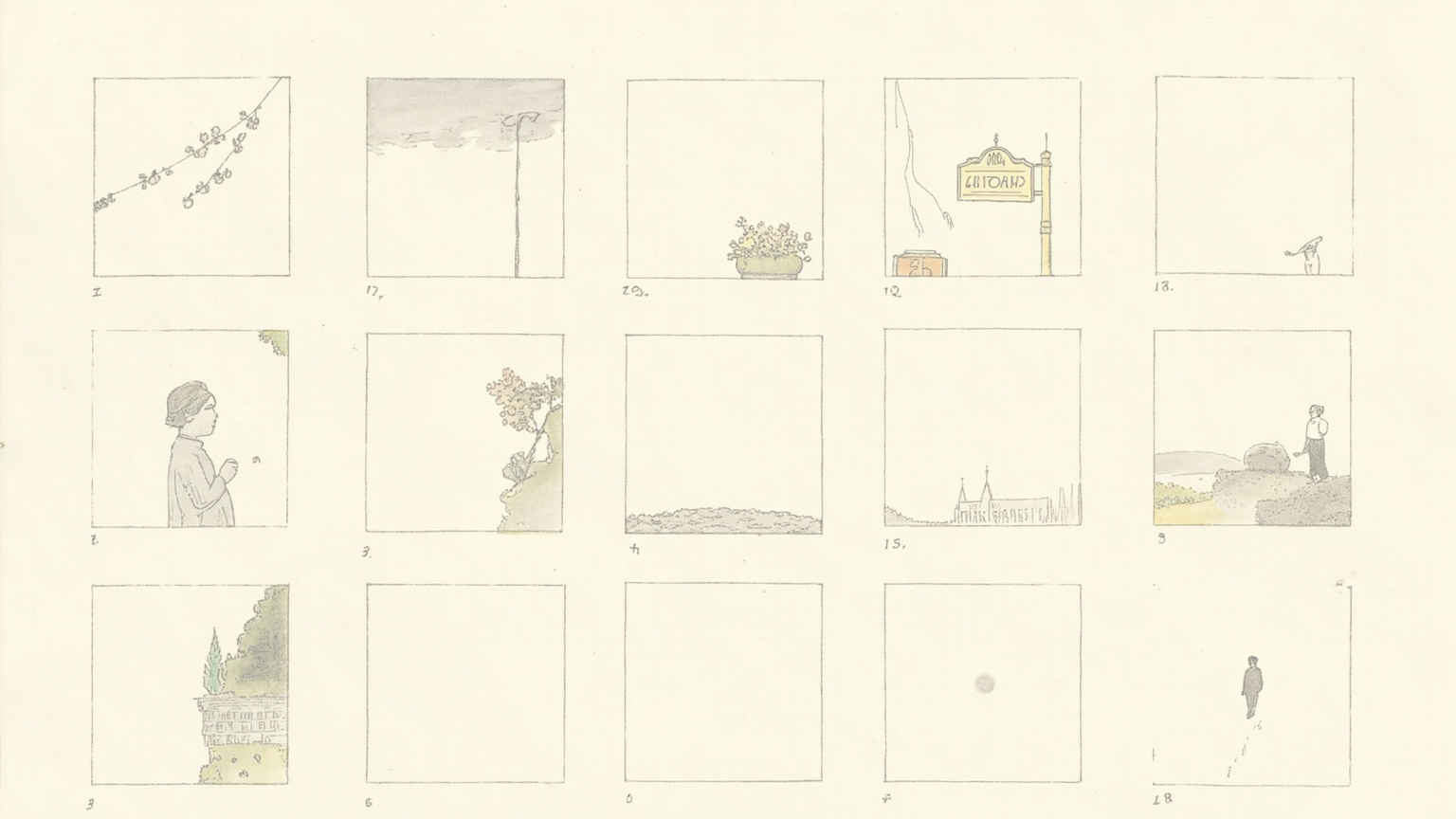
Before the guide was written, this book got a visual foundation — every illustration you just read grew out of it.


