He compressed a lifetime into one sentence: what you are matters far more to your days than what you have or how you are seen
Text and illustrations produced by the pipeline
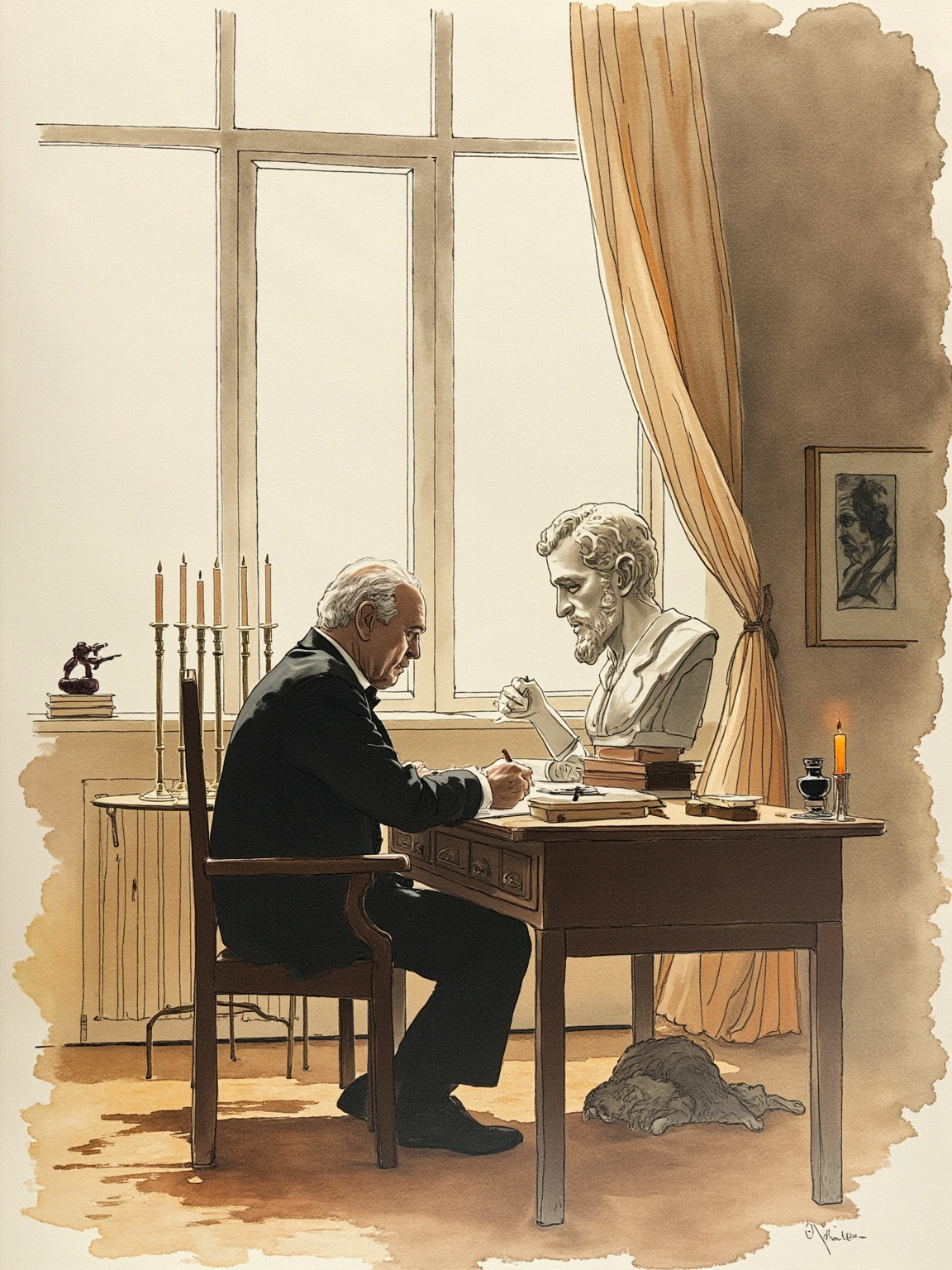
In his Frankfurt apartment, the sixty-three-year-old Schopenhauer sat down each day facing a bust of Kant on the wall. He never married, kept few friends, and shared his rooms with a single living creature: a curly-haired poodle he insisted on naming World-Soul. His days ran to one shape — the desk, then a fixed walk along the Main, then home again to write in front of the bust. This book grew out of that solitary life. A man who had given up competing for standing in the academy sat down and sorted out, for anyone who cared to read it, everything he had worked out about how to live.
In mid-nineteenth-century Germany, philosophy usually meant a thick system, built argument by argument. Schopenhauer did the opposite. He does not argue his way to a conclusion, does not cite authorities, does not pile up terminology — he simply states the conclusions, short chapter after short chapter, like a man who has lived long enough to read you an itemized account. He was sixty-three when it appeared, as the first volume of Parerga and Paralipomena, and it became the only book of his life that actually sold, the one ordinary readers wore out. For a while, shops in Paris, London, and Vienna displayed his portrait with a caption underneath: the man who wrote a slim treatise on the wisdom of life.
The book's skeleton is a three-part division, simple to the point of bluntness: what decides a person's fate and daily happiness comes down to three things. First, what a man is: health, intellect, character, the quality of the will itself. Second, what a man has: property, position, inheritance. Third, what a man represents in the eyes of others: reputation, standing, other people's opinions. Once the three are laid out, the whole book has only one job left: to argue, from every angle, that the first outweighs the other two.
The division itself is his sharpest cut. Most people spend a lifetime chasing the second and third categories, while he insists that what actually decides whether your days go well is simpler: whether you wake up with a clear, quiet, reasonably furnished mind, or with one that is anxious, empty, and bored. Property only needs to keep want at bay — beyond that, luxury and surplus add almost nothing to happiness. It's a line he lived out himself, for a lifetime.
For what a man is, he draws up a detailed account. Health comes first: a healthy beggar, he says, is happier than a sick king. After that come intellect, cultivation, calm of the will, and finally a good character. These are things a person owns outright, things no one can take and no misfortune can strip away — what he calls the things that are truly ours, as opposed to the things that merely surround us.

![[image_hint: 一间灯火通明的十九世纪德意志沙龙客厅,衣着讲究的男女三三两两站着交谈,每人都摆出一副最得体的姿态,角落阴影里叔本华靠窗站着,手中捏着一杯酒却没喝,目光越过人群望向别处,画面有种冷眼旁观的疏离感]](https://imaread-images.oss-cn-hangzhou.aliyuncs.com/agentic/story-scenes/the-wisdom-of-life-inline-120.jpeg)
![[image_hint: 一间昏暗的十九世纪卧房,床上的人侧卧蜷着,手紧攥床单,窗外透进灰白的天光,墙上没有装饰,只有空荡荡的墙面,人形消瘦,表情痛苦——叔本华笔下"意志的不得"的具象一刻]](https://imaread-images.oss-cn-hangzhou.aliyuncs.com/agentic/story-scenes/the-wisdom-of-life-inline-140.jpeg)
![[image_hint: 叔本华独坐在美茵河畔长椅上,旁边是那只小鬈毛狗,河面平静,远处是法兰克福老城的轮廓,光线是黄昏将尽的那种金灰色,画面安静得近乎寂寥,却有一种安然的气味]](https://imaread-images.oss-cn-hangzhou.aliyuncs.com/agentic/story-scenes/the-wisdom-of-life-inline-150.jpeg)
![[image_hint: 一位十九世纪德意志青年男子独自站在城市街角,外套领口竖起,手里攥着一封未寄出的信,街灯刚亮,行人稀少,他脸上那种又焦灼又迷茫的神情——叔本华笔下"青年受痛苦支配"的具象]](https://imaread-images.oss-cn-hangzhou.aliyuncs.com/agentic/story-scenes/the-wisdom-of-life-inline-200.jpeg)
![[image_hint: 叔本华独坐在书桌前合上手稿,台灯将熄,窗外夜色已深,桌上只剩一杯清水,那只小鬈毛狗伏在他脚边打盹,画面沉静、收束,有一种把一生账目算完的感觉]](https://imaread-images.oss-cn-hangzhou.aliyuncs.com/agentic/story-scenes/the-wisdom-of-life-inline-240.jpeg)
So the point of this companion piece isn't to read the book for you. It's to give you a reason to sit down at your own desk and open that slim little book yourself.
Before the guide was written, this book got a visual foundation — every illustration you just read grew out of it.


The craft is in what he leaves out. He never stacks up abstract praise. He writes the value of health as the lightness of sleeping well, eating with appetite, having a clear head through the day. He writes the value of intellect as how much of interest a mind still has to draw on when a person is left alone with the world — the first a gift from the body, the second something you can only build slowly, while young. This is how he takes inner richness out of vague philosophical language and turns it into a life you can actually live, one piece at a time.
It's the third category he goes after hardest. He calls people who chase reputation, status, and social display the vulgar — not as an insult but as a diagnosis: they have mistaken a means for an end. What other people think of you is a mirror made of misreadings, and to spend a life's energy fussing over the face in that mirror is itself a kind of collective delusion.
His dissection of reputation is especially sharp. He grants that a name can protect you, but warns that keeping one often means twisting yourself into the shape that name requires — pawning yourself off in exchange for other people's nods of approval. Society fares even worse under his pen: there, people live not for themselves but as an audience for each other, and the emptier a person is inside, the harder they fight for a place in the crowd.
Another thread runs the length of the book: his diagnosis of suffering and boredom as twin ailments. The core claim is almost blunt in its simplicity. Suffering is the will not getting what it wants — physical discomfort, thwarted desire, love that goes unanswered, all fall under this heading. Boredom is the will getting everything it wants, at which point a new affliction rushes in: nothing left to want. The two trade off, one after the other, with almost no middle ground between them.
The remedy he draws from this is no mystery: moderation, calm, self-sufficiency. Moderation is not abstinence: it means not letting desire swell to the point of tearing your life apart. Calm means unburdening the will, doing less of what is bound to torment you. Self-sufficiency means moving the source of your pleasure as far as possible inward — into whatever understanding you have, whatever cultivation, the handful of small interests you're happy to return to again and again. The further inward you move it, the harder it is for the outside world to reach you.
One type of person comes back again and again for his approval: he calls them the solitary. Note what he does not mean: not hermits, not monks, but people who are self-sufficient within their own thought and mind. Such a person can eat dinner alone, read alone, walk alone, live alone, and feel nothing missing. What they fear is not solitude but being forced into company where they have nothing to say.
His point, roughly, is that the best fortune a person can have is to discover early in life the path they're suited to, and simply keep walking it. It sounds like a platitude, but underneath it is the plainest portrait he gives of the solitary type: the sooner you know what suits you, the less you need a crowd cheering you on. He was living proof of his own sentence — he spent his life exactly as he wrote it should be spent.
His verdict on age is both the coldest and the warmest part of the book. The cold side first: he says outright that youth is, by its nature, ruled by suffering — sexual desire, ambition, love, each in turn pulling a person into its own whirlpool. That's simple physiology, not a character flaw, so there's no need to blame yourself for the mess youth makes of you. You just have to get through it.
The warm side, the one that made me stop and think, is his estimate of old age: if a man's inner life is not empty, old age is the best season life has to offer. Read it backward and the logic sharpens: an empty inner life leaves nothing in old age but boredom, while a life spent accumulating understanding, cultivation, and restraint turns those same years into the ones lived most fully at the lowest cost. This isn't comfort talk. It's an account carefully worked out.
In its closing pages, the book brings the reader back to the three categories it opened with, and pulls them together: only what is inherent to our own character truly belongs to us. Health, understanding, cultivation, restraint, a rich inner life — these no one can take from you and no fortune can strip away, and everything else you can do without. The whole book closes on that exhortation, cleanly, with nothing left over.
One thing has to be said plainly here: Schopenhauer, in this book and in the same volume it appeared alongside, left behind a number of demeaning remarks about women. That's the accent of his century, unremarkable to readers at the time and not something a reader today should carry forward unquestioned. What we come to this book for is the rigor with which he strips happiness down to its essentials, not his judgments that have not aged well. Naming that plainly is the least a reader today owes this book.
He lived his life the way he wrote this book, alone, restrained, at a distance from the crowd — and that gives it a layer no book of maxims can fake.
An explainer can give you the map, but the book is the ground itself. Two things here can't be replaced. The first is the sentences: cold, precise, laced with a sharp humor, each one landing exactly where it aims. It's a kind of prose that stands as a model in the German essay tradition, and even the most accurate paraphrase loses most of it. The second is harder to name: this book isn't a set of opinions, it's a way of living worked out at one desk over thirty years, and you have to walk that desk and that riverbank yourself before he stops feeling like just another secondhand philosopher telling you to let go. Take the passage on chasing other people's opinions — the edge of his sentence there is thin as a blade: reputation was only ever meant to be a shell that protects us, and yet people will hand over their real selves just to keep it intact. That's the difference between the map and the ground.