The Travels of Sir John Mandeville · Companion Guide
曼德维尔游记
一名从未离家的英国骑士,在书房里拼出整座东方——越往东越像梦,越写越像真的。
A knight who never left home, and how he wrote the whole of the East
An English knight sets out in 1322 from St Albans in southern England, crosses Turkey, detours through the Holy Land, pushes on into Cathay, and finally stops at the edge of the legendary kingdom of Prester John — a single gate away from the earthly Eden. Along the way he watches the Great Khan's processions, turns down a sultan's offer of marriage, and passes through the land of the Amazons, among cannibals, dog-headed men, and men who stand on a single foot. It became the most widely read book of the world in medieval Europe: some three hundred manuscripts and editions survive, several times more than the Travels of Marco Polo. Columbus carried it to sea. Leonardo kept a copy on his shelf. In the eighteenth century, Dr. Johnson called it the father of English prose.
But this knight never left home.
What this book actually is
The earliest surviving text of The Travels of Sir John Mandeville is in French, written no later than the mid-fourteenth century, and within thirty years it had been translated into Latin, English, and a dozen other major European languages. Sir John Mandeville himself is a constructed persona — scholars still have not settled on the real author. Candidates include a physician from Liège and a friar from Flanders, but certainly not the English knight of the title. The farthest the actual writer ever traveled was probably the library next door to his own study.
Its place in literary history is unusual. It is at once a medieval catalogue of Eastern wonders and one of the wellsprings of Europe's entire idea of the East. From Cathay and Mangi to the Christian kingdom of Prester John, to Cippangu — the island later called Japan — to the very gate of Eden, much of the map Europeans carried in their heads when they thought of the East was one Mandeville had drawn for them. Of the three writers who shaped the medieval imagination of the East — Marco Polo, Ibn Battuta, and Mandeville — this last one told the best stories and trusted the least of them.
The world, and its rules
The book's world is shaped like a U. It starts at St Albans in southern England, runs east through Asia Minor and Cilicia into the Holy Land of Jerusalem, turns south through Egypt, follows the Nile down to Ethiopia and the islands of the Indian Ocean, and reaches Cathay and the Chinese lands called Mangi before pressing on to the legendary kingdom of Prester John. Beyond that lies a darkness no mortal can enter, bordering the earthly Eden. Christendom and the Islamic world cross paths again and again along this route — pilgrim candles, a sultan's court, exotic goods in the marketplace, the Bedouin desert, the gilded roofs of the Great Khan, all thrown into one pot.
There is only one rule: the farther east you go, the more it turns into a dream. The eastern Mediterranean is still rendered with the plain accuracy of a pilgrim's guidebook; past India the book starts to drift; by Cathay it has become a pageant of imperial splendor; beyond that lies a half-pagan, half-Christian country out of legend. The reader has to accept one thing — fact and invention here are two strands of the same rope. Pulling them apart defeats the point.
A scrapbook kept by a traveler who never traveled
The story begins the moment the narrator introduces himself. In 1322, he says, he left St Albans and crossed the sea to Constantinople. What makes the opening work is the voice — a thoroughly old-fashioned knightly register, like a medieval résumé: an Englishman of good standing, setting out from a holy town, traveling east under the protection of saintly relics. At this point the reader still believes every word of it.
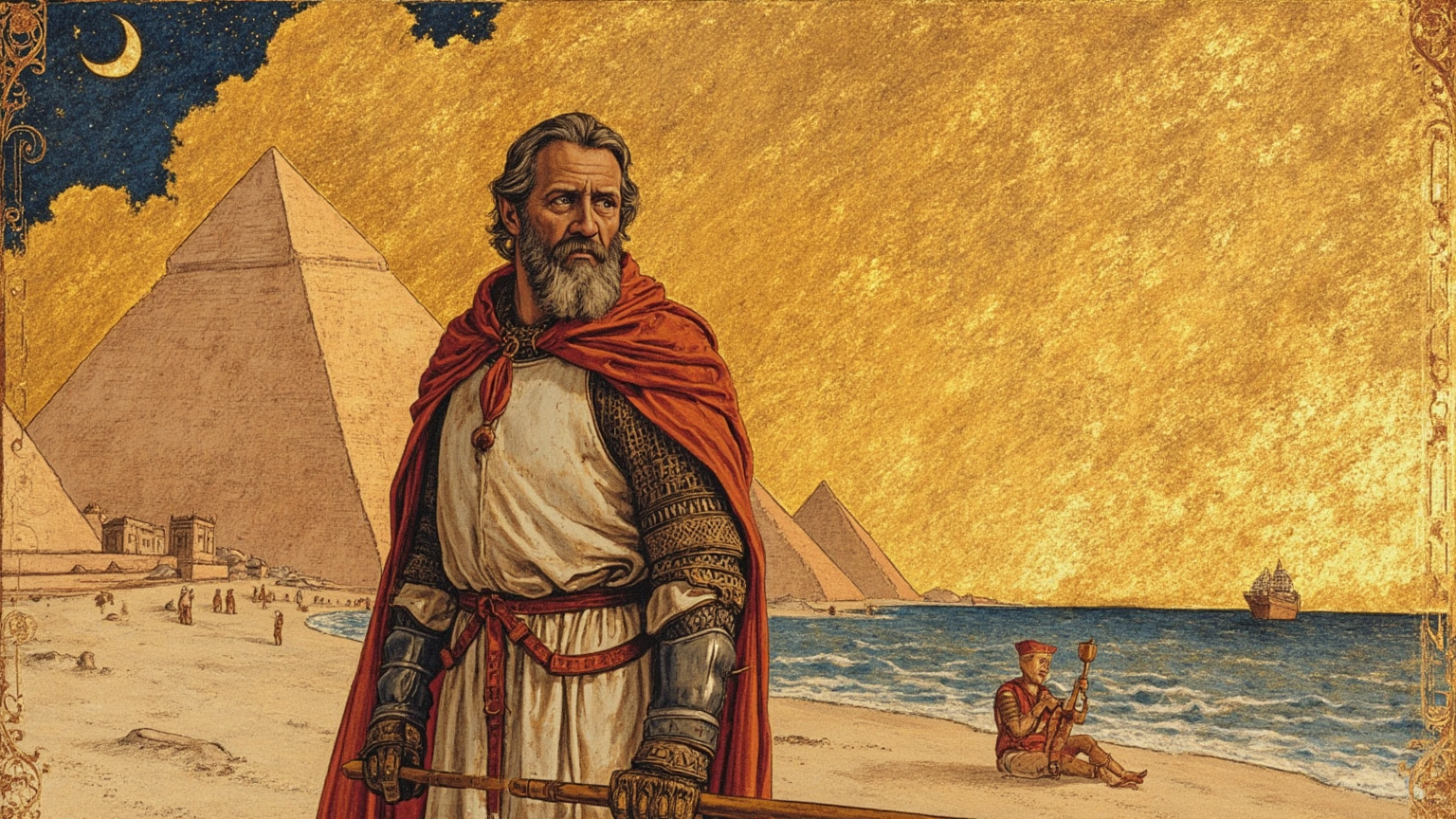
And so it happened that on St. Michael's Day, in the year 1322, I departed from England, and so came to the city of Constantinople.
于是便如此发生:1322 年圣米迦勒节那日,我离开了英格兰,一路行抵君士坦丁堡城。
金句 · 开篇 · 启程自圣奥尔本斯
The real trick is that he keeps the reader believing it all the way to the last page — the register never breaks. The book is a textbook case of the armchair-traveler tradition: the author never left his study. He worked with scissors, paste, borrowed manuscripts, and imagination, lifting from pilgrim guides, Franciscan accounts of the East, encyclopedias, Herodotus-style tales of antiquity, and Odoric of Pordenone's account of his journeys — whatever came to hand.
Sometimes the copying went wrong. Odoric had written about cormorants trained to dive for fish; Mandeville's author misread the source and turned them into little trained beasts called loyres — actually otters — without ever noticing the animal had changed species. This kind of secondhand misreading is one of the most charming details in the whole book. It shows exactly how the East got translated, layer by layer, from one study to the next.

And there are many beasts within the river that are called crocodiles; and they slay men when they may take them.
河中多有鳄鱼之属,能啮人,凡可捕便杀。
金句 · 尼罗河篇 · 鳄与异兽
Entering Turkey, the narrator by chance spends a long stretch at the sultan's side and gets a close view of campaigns against the Bedouin. Pleased with him, the sultan offers him marriage to a prince's daughter. The episode is one of the most dramatic in the book: the narrator refuses — not because she isn't beautiful, but because he will not give up his Christian faith. The line lays the book's whole premise bare. This is a Christian's East, seen through a Christian's eyes, and however seductive the Islamic world gets, it still has to clear that one bar.
Heading south to the Holy Land gives the book its most grounded stretch: the Church of the Holy Sepulchre, the Mount of Olives, Bethlehem, the miracle of the burning lamp at St Catherine's Monastery. This section is written almost exactly like a medieval pilgrim guide, town by town, church by church, relic by relic. Set it beside a genuine fourteenth-century pilgrim handbook and the narrator turns out to have copied carefully — even the bearings and the order of the pilgrimage route line up.
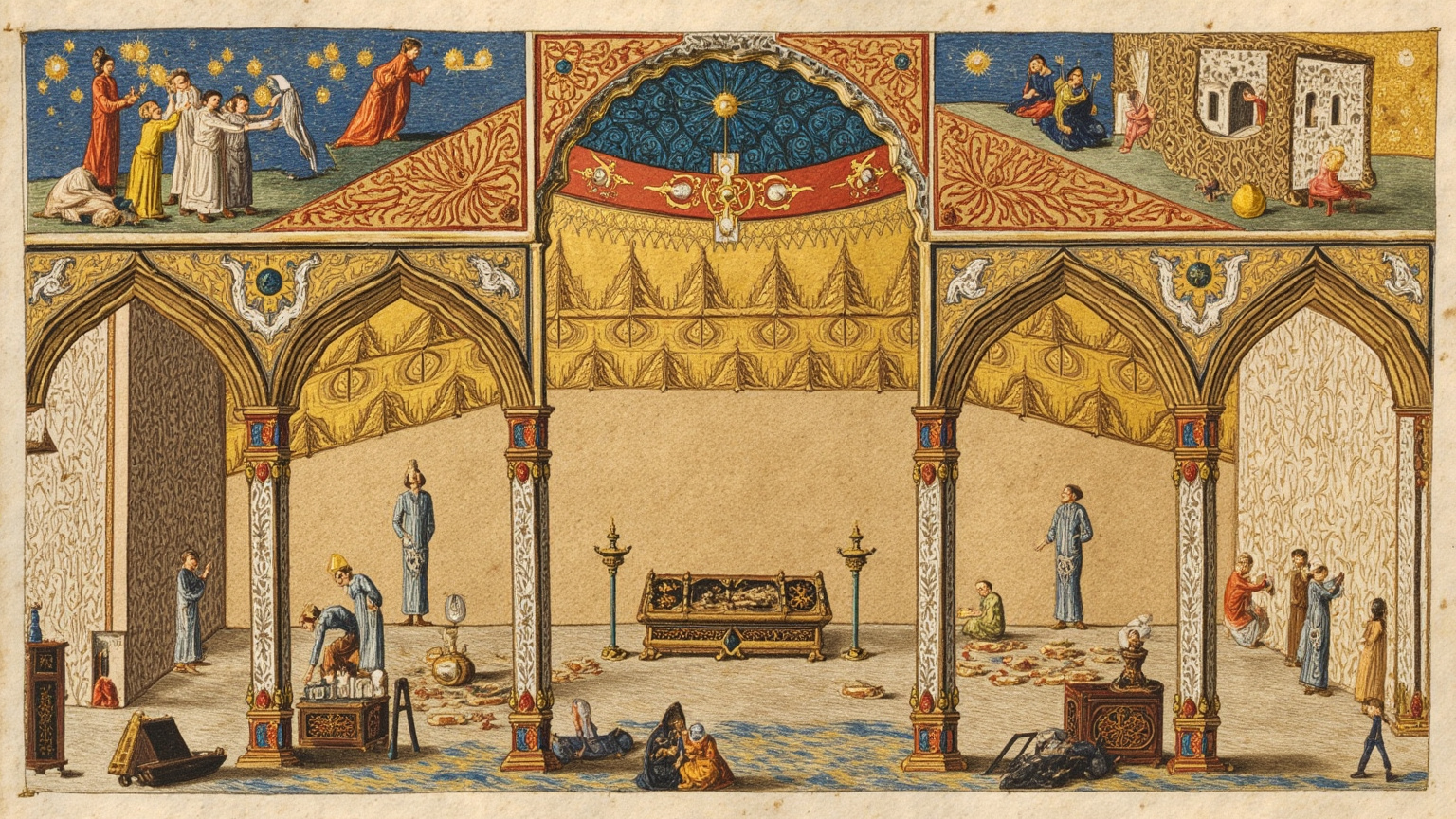
For there is the sepulchre of our Lord Jesus Christ, and there is the lamp that burneth by the oil that is brought thither from the mount Sinai.
那里有我主耶稣基督的圣墓,有那盏永不熄的灯——油是从西乃山一路送来的。
金句 · 圣地篇 · 圣墓烛火
Then the tone drops and the route turns south into Egypt — the pyramids, the Nile, crocodiles, strange customs — before moving on to Ethiopia, Chaldea, the land of the Amazons, and India with its scattered islands. This is the most encyclopedic stretch of the book: headless men, men who stand on one foot, dog-headed men, men with enormous ears, tales of cannibalism, all crowded into this one region. The most vivid of all is the land of the Amazons — a nation of women, every one of them a rider and a fighter, who meet the men of a neighboring country each spring, take only what they need, and raise whatever children are left to them. None of this is Mandeville's invention; it is the standard furniture of the medieval wonders-of-the-East tradition. He just tells it better than anyone.
The first time I read the Amazon passage, I had to stop for a second — medieval writers were already talking about a nation of women in exactly this register. That storyteller's ease is why some modern scholars place this book in the tradition of fantasy literature. It isn't just recording what the East is. It's working out how the East can be told.
The Great Khan, and the edge of the world
Once the narrative reaches the East, the pace suddenly stretches out. The chapters on Cathay and Mangi are the book's visual climax: the Great Khan's court is paved in gold and silver bricks, and his processions are described to the point of absurdity — tens of thousands of attendants, a hundred and thirty thousand minstrels, a hundred and fifty thousand keepers tending rare birds and beasts, a medical staff of over four hundred, and four armies of five hundred thousand men apiece riding escort.
Numbers like these are an old trick of medieval royal narrative: inflate the scale of big until it can't be argued with, and the reader stops questioning and starts marveling. This isn't reportage, it's spectacle — an East you couldn't have imagined, imagined for you. There's a telling contrast here: a contemporary European monarch's retinue running into the hundreds was already a notable procession, while Mandeville's Eastern ruler travels with numbers in the hundreds of thousands, pure imagined immensity. The point of the passage isn't accuracy. It's to overwhelm whatever common sense the reader walked in with.
Nearly all of it is lifted from Odoric of Pordenone's account and from Marco Polo, and lifted without a trace of apology — copied into a paper palace for an emperor of the East.

And the Great Khan hath so great multitude of folk in his host, that no man may tell the number, save God alone.
大汗军旅之众,无人能数其数——唯上帝知之。
金句 · 大汗出巡 · 帝王排场
Farther east still lies the legendary kingdom of Prester John — one of the most durable legends of the Middle Ages, a Christian king somewhere in the East ruling a rich land of devout subjects. Mandeville places this legend at the very eastern edge of the map: beyond Prester John's kingdom lies a darkness bordering the earthly Eden, and no mortal can go any farther. This is the stroke that closes the book's U-shaped route — a journey that leaves England as a pilgrimage and ends at the gate of Heaven.
Back in Europe, the narrator claims to have finished the manuscript in 1356 (some texts say 1371), and states that the work was reviewed by a papal commission and confirmed to be true. Placed at the very end, this claim is the book's most elegant move — it hides the fact that this is a forgery in the most visible spot available. Read that line and you either believe it or you smile. The book was never a firsthand account, but the narrator holds the pose of one all the way to the last sentence.

Beyond that land no man may go, for the desert and the darkness, and the great waters that have no end.
此土之外,无人可至——惟沙漠、惟幽暗、惟那无涯的巨浸。
金句 · 大陆尽头 · 伊甸园之邻
Medieval readers bought it. Some three hundred manuscripts and editions survive, translated into nearly every major language of Europe at the time. When Dr. Johnson called it the father of English prose in the eighteenth century, he meant it as mockery — but the remark proves something in spite of itself. The English translation was written well enough to outlive the absurdity of its own premise.
What the book is really saying
On the surface it's a travel account of the East. Underneath, it's medieval Europe's ledger of everything it imagined about the Other. One line is worth pulling out on its own — everyone wants to hear something new: these wonders were told, believed, and copied because people wanted the strange. Mandeville names the mechanism himself. He never pretends not to know what he's doing.
Reading it today turns up at least three layers of meaning. First, it's a mirror of how medieval Europe imagined the East — real kingdoms and legendary ones stitched onto the same road, the dream thickening the farther east you go. Second, it's a record of how the East got translated from one European study to the next, changing a little with every copy. Third, it's one of the distant ancestors of fantasy literature, standing in the same line as the utopias, fantasy fiction, and space opera that came after it.
You already know the plot. Why read the text itself
A guide like this gives you the map. The text itself is the ground. Read it and you run into things no summary can carry — the sentence rhythm, translated out of fourteenth-century French, that still breathes like the Middle Ages; the odd double register of a narrator who turns down a royal marriage while describing the Islamic court with unmistakable admiration; the hushed, almost devotional quiet of the Holy Land chapters set against the sheer excess of the Great Khan's processions later on. None of that lives in the plot. It lives in the sentences.
There's one more reason: the book's straight-faced nonsense has a strangely contemporary feel today. Mandeville never plays it as comedy, yet he holds the pose of an eyewitness from the first page to the last — and no summary can reproduce that gap. If you want to step inside it, set aside a quiet evening, start at St Albans, and follow this knight who never left home all the way to the darkness at the edge of the world.
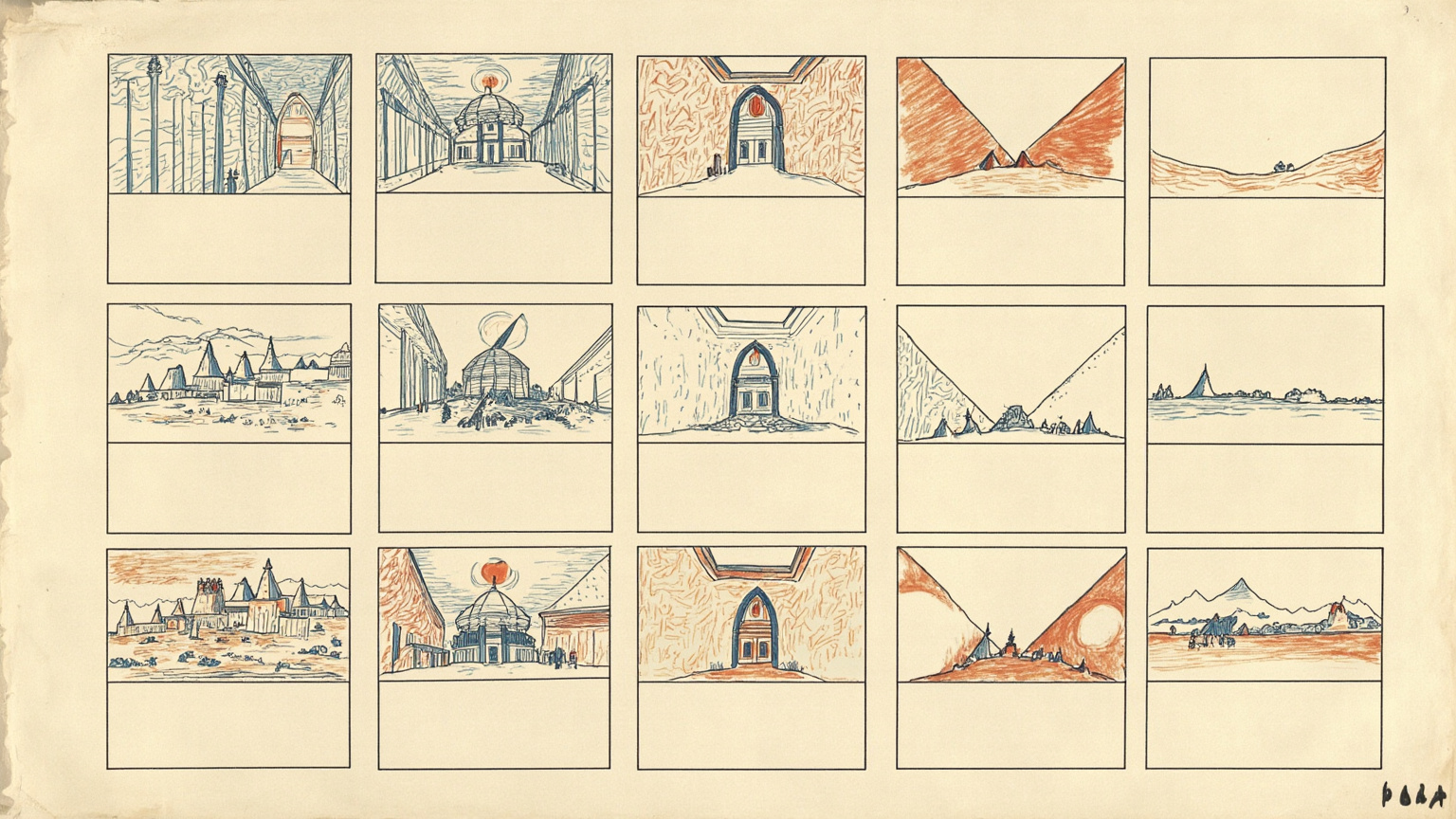
Art Direction4 plates
Before the guide was written, this book got a visual foundation — every illustration you just read grew out of it.